

Better listening is a practice, not a perfectly timed response. Communication exercises for couples often take turns between speaking and listening, with each partner reflecting back what they heard. In an uninterrupted active-listening exercise, one partner speaks for 3 to 5 minutes while the other gives their full attention.
If conversations often turn defensive or lead to misunderstandings, a simple structure can help. These exercises aren’t about deciding who’s right. They make room to listen, acknowledge feelings, and respond with care.
Here, you’ll find practical listening exercises, a way to make stressful conversations feel more manageable, and guidance on how regular practice may help over time. You’ll also learn what couples therapy exercises involve and how a short daily check-in, such as 10 to 15 minutes together, can give you a consistent place to reconnect.
Key Takeaways
- Reflect back what you hear and acknowledge your partner’s feelings before responding.
- Use a regular relationship check-in to share appreciation and talk through what’s working or needs attention.
- In a stress-reducing conversation, listen to understand rather than rushing to offer advice or solutions.
- Make room for small moments of connection, such as a thoughtful gesture or distraction-free time together.
1. Active listening and empathetic responses
Useful communication exercises for couples include uninterrupted listening, mirroring, and the speaker-listener technique. These structured practices help partners understand each other’s feelings before responding, which can support connection and intimacy. Choose one topic and agree who will speak first.
For uninterrupted active listening, give one partner 3 to 5 minutes to speak. The listener stays present, avoids interrupting, and notices both words and emotion. Then they reflect back the message: “You felt left out when plans changed.” The speaker can clarify what the listener missed. Switch roles afterward so both partners have space to share.
Imago Dialogue offers another structured approach. One partner shares a short statement, a few sentences at a time. The listener mirrors the message, then checks whether they understood it correctly. Next, they validate the feeling without claiming to agree: “I can see why that felt disappointing.” Slowing the exchange can reduce assumptions during conflict.
The speaker-listener technique gives each partner a clear turn to speak and listen. Try an “I” statement, such as “I feel worried when we don’t discuss plans.” The listener paraphrases what they heard before responding, then you switch roles. Open-ended questions like “What felt hardest about that?” invite fuller explanations without making the conversation feel like an interrogation.
To avoid escalating conflict, keep to one concern, reflect the speaker’s meaning, and acknowledge their feelings before offering your view. If either person starts preparing a rebuttal, return to listening and ask what matters most. The original study authors examined data from 1,157 married clients seeking couple therapy. That detail describes the clients studied, not a guaranteed outcome; these exercises are tools for practicing clearer communication.
2. How long does it take for communication exercises to improve a relationship?
There isn’t one calendar that fits every relationship. Progress is easier to notice when check-ins happen regularly and partners can discuss concerns before they become recurring arguments. Emotionally Focused Therapy typically produces measurable improvement within 8 to 20 sessions. The Gottman Seven Principles program has shown improved relationship quality with as little as 12 hours of structured work. These are different approaches, so their timelines aren’t interchangeable promises.
A weekly relationship meeting gives both partners shared time to talk about life stressors and the relationship itself. Set aside 20 to 30 minutes, then take turns naming what’s working, what could improve, and one specific thing you appreciated. Keep the conversation focused on understanding patterns, not settling every disagreement at once. A steady appointment makes it easier to return to a concern calmly.
For a lighter daily practice, reserve 10 to 15 minutes to check in. Each partner can describe a moment that felt difficult and a moment that felt positive. You might also offer one specific appreciation once per day, such as thanking your partner for handling an errand. A weekly appreciation conversation can take 10 to 20 minutes and help create a shared habit of noticing care.
An Emotionally Focused Therapy attachment check-in is designed to take 20 minutes. Partners can use this time to express what has felt connecting or distant, and what support they need. Long-distance couples can schedule a video or phone check-in, share one appreciation, and discuss a current stressor using the same routine.
Track progress through small changes: do conversations start more gently, or do you recover sooner after tension? If difficult patterns keep repeating, couples counseling can offer structured space to understand them and practice new ways of relating.
3. Stress-reducing conversations
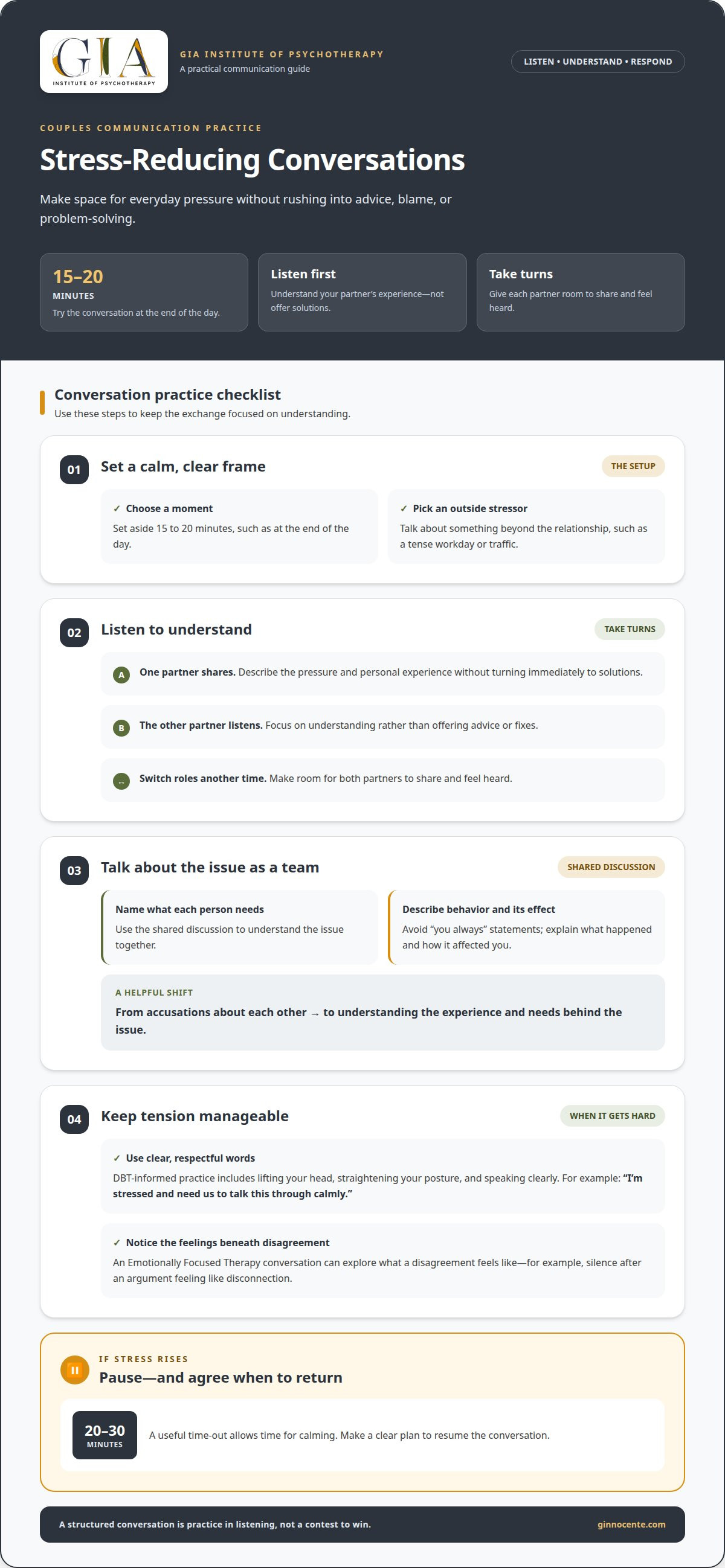
A stress-reducing conversation gives partners room to share pressure without turning immediately to problem-solving. Try it at the end of the day for 15 to 20 minutes, focusing on something outside the relationship, such as a tense workday or traffic. One partner describes the stress while the other listens to understand, not to offer advice or solutions. Then switch roles another time, so each person can feel heard.
The exercise divides the conversation between listening to each partner and discussing the relationship. Use the first turns to describe personal experiences without accusations. In the shared discussion, identify what each person needs and approach the issue as a team. Avoid “you always” statements; describe the behavior and its effect instead.
DBT-informed communication practice can help partners notice how they present themselves during a difficult conversation. Try lifting your head, straightening your posture, and speaking clearly. Pair confident body language with respectful words, such as, “I’m stressed and need us to talk this through calmly.” The aim isn’t to dominate, but to express a need without increasing tension.
Emotionally Focused Therapy conversations can center on the feelings beneath a disagreement. For example, one partner might explain that silence after an argument feels like disconnection, while the other shares what makes it hard to re-engage. Naming those feelings helps couples therapy address the pattern, rather than treating each disagreement as an isolated event. If stress rises, pause and agree on a time to return to the conversation. A useful time-out lasts 20 to 30 minutes for calming, with a clear plan to resume.
4. What Are Couples Therapy Exercises?
Couples therapy exercises are structured activities for practicing new ways of relating. To express a need or feeling, try this prompt: “I feel ___ when ___, and I need ___.” For example: “I feel distant when we spend evenings on separate screens, and I need time together.” Each partner takes a turn completing the sentence while the other listens without interrupting.
Naming emotions can make a difficult conversation more precise. Instead of saying “I’m upset,” try naming a feeling, such as lonely, worried, or overlooked. Notice physical cues too: a tight jaw, tense shoulders, or a racing heartbeat may signal that a pause could help. Before choosing your next words, consider what the feeling may be asking for, such as reassurance or clearer plans.
To build emotional safety, agree on boundaries before discussing a sensitive topic. Avoid yelling, name-calling, and personal attacks; either person can request a pause if the conversation feels overwhelming. You can also use a safety scale from 0 to 10 to describe how emotionally safe the discussion feels. A lower rating is a cue to slow down, listen, or return to the topic later.
Validation doesn’t require agreement. Try saying, “I can understand why that hurt,” then ask what would help your partner feel heard. This acknowledges their experience without setting aside your own perspective. In couples therapy, a therapist can help partners explore the deeper feelings beneath recurring arguments and practice specific ways to respond differently.
Reconnection also grows through intentional romance and intimacy. Plan a screen-free date, share a thoughtful gesture, or set aside quiet time to talk about what each of you enjoys. Keep the invitation specific, such as, “Could we take a walk together after dinner?” These small shared actions can create room for warmth beyond conflict. If you want guided support practicing these conversations, take the next step toward relationship support.
GIA Institute of Psychotherapy: Adult Individual Psychotherapy
GIA Institute of Psychotherapy offers individual therapy for adults who want to understand their own responses and practice new strategies. If relationship communication is affecting your well-being, individual therapy can help you explore what happens during difficult conversations and find clearer ways to express your needs. When both partners want to address recurring patterns together, Couples Counseling provides a shared space to practice listening and responding.
Therapy can also support children, teens, and families working through communication challenges in their relationships. The focus depends on who needs support and whether the work is individual, relational, or family-centered. Contact GIA Institute of Psychotherapy to take a thoughtful next step.
Make space for a different kind of conversation
Better communication doesn’t mean getting every conversation right. It starts with noticing what happens between you, staying curious, and trying a more thoughtful response. Practicing communication exercises for couples can be one small way to create change. Therapy can also help you understand the personal experiences that shape how you connect.
GIA Institute of Psychotherapy offers individual therapy for adults, children, and teens, as well as Family Therapy. These services provide space to explore personal concerns, support younger family members, or work through family dynamics. Couples Counseling gives partners a setting to address their relationship and practice communicating together.
If you’re ready to explore support that fits your needs, contact GIA Institute of Psychotherapy. Taking a next step can begin with an honest conversation, and new ways of connecting can grow from there.
Frequently Asked Questions
What Are Couples Therapy Exercises?
Couples therapy exercises are guided practices that help partners understand and respond to one another differently. For example, try role reversal: pause a disagreement and describe your partner’s perspective as accurately as you can, then let them clarify. This can reveal where assumptions have crept in. GIA Institute of Psychotherapy offers Couples Counseling for partners in Ocean City, Linwood, Margate, Ventnor, Egg Harbor Township, Upper Township, and Galloway, New Jersey.
How long does it take for communication exercises to improve a relationship?
There’s no single timetable for change. It depends on the patterns partners are addressing and how consistently they practice. Look for small signs, such as returning to a difficult topic with less defensiveness or asking for clarification instead of assuming intent. After a conversation, make a brief note about what felt different. Reviewing those notes can make gradual shifts easier to notice.
What Are the Best Relationship Activities for Couples?
The most helpful activities encourage curiosity and shared attention rather than competition. Take turns choosing a song tied to a personal memory and explaining why it matters. Or ask each other about a hope for the coming year and what support would feel meaningful. These activities can open up fresh conversation when the focus is on learning about each other, not correcting each other.
What Causes Communication Barriers?
Communication barriers can grow from stress, assumptions, unresolved hurt, or different approaches to conflict. One partner might interpret silence as disinterest, while the other is taking time to gather their thoughts. Interruptions and multitasking can also blur meaning. Notice the moment a conversation shifts, perhaps through a change in tone or a misunderstood phrase. That gives you a specific place to begin repairing the connection.
Why Do Couples Struggle with Communication?
Partners may struggle when they feel unheard, fear criticism, or enter a conversation expecting an argument. Past disagreements can shape how each person interprets a new concern. “Can we talk about the schedule?” might sound like blame when tension is already high. Try raising the concern gently, then ask what your partner understood. This can reveal the meaning behind each response.
How can couples practice active listening together?
Choose a manageable topic, such as weekend plans, and take turns sharing one concern or preference. The listener summarizes the main point, then asks, “Did I understand you?” The speaker can clarify before you switch roles. To deepen the exercise, each partner can name what they think the other may be feeling and invite them to correct it. Keep the focus on understanding, not preparing a counterargument.


