
Have you ever felt like your emotions are a tidal wave, pulling you under before you even realize the tide has turned? It is exhausting to live in a cycle of "too much" feeling, where every reaction feels out of your control and your relationships seem to follow the same painful, repetitive patterns. You aren't alone in this struggle, and your intensity isn't a flaw; it is often just a sign that your internal toolkit needs a few more specialized instruments to help you stay afloat.
If you have been searching for DBT therapy NJ, you likely want more than just a diagnosis. You want to feel seen and validated while gaining the actual skills to handle life's stressors without being overwhelmed. This article explores how Dialectical Behavior Therapy offers a sturdy bridge toward emotional regulation and provides an essential checklist for starting your journey. We will look at the core pillars of this approach and how to find a skilled, relatable guide in New Jersey who can help you rewrite your internal narrative with hope and clarity. Your path to balance starts with the understanding that healing is a collaborative, steady process that honors your unique spirit.
Key Takeaways
- Learn how the synthesis of acceptance and change in DBT provides a steady foundation for navigating intense emotions and repetitive relationship patterns.
- Identify if you are ready to rewrite your internal narrative using our readiness checklist focused on gaining clarity and reclaiming your emotional agency.
- Gain a clear understanding of the four core skill modules that serve as a protective buffer between life's triggers and your internal reactions.
- Use our quality checklist to vet providers of DBT therapy NJ, ensuring you find a guide who is both clinically expert and deeply relatable.
- Discover how integrating expressive arts and neuroscience with traditional skills creates a more holistic, multi-sensory path toward long-term healing.
What is DBT Therapy? Understanding the Path to Balance
Finding balance often feels like trying to stand still in a storm. If you've been looking for DBT therapy NJ, you're likely seeking a way to quiet the noise and regain your footing. Originally developed to treat complex personality disorders, dialectical behavior therapy has evolved into a versatile, evidence-based approach for anyone struggling with intense emotional waves. It is a specialized form of cognitive behavioral therapy that places a unique emphasis on the social and emotional aspects of the human experience. While traditional talk therapy might focus on understanding the "why" of your past, DBT focuses on the "how" of your future. It provides a concrete toolkit for navigating the present moment with grace and resilience.
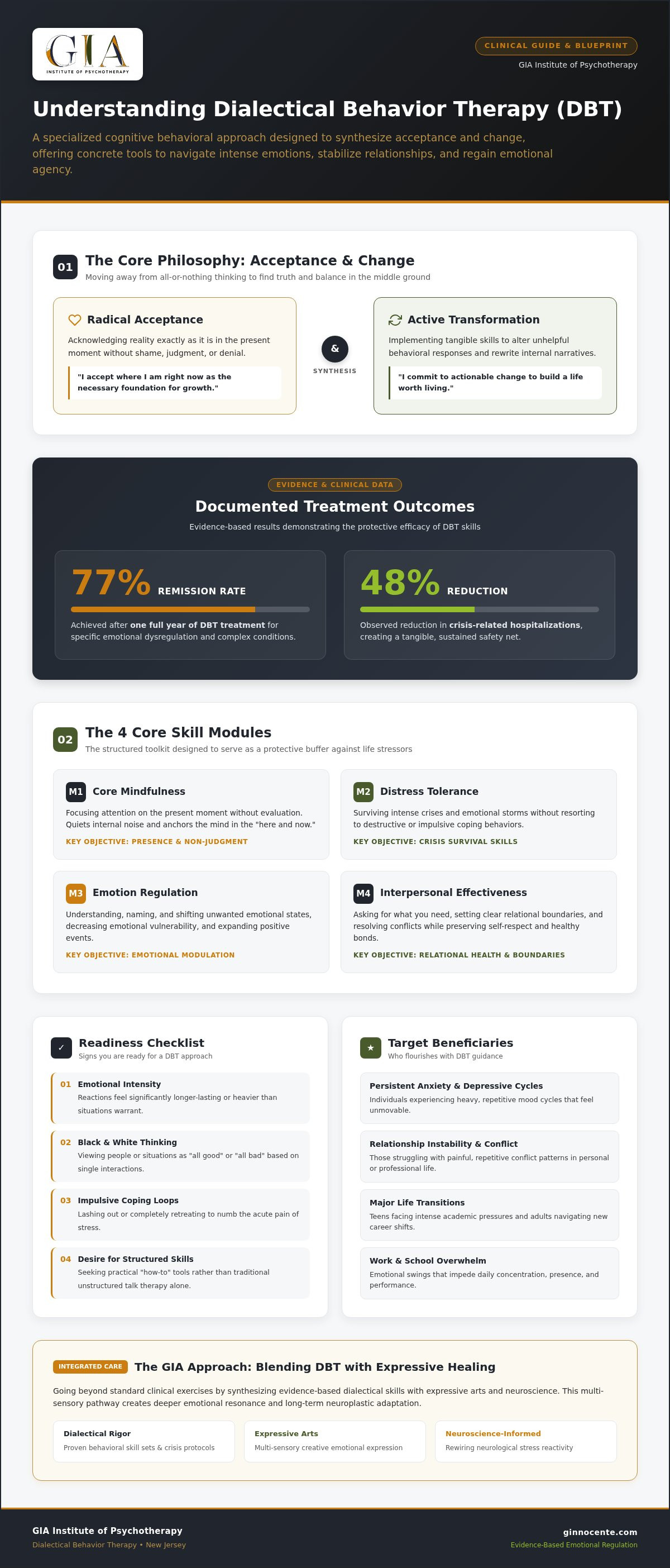
The term "dialectical" might sound clinical, but its meaning is deeply human. It refers to the process of bringing together two seemingly opposite ideas to find a middle ground. In the context of your healing, this means moving away from "all-or-nothing" thinking. Instead of feeling stuck between "I'm a failure" and "everything is fine," DBT helps you find the truth in the middle. Data shows this approach is incredibly effective; landmark studies have shown a 77% remission rate for specific conditions after one year of treatment. Additionally, participants often see a 48% reduction in crisis-related hospitalizations, proving that these skills create a tangible safety net for your well-being.
The Core Philosophy of Acceptance and Change
At its heart, this therapy is a delicate dance between validation and transformation. You can't change a pattern you haven't first acknowledged with compassion. We begin by accepting exactly where you are right now, without judgment or shame. This acceptance isn't about giving up; it's the necessary foundation for growth. Once you feel seen and understood, we can begin the work of implementing new strategies to shift your internal narrative. The dialectical approach is the gentle art of holding your current reality and your desire for change in the same hand, allowing emotional resonance to guide you forward.
Who Can Benefit from DBT in New Jersey?
You don't need to be in a state of total crisis to benefit from this work. Many individuals seeking DBT therapy NJ find that these skills are life-changing during major transitions, such as starting a new career or navigating the complexities of adolescence. It's an ideal fit for those who feel "too much" or struggle with:
- Persistent anxiety or depressive cycles that feel heavy and unmovable.
- Relationship instability and the pain of repetitive conflict.
- Intense emotional swings that make it hard to stay present at work or school.
- A desire for a structured, skills-based approach rather than just traditional talk therapy.
Whether you're a teen facing school pressure or an adult seeking relational health, these practical strategies offer a way to move through the world with more clarity and less fear. This is about more than just managing symptoms; it's about building a life that feels worth living.
Is DBT Right for You? A Readiness Checklist
Have you ever felt like your emotions take the driver's seat, leaving you as a passenger in your own life? This experience of being emotionally hijacked is common for those seeking DBT therapy NJ. It happens when life's stressors trigger an immediate, overwhelming response that bypasses your logical mind. Instead of viewing these moments as a clinical diagnosis, consider them a call for internal clarity. Are you ready to rewrite the story of how you react to the world? Self-reflection is the first step toward reclaiming your agency.
Signs You Might Flourish with DBT Skills
Identifying with certain patterns can help you determine if this approach aligns with your needs. You might find that your current coping mechanisms were once survival strategies, but they no longer serve the person you are becoming. Consider the following reflections:
- Emotional Intensity: Do you often feel that your emotional reactions are much more intense or longer-lasting than the situation warrants?
- Relationship Dynamics: Are you struggling with black and white thinking, where loved ones are either "all good" or "all bad" based on a single interaction?
- Impulsive Coping: Do you find yourself reaching for impulsive behaviors, like lashing out or retreating entirely, to numb the pain of stress?
- Internal Narrative: Do you feel stuck in repetitive cycles that leave you feeling out of control or misunderstood by those around you?
Moving from Validation to Action
Being ready for DBT skills training means you are open to learning new ways of responding to your environment. It is a transition from simply understanding your pain to actively building a life that feels more stable. This process is deeply collaborative. It is not something a therapist does to you; it is a journey you take together. Finding the right "click factor" with a provider is essential for this work to take root.
A therapist should feel like a safe harbor, a steady presence who is both highly skilled and deeply relatable. When you feel seen and validated, the work of change becomes less daunting and more restorative. If you are looking for a compassionate guide to help you navigate these transitions, the team at GIA Institute is here to support your growth. This partnership allows you to move at a pace that honors your spirit while providing the practical strategies needed for lasting balance.
The 4 Pillars of DBT: Your Skill-Building Toolkit
When you begin your journey with DBT therapy NJ, you aren't just entering a space for conversation; you are acquiring a practical toolkit for life. These skills function as a protective buffer between a sudden trigger and your immediate reaction. Instead of feeling swept away by an emotional current, you learn to pause, breathe, and choose a response that aligns with your values. At GIA Institute, our therapists focus on these practical strategies to help you move past survival mode and reconnect with the best parts of yourself. By mastering these four pillars, you gain the internal clarity needed to navigate life's transitions with a sense of steady confidence.
Mindfulness and Distress Tolerance
Mindfulness is the foundation of all healing. It is the simple, yet profound, practice of being fully present in the moment without judgment. By learning to observe your thoughts and feelings as they arise, you create the space necessary to avoid being overwhelmed by them. According to Harvard Health's overview of dialectical behavior therapy, this awareness is crucial for balancing acceptance with the desire for change.
Distress tolerance builds on this foundation by teaching you how to survive a crisis without making the situation worse. These are "crisis survival" skills intended for moments when your emotions feel unbearable. A concrete example used in our sessions is the TIPP skill. This involves using Temperature (like splashing cold water on your face), Intense exercise, Paced breathing, or Paired muscle relaxation to physically reset your nervous system. These tools don't solve the problem, but they keep you safe until the emotional wave passes.
Emotion Regulation and Interpersonal Effectiveness
Emotion regulation is about understanding the "why" behind your feelings. It helps you identify the source of your distress and reduces your vulnerability to "emotion mind." By learning to label your feelings and taking opposite action when an urge is unhelpful, you regain authority over your internal world. This is especially helpful for adults and teens who feel constantly at the mercy of their moods.
Interpersonal effectiveness focuses on relational health. It provides a roadmap for asking for what you need, saying "no" when necessary, and maintaining your self-respect during conflict. These skills are vital components of our Couples Counseling and Family Therapy programs. Whether you are navigating school advocacy for a child or trying to break repetitive cycles in a marriage, these pillars help you communicate with clarity and kindness. They ensure that your relationships become a source of support rather than a source of stress.
Choosing a DBT Provider in NJ: A Quality Checklist
Finding the right guide for DBT therapy NJ is about more than just scanning a list of credentials. It is about finding a steady, calming presence who understands the unique rhythms of life in South Jersey. While clinical expertise is essential, the "click factor" is what allows the therapeutic work to truly take root. You deserve a therapist who is both an authoritative expert and a deeply relatable human being. This balance ensures that you feel seen and understood rather than just diagnosed. When you are vetting a potential provider, look for someone who views the healing journey as a collaborative partnership rather than a clinical process.
What to Ask a Potential DBT Therapist
A quality therapist will welcome your curiosity and transparency. Asking specific questions helps you determine if their approach aligns with your need for both structure and emotional resonance. Consider using this checklist during your initial conversation:
- Training and Experience: What is your specific training in Dialectical Behavior Therapy, and how long have you been practicing this modality?
- Session Integration: How do you integrate DBT skills into individual sessions to ensure I have a practical toolkit for daily life?
- Blended Modalities: Do you incorporate other evidence-based approaches like neuroscience, Expressive Arts, or Internal Family Systems (IFS)?
- Relatability: How do you balance the clinical structure of DBT with a warm, human-centric approach?
The best outcomes often happen when a therapist blends the cognitive structure of DBT with the deep, restorative work of EMDR or relational psychotherapy. This multi-sensory approach addresses both the mind and the nervous system, providing a more holistic path toward balance.
Local Access in South Jersey
Consistency is the heartbeat of emotional growth. If you live in Linwood, Ocean City, or Margate, finding a local practice makes it much easier to maintain your commitment to the process. Traveling to massive healthcare hubs in North Jersey often adds a layer of stress that can hinder your progress. By choosing a provider near Egg Harbor Township or Upper Township, you ensure that your "safe harbor" is always within reach. Local access allows you to integrate your sessions into your existing life without the burden of a long commute. For more information on navigating these first steps, explore our guide on How to Start Therapy in NJ: A Gentle Guide to Your Journey.
If you are looking for a compassionate guide to help you navigate life's transitions, we invite you to connect with our team at GIA Institute to discover how we can support your journey toward internal clarity and lasting relational health.
The GIA Approach: Blending DBT with Expressive Healing
At GIA Institute, we believe that therapy should feel less like a clinical appointment and more like a homecoming. While the structure of DBT therapy NJ provides the necessary scaffolding for emotional stability, we understand that human healing requires more than just logic and worksheets. Our approach is authentic and relatable, moving away from the "cookie-cutter" feel of larger medical systems. By blending the evidence-based pillars of DBT with the creative flow of Expressive Arts and the intuitive nature of Play Therapy, we offer a multi-sensory path to recovery. This integration allows you to process emotions that words alone sometimes cannot reach, helping you heal old wounds and finally discover the best, most resilient version of yourself.
Neuroscience Meets Compassion
We place a high value on transparency, which is why we incorporate neuroscience into our collaborative journey. When you understand how your brain and nervous system respond to stress, you stop feeling "broken" and start feeling empowered. This knowledge transforms a confusing emotional surge into a manageable physiological event. Whether you are an adult seeking internal clarity or a parent looking for support for a child, GIA serves as a safe harbor in South Jersey. We provide a non-judgmental space where the strength of the human spirit is honored, ensuring that every step you take is rooted in both clinical authority and profound empathy. Our work is a partnership, a shared effort to rewrite your internal narrative with hope and presence.
Your Next Steps Toward Emotional Freedom
Taking the first step toward change requires immense courage, and we don't take that lightly. If you've been caught in repetitive relationship cycles or felt overwhelmed by life's transitions, the transition to a skills-based approach can be life-changing. For parents, we also provide specialized School Advocacy Services to ensure that the DBT skills your child learns in therapy are supported and understood within their educational environment. This comprehensive care ensures that the progress made in our sessions translates to success in everyday life across Linwood, Margate, and the surrounding communities. You don't have to navigate these waves alone; a steady, calming presence is ready to guide you toward a life of balance and relational health. We invite you to connect with GIA Institute to begin your DBT journey and reclaim your sense of peace today.
Embracing Your Path to Emotional Clarity
You have explored how Dialectical Behavior Therapy serves as a bridge between accepting your current reality and building the life you desire. By mastering the four core pillars, you gain a practical toolkit that transforms how you respond to life's triggers. Finding the right support for DBT therapy NJ means choosing a guide who understands that your emotional intensity is a strength, not a flaw. It's about moving from feeling "emotionally hijacked" to feeling centered and in control.
At GIA Institute, we offer an authentic and relatable therapeutic approach that blends traditional skills with the depth of EMDR and IFS. Serving Ocean City, Linwood, and the wider South Jersey community, we focus on providing a safe harbor where you can heal old wounds and discover your best self. You don't have to navigate these waves alone. Are you ready to rewrite your internal narrative and find lasting balance? Ready to find your balance? Schedule a consultation with GIA Institute today.
Healing is a steady, intentional journey. Your future is full of possibility, and we are here to walk beside you every step of the way.
Common Questions About DBT Therapy in NJ
What is the difference between CBT and DBT?
CBT primarily focuses on identifying and shifting distorted thought patterns to change behavior. While DBT is a branch of CBT, it introduces the critical element of validation and acceptance alongside change. It is designed specifically to help individuals manage intense emotional waves and interpersonal conflict. This makes it a powerful choice for those seeking DBT therapy NJ who feel standard talk therapy hasn't addressed their deep emotional resonance.
How long does it take to see results from DBT therapy?
While every healing journey is unique, many clients begin to feel a shift in their internal clarity within the first few weeks of learning practical coping strategies. A standard comprehensive cycle often lasts between six months and one year to ensure skills become second nature. This methodical pace allows you to integrate new responses into your daily life in Ocean City or Linwood, providing a steady foundation for long-term transformation.
Is DBT only for people with Borderline Personality Disorder?
No, DBT has evolved far beyond its origins. While it remains the gold standard for borderline personality disorder, it is highly effective for anyone struggling with emotional regulation, chronic anxiety, or repetitive relationship conflict. At GIA Institute, we use these strategies to help adults and teens navigate various life transitions. It provides a versatile toolkit for anyone who feels "too much" or struggles to find a middle ground in their daily emotional experiences.
Can DBT be used for children and teenagers in NJ?
Yes, Dialectical Behavior Therapy is an excellent resource for children and teenagers navigating the pressures of school and social development. In South Jersey, we offer specialized programs that adapt these skills for younger minds, often incorporating Play Therapy or Expressive Arts. This multi-sensory approach helps teens in communities like Upper Township or Galloway build resilience and improve communication with their families, ensuring they have the tools to handle intense stressors effectively.
What should I expect in my first DBT-focused session?
Your first session is a gentle space for assessment and connection rather than a deep dive into trauma. We focus on understanding your current challenges and identifying the specific goals you want to achieve. You can expect to discuss your history of emotional regulation and begin exploring how these skills might fit into your life. It is a collaborative process designed to make you feel seen, validated, and hopeful about the path ahead.
Does GIA Institute offer DBT for couples or families?
GIA Institute provides comprehensive support for couples and families looking to break painful, repetitive cycles. We blend DBT skills with Emotionally Focused Therapy (EFT) to help partners and family members communicate their needs more clearly. This approach is particularly restorative for families in the Margate and Ventnor areas who want to improve their relational health. By learning these skills together, you can create a safe harbor within your own home and strengthen your collective bonds.
Is DBT therapy covered by insurance in New Jersey?
Many providers of DBT therapy NJ operate as out-of-network providers to maintain the high level of specialized care required for this modality. However, New Jersey state regulated private insurers and Medicaid currently follow telehealth pay parity through December 31, 2027, which may assist with reimbursement for virtual sessions. We recommend contacting your insurance carrier to discuss your specific plan's out-of-network benefits and how they apply to specialized clinical services in the Garden State.


