

What if the tense morning standoffs before the bell rings or the quiet distance growing between you and your partner aren't signs of a broken home, but distress signals from a family system under strain? When searching for compassionate family therapy South Jersey parents can rely on, you need far more than clinical cliches. You deserve a grounded, supportive space that truly understands both your child's emotional world and the real-time demands of your household.
It's exhausting to feel like every conversation might trigger a conflict, especially when you're also trying to manage behavioral challenges and support an anxious child. You aren't failing, and you don't have to carry this alone. In this guide, you'll discover how to choose the right therapeutic approach for your family's unique needs and begin a journey toward lasting emotional resonance and structural health. We will walk through modern relational care, practical New Jersey school advocacy, and steady pathways to bring peace back to your home.
Key Takeaways
- Reframe daily household friction and behavioral challenges not as personal failures, but as distress signals within your broader family system.
- Discover how evidence-based family therapy South Jersey practices combine modalities like Emotionally Focused Therapy and expressive arts to rebuild secure connections.
- Learn a clear decision framework to choose a clinician who balances proven clinical expertise with genuine, relatable warmth.
- Unpack the emotional dynamics behind school refusal and discover how professional school advocacy helps protect your child's well-being in New Jersey classrooms.
- Gain practical strategies to align your parenting approach, improve communication with teens, and establish a lasting sense of calm at home.
Understanding the Need for Family Therapy in South Jersey
Raising children carries quiet weights that symptom checklists and cold medical directories never capture. When dinner tables fall silent, morning routines unravel, or bedtime turns into an exhausting battleground, it's easy to slip into self-blame. You wonder what you missed or where things went off course. Relational friction isn't an indictment of your character or your parenting. When seeking compassionate family therapy South Jersey parents often discover that genuine relief begins the moment we stop asking who is at fault and start asking what the family dynamic is trying to communicate.
Common Family Challenges in Our Community
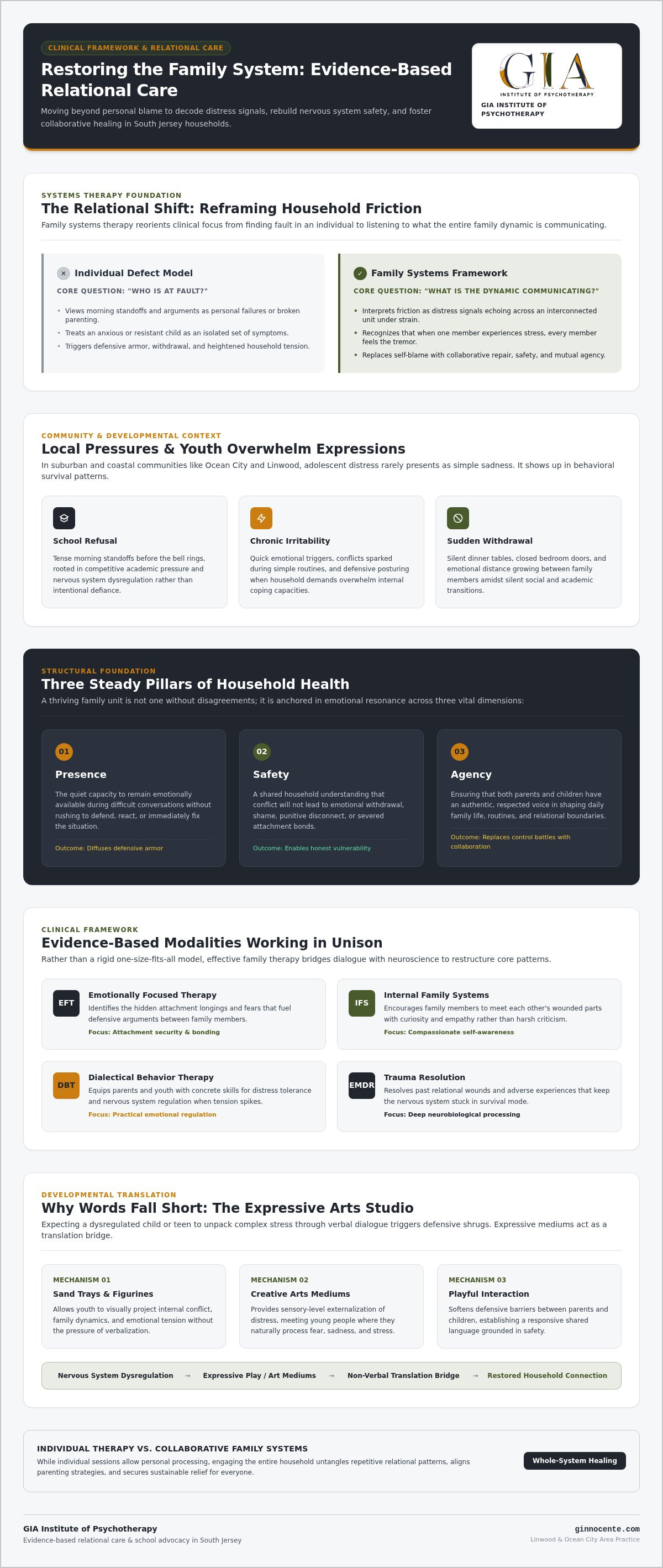
Every community carries its own subtle pressures. Families living in coastal and suburban neighborhoods like Ocean City and Linwood face a distinct blend of competitive academic expectations, social transitions, and the silent creep of adolescent distress. Often, a young person's emotional overwhelm doesn't manifest as sadness. Instead, it looks like school refusal, chronic irritability, or sudden withdrawal. Grounded in family systems therapy, modern relational care views these struggles not as isolated flaws, but as distress signals echoing across the entire household. When one part of the system experiences strain, everyone feels the tremor.
The Goal: Restoring Emotional Resonance
A thriving household isn't one without disagreements. True relational health is anchored in three steady pillars:
- Presence: The quiet capacity to remain emotionally available during difficult conversations without rushing to defend or fix.
- Safety: A shared understanding that conflict won't lead to emotional withdrawal, shame, or disconnection.
- Agency: Ensuring both parents and children have an authentic, respected voice in shaping family life.
While individual sessions give children or adults space to process their personal thoughts, engaging in family therapy South Jersey clinicians facilitate allows the entire unit to heal collaboratively. Working with a relatable, non-judgmental guide gives your family permission to set down defensive armor, untangle persistent patterns, and restore the calm, loving connection you have been missing.
Evidence-Based Approaches: From EFT to Expressive Arts
Words can only take a dysregulated nervous system so far. When household tension spikes, our brains shift into survival mode, making logical communication and calm conflict resolution nearly impossible. Modern relational care bridges traditional clinical dialogue with neuroscience, recognizing that genuine healing happens only when the mind, body, and emotional system feel safe enough to reconnect.
The Power of Specialized Clinical Modalities
Rather than relying on a rigid, one-size-fits-all model, effective family therapy South Jersey practitioners deliver integrates several proven methodologies. Modalities like Emotionally Focused Therapy (EFT) help identify the hidden attachment longings beneath defensive arguments, while Internal Family Systems (IFS) encourages members to meet each other's wounded parts with curiosity rather than criticism. Research highlighted by the American Association for Marriage and Family Therapy demonstrates that systems-oriented interventions produce lasting behavioral change by restructuring these core relational patterns. When paired with Dialectical Behavior Therapy (DBT) for regulation and EMDR for resolving past trauma, families gain practical emotional balance alongside deep healing.
Expressive Arts and Play Therapy for Children
Children and teens rarely articulate their deepest struggles through straightforward adult conversation. Expecting an anxious eight-year-old or an overwhelmed adolescent to sit on a couch and unpack their stress often leads to shut doors and defensive shrugs. Expressive modalities meet young people where they actually process emotion.
Through play therapy and expressive art studios, youth express what words cannot hold. In these sessions, sand trays, creative mediums, and playful interaction become a translation bridge between a child's internal landscape and their parents' understanding. This neurobiologically informed approach softens household defenses, helping you build a responsive, shared language. If your household is navigating persistent friction, exploring relational family therapy options can provide a restorative path forward.
Choosing the Right Family Therapist: A Selection Framework
Scrolling through an online directory often leaves parents more overwhelmed than when they started. Long lists of credentials tell you where a clinician studied, but they rarely reveal how that practitioner will sit with your family during moments of vulnerability. Choosing effective family therapy South Jersey families can truly trust requires looking past generic bios. You need a clear framework that connects clinical precision with authentic, human relatability.
Start by naming your household's primary need. Are you seeking de-escalation tools for high-conflict conversations? Do you need relational repair after a major life transition like divorce? Or are you looking for a clinical ally who understands how your child's emotional distress spills over into the classroom? A great clinician balances ego-free collaboration with clear structural direction, creating a setting where everyone feels heard without taking sides.
Questions to Ask During Your Initial Consultation
Initial consults are two-way conversations. Use this time to assess how comfortable your family will feel sharing difficult truths by asking direct, practical questions:
- Engagement: How do you help guarded adolescents or hesitant partners feel safe enough to participate without feeling ambushed?
- School Coordination: Do you offer professional school advocacy services, or collaborate directly with Child Study Teams when academic stress impacts our home life?
- Methodology: How do you blend clinical modalities like DBT or EFT with practical, daily home strategies?
Matching Modalities to Your Family's Needs
Different family struggles call for distinct clinical tools. If emotional volatility regularly derails family routines, Dialectical Behavior Therapy (DBT) provides the concrete regulation skills needed to re-establish baseline calm. Conversely, when the core issue is an emotional gulf between partners or an estranged parent-child dynamic, Emotionally Focused Therapy (EFT) prioritizes attachment repair. In complex cases, you need a multi-modal approach that views individual health through a systemic lens.
Practical alignment matters just as much as theoretical fit. When school refusal or classroom anxiety is central to your family's stress, your provider should understand the regulatory frameworks maintained by the New Jersey Office of Special Education. A comprehensive practice serving children, teens, and adults ensures your family's care adapts as your needs evolve over time.
Navigating School Advocacy and Family Dynamics in NJ
A child's struggle at school rarely stays confined to the classroom. When academic anxiety, sensory overload, or social distress bubble over, they surface at home as tearful Sunday evenings, explosive morning routines, and painful standoffs at the front door. School refusal is not rebellion or simple avoidance. It is a physiological freeze response, signaling that a young person's internal coping capacity has been thoroughly overwhelmed.
Supporting Your Child Through School Challenges
Parents in communities like Linwood and Galloway often feel isolated when morning panic disrupts family life. Addressing the root causes of school avoidance requires examining the bridge between home and the classroom. Through comprehensive family therapy South Jersey parents learn to de-escalate morning friction, validate real underlying fears, and create consistent routines that restore emotional safety. By changing how the family system responds to academic distress, you shift the dynamic from high-stakes confrontation to collaborative problem-solving.
Clinical Support for Educational Success
School struggles cannot be resolved at home alone when a child lacks appropriate classroom accommodations. Collaborating with a multidisciplinary Child Study Team (CST), including the school psychologist, learning consultant, and social worker, can feel intimidating for parents facing complex special education frameworks under N.J.A.C. 6A:14. Having a clinical ally changes that balance entirely.
Recent New Jersey regulations, such as P.L. 2025, c. 107, empower parents by requiring districts to deliver annual IEP materials at least two business days before meetings. A therapist experienced in educational advocacy bridges clinical observations with actionable 504 plans or IEP accommodations, such as built-in sensory breaks or adjusted arrival protocols. This active coordination protects your child's dignity, relieves academic panic, and restores peace to your household. If your family feels overwhelmed by upcoming district meetings, partner with our school advocacy specialists to ensure your child receives the classroom support they deserve.
Beginning Your Journey with GIA Institute of Psychotherapy
Walking into a clinical office shouldn't feel like stepping into a sterile exam room or standing trial for household chaos. At GIA Institute of Psychotherapy, we believe genuine change takes root only when parents and children feel genuinely seen rather than diagnosed. Serving as a steady safe harbor for households across the shore and inland communities, our practice offers authentic, relatable care designed to untangle relational strain without judgment. Healing isn't about assigning blame; it's about uncovering the innate strengths within your family system.
Your first session is structured as a gentle, grounded conversation. There are no sudden interrogations or forced disclosures. Instead, we take the time to understand your daily reality, listen to each person's perspective, and establish a calm rhythm where everyone feels protected. It's a collaborative space dedicated to long-term relational health and mutual understanding.
A Personalized Roadmap to Healing
No two households share the same story or emotional rhythm. That's why our clinicians craft tailored strategies that blend modalities like Internal Family Systems, EMDR, and practical parenting communication tools. Rather than focusing merely on behavioral friction, we help family members rediscover the best parts of themselves and each other. For parents seeking effective family therapy South Jersey offers, our Somers Point team works closely with families throughout Ocean City, Linwood, Margate, and surrounding towns to create lasting emotional balance.
Taking the First Step Toward Connection
Beginning therapy can bring up quiet doubts. You might wonder how a guarded teenager will respond, or whether opening up will trigger more arguments at home. When sharing this next step with your children or partner, keep the focus blameless. Frame counseling not as a fix for a problem child, but as an intentional investment in everyone's peace of mind.
Rebuilding connection is a shared journey, and you don't have to navigate it alone. If you're ready to trade persistent tension for calm clarity, discover a path to healing with GIA Institute and schedule a consultation with our empathetic clinical team today.
Moving Forward: Embracing a Restorative Path for Your Family
A peaceful household doesn't happen by accident, nor does it require perfection. Real connection grows when families learn to step away from exhausting cycles of blame, interpret behavioral challenges as distress signals, and communicate with renewed presence. Whether you're working through morning school refusal or seeking to rebuild warmth between partners, the right support transforms how your household moves through life together.
Serving communities across Ocean City, Linwood, and the wider coastal region, GIA Institute provides empathetic, restorative care that bridges evidence-based modalities like EMDR and DBT with proactive school advocacy. You don't have to carry the emotional weight of a strained dynamic alone. When you are ready to invest in meaningful family therapy South Jersey parents trust for lasting change, we are here to walk beside you. Begin your family's healing journey with GIA Institute and take the first step toward genuine harmony at home.
Frequently Asked Questions
What is the difference between individual and family therapy?
Individual therapy focuses on one person's internal narrative, personal coping mechanisms, and unique emotional wounds. Family therapy shifts that lens outward to examine the patterns, communication loops, and interactions between everyone in the household. Instead of treating a single person as the problem, family sessions address the broader relational dynamics to build a more supportive home environment where everyone can flourish.
How long does family therapy typically last in South Jersey?
The overall duration of therapy depends on your family's unique goals, relational patterns, and life transitions. Many families participating in family therapy South Jersey clinicians provide experience meaningful shifts within 12 to 20 weekly sessions. Some households focus on short-term support to navigate immediate stressors, while others continue periodic check-ins to reinforce healthy communication habits as children grow.
Can family therapy help with school refusal and IEP issues?
Yes. School refusal often stems from hidden anxiety, sensory overwhelm, or relational friction rather than simple defiance. Family therapy unpacks these underlying emotional drivers while equipping parents with calming de-escalation strategies. Combining clinical sessions with dedicated school advocacy helps bridge the communication gap between home and district Child Study Teams, ensuring appropriate 504 plans or IEP accommodations are put into place.
What should we expect during our first family therapy session?
Your first session is a gentle, collaborative assessment rather than an interrogation. Your clinician will establish a calm space where each family member can share their perspective without fear of criticism or taking sides. You will explore current relational patterns, identify shared hopes for therapy, and outline a realistic roadmap for future sessions at a pace that feels comfortable for everyone.
Is family therapy covered by insurance in New Jersey?
Coverage varies widely depending on your specific health insurance provider and policy terms. While some insurers reimburse for relational therapy under behavioral health benefits, many specialized private practices operate on an out-of-network basis. In those cases, clinics provide detailed monthly statements (superbills) that you can submit to your insurance company for potential direct reimbursement. Check with your carrier directly to verify out-of-network mental health coverage.
How do we know if our family needs a "neuroscience-based" approach?
A neuroscience-informed approach is especially helpful when standard talk therapy stalls or household conflict triggers immediate fight-or-flight reactions. If logical reasoning quickly devolves into shouting matches, complete shutdowns, or physical complaints like stress-induced stomachaches, brain-based modalities help. Techniques like EMDR and somatic regulation calm the nervous system first, ensuring that productive, empathetic conversation can actually take root.
What if one family member is reluctant to attend therapy?
Reluctance is completely normal, especially for guarded teenagers or partners who worry about being blamed for household difficulties. Experienced family therapists never force participation or allow sessions to turn into an ambush. Even if one member initially refuses to join, starting sessions with willing family members often creates positive systemic shifts that gradually encourage the hesitant person to step into the room.
How do you involve young children in family therapy sessions?
Young children rarely express deep emotional distress through adult conversation. Instead, clinicians integrate expressive arts and play therapy, utilizing games, drawing, and sand tray exercises. These playful, developmentally tailored tools allow children across Linwood, Galloway, and neighboring shore towns to communicate their inner worlds naturally, helping parents decode behavioral distress signals without placing heavy adult conversational burdens on little shoulders.


