

What if the recurring arguments unraveling your household aren't proof of broken relationships, but signs of a stuck pattern waiting to be understood? When simple conversations collapse into defensiveness, quiet withdrawal, or slammed doors, seeking dedicated therapy for family conflict NJ families trust can offer a steady path forward.
It is deeply exhausting to watch your children pull away or to feel like every interaction triggers fresh tension, leaving everyone drained and unheard. You don't have to carry that helplessness alone, nor do you need to assign blame to find relief. Discover how specialized family therapy in New Jersey helps resolve chronic tension, establish healthy boundaries, and rebuild lasting connection where every voice is respected. In this guide, you will learn how systemic care transforms daily friction into emotional safety, calm communication, and renewed warmth across your home.
Key Takeaways
- Learn to distinguish between typical household disagreements and the systemic communication loops that require clinical care.
- Explore how modern modalities, including systems theory and expressive therapies, dismantle cycles of defensiveness without assigning individual blame.
- Understand the five-step counseling roadmap that prioritizes emotional safety and gradual stabilization before addressing deep-seated friction.
- Discover practical, supportive strategies to frame family counseling collaboratively so hesitant children and teens feel safe participating.
- Identify what to look for when choosing therapy for family conflict NJ families rely on, ensuring your South Jersey clinician understands systemic relational dynamics.
Understanding Family Conflict: When Household Tension Requires Professional Guidance
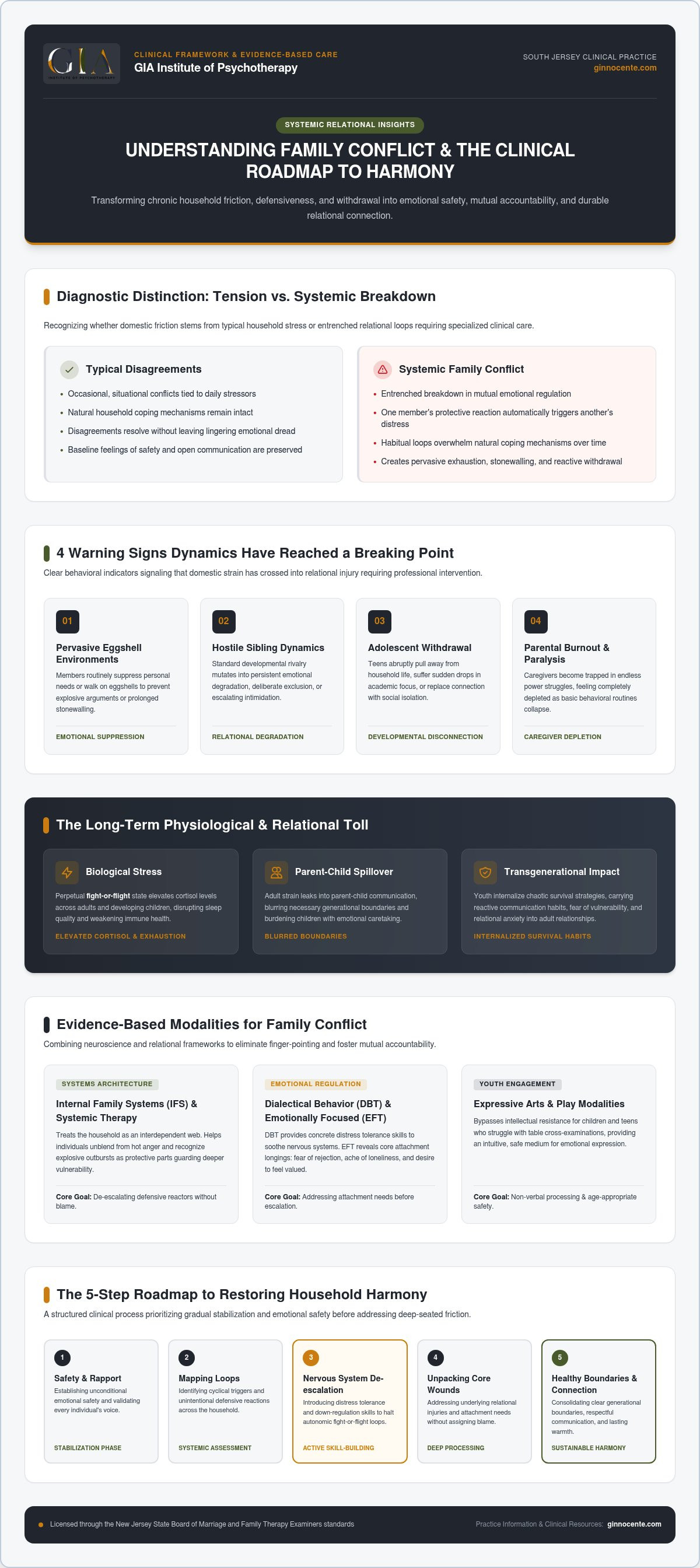
Every home experiences friction, yet occasional disagreements differ fundamentally from recurring cycles of emotional withdrawal, blame, and defensiveness. Systemic family conflict in modern households is an entrenched breakdown in mutual emotional regulation, where habitual relational patterns overwhelm a family's natural coping mechanisms. Instead of viewing discord as the fault of a single "difficult" individual, clinical frameworks such as family systems therapy explore how each person's protective reaction inadvertently triggers another's distress. Over time, this unaddressed tension does not fade on its own. It seeps into daily functioning, disrupting sleep quality, weakening physical immune health, and derailing children's academic focus.
Signs Your Family Dynamic Has Reached a Breaking Point
Recognizing when typical domestic stress has crossed the threshold into unsustainable relational injury is the first step toward relief. Seeking professional therapy for family conflict NJ clinicians provide becomes essential when home life feels defined by exhaustion rather than safety. Watch for these clear warning signs:
- Pervasive eggshell environments: Household members routinely suppress their needs or walk on eggshells to prevent explosive arguments or prolonged stonewalling.
- Hostile sibling dynamics: Typical developmental rivalry mutates into persistent emotional degradation, deliberate exclusion, or escalating physical intimidation.
- Adolescent withdrawal: Teens abruptly pull away from household life, experience sudden drops in grades, or substitute authentic connection with deep social isolation.
- Parental burnout and paralysis: Caregivers find themselves trapped in endless power struggles, feeling entirely depleted as basic behavioral routines collapse.
The Long-Term Impact of Unresolved Domestic Conflict
Living amidst chronic relational gridlock takes a measurable physiological toll on every family member. Prolonged domestic tension keeps nervous systems locked in perpetual fight-or-flight, elevating cortisol levels across developing children and adults alike. Unresolved adult strain also leaks into parent-child communication, blurring necessary boundaries and unintentionally burdening kids with emotional caretaking. Without an intentional shift, children internalize these chaotic survival strategies, carrying reactive communication habits, fear of vulnerability, and deep relational anxiety straight into their future adult relationships.
Clinical Modalities for Resolving Family Conflict: Evidence-Based Approaches
Resolving entrenched household battles requires clinical precision rather than generic parenting advice. When families sit down together, modern therapeutic modalities combine neuroscience and relational systems to untangle years of defensive habits. Qualified clinicians licensed through the New Jersey State Board of Marriage and Family Therapy Examiners understand that selecting the right framework prevents clinical sessions from devolving into finger-pointing matches, transforming reactive living rooms into spaces of mutual accountability.
Internal Family Systems (IFS) and Systemic Family Therapy
Internal Family Systems views each person as an ecosystem of parts, such as protective critics or defensive reactors, that get triggered when feeling unsafe. In family systems therapy, the entire home operates as an interdependent web where one member's anxiety directly impacts everyone else. In session, parents and youth learn to unblend from hot anger, recognizing that explosive behavior is often an overwhelmed part trying to guard vulnerable feelings.
Dialectical Behavior Therapy (DBT) and Emotionally Focused Therapy (EFT)
High-conflict households frequently struggle with emotional dysregulation and communication shutdown. Dialectical Behavior Therapy equips families with concrete distress tolerance and interpersonal effectiveness skills, keeping autonomic nervous systems calm before conversations escalate. Simultaneously, Emotionally Focused Therapy peels back reactive layers to reveal the core attachment longings underneath: the fear of rejection, the ache of loneliness, and the desire to feel valued.
Expressive Arts and Play Modalities for Younger Members
Children and adolescents rarely open up when cross-examined across an office table. Expressive arts and play therapy bypass intellectual resistance, giving younger family members an intuitive medium to illustrate their internal world without needing adult vocabulary. Clinicians use these creative outlets to level the power dynamic, creating collaborative engagement even among resistant teenagers.
At the GIA Institute of Psychotherapy, integrative clinical teams blend these evidence-based frameworks to honor each household's unique rhythm. If your family is ready to move beyond defensive loops toward lasting emotional safety, connecting with specialized therapy for family conflict NJ practitioners can help restore harmony to your home.
The Family Therapy Process: A 5-Step Roadmap to Restoring Household Harmony
Entering counseling often triggers anxiety when family members fear being blamed, judged, or cornered in an unfamiliar setting. Effective systemic counseling follows a deliberate five-stage trajectory: collaborative intake, cycle mapping, experiential de-escalation, attachment repair, and home consolidation. By prioritizing safety before confrontation, this structured framework reassures hesitant participants that therapy is a restorative process, not an interrogation. Clinicians regulated under the New Jersey State Board of Marriage and Family Therapy Examiners maintain strict clinical neutrality, ensuring every family member feels protected and heard. Meaningful progress in therapy for family conflict NJ households undertake isn't measured by sudden perfection, but by how quickly members repair connections after everyday misattunements occur.
Steps 1 and 2: Collaborative Intake and Mapping Interaction Cycles
The journey begins with comprehensive individual and joint conversations where no single person is cast as the problem. Together with the clinician, families uncover the repetitive trigger loops that turn minor household misunderstandings into full-blown arguments. Setting clear conversational ground rules during this early stage ensures that vulnerability never turns into an unsafe free-for-all.
Steps 3 and 4: De-escalation Skills and Rebuilding Secure Attachment
Once interaction patterns are visible, the work shifts toward tangible emotional regulation and mutual understanding. During these middle phases, families practice the following practical interventions:
- Real-time physiological pausing: Identifying early somatic signals of distress and taking structured time-outs before emotional flooding overrides rational dialogue.
- Uncovering primary vulnerabilities: Helping teens and parents safely voice underlying feelings of inadequacy, grief, or loneliness rather than leading with defensive anger.
- Attachment-focused communication: Replacing accusatory demands with direct, soft expressions of core emotional and relational needs.
Step 5: Consolidating New Norms and Maintaining Relational Resilience
Lasting transformation occurs when clinical breakthroughs transition into natural domestic routines. Families establish sustainable rhythms, such as collaborative check-ins and structured listening rituals, that preserve connection outside the therapeutic office. Sessions taper gradually as household members resolve friction independently, completing therapy with practical blueprints designed to navigate future developmental shifts with confidence.
How to Prepare Your Household for Family Counseling in New Jersey
Framing counseling as a collaborative gift rather than a disciplinary measure changes everything. When households view systemic support as an opportunity to lighten everyone's emotional load, defensive walls naturally begin to soften. To explain counseling to children with clarity, tell them that therapy is a safe, neutral space designed to help everyone learn how to listen better and feel happier at home, rather than a place where anyone gets into trouble. Thoughtful preparation transforms what might feel like a punishment into a welcoming haven of mutual relief. When pursuing specialized therapy for family conflict NJ households discover that early transparency sets the groundwork for deep, lasting healing.
Talking to Reluctant Teens and Hesitant Partners
Resistance is a natural protective reaction when someone fears being scapegoated or criticized. Reassure hesitant partners and teenagers that the therapist does not act as an umpire assigning penalties, but as a balanced advocate for every individual's emotional well-being. Validate their skepticism openly and invite them to commit to a brief trial of three or four sessions. Shifting the conversation from "fixing what's wrong with you" to "improving how our home feels" allows reluctant members to step into the room on their own terms.
What to Expect in Your Initial Family Consultation
The first appointment is gentle, exploratory, and designed to establish mutual comfort. Rather than forcing high-stakes disclosures or dramatic confrontations, clinicians take time to understand your family's history, developmental phases, and unique strengths. You will discuss scheduling cadences, privacy protections, and practical goals while the therapist observes interaction styles in real time. It is a low-pressure space to evaluate the therapeutic fit and ensure everyone feels respected.
Creating a Supportive Home Environment Between Therapy Sessions
Growth takes root in the ordinary moments between weekly sessions. Practice communication exercises gradually, treating new tools as curious experiments rather than rigid household rules. Make a conscious effort to acknowledge quiet victories, whether that means an adolescent pausing before reacting or a parent offering an unprompted apology. When you are ready to break old patterns, reach out to the clinicians at GIA Institute to schedule family therapy and begin writing a calmer chapter for your household.
Choosing the Right Family Conflict Therapist Across South Jersey Communities
Finding therapeutic support within your own community changes the counseling experience. Local clinicians understand the distinct rhythms of South Jersey, from competitive school districts to shifting seasonal demands that often heighten domestic stress. A strong therapeutic alliance, where both caregivers and youth feel genuinely understood and safe, remains the single greatest predictor of lasting clinical success. Combining in-office visits with flexible hybrid options ensures consistent care that fits smoothly around complex work schedules, extracurricular activities, and commutes. When seeking dedicated therapy for family conflict NJ parents can trust, regional proximity fosters genuine clinical continuity and ease.
Key Questions to Ask a Prospective Family Counselor
Interviewing a therapist helps determine whether their clinical philosophy matches your household's unique needs. Before beginning, consider asking these practical questions:
- What specific systemic therapy credentials, state licensures, and clinical frameworks guide your practice?
- How do you approach multi-generational tension, adolescent behavioral distress, and delicate school transitions?
- How do you balance structured skill-building exercises with open-ended emotional processing in each session?
Accessing Compassionate Care in Atlantic and Cape May Counties
Families living across Atlantic and Cape May counties don't need to commute toward Philadelphia or North Jersey to receive specialized relational care. Whether you are navigating adolescent withdrawal in Linwood, parenting friction in Margate, or blended household dynamics in Ocean City, Ventnor, and Upper Township, dedicated outpatient care is accessible right in your neighborhood. Households throughout Egg Harbor Township and Galloway also find a grounded, non-judgmental environment designed to help every voice feel valued. To explore how systemic counseling dissolves gridlock and re-establishes safety, connect with the clinical team at GIA Institute to restore lasting household peace.
Taking the First Step Toward Household Peace
Chronic tension does not mean your family is broken; it simply reveals that familiar communication habits have reached their limit. Moving beyond defensive cycles requires shifting from personal blame to relational understanding, allowing every member of your household to rediscover emotional safety. Serving families throughout Atlantic and Cape May counties, our clinical approach integrates evidence-based modalities like IFS, DBT, CBT, and expressive arts therapy, honoring the unique perspective of both children and adults.
You don't have to carry the weight of persistent domestic friction alone, nor must you wait for another painful misunderstanding before seeking support. Transformation happens gradually as new boundaries take root and compassionate conversations replace old reactions. When you are ready to restore calm and mutual trust under one roof, begin your family healing journey with the GIA Institute. Specialized therapy for family conflict NJ households trust offers the structured, compassionate guidance needed to help your family reconnect with enduring warmth.
Frequently Asked Questions
Is family therapy effective if one person refuses to participate?
Yes, family therapy remains highly impactful even if one household member chooses not to attend. Because families operate as interconnected systems, helping two or three members alter their reactions ripples throughout the entire home. When a parent or sibling learns to pause defensive cycles and communicate calmly, the emotional atmosphere shifts, often motivating the hesitant member to participate later. You don't need full initial attendance to begin transforming household friction.
Can family therapy make our household arguments worse before getting better?
It is common for tension to temporarily feel heightened as long-hidden grievances are brought into the open. When families stop tiptoeing around sensitive issues, uncomfortable truths surface before new communication skills fully take hold. A skilled clinician creates structured safety boundaries so these conversations remain productive rather than destructive. This brief adjustment period marks the dismantling of old, dysfunctional habits to make space for genuine emotional relief and long-term peace.
How does a therapist avoid taking sides during intense family disputes?
Professional clinicians maintain strict multipartiality, viewing the shared relational dance rather than an individual person as the clinical focus. In specialized therapy for family conflict NJ clinicians guide, the therapist validates the emotional pain behind each person's perspective without endorsing harmful actions. By focusing on circular causality, how one person's withdrawal triggers another's criticism, the counselor ensures no single member feels blamed, ganged up on, or alienated during sessions.
What happens if our children or teens refuse to speak in therapy?
Silence is respected as an understandable protective defense rather than stubborn defiance. Experienced family clinicians never interrogate reluctant youth or force verbal disclosure. Instead, therapists utilize expressive arts, play modalities, and collaborative activities that reduce social pressure. When children realize the room is a safe haven where they won't be scolded or forced to defend themselves, their natural defensiveness softens, paving the way for authentic expression.
How long does therapy for family conflict typically take to show results?
Most families engaging in therapy for family conflict NJ providers offer begin noticing small de-escalation improvements within three to six sessions. Systemic therapy is typically a focused, goal-oriented process, often unfolding over several months depending on the complexity of domestic strain. Early progress shows up as quicker recoveries after misunderstandings and reduced emotional reactivity at home, while long-term resilience develops gradually through sustained boundary setting and repair rituals.
Can family counseling help with school-related behavioral struggles and refusal?
Yes, family counseling provides critical support for academic stress, attendance resistance, and behavioral dysregulation. School struggles often reflect underlying relational anxiety, sensory overload, or developmental transitions. Relational clinicians evaluate how household expectations and classroom dynamics interact, offering supportive school advocacy services alongside family sessions. In South Jersey communities like Linwood, Ocean City, and Margate, this collaborative approach bridges the gap between home peace and positive school engagement.
What is the difference between family counseling and individual adolescent therapy?
Individual adolescent counseling focuses on a young person's internal world, while family counseling reshapes how the entire household interacts. Individual sessions provide private spaces for teens to explore personal mood struggles or identity questions. In contrast, family therapy addresses the collective system, improving parent-child attunement, conflict de-escalation, and everyday communication patterns. Many families in Atlantic and Cape May counties benefit from combining both modalities to ensure lasting domestic progress.


