

What if the missing piece in your child's school plan isn't another evaluation, but a steady bridge between their emotional reality and the classroom? When you watch your child face severe morning anxiety or school refusal, sitting across a conference table from a district Child Study Team can leave you feeling dismissed and overwhelmed. Grounded IEP advocacy New Jersey families rely on shifts this dynamic, translating deep clinical insights and complex administrative codes into clear, compassionate, and enforceable classroom support.
You already know in your heart that a child cannot learn effectively when they don't feel emotionally safe, yet proving that educational need is often exhausting. In this guide, you will discover how specialized IEP advocacy in New Jersey secures essential emotional, behavioral, and academic accommodations for your child while preserving positive school relationships. We'll explore current state timelines under N.J.A.C. 6A:14, essential documentation practices, and collaborative approaches to help your child feel truly seen, supported, and ready to thrive.
Key Takeaways
- Understand how specialized IEP advocacy New Jersey families utilize bridges clinical mental health insights with state special education standards under N.J.A.C. 6A:14.
- Learn the critical legal and functional differences between an IEP and a 504 Plan to ensure your child receives the exact level of support they need.
- Master the state-mandated evaluation timelines and procedural safeguards that empower your parental voice throughout the Child Study Team process.
- Discover what credentials and clinical experience to look for when choosing an educational advocate to represent your family.
- Explore how pairing child psychotherapy with collaborative school advocacy transforms school refusal into lasting emotional regulation and academic growth.
What Is IEP Advocacy in New Jersey and When Is It Necessary?
Special education advocacy is far more than legal posturing or procedural check-ins. At its core, professional IEP advocacy New Jersey families rely on translates a child's clinical, emotional, and neurodivergent realities into structured, legally binding school supports. While many families assume specialized plans only serve severe cognitive or physical impairments, modern educational frameworks increasingly recognize that severe school-induced anxiety, panic disorders, and depression directly impede learning.
Federal protections under the Individuals with Disabilities Education Act (IDEA) establish your child's right to specialized instruction. When codified as an Individualized Education Program (IEP), this federal guarantee blends with state-level mandates. An IEP is not a privilege; it is a legally enforceable roadmap designed to address emotional dysregulation, sensory overload, and executive dysfunction just as readily as reading delays.
Understanding New Jersey Administrative Code 6A:14
New Jersey oversees special education through N.J.A.C. 6A:14. This code requires district Child Study Teams to evaluate, identify, and support eligible students under strict procedural guarantees. Central to this code is Free Appropriate Public Education (FAPE), which ensures your child receives meaningful educational benefit tailored to their unique needs. Additionally, the code mandates placement in the Least Restrictive Environment (LRE), meaning your child must learn alongside non-disabled peers to the maximum extent appropriate, receiving accommodations before being placed in more restrictive settings.
When Parental Intuition Signals the Need for Professional Support
Parents often sense distress long before a school acknowledges a crisis. Clinical advocacy becomes vital when persistent emotional battles start eroding your child's sense of safety, including:
- Chronic somatic complaints and school refusal: Frequent morning stomachaches, headaches, or panic attacks that prevent your child from stepping through the school doors.
- Unexplained academic decline: Sudden drops in grades or incomplete classwork caused by debilitating anxiety or sensory overwhelm rather than a lack of cognitive ability.
- Unfulfilled informal promises: Verbal agreements from teachers to "give extra time" or "offer a calm corner" that vanish during testing or substitute days because they were never written into an enforceable plan.
Bridging the gap between home struggles and formal school classifications requires strategic documentation. Grounded IEP advocacy New Jersey professionals provide the clinical clarity necessary to ensure school teams understand the authentic emotional drivers behind these behavioral patterns, transforming parental intuition into definitive classroom protection.
IEP vs. 504 Plan: Selecting the Right Educational Framework in NJ
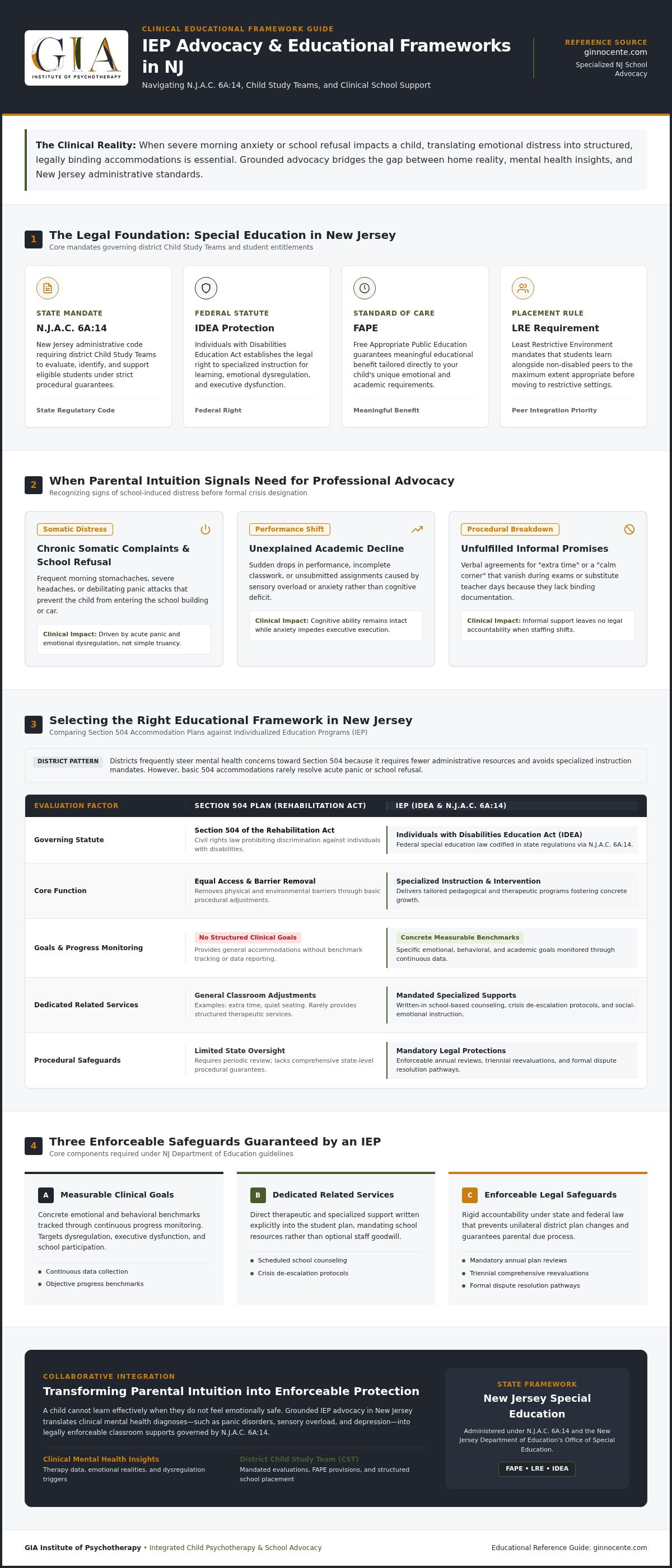
When a child struggles to get out of the car in the morning, well-meaning educators frequently suggest a 504 plan. Districts often steer mental health concerns toward Section 504 of the Rehabilitation Act because it requires fewer administrative resources and avoids specialized instruction mandates. While a 504 plan removes physical and environmental barriers through basic accommodations, it rarely resolves the acute panic driving persistent school refusal. For children facing deep emotional dysregulation, the comprehensive safeguards of an IEP provide the structured safety they actually need.
Key Distinctions Between Section 504 and IDEA in New Jersey
Section 504 is a civil rights statute guaranteeing equal access, whereas an IEP under the Individuals with Disabilities Education Act (IDEA) delivers specialized instruction designed to foster genuine academic and emotional growth. Guided by regulations from the NJ Department of Education's Office of Special Education, an IEP establishes formal accountability. Unlike a 504 plan, an IEP provides:
- Measurable clinical goals: Concrete emotional and behavioral benchmarks tracked through continuous progress monitoring.
- Dedicated related services: Direct support written into the plan, such as scheduled school-based counseling and crisis de-escalation protocols.
- Enforceable legal safeguards: Mandatory annual reviews, triennial reevaluations, and formal dispute resolution pathways.
When severe anxiety makes entering a school building feel impossible, simple environmental modifications like preferred seating or extended test time aren't enough to restore functioning.
Mental Health Classifications: Understanding OHI and ERI in NJ
Securing an IEP for emotional well-being requires identifying the classification that best reflects your child's reality. New Jersey recognizes two primary pathways for mental health needs:
- Other Health Impairment (OHI): Often utilized when clinical anxiety, depression, or ADHD limits a child's vitality, alertness, or cognitive stamina throughout the school day.
- Emotional Regulation Impairment (ERI): Designed for students whose chronic emotional distress, interpersonal challenges, or mood instability directly impairs educational performance over an extended period.
Determining which classification fits best requires aligning clinical observations with district standards. Engaging experienced School Advocacy Services ensures this diagnostic bridge is built accurately. Grounded IEP advocacy New Jersey parents turn to helps translate clinical evaluations into clear educational necessity, giving your child the legal framework needed to heal and learn.
The New Jersey IEP Process: A Step-by-Step Strategic Roadmap
Walking through the special education system often feels overwhelming when your family is already coping with emotional distress. Fortunately, state law establishes precise procedural guardrails designed to hold school districts accountable. By understanding these milestones, you can replace uncertainty with clear, collaborative momentum. Dedicated IEP advocacy New Jersey families rely on transforms this complex bureaucratic pathway into a methodical, supportive journey toward academic healing.
Initiating the Evaluation: The 20-Day Identification Meeting
Everything starts with a formal, dated written request sent directly to your district's director of special services. Once received, the district has 20 calendar days to convene an initial identification meeting with the Child Study Team. Bringing comprehensive clinical documentation from your child's outpatient therapist or psychologist establishes immediate credibility. This external insight helps substantiate the clear connection between emotional struggles at home and functional barriers in the classroom.
The 90-Day Evaluation Window and Eligibility Determination
Once you provide written consent for evaluation, New Jersey mandates a strict 90-day window to complete assessments and determine eligibility. These evaluations typically examine psychological, educational, and social functioning. The district must provide you with copies of these reports at least 10 calendar days before the eligibility meeting. If school evaluations overlook the depth of your child's anxiety or neurodivergence, you have the right to request an Independent Educational Evaluation (IEE) at district expense.
Navigating High-Stakes Child Study Team Annual Reviews
Annual reviews require ongoing diligence to ensure services match your child's developmental growth. Prioritize tangible supports, such as structured sensory breaks, executive functioning accommodations, and regular counselor check-ins. Always request draft documents before the meeting to avoid feeling rushed. Remember that New Jersey gives parents 15 calendar days to review the proposed IEP document before consenting, providing essential breathing room to review terms with your support team.
What to Look for in a New Jersey Special Education Advocate
Choosing someone to sit beside you at the conference table is an intimate, high-stakes decision. Special education representation spans a wide spectrum, from litigation attorneys focused on due process to peer advocates offering parent-to-parent tips. When a child's educational roadblocks stem from panic, depression, or neurodivergent burnout, combative tactics often backfire. High-conflict posturing can alienate educators and create an adversarial environment for your child. Instead, effective IEP advocacy New Jersey families rely on centers on calm, trauma-informed collaboration that preserves working relationships while firmly upholding your child's rights.
Essential Qualifications for Mental Health Educational Advocates
A strong advocate must understand internal nervous system regulation just as deeply as state administrative codes. Look for professionals who possess specific competencies, including:
- Translating clinical documentation: The ability to take clinical evaluations, therapy progress notes, and diagnostic summaries and translate them into measurable, defensible IEP goals.
- Understanding school avoidance neurobiology: Direct experience identifying the physiological roots of panic and sensory overload rather than dismissing distress as behavioral non-compliance.
- Designing holistic supports: Knowledge of non-punitive interventions, de-escalation strategies, and specialized classroom accommodations that foster emotional resilience.
Questions Every Parent Should Ask Before Retaining an Advocate
Before partnering with an educational advocate, ask these focused questions to ensure their philosophy matches your family's needs:
- "What is your relationship philosophy with district Child Study Teams?" Look for a steady, restorative voice rather than someone who enters meetings looking for a fight.
- "How familiar are you with South Jersey school districts?" Experience navigating local administrations across Atlantic and Cape May counties provides invaluable context for district culture.
- "How do you collaborate with our outside providers?" Your advocate should actively communicate with your child's treating clinicians to present a united, cohesive perspective to the school.
When you need a compassionate ally to guide these difficult conversations, our team is ready to help your family find steady footing. Explore our dedicated School Advocacy Services to discover how we bridge therapeutic insight with practical educational navigation.
How GIA Institute Champions Your Child Through Integrated Advocacy
Navigating school placement meetings while holding your child's emotional distress can leave any parent feeling depleted. At GIA Institute of Psychotherapy, we believe you shouldn't have to carry that weight alone. We integrate evidence-based clinical care with dedicated School Advocacy Services, bridging the gap between outpatient therapy and public school reality. By pairing child psychotherapy with strategic representation, our work transforms intimidating administrative conferences into restorative spaces focused on meaningful growth.
Outpatient clinical documentation carries significant weight when presented with precision. When our clinicians evaluate behavioral barriers, we translate therapeutic observations into the specific regulatory language district teams respect. This integrative approach elevates the IEP advocacy New Jersey parents rely on, grounding every requested accommodation in clinical science and child development.
Bridging Neuroscience, Therapy, and School Accommodations
We draw upon evidence-based modalities, including Cognitive Behavioral Therapy (CBT), Dialectical Behavior Therapy (DBT), Internal Family Systems (IFS), and Play Therapy. These frameworks help us understand the distinct neurological patterns underlying sensory overload and school-induced panic. By mapping these clinical insights directly to classroom interventions, we help schools craft accommodations that actually work. Simultaneously, we empower young people to develop distress tolerance and self-advocacy skills, giving them agency in their own educational healing.
Local Advocacy Tailored to South Jersey School Districts
School district cultures vary widely from one community to the next. Our team brings deep familiarity with South Jersey educational communities, including Linwood, Ocean City, Margate, Ventnor, Upper Township, Egg Harbor Township, and Galloway. We understand the specific administrative dynamics across Atlantic and Cape May counties, allowing us to maintain productive, non-adversarial dialogues with Child Study Teams.
Rather than entering meetings with an antagonistic posture, we act as a calm, collaborative presence beside you at the conference table. This balanced relationship protects your child's educational rights while preserving vital partnerships with teachers and case managers. Educational friction can give way to genuine emotional stability. Reach out today to schedule an introductory consultation and discover how specialized IEP advocacy New Jersey families trust can help your child feel safe, supported, and understood in the classroom.
Restoring Hope and Stability to Your Child's Education
Watching your child struggle with classroom anxiety or morning school refusal is painful, but you don't have to carry this journey alone. When you align clear clinical insight with state education codes, the school experience begins to transform. Establishing an enforceable IEP provides your child with dedicated emotional benchmarks, proactive de-escalation strategies, and the structural safety they need to thrive. With the right support, intimidation shifts into genuine collaboration.
Specialized IEP advocacy New Jersey families rely on brings calm clarity to the Child Study Team table. Our licensed therapists combine evidence-based clinical care with practical educational representation across Atlantic and Cape May County schools, easing family stress while safeguarding your child's dignity. You don't have to choose between clinical healing and educational progress; both work hand in hand to restore your child's confidence.
Take the next step toward educational peace. Schedule an IEP advocacy and clinical consultation with GIA Institute today, and let's build a brighter, more supportive school experience together.
Frequently Asked Questions
Can a parent bring an advocate or therapist to a New Jersey IEP meeting?
Yes, parents have the legal right under federal IDEA and New Jersey regulations to invite individuals with knowledge or special expertise regarding their child. Bringing an advocate or outpatient therapist provides steady clinical support during Child Study Team discussions. Professional IEP advocacy New Jersey families utilize ensures meeting conversations stay focused on objective emotional needs while preserving constructive, collaborative relationships with district personnel.
What happens if the Child Study Team denies my request for an IEP evaluation?
If the Child Study Team decides an evaluation is unnecessary, they must issue a written notice explaining their rationale within 15 calendar days of the decision. You have immediate options to challenge this finding. You can request formal mediation, file for due process, or work alongside a clinical advocate to gather supplementary documentation from treating therapists that demonstrates how emotional distress actively interferes with your child's learning.
How long does a New Jersey school district have to complete an IEP evaluation?
New Jersey mandates a 90-calendar-day timeline from the day the district receives your written consent for evaluation to the completion of assessments and IEP implementation. Additionally, the district must schedule an initial identification meeting within 20 calendar days of receiving your initial written referral. All evaluation reports must be shared with you at least 10 days before the eligibility conference.
Is an IEP better than a 504 plan for a child with severe school anxiety?
An IEP is generally far more effective for severe school anxiety and persistent attendance barriers. While a 504 plan primarily provides environmental accommodations like quiet testing spaces, an IEP delivers specialized instruction alongside enforceable related services. This includes dedicated school counseling, targeted behavioral goals, and structured de-escalation protocols designed to resolve the underlying panic preventing classroom attendance.
Can an IEP include specialized mental health therapy or emotional accommodations?
Yes, an IEP can incorporate related services such as individual or group counseling delivered by certified school social workers or psychologists. It can also outline accommodations like sensory cooldown passes, modified morning entry schedules, and non-punitive attendance policies. Specialized IEP advocacy New Jersey parents seek ensures these goals are framed around functional emotional regulation rather than disciplinary compliance.
What should I do if my school district fails to implement agreed IEP accommodations?
Start by documenting every missed accommodation in writing, establishing a clear timeline of events. Schedule an emergency IEP review meeting with the case manager to address implementation lapses collaboratively. If the school remains non-compliant, you can file a formal complaint with the New Jersey Department of Education's Office of Special Education or seek mediation to enforce your child's legal plan.
Does New Jersey allow independent educational evaluations paid by the district?
Yes, if you disagree with the evaluations conducted by your district's Child Study Team, you have the right to request an Independent Educational Evaluation (IEE) at public expense. Once you submit a written request, the district must either agree to fund an independent specialist or file for due process within 20 calendar days to defend the validity of its original testing.


