
What if exploring EMDR therapy didn’t mean having to share everything before you feel ready? If unsettling memories or strong emotional reactions have been difficult to manage, it’s understandable to wonder what happens in a session and whether the approach might fit. EMDR therapy Upper Township NJ can be part of a thoughtful, collaborative therapy journey, with room to discuss your questions, comfort level, and pace.
In this guide, you’ll learn what EMDR may involve in clear, everyday language, what to consider when deciding whether it feels right for you, and how GIA Institute of Psychotherapy supports adults in Upper Township and nearby South Jersey communities. Therapy can begin with conversation and preparation, rather than pressure to revisit difficult experiences before you’re ready. Understanding the process can help you take a considered next step with greater clarity and a stronger sense of choice.
Key Takeaways
- EMDR stands for Eye Movement Desensitization and Reprocessing, a psychotherapy approach that may be considered when distressing memories or reactions feel hard to manage.
- Sessions follow a clinician-guided process, and bilateral stimulation can take forms beyond eye movements.
- You don’t have to recount every detail of a painful experience. Your comfort and pace can be part of the conversation.
- Your goals, questions, and personal comfort can help you prepare for a conversation about whether EMDR may fit your needs.
- EMDR therapy Upper Township NJ is one option within GIA Institute of Psychotherapy’s broader approach for clients in Upper Township and nearby communities.
Considering EMDR Therapy in Upper Township, NJ? Start With What You Need
Reaching out for support when memories or emotional reactions feel difficult to manage can bring up mixed feelings. You might want things to feel different and still feel unsure about discussing the past, choosing an approach, or knowing where to begin. You don’t need a diagnosis or a complete explanation of what’s troubling you to start a conversation about your needs.
EMDR stands for Eye Movement Desensitization and Reprocessing. It’s a psychotherapy approach that a clinician may use when someone is experiencing trauma-related distress. The name refers to one form of stimulation used in the approach, but EMDR is a structured therapeutic process, not simply a technique applied in isolation. Whether it may suit you depends on your circumstances, priorities, and comfort, considered together with your clinician.
What might lead someone in Upper Township to explore EMDR?
People consider therapy for many reasons. A reminder of a difficult experience might bring a wave of emotion, tension, or unease. A memory may come to mind unexpectedly, or a reaction may feel stronger than the present situation seems to call for. These experiences can affect sleep, relationships, concentration, or ease in everyday routines. They don’t automatically mean someone needs EMDR, and no single reaction determines which kind of support is right.
It can help to notice what you’d like to change, even if you’re unsure why a particular response occurs. Perhaps you want to feel more grounded when a reminder comes up, or understand why certain situations leave you unsettled. Those observations can be starting points for a collaborative discussion, not a test you have to pass. GIA Institute of Psychotherapy serves adults in Upper Township and nearby South Jersey communities, including Ocean City, Linwood, Margate, Ventnor, Egg Harbor Township, and Galloway.
What EMDR can and cannot promise
EMDR is a therapeutic approach, not an instant fix or a guarantee of a particular result. People’s experiences, needs, and responses to therapy differ. A clinician can learn about what you’re dealing with, hear what you hope to work toward, and discuss whether EMDR may be a reasonable part of your care. That conversation can also consider other approaches and the kind of support that feels appropriate to your goals.
Rather than deciding from a checklist, you and your clinician can explore questions such as:
- What situations or reminders feel hardest to manage right now?
- What would you hope might feel different in daily life?
- What concerns or boundaries would help you feel more comfortable discussing therapy?
You’re allowed to be uncertain. Ask questions, share only what feels manageable, and take time to understand the options. The aim isn’t to force a particular method, but to make space for care that respects your experience and supports a thoughtful next step.
What Happens in EMDR Therapy? A Clear, Collaborative Process
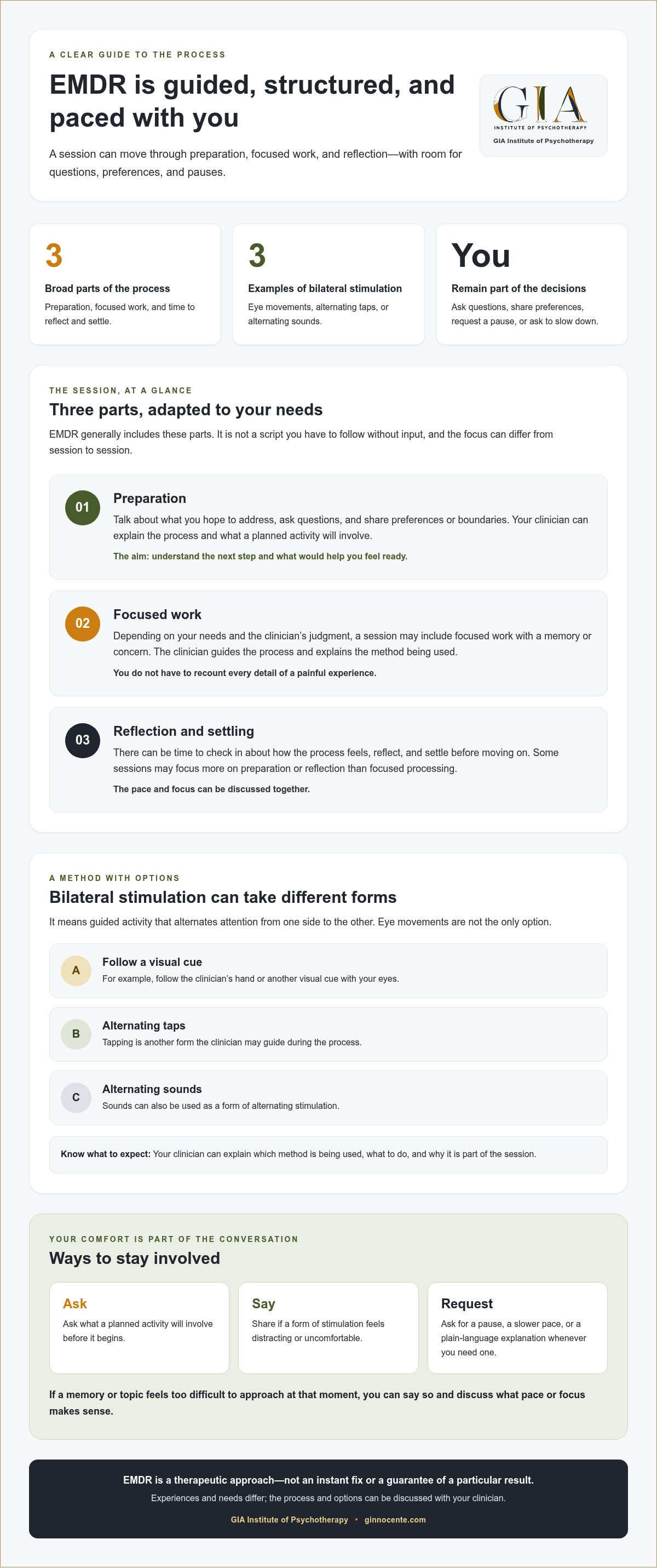
Knowing that EMDR has a structure can make the process feel less mysterious, especially if you’re unsure what a session involves. The clinician guides the work, explains what’s happening, and makes space for your questions. Rather than relying on a single technique, EMDR generally includes preparation, focused work with a memory or concern, and time to reflect and settle before moving on.
The steps aren’t a script you have to follow without input. A clinician can adapt the pace and focus to your needs, and you can speak up if you feel confused, uncomfortable, or want to pause. Structure helps guide the work, but it does not promise a particular outcome.
How bilateral stimulation fits into EMDR
Bilateral stimulation means guided activity that alternates attention from one side to the other. This may involve following a clinician’s hand or another visual cue with your eyes, or using other forms such as alternating taps or sounds. Eye movements aren’t the only option. Your clinician guides this part of the process and can explain the method being used, so you understand what to do and why it’s part of the session.
Why preparation and pacing matter
Before focused processing, time can be spent discussing what you hope to address, what questions you have, and what would help you feel ready. Preparation also gives you a chance to share preferences and boundaries. You don’t have to agree to move faster than feels manageable. Asking for a pause or clarification is part of communicating during therapy.
A session might include a conversation about your goals, an explanation of the next step, and a check-in about how the process feels. If a memory or topic feels too difficult to approach at that moment, say so. Your clinician can discuss what pace or focus makes sense with you, rather than treating discomfort as something to push through.
EMDR therapy Upper Township NJ can begin with understanding the process, not with an expectation that you immediately dive into a painful memory. The work may look different from person to person. Some sessions may focus more on preparation or reflection, while others may include focused processing, depending on the person’s needs and the clinician’s judgment.
- Ask what a planned activity will involve before it begins.
- Share if a form of stimulation feels distracting or uncomfortable.
- Request a pause, a slower pace, or a plain-language explanation whenever you need one.
These are practical ways to stay involved in decisions about your therapy. At GIA Institute of Psychotherapy, EMDR is part of a broader approach to care, alongside other therapeutic methods. To learn about collaborative therapy in the Upper Township area, explore GIA’s psychotherapy approach.
Is EMDR Therapy Right for You? Addressing Common Concerns
You can be curious about EMDR and uncertain about it at the same time. You may wonder whether discussing a difficult memory will feel overwhelming, or whether your experience is “serious enough” to bring to therapy. Neither question needs an immediate answer. Interest in EMDR is a reason to explore the approach, but it doesn’t determine whether it’s the right fit. That decision comes from a conversation about your needs, circumstances, and goals, not from checking boxes on a list.
Does EMDR require sharing every detail?
You don’t have to assume you’re ready to describe a painful experience in full detail simply because you’re considering EMDR. Therapy may involve discussing experiences and feelings, but you can talk with your therapist about what you’re comfortable sharing, what questions you have, and what feels too difficult to approach right now. You can revisit those boundaries as therapy unfolds. Being cautious isn’t a failure or a refusal to engage. It’s useful information about what you need to feel supported.
If you’re worried about losing control of the conversation, say so. You might explain, “I’d like to understand the process before discussing specifics,” or “I can talk about how this affects me now, but I’m not ready to describe every detail.” These are valid ways to start. Your therapist can discuss what information may be helpful and make room for your concerns without assuming you must share more than feels manageable.
How EMDR may fit alongside other therapy approaches
EMDR is one approach a clinician may consider, not the only way to work toward your therapy goals. GIA Institute of Psychotherapy also offers CBT, DBT, and IFS. These approaches have different frameworks and methods, so they aren’t interchangeable labels for the same process. Your clinician can consider which approach, or combination of approaches, may best respond to the concerns you bring and what you hope to address.
For instance, you might want to talk through a specific distressing memory while also seeking practical ways to manage difficult feelings in daily life. That example doesn’t automatically point to one method. It can open a discussion about your priorities, preferences, and the support that could be useful. Your needs may also change over time, so treatment choices can be revisited through ongoing conversation.
If you’re exploring EMDR therapy Upper Township NJ, bring questions rather than a conclusion about what you “should” choose. You might ask:
- How would we discuss whether EMDR fits my goals and situation?
- What can I share if I’m not ready to describe an experience in detail?
- How might we talk about other approaches if my needs or preferences point elsewhere?
Your answers don’t have to be perfectly organized. A thoughtful conversation can help you understand your options while keeping your comfort and goals at the center.
Preparing for EMDR Therapy Near Upper Township, NJ
Thinking ahead can make a first therapy conversation feel more manageable, but you don’t need to arrive with a complete account of what happened or a firm decision about EMDR. Begin with what you notice in daily life, what you hope might change, and what you’re unsure about. A few notes on your phone or a short list of questions may help, but speaking spontaneously is fine too.
Questions you may want to bring to a first conversation
Consider what would help you feel informed and included. You might describe an everyday situation that feels difficult, then ask how therapy goals are set and how readiness and pacing are discussed. If revisiting painful memories worries you, name that concern directly. You’re not expected to know whether EMDR is right for you before discussing your needs with a clinician.
- What would you hope feels different in your day-to-day life?
- How would we decide whether EMDR fits my goals and circumstances?
- How do we talk about readiness and choose a pace that feels manageable?
- What can I do if I feel uneasy about discussing a difficult memory?
Your answers can be brief or still taking shape. For example, “I want reminders to feel less disruptive” is a useful starting point, even if you can’t yet explain every detail behind that hope. You can bring a question without being ready to share the story connected to it. Preparation is about making room for your priorities, not rehearsing a perfect explanation.
Finding a comfortable starting point in South Jersey
Local care can feel more approachable when you know the practice serves your community. GIA Institute of Psychotherapy supports clients in Upper Township and nearby South Jersey communities, including Ocean City, Linwood, Margate, Ventnor, Egg Harbor Township, and Galloway. If you’re considering EMDR therapy Upper Township NJ, use your first conversation to discuss how your concerns and preferences may shape a therapy plan.
It may help to think through practical details that affect your comfort, such as what you’d like to ask before discussing personal experiences and what would help you feel settled before and after a session. You don’t need every answer in advance. If your goals change or a question occurs to you later, it can still be part of the conversation.
When you’re ready to take a thoughtful next step, explore GIA’s psychotherapy services and consider what kind of support feels aligned with your needs. Starting with a question is enough.
Explore EMDR Therapy With GIA Institute of Psychotherapy
Exploring EMDR doesn’t mean committing to one method before you understand how it may fit your needs. GIA Institute of Psychotherapy offers EMDR as part of a broader psychotherapy practice that supports adults, children, teens, couples, and families. For adults considering EMDR therapy Upper Township NJ, that wider perspective makes room to discuss both a particular concern and the kind of support that feels comfortable and useful.
GIA’s approach brings together traditional therapy, neuroscience-informed perspectives, practical strategies, and expressive modalities. These elements aren’t a promise of a particular result or a formula applied the same way to everyone. They offer ways to shape therapeutic conversations around the person, their goals, and what they’re ready to explore.
A person-centered approach to therapy
Therapy can make space to understand what feels difficult, notice what matters to you, and consider practical steps toward personal growth. A collaborative process means your questions have a place. You can talk about what you hope to work on, what feels uncertain, and what pace seems manageable. The goal is to keep your experience at the center of the conversation rather than assume one approach fits every person.
That flexibility matters if you’re still deciding what kind of support you want. You might come in with a clear goal, such as feeling less unsettled by a particular reminder, or with a broader sense that something is affecting your daily life. Either can be a starting point. You don’t need a polished explanation before therapy can begin.
Taking a thoughtful next step
A first step can be as simple as learning more about the practice and noticing which questions you’d like to bring into a conversation. You may want to ask how goals are discussed, how your comfort shapes the pace, or how EMDR fits alongside other approaches. The aim isn’t to arrive with a decision already made, but to understand the options and consider what aligns with your needs.
GIA serves clients in Upper Township and nearby South Jersey communities, including Ocean City, Linwood, Margate, Ventnor, Egg Harbor Township, and Galloway. The practice also supports children, teens, couples, and families, while offering adults a place to explore their own goals in therapy.
To learn more, Learn about therapy at GIA Institute. Begin with questions, share what feels comfortable, and move at a considered pace as you explore whether EMDR may be part of your therapy journey.
Take Your Next Step at a Pace That Feels Right
You don’t have to settle every question before beginning. Start by noticing what you hope might feel different and bringing that hope into a conversation. Exploring EMDR therapy Upper Township NJ can help you consider what support could look like without deciding in advance that one approach must be the answer.
At GIA Institute of Psychotherapy, EMDR is offered alongside approaches such as CBT, DBT, and IFS, so therapy can be shaped around your needs and goals. GIA serves people in Upper Township and nearby South Jersey communities. You can ask questions, share your preferences, and discuss a pace that feels thoughtful for you.
To learn more about support in Upper Township and nearby communities, including Ocean City, Linwood, Margate, Ventnor, Egg Harbor Township, and Galloway, explore therapy services at GIA Institute. Take the first step by learning about GIA’s psychotherapy services and bringing your questions to a conversation.
Frequently Asked Questions
Is EMDR therapy effective for everyone?
No, EMDR isn’t effective for everyone, and no therapy can guarantee a particular result. People respond differently based on their circumstances, needs, and therapeutic process. A clinician can discuss what you’d like help with and whether EMDR seems like a reasonable fit. For example, you might describe a reminder that affects your concentration or relationships. The conversation can also consider other approaches if your goals point in a different direction.
Can I try EMDR if I am worried about revisiting difficult memories?
Bring that worry into a conversation before deciding whether to pursue EMDR. Readiness, boundaries, and pace are appropriate topics to discuss with your therapist, and you can ask questions or say if something feels uncomfortable as therapy unfolds. You might jot down what you fear could happen during a session, then use that note to explain what would help you feel more informed and supported.
Do I have to talk in detail about a traumatic experience during EMDR?
Not everyone’s experience of EMDR involves the same amount or kind of discussion, so ask your therapist what may be relevant to your situation. You can talk about privacy, comfort, and what you feel ready to share. If you prefer to begin by describing how an experience affects you now, rather than recounting the event, say so. Your questions can help shape a conversation about how the process may work for you.
How long does EMDR therapy take?
There isn’t one set duration for EMDR therapy. The time involved can depend on your needs, goals, history, and how the therapeutic process develops. Rather than relying on a general session estimate, ask how you and your clinician will review your goals and discuss next steps. You might also ask what signs of progress you’ll pay attention to together, so expectations can be revisited as your needs become clearer.
Can EMDR bring up strong emotions during or after a session?
Emotional responses can differ from person to person, so tell your therapist about concerns before beginning focused work. You can discuss how you’ll communicate if you feel unsettled and what support or reflection might be useful around a session. If you notice a response you didn’t expect, sharing that experience can help guide a conversation about your comfort and the pace of future work.
Can EMDR therapy help with concerns other than PTSD?
People may explore EMDR in relation to different kinds of distress, but that doesn’t mean it’s the right approach for every concern or person. A clinician can consider your circumstances and what you hope to change before discussing whether EMDR fits. Try describing one specific challenge, such as a recurring reminder that disrupts your routine, and ask how therapy goals could address what matters most to you.
Is EMDR available near Upper Township, New Jersey?
Yes. GIA Institute of Psychotherapy serves Upper Township and nearby South Jersey communities, including Ocean City, Linwood, Margate, Ventnor, Egg Harbor Township, and Galloway. If you’re considering EMDR therapy Upper Township NJ, explore GIA’s therapy services as a local next step. You don’t need to have every question settled first. Begin by identifying what you’d like support with and what you want to understand about therapy.


