
What if the first step toward feeling steadier isn’t having all the answers, but finding support that helps you practise one skill at a time? If you’re searching for a DBT therapist near me, you may already know how exhausting intense emotions or difficult moments can feel. It’s understandable to want practical help nearby, without pressure or judgment.
Dialectical behavior therapy, or DBT, focuses on skills for mindfulness, distress tolerance, emotion regulation, and communication. In therapy, those skills can help you pause before reacting, make sense of a strong emotion, or express a need more clearly. This article explains DBT’s practical focus and offers ways to decide what you want from support. GIA Institute of Psychotherapy offers DBT as part of its counseling practice in South Jersey. Whether you’re in Linwood, Margate, Egg Harbor Township, or a nearby community, you can start by considering what kind of support feels right for you.
Key Takeaways
- DBT offers practical skills to practise in everyday life; it doesn’t promise to eliminate difficult feelings.
- Searching for a DBT therapist near me doesn’t define or diagnose you. People explore DBT for many emotional, relational, or coping concerns.
- Before starting, jot down what’s been difficult, what you’d like to change, and any questions you have about DBT.
- GIA Institute of Psychotherapy offers DBT alongside other approaches in its South Jersey counseling practice.
- A first conversation can help you discuss your goals and explore whether DBT feels like a useful direction.
Looking for a DBT therapist near you in South Jersey?
Searching for help can feel vulnerable, especially when you’re unsure what kind of support you need or how to begin. You don’t have to arrive with the right words or a clear explanation. This guide explains DBT, what “near me” can mean in South Jersey, and how to prepare for a first conversation. Dialectical behavior therapy (DBT) teaches practical skills for managing emotions and relationships.
DBT is one of the psychotherapy approaches offered at GIA Institute of Psychotherapy. The practice combines practical strategies with a human-centered perspective. Learning about DBT can help you identify questions to discuss in therapy; a search or description of the approach is not a diagnosis. For a broader overview of DBT’s background and principles, see What is Dialectical Behavior Therapy?
What does ‘near me’ mean when searching for DBT in South Jersey?
A search for a “DBT therapist near me” may be about finding support for yourself or someone you care about. “Near” can start with the communities where you live and spend time. GIA serves people in Ocean City, Linwood, Margate, Ventnor, Egg Harbor Township, Upper Township, and Galloway. Including these place names in a search can help narrow results to your local South Jersey context.
Location can make therapy easier to access, but it isn’t the only factor to consider. A supportive therapeutic relationship matters too. Look for a setting where you feel listened to, respected, and able to speak honestly. If you’re unsure what you want from therapy, you can start by describing what has felt difficult lately, even if you don’t yet know whether DBT is the right approach.
What should you expect from a DBT therapist search?
Expect to learn about an approach and consider the support you’re looking for, not to receive a diagnosis from a search result. People explore DBT for different reasons, and reading about it doesn’t define who you are. The point is to understand the language and possible next steps, so you can approach therapy at a manageable pace.
You may also encounter the term DBT Prolonged Exposure, which refers to a specific DBT-related treatment approach. Directories such as dbtpe.org focus on providers trained in that method. This is distinct from a general search for DBT therapy or counseling in your area. If you’re looking for general DBT support in South Jersey, focus on the concerns you want help with and the questions you’d like to discuss. You don’t need to have everything figured out before beginning.
What DBT therapy involves: practical skills for everyday moments
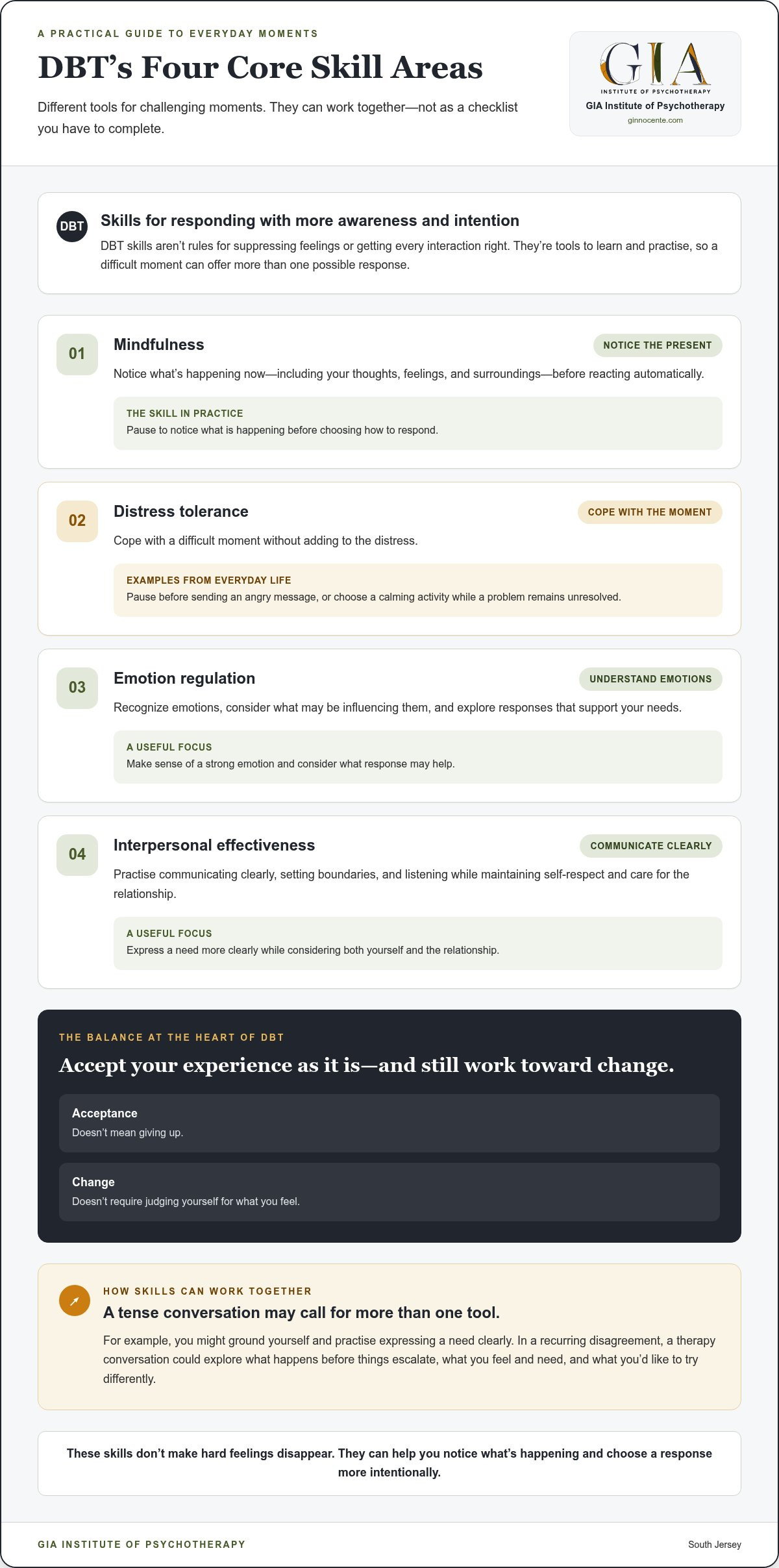
DBT is a skills-focused therapy that helps people approach everyday challenges with greater awareness and intention. It isn’t a quick fix, and its skills aren’t rules for suppressing feelings or getting every interaction right. They’re tools to learn and practise, so a difficult moment can offer more than one possible response.
One way to describe DBT’s central balance is this: you can accept your experience as it is and still work toward change. Acceptance doesn’t mean giving up, and change doesn’t require judging yourself for what you feel. Together, these ideas can make room for honest reflection and practical steps. Understanding DBT Therapy offers further context on the approach.
How do DBT's four core skill areas help?
The four areas offer different ways to respond to challenging moments. They can work together, rather than serving as a checklist you must complete.
- Mindfulness: Notice what’s happening in the present, including your thoughts, feelings, and surroundings, before reacting automatically.
- Distress tolerance: Cope with a difficult moment without adding to the distress. For example, you might pause before sending an angry message or choose a calming activity while a problem remains unresolved.
- Emotion regulation: Recognize emotions, consider what may be influencing them, and explore responses that support your needs.
- Interpersonal effectiveness: Practise communicating clearly, setting boundaries, and listening while maintaining self-respect and care for the relationship.
These skills don’t make hard feelings disappear. They can help you notice what’s happening and choose a response more intentionally. The skill that’s useful may depend on the situation. A tense conversation, for example, might call for both grounding yourself and expressing a need clearly.
What might DBT look like in a therapy conversation?
Imagine a recurring disagreement leaves you feeling unheard. A DBT-focused discussion might explore what happens before the conversation escalates, what you feel and need, and what you’d like to try differently. You and your therapist could consider a skill, such as pausing to notice the emotion or practising a clear way to make a request. This is an illustration; sessions can vary according to your concerns and goals.
The focus and pace of therapy depend on the person and their concerns. You can start with one familiar situation rather than arriving with a complete plan. If you’re searching for a DBT therapist near me, GIA offers DBT alongside other clinical approaches. Learning about GIA’s psychotherapy approach can help you consider whether its practical, human-centered care feels like a good starting point.
Is DBT a good fit? Understand the approach without labeling yourself
Searching for a DBT therapist doesn’t diagnose you, define your personality, or mean you need to fit a particular label. It’s a way to learn about an approach that may offer useful skills. People explore DBT for many reasons, including feeling overwhelmed by emotions, having recurring relationship difficulties, or wanting new ways to cope with stress. Those experiences deserve to be understood in their own context.
DBT may be one approach to discuss, but it isn’t a guaranteed fit or a promise of a particular outcome. A clinician can listen to what you want help with, learn about your circumstances, and discuss your needs in a therapeutic context. You don’t have to make that assessment alone or decide in advance which therapy is “right.”
Can DBT support concerns beyond a specific diagnosis?
You don’t need to begin with a diagnosis to explore DBT skills. Someone might be curious about the approach because emotions feel hard to manage, conflict is taking a toll, or stress makes it difficult to respond in ways they feel good about. These are examples of concerns people may bring to therapy, not a checklist for deciding who should receive DBT.
The focus is on what you’d like support with and whether practising skills could be useful. A clinician can help put your concerns in context and discuss possible approaches. You can talk about what’s happening without explaining it in clinical terms.
What if you are unsure DBT is the right approach?
Uncertainty is a reasonable place to begin. An initial conversation can be a chance to describe what’s been difficult, what you hope might feel different, and what you’d like to understand about therapy. Rather than trying to choose a label for yourself, consider the moments or patterns that led you to search for a DBT therapist near me. Share those concerns and explore whether DBT seems relevant.
GIA Institute of Psychotherapy offers several clinical approaches, including DBT, CBT, EMDR, and IFS. You can discuss your needs without assuming one method fits everyone. It may help to reflect on questions such as:
- What situations or patterns would I most like help understanding?
- What would I hope to handle differently, even in a small way?
- What do I want to know about how therapy could support those goals?
Your answers don’t need to be polished. They’re simply a starting point for a conversation with a clinician, who can help consider your needs and discuss an approach without reducing your experience to a label.
Finding DBT therapy near you: prepare for a comfortable first step
Taking a first step toward therapy can bring hope and apprehension at the same time. You might want support and still feel unsure how to describe what’s going on. You don’t need a polished explanation or perfect questions. A few notes can help you start a conversation with GIA Institute of Psychotherapy about your concerns and whether DBT may be useful to explore.
What can you share when beginning a DBT conversation?
Start with ordinary language. You could mention a situation that keeps weighing on you, a moment when emotions feel difficult to manage, or a conversation you wish had gone differently. You don’t have to identify a diagnosis or use clinical terms. If you’re looking for a DBT therapist near me, begin with what you want help understanding or changing.
Before beginning, consider writing down a few thoughts:
- What feels difficult? Note a situation, feeling, or recurring pattern you’d like to talk about.
- What would you like to feel different? Think about a small change, such as feeling more able to pause, communicate a need, or cope with stress.
- What would you like to know about DBT? Write down questions about the approach, its practical focus, or how it might relate to your concerns.
These notes are prompts, not an assignment. Bring one idea, change your mind, or begin by saying you’re unsure where to start. A therapist can help you find the words as the conversation unfolds.
How can you make the first step feel more manageable?
If speaking about personal concerns feels difficult, keep your notes nearby and use them as a reminder. You might also write down what you hope to understand about therapy, such as how DBT skills could relate to a specific challenge in your life. You don’t need to explain everything at once. One question or example is enough to open a conversation.
GIA serves individuals and families in Ocean City, Linwood, Margate, Ventnor, Egg Harbor Township, Upper Township, and Galloway. These South Jersey communities provide a local context as you consider counseling. If you’re supporting a loved one, you can reflect on what they’ve shared and the support they may be seeking, while respecting that their therapy journey is their own.
It’s okay to feel uncertain. Starting therapy doesn’t require you to have everything figured out. It can be a chance to talk about what matters and consider a next step at a comfortable pace. To learn more, explore therapy with GIA.
DBT therapy at GIA Institute: take your next step in South Jersey
Considering DBT can be a way to look for practical support while staying curious about what fits your needs. GIA Institute of Psychotherapy offers DBT alongside several clinical approaches. Its care brings together traditional therapy, practical strategies, and a human-centered perspective, making room for your experiences and goals without judgment or promises of a particular result.
How does DBT fit within GIA's counseling approach?
DBT is one option within GIA’s broader psychotherapy approach, alongside CBT, EMDR, IFS, EFT, Play Therapy, and Expressive Arts. These approaches offer different ways to understand concerns and work toward meaningful goals. They aren’t automatically combined in every person’s therapy; the focus is on discussing your needs and what kind of support may be relevant.
DBT’s skills-based focus can bring practical tools into that conversation, while therapy also makes room to understand the feelings and experiences behind a challenge. You might want to explore how you respond during stressful moments or practise communicating a need more clearly. Therapy can be collaborative: you bring your perspective and hopes, and the work can be shaped around what matters to you. There’s no need to have a complete plan before starting.
If you’ve been searching for a DBT therapist near me, remember that the approach is one part of a therapeutic relationship. Feeling respected and heard matters as you explore what support could look like. You can begin with the concerns that brought you to therapy and make room for questions as you learn more.
Where does GIA serve people seeking DBT in South Jersey?
GIA serves people in communities across South Jersey, including:
- Ocean City
- Linwood
- Margate
- Ventnor
- Egg Harbor Township
- Upper Township
- Galloway
Whether you’re exploring therapy for yourself or someone you care about, you can begin with the questions and concerns you have now. You don’t need the right label or a perfect explanation. A useful next step is to learn about care that may suit your needs.
Connect with GIA Institute of Psychotherapy to explore a supportive starting point in South Jersey.
Let your next step begin with what matters to you
You don’t need to know exactly which approach is right before you reach out. A useful beginning can be as simple as naming what you’d like support with and making space to discuss what might help. Searching for a DBT therapist near me can be a first step toward exploring those questions, not a commitment to a particular path.
At GIA Institute of Psychotherapy, DBT is offered alongside approaches such as CBT, EMDR, and IFS. The practice’s warm, collaborative style centers your concerns and practical strategies without assuming one approach fits everyone. GIA serves South Jersey communities, including Ocean City, Linwood, Margate, Ventnor, Egg Harbor Township, Upper Township, and Galloway.
Start by sharing what you’re hoping for, whether that’s a question, a concern, or simply the feeling that you’d like support. Connect with GIA Institute of Psychotherapy to explore counseling in South Jersey.
Frequently Asked Questions
What is DBT therapy?
Dialectical behavior therapy, or DBT, is a structured approach that helps people build skills for navigating emotions, distress, and relationships. Its skills include mindfulness, distress tolerance, emotion regulation, and interpersonal effectiveness. For example, a person might practise noticing rising frustration before responding to a difficult message. DBT doesn’t promise to erase hard feelings; it offers ways to meet them with more awareness. GIA includes DBT among its counseling approaches.
Can DBT help with anxiety or depression?
DBT may be worth discussing if you’re looking for practical ways to handle distress, strong emotions, or challenging interactions. Whether it suits your needs depends on your circumstances and goals, so a therapist can help explore that in a clinical conversation. GIA provides counseling for anxiety and depression and includes DBT among its specialized approaches. You might begin by describing what feels hardest in daily life, rather than choosing a method first.
Is DBT only for people with borderline personality disorder?
No. Although DBT was originally developed for borderline personality disorder, exploring it doesn’t mean you have that diagnosis. People may be interested in its skills for different reasons, such as wanting to respond more thoughtfully during conflict or cope with stressful moments. A diagnosis isn’t something to infer from a search term. A therapist can discuss your concerns and goals with you and help consider what approach may be appropriate.
How do I find a DBT therapist near me in South Jersey?
Start by noting what you want help navigating and what you hope might change. If you’re searching for a DBT therapist near me, GIA Institute of Psychotherapy offers DBT among its counseling approaches and serves Ocean City, Linwood, Margate, Ventnor, Egg Harbor Township, Upper Township, and Galloway. Visit GIA’s website to learn about the practice and consider a next step. You don’t need a diagnosis or perfect wording to begin.
What skills do you learn in DBT?
DBT teaches mindfulness, distress tolerance, emotion regulation, and interpersonal effectiveness. Together, these areas can help someone notice what’s happening, get through a difficult moment, understand emotional responses, and communicate needs. For instance, you might work on expressing a boundary clearly while staying mindful of the relationship. Therapy can help connect skills to situations in your life. The aim is practice and greater choice, not handling every conversation or challenge perfectly.
How is DBT different from CBT?
DBT and CBT are both evidence-based approaches, but they emphasize different frameworks and tools. CBT often explores how thoughts, feelings, and actions influence one another. DBT gives particular attention to balancing acceptance with change and practising skills related to mindfulness, distress, emotions, and relationships. Neither label alone determines what will suit you. A therapist can discuss your goals and help consider which approach may fit your concerns.
Does DBT therapy guarantee that emotional distress will go away?
No. DBT can’t guarantee a specific outcome or make difficult feelings disappear on demand. It focuses on practising skills that may help you understand what you’re experiencing and choose how to respond. What therapy looks like and what feels useful can vary with a person’s needs and circumstances. If distress is affecting your life, share that with a qualified therapist and connect with GIA Institute of Psychotherapy to explore counseling support.


