

What if the argument that keeps resurfacing is less about the immediate issue and more about a painful cycle between you and your partner? You may find yourselves moving between conflict and withdrawal while the feelings and needs underneath remain hard to express. If you’re considering Emotionally Focused Therapy Linwood NJ, you may be wondering whether understanding that cycle could help you feel closer again.
It’s understandable to feel uncertain about couples therapy, especially if you’re not sure where to begin or what to say. Emotionally Focused Therapy (EFT) helps couples explore the emotional patterns behind recurring struggles and practice responding to one another with greater openness. The focus isn’t on deciding who’s at fault. It’s on making room for each partner’s experience and understanding what happens between you.
In this article, you’ll learn how EFT can help couples recognize relationship cycles and consider new ways of connecting. You’ll also find practical questions to reflect on and learn how GIA provides couples counseling using EFT in Linwood and nearby South Jersey communities.
Key Takeaways
- EFT helps couples look beyond repeated arguments or distance to understand the emotional pattern shaping their interactions.
- A hypothetical relationship cycle can show how partners’ reactions may leave both feeling unheard, even when each wants connection.
- Couples may explore EFT for recurring conflict or disconnection. The approach should be considered in light of each couple’s circumstances and goals.
- Emotionally Focused Therapy Linwood NJ offers a way to learn what couples may explore in counseling, from sharing concerns to considering new responses.
- GIA brings an authentic, collaborative approach to couples counseling, combining emotional understanding with practical strategies and space to explore old wounds.
Emotionally Focused Therapy in Linwood, NJ: What Couples Can Expect It to Address
It can feel confusing when closeness gives way to the same argument, tense silence, or growing distance. You may care deeply about each other and still struggle to talk about what hurts. These moments don’t mean either partner is to blame. They can point to a recurring relationship pattern that’s difficult to interrupt on your own.
Emotionally Focused Therapy (EFT) is a couples therapy approach that explores how emotions and relationship patterns shape connection between partners. Rather than treating a disagreement as an isolated problem, EFT helps couples notice how each person responds when connection feels uncertain. The Emotionally Focused Therapy (EFT) overview describes the approach’s roots in attachment theory, a way of understanding the importance of emotional bonds.
For couples exploring Emotionally Focused Therapy Linwood NJ, this means taking time to understand what may be happening beneath a familiar conflict. The work focuses on each partner’s experience and the pattern they’re caught in, rather than deciding who is right.
What does Emotionally Focused Therapy focus on?
Emotions can shape how partners reach for connection or protect themselves when they feel hurt, dismissed, or unsure. One person might ask for more conversation or reassurance, while the other pulls back to avoid escalation. These reactions can reinforce each other: the more one partner pursues, the more the other retreats, and both can end up feeling alone.
EFT uses attachment as a way to understand needs for closeness, responsiveness, and reassurance. These needs are part of seeking meaningful connection, not proof that someone is too demanding or uncaring. By slowing down and looking at the pattern, couples can begin to put words to feelings and needs that are harder to express during a heated moment.
Why do Linwood-area couples explore EFT?
Couples may consider EFT when the same disagreements return without resolution, emotional distance grows, or vulnerable conversations feel risky. Frustration can be easier to show than sadness or fear. Silence can feel safer than explaining a need and risking being misunderstood. Recognizing these responses can help couples make sense of what’s happening between them with greater compassion.
There’s no single relationship story behind seeking support. Some couples reach out when a difficult period is beginning; others seek help during a transition or after a challenging chapter. For people in Linwood and nearby South Jersey communities, including Ocean City, Margate, and Egg Harbor Township, EFT provides a structured setting to explore what happens during disconnection and what each partner hopes for instead.
GIA Institute of Psychotherapy provides couples counseling using EFT. The conversation is authentic, relatable, and collaborative, creating space to understand the pattern and explore practical ways to respond to one another with greater openness.
How EFT Helps Couples Understand the Cycle Beneath Relationship Conflict
A disagreement might seem to be about a missed message, a household task, or changed plans. Yet the same exchange can return even after the original issue is settled. In EFT, a relationship cycle is the repeating sequence of reactions partners fall into during disconnection. One person’s response affects the other, and both may end up feeling unheard or alone.
EFT shifts attention from winning an argument to understanding the cycle that keeps pulling partners into it. This doesn’t make the subject of a disagreement unimportant. It means noticing how each partner experiences the exchange, what they do next, and how those reactions shape the conversation.
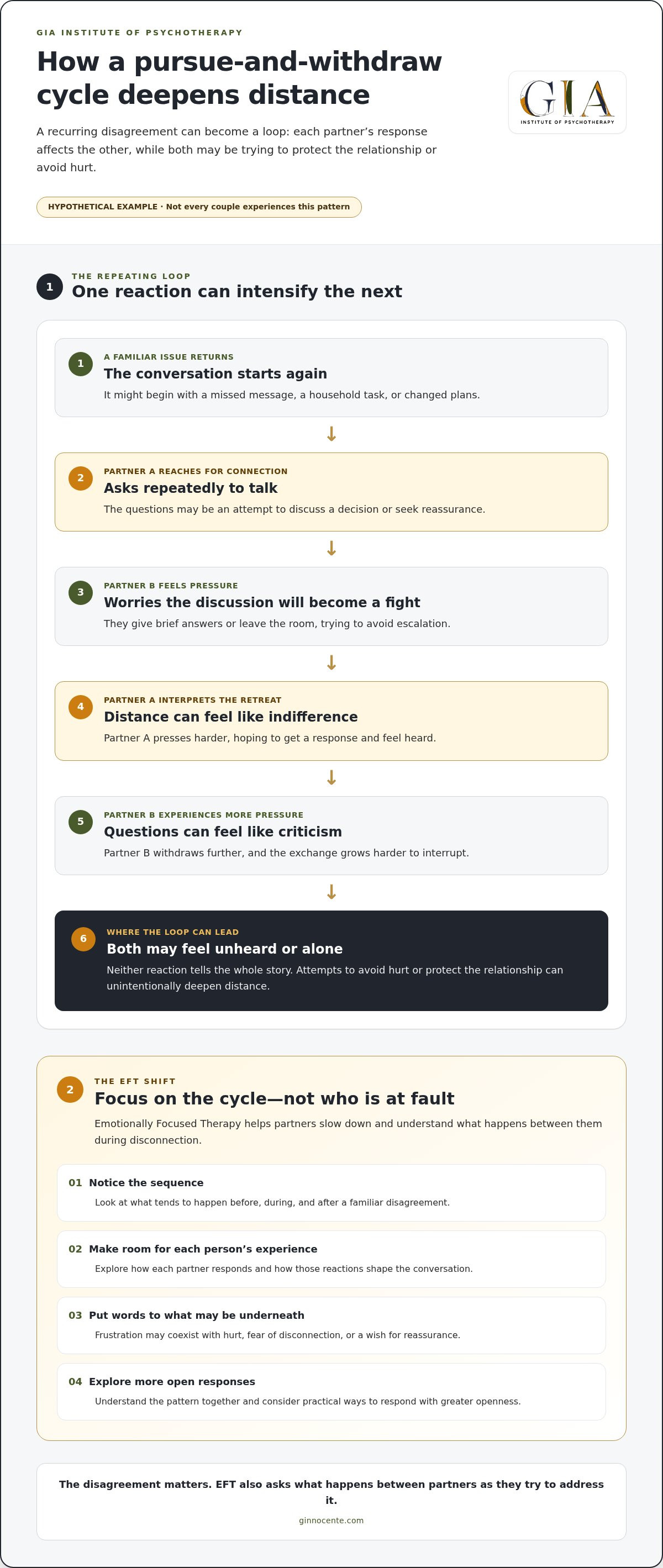
Hypothetical example: Imagine one partner asks several times to talk about a decision. The other feels pressured and worries the discussion will turn into a fight, so gives brief answers and leaves the room. The first partner may read that retreat as indifference and press harder. The second may experience the repeated questions as criticism and withdraw further. Neither response tells the whole story, and this example doesn’t represent every couple’s experience. It illustrates how attempts to protect the relationship or avoid hurt can unintentionally deepen distance.
How can a pursue-and-withdraw pattern take hold?
In a pursue-and-withdraw pattern, one partner presses for conversation or reassurance while the other steps back, goes quiet, or changes the subject. Each response can intensify the other: more pursuit may leave the withdrawing partner feeling overwhelmed, while more distance may leave the pursuing partner feeling increasingly anxious or unheard.
EFT explores this loop as a pattern the couple is caught in, not a flaw belonging to either person. To make it more visible, partners can look at what tends to happen before, during, and after a familiar disagreement. They can notice what each person does and how the other responds. This helps them see how reactions make sense in context, even when the result is painful for both.
What emotions and needs may sit beneath conflict?
Frustration may be the most visible feeling in an argument, but it can coexist with hurt, fear of disconnection, or a wish for reassurance. A sharp question might carry a vulnerable hope to feel considered. Silence might be an effort to avoid saying something hurtful. These are possibilities to explore, not assumptions about what either partner must be feeling.
In couples counseling, partners can take time to notice and express what’s happening beneath their immediate reactions. The pace matters: difficult feelings don’t have to be shared all at once. The International Centre for Excellence in Emotionally Focused Therapy offers information about EFT. In therapy, couples can explore how a particular cycle unfolds in their relationship.
For couples considering Emotionally Focused Therapy Linwood NJ, understanding the cycle can be a useful starting point for more open conversations. GIA provides couples counseling using EFT, with a collaborative approach to exploring relationship patterns and practical ways to respond. Learn more about GIA couples counseling as you consider a next step.
Is EFT Right for Your Relationship? Common Questions
Considering couples therapy can bring up mixed feelings. You might want to understand why the same conflict returns while worrying that therapy will become a search for who’s at fault. EFT offers a way to explore recurring patterns together. Whether it fits depends on what you’re facing and what kind of support feels appropriate.
Your relationship doesn’t have to be in crisis for you to consider therapy. Some couples seek support when they notice growing distance; others want help talking through a transition or a recurring concern. Reaching out can be a thoughtful step, not a verdict on the relationship.
When might couples consider EFT in Linwood?
Couples may explore EFT when arguments circle back to the same themes, emotional closeness feels harder to reach, or important feelings and needs are difficult to express. A partner may know they feel hurt or frustrated but struggle to explain what they need in the moment. Changes in family life, work, or shared plans can also prompt couples to seek support as they adjust together.
There isn’t one situation that defines who EFT is for. Couples in Linwood and surrounding South Jersey communities bring different histories, concerns, and hopes to counseling. GIA provides couples counseling using EFT, creating space to explore whether understanding relationship patterns could help with the concerns you share.
What if one or both partners feel unsure about therapy?
Uncertainty is understandable. One partner may be ready to talk while the other worries about being judged, pressured, or asked to share more than feels comfortable. Those hesitations can be part of the conversation. Neither partner needs to arrive with a perfect explanation of what’s wrong.
You might begin by asking each other: What feels hardest between us lately? What do we hope to understand, or what would we like to change in how we respond to each other? Listening to each answer without immediately debating it can help clarify what each person wants from support. It’s okay if your answers differ.
Therapy isn’t a quick fix or a way to prove one partner right. In EFT, the focus is on exploring shared patterns and each person’s experience with care. A conversation about couples counseling can help you consider what support might look like without requiring either of you to promise a particular outcome. Emotionally Focused Therapy Linwood NJ may be worth exploring if you want a collaborative way to understand what’s happening in your relationship.
What the EFT Couples Therapy Journey Can Look Like in Linwood
Starting couples counseling doesn’t require having the right words or a complete account of what’s gone wrong. Begin with what feels most present: a disagreement that keeps resurfacing, a growing sense of distance, or a wish to understand each other differently. In Emotionally Focused Therapy Linwood NJ, the work is collaborative, with space for both partners’ experiences and a pace that can adapt as concerns unfold.
Each couple’s experience is different, but EFT may involve a broad progression:
- Share what brings you in. Each partner can describe concerns and what they hope to understand, even when their perspectives differ.
- Notice recurring patterns. Look at what tends to happen when tension or disconnection appears and how each person responds.
- Explore feelings and needs. Move beyond the surface of a disagreement to consider what each partner experiences underneath it.
- Consider new responses. With greater awareness, explore ways of communicating and responding that feel more open and supportive.
This is a general picture, not a script. Sessions won’t necessarily follow an identical structure, and there’s no fixed timeline that applies to every couple. What comes into focus depends on the concerns you bring, what feels manageable to discuss, and what you’re ready to explore together.
How might couples begin discussing their concerns?
A useful starting point is one recurring situation and its impact on each of you. For example, describe what happens when plans change, how the conversation typically unfolds, and what each of you finds difficult about it. You don’t need to prepare a polished explanation or agree on one version of events. Each partner can share their perspective while the therapist makes room for both.
How can couples work with difficult feelings in therapy?
Exploring emotions doesn’t mean forcing immediate agreement or asking either partner to share more than feels manageable. It can involve slowing a conversation down, noticing reactions, and finding language for feelings or needs that are difficult to express during conflict. That awareness can make room to consider a different response. It doesn’t mean disagreements will disappear or that trust will automatically be restored.
GIA Institute of Psychotherapy provides couples counseling using EFT, with an authentic, relatable, and collaborative approach to relationship concerns. If learning more about the process feels like a helpful next step, explore GIA’s couples counseling.
Explore Emotionally Focused Couples Therapy with GIA in Linwood, NJ
Learning about EFT can make the idea of couples counseling easier to understand. Whether to explore it is a personal decision. You don’t need to arrive with a clear plan or a shared explanation of every difficulty. A starting point can be noticing that you’d like to understand one another better or find new ways to approach a familiar challenge.
GIA Institute of Psychotherapy provides couples counseling using Emotionally Focused Therapy for couples in Linwood and nearby South Jersey communities. The practice also serves Ocean City, Margate, Ventnor, Egg Harbor Township, Upper Township, and Galloway. For people seeking Emotionally Focused Therapy Linwood NJ, GIA offers a local setting to explore relationship concerns through a human-centered, collaborative approach.
A collaborative, human-centered approach to couples counseling
GIA’s approach is authentic and relatable, with attention to the patterns that shape how partners connect. Rather than reducing a relationship concern to one person’s behavior, couples can explore what happens between them and how each partner experiences those moments. This makes room for both perspectives to be heard.
Alongside traditional therapy, GIA emphasizes practical strategies and the possibility of healing old wounds. Couples can explore what makes a conversation difficult, identify needs that are hard to voice, or consider a different way to respond when tension arises. These are areas to work through together, not promises of a particular result. Each couple brings its own history, concerns, and hopes.
It can help to think about what you’d like counseling to make space for. Perhaps you want to talk about a recurring disagreement without falling into the same exchange. Maybe you hope to understand why one of you goes quiet or why important feelings are difficult to share. You don’t need to settle on one goal before beginning. Naming even a small question can give the conversation somewhere to start.
Taking a first step with GIA in Linwood
Beginning therapy can feel vulnerable, particularly if you’re unsure how your partner will respond or what you’ll be asked to discuss. You don’t need every answer before exploring couples counseling. Consider what you hope to understand or work through together, while leaving room for each of you to express a different perspective.
If learning about GIA’s approach feels useful, explore the practice’s couples counseling information at your own pace. You can start by reflecting on what feels difficult in your relationship and what you’d like to understand. A first step can be learning more about the support GIA provides and whether it feels relevant to your relationship.
Explore couples counseling with GIA.
Let Curiosity Open the Door to a New Conversation
You don’t have to know exactly where your relationship is headed to take a thoughtful next step. It may be enough to recognize that you’d like to listen differently, understand what feels difficult to say, or make room for both partners’ hopes. Even a small shared question can offer a place to begin.
If Emotionally Focused Therapy Linwood NJ feels worth exploring, GIA provides couples counseling using EFT for partners in Linwood and nearby South Jersey communities. Learn about the practice and consider whether its collaborative, human-centered approach fits what you’re seeking. You don’t need every answer before exploring support.
Explore couples counseling with GIA and take a next step toward understanding the patterns in your relationship.
Frequently Asked Questions
Is Emotionally Focused Therapy only for married couples?
No. Emotionally Focused Therapy is a couples therapy approach, and marriage isn’t a requirement for considering counseling. The useful question is whether you and your partner want support understanding how you relate, especially when emotional closeness feels strained. You might be dating, living together, or building a shared life in another way. EFT may be worth learning about, though no approach is the right fit for every couple.
How long does Emotionally Focused Therapy take?
There isn’t a set timeline that applies to every couple. The length of therapy can depend on your concerns, what you hope to work on, your circumstances, and the pace that feels manageable. You can talk together about what progress would mean to you, such as having a more open conversation about a recurring concern, and revisit those hopes collaboratively as therapy continues.
Can EFT help if one partner is unsure about couples therapy?
Yes, uncertainty can be part of the conversation, even when partners feel differently about beginning. You might name what feels uncomfortable, such as worry about being blamed or not knowing what to say. It can also help to consider what each of you hopes to understand. Discussing hesitation doesn’t require either partner to promise a particular outcome or agree that every concern will be resolved.
What happens if a conversation becomes emotionally difficult during EFT?
Difficult feelings and reactions can be brought into therapy and explored thoughtfully, with both partners’ experiences in view. You can say when a subject feels overwhelming or when you need to slow down. That doesn’t mean every conversation will feel comfortable, and no process can guarantee that distress won’t arise. Naming what’s happening in the moment can help you and your partner consider how to continue.
Is Emotionally Focused Therapy different from other forms of couples counseling?
EFT gives particular attention to emotions, attachment, and the interaction patterns that influence how partners connect. Other couples counseling approaches may focus on different methods or goals, such as practicing communication skills or addressing a specific concern. One approach isn’t automatically better for every couple. Consider whether exploring feelings and relationship patterns connects with what you hope to understand or work on together.
Which South Jersey communities does GIA serve for couples counseling?
GIA serves couples in Linwood, Ocean City, Margate, Ventnor, Egg Harbor Township, Upper Township, and Galloway. This overview can help you recognize whether GIA’s couples counseling is relevant to where you live. If you’re exploring Emotionally Focused Therapy Linwood NJ, learn more about GIA’s supportive, collaborative approach and consider whether it feels like a helpful place to begin.


