

What if your child’s play could communicate what they’re not yet ready to say aloud? When feelings or experiences are hard to explain, toys, stories, art, and games can offer another way to express them. If you’re exploring play therapy for children Margate NJ, it’s natural to wonder whether this is thoughtful clinical support or simply playtime, and how to help without making your child feel pressured or labelled.
Those questions deserve care. Play therapy uses a child’s natural way of communicating within a therapeutic relationship, with activities guided by the child’s needs. It isn’t about forcing a conversation or deciding what a child’s behavior means before understanding their experience.
In this guide, you’ll learn how play can help children express difficult feelings, what parents can generally expect, and when therapy may be a useful next step. We’ll also explain how GIA Institute of Psychotherapy’s child and teen therapy, Play Therapy, and family-centered approach can support families in Margate. The goal is to help you move forward with curiosity, care, and realistic expectations.
Key Takeaways
- A shift in your child’s feelings or behavior can be a reason to get curious, not assign blame.
- Play therapy gives children a developmentally accessible way to communicate, even when they aren’t ready to describe feelings in words.
- Notice patterns, use gentle language, and explain therapy without suggesting your child is broken or responsible for family difficulties.
- Explore how play therapy for children Margate NJ may fit your family’s needs and what a thoughtful next step could look like.
- GIA Institute of Psychotherapy offers child and teen therapy, with Play Therapy and expressive approaches within broader support for children and families.
When Margate parents may consider play therapy for a child
Noticing a change in your child’s feelings or behavior is a reason to get curious, not assign blame. Children respond to new demands and experiences in different ways, and a difficult stretch doesn’t automatically mean something is wrong. Parents in Margate might consider support when a child seems to have trouble sharing what’s bothering them, adjusting to a transition, or feeling understood in important relationships. The aim isn’t to label a child. It’s to understand their experience and consider what kind of support could help.
What changes might prompt a parent to seek support?
Look at patterns rather than treating one moment as an answer. Is your child unusually quiet after a change in routine, quick to become upset in a particular situation, or finding it hard to talk about conflict with a friend or family member? Note when the behavior happens, what tends to come before it, how long it lasts, and what seems to help. When you share your observations, include your child’s own words where possible. A single behavior can’t diagnose a mental health concern or determine the right support. If a pattern is affecting daily life or relationships, a conversation with a mental health professional can help you explore it thoughtfully.
Families may explore therapy during a move, a change in family relationships, difficulty managing strong emotions, or when a child seems unsure how to ask for help. These examples aren’t a checklist, and children can need time before they’re ready to explain what’s happening. For families considering play therapy for children Margate NJ, a useful starting point is the child’s particular situation, not a label or comparison with other children.
Why might play feel easier than talking?
Some children find it more comfortable to express themselves through play, drawing, or stories than through direct questions. These activities can give a child room to communicate at their own pace, while a therapist responds with care and attention. Play therapy uses children’s play within a therapeutic setting to support expression and help them explore their experiences.
Still, play isn’t a secret code. A toy, drawing, or repeated game doesn’t have one fixed meaning that a parent can interpret with certainty. The therapist considers the child’s play alongside their words, relationships, circumstances, and needs, rather than drawing conclusions from one moment. This keeps the focus on understanding the child, not guessing what a particular action “must” mean.
For Margate families, exploring therapy can be a thoughtful option when you want your child to have support that fits how they communicate, while keeping their wider family context in view. It doesn’t mean every challenge requires treatment or that parents have failed. It can be a way to make space for a child’s perspective and consider the next helpful step together.
How play therapy helps children express feelings and build understanding
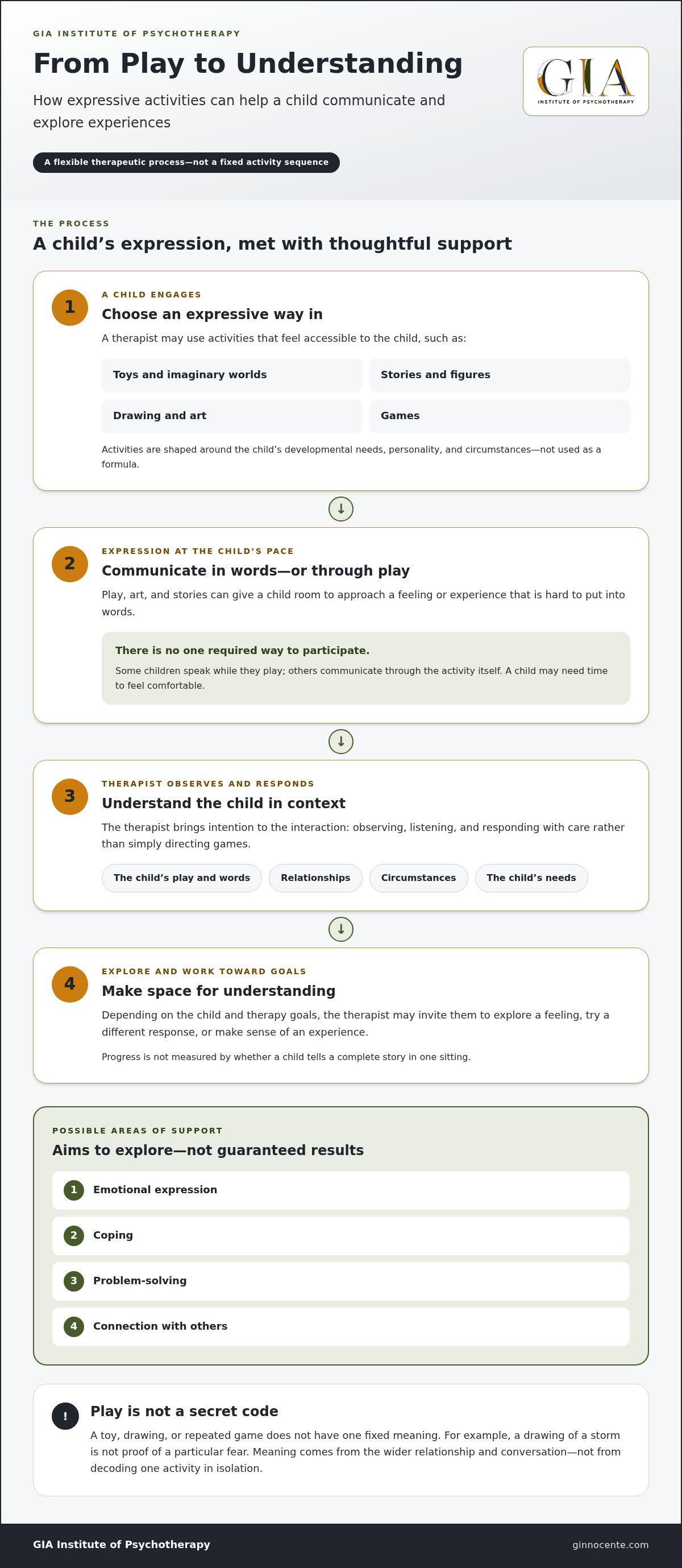
Play therapy is a therapeutic approach in which play and creative expression can help a child communicate, explore experiences, and work toward goals. Rather than relying only on direct questions, a therapist may use toys, stories, games, or art to meet a child in a way that feels more accessible. The activities aren’t a formula. The therapist considers the child’s developmental needs, personality, and circumstances when shaping the work.
Therapeutic play is purposeful support, not simply unstructured playtime. Its purpose is to create opportunities for expression and understanding within a therapeutic relationship. Depending on the child and the goals of therapy, the work may support emotional expression, coping, problem-solving, or connection with others. These are aims to explore, not guaranteed results or a promise that one activity will resolve a difficulty.
What happens through play, art, and other expressive activities?
A child might create a story with figures, draw a scene, play a game, or build an imaginary world with toys. These activities can offer ways to approach a feeling or experience that’s hard to put into words. The benefits of play therapy include giving children a developmentally accessible way to express themselves, while keeping the therapist’s attention on the child’s needs and context.
The meaning comes from the wider conversation and relationship, not from a parent trying to decode each choice. A drawing of a storm, for example, isn’t proof of a particular fear. A therapist may stay curious, notice how the child engages, and respond in a way that invites exploration without assuming what the activity means. Some children speak while they play; others communicate through the activity itself.
How does a therapist create a therapeutic process?
The therapist brings intention to the interaction. They observe, listen, and respond to the child rather than simply setting out toys or directing a sequence of games. The therapist may encourage a child to explore a feeling, try out a different response, or make sense of an experience. The exact approach can vary, and a child doesn’t have to participate in one specific way for the therapist to learn about their needs.
A supportive relationship develops through respectful, responsive interactions, though a child may need time to feel comfortable. Therapy can have goals while still allowing the child to engage at their own pace. Progress isn’t measured by whether a child tells a complete story in one sitting. The therapist considers patterns over time and the family context, not one isolated drawing, toy, or play action.
For families considering play therapy for children Margate NJ, this balance matters: the child has room to lead, while the therapist keeps the work connected to meaningful goals. GIA Institute of Psychotherapy includes Play Therapy and Expressive Arts among its approaches to child and teen therapy. Parents can explore how these approaches fit within child and teen therapy as part of broader support for children and families.
Play therapy concerns and misconceptions: what parents in Margate should know
It’s understandable to wonder whether a child is receiving therapy if they’re playing instead of answering questions. The difference lies in the purpose and relationship around the activity. In therapy, play may be part of a considered process shaped by the child’s needs, rather than recreation alone. That doesn’t mean every game has a hidden message or that a therapist can promise a particular result. It means play can offer another way for a child to engage with support.
Is play therapy just playtime?
Free play is usually for enjoyment, exploration, or passing time. In therapeutic work, play may be used intentionally to support a child’s communication and work toward goals. The therapist pays attention to how the child engages and responds thoughtfully, while allowing room for the child’s pace and choices. An activity can be enjoyable and still have a therapeutic purpose, but one toy or action doesn’t have one certain meaning.
This comparison can help clarify the distinction for families in Margate:
Ordinary play: The child chooses an activity primarily for recreation, without a therapy goal guiding the interaction.
Play as communication: A child may use play or creative expression to show an interest, feeling, or experience, though adults shouldn’t assume they know exactly what it means.
Therapist-guided therapeutic work: A therapist brings purpose to the interaction, considers the child’s individual context, and responds in ways that support the therapeutic goals.
These categories can overlap. A child may enjoy an activity that also helps them connect or express themselves. What makes therapy distinct is the therapist’s intentional role, not whether the activity looks serious from the outside.
Does a child need to explain everything in words?
No. A child doesn’t have to describe every feeling or experience for therapy to be meaningful. Some children may talk during an activity; others may communicate through choices, creative expression, or how they engage with the therapist. These are possible forms of communication, not guaranteed access to feelings a child hasn’t shared.
Parents can help by resisting the urge to ask for a full report after every session or to press a child to explain a drawing or game. A gentle invitation, such as “Would you like to tell me about anything from today?” leaves room for an answer, a few words, or no conversation at all. The therapist can help parents understand how to support the child without turning home into an interview.
Children differ in how they participate and how quickly they feel ready to engage. A quiet session or a child who prefers one activity doesn’t, on its own, tell you whether therapy is working. Play therapy for children Margate NJ is best approached with patience and realistic expectations: the process is built around understanding the child, not requiring them to perform, disclose, or change on demand.
How Margate parents can support a child before and during therapy
Your steady presence can help a child approach therapy with less pressure. For families in Margate, preparation doesn’t mean rehearsing what a child should say or asking them to report every detail afterward. It means offering simple reassurance, staying curious about their experience, and letting the therapist guide how caregiver involvement fits the child’s needs.
Try this simple sequence as you prepare:
- Notice patterns. Keep track of changes you’ve observed, when they tend to happen, and what seems to help. Share what you’ve noticed without treating your notes as a diagnosis.
- Speak gently. Choose a calm moment and use a warm, matter-of-fact tone. Let your child know you’re available to listen, without requiring them to talk before they’re ready.
- Explain therapy simply. Describe it as a place where a child can get support with feelings, challenges, or things that have been on their mind. Avoid presenting it as a consequence for misbehavior.
- Make room for questions. Your child may wonder what therapy is like or whether they’ll have to talk. Answer honestly, and don’t promise exactly what will happen in every session.
What can parents say when introducing therapy?
Try language that fits your child’s age and situation: “You haven’t done anything wrong. We’re finding someone who can help you with some big feelings.” Or, “You can ask questions, and you don’t have to figure everything out today.” Avoid suggesting that your child is broken, bad, or responsible for family difficulties. Therapy is support, not punishment.
After a session, you might ask, “How are you feeling?” rather than “What did you tell the therapist?” A child can choose whether to share. Avoid making therapy feel like a test by expecting a detailed explanation or treating silence as a problem to solve.
How can caregivers support progress at home?
Children benefit from patient listening and caring responses, especially when their feelings are difficult to hear. You can acknowledge an emotion without rushing to correct it: “That sounds frustrating,” or “I’m here with you.” Caregiver involvement can also help the therapist understand a child within their family context, while respecting the child’s therapeutic relationship.
Ask the therapist how your participation can best support the child’s needs and treatment goals. Depending on the child and the work, caregiver involvement may look different over time. Support doesn’t mean trying to interpret every drawing or play activity at home. Instead, share relevant observations and let the therapist help connect them to the broader picture.
If you’re considering play therapy for children Margate NJ, GIA Institute of Psychotherapy offers child and teen therapy that includes Play Therapy and expressive approaches. Explore GIA’s child and teen therapy to learn about support for children and families.
Finding play therapy for children in Margate, NJ with GIA
For parents considering play-based support, a local connection can make the next step feel more approachable. GIA Institute of Psychotherapy provides Individual Therapy for Children and Teens, including Play Therapy, and serves families in Margate and nearby communities. Families searching for play therapy for children Margate NJ can explore this approach as part of broader psychotherapy and counseling support, rather than viewing play as a stand-alone activity or a label for a child.
What kind of support does GIA provide for children?
GIA’s work with children and teens includes traditional therapy, practical strategies, and expressive approaches. Play Therapy and Expressive Arts are among the modalities used to support children’s communication and engagement. These approaches can offer different ways for a child to participate, while the therapist remains attentive to the child’s needs and circumstances. The specific approach is not a preset formula; it belongs within the broader therapeutic work.
Care also recognizes that a child is part of a family, not separate from the relationships and routines around them. A collaborative approach can help parents share what they’ve noticed and better understand how to support their child, while keeping the child’s own experience in view. The aim is to consider the family context with care, not to assign blame or assume that one person is responsible for a challenge.
For some children, expressive activities may make it easier to engage with therapy. For others, a different approach may feel more suitable. Play Therapy is one option within GIA’s wider support for children and families, alongside individual child and teen therapy and family therapy. This gives parents room to learn about the approaches without expecting every child to respond in the same way.
What is a gentle next step for a Margate family?
Before taking action, it can help to name what you’re noticing and what you hope your child might have support with. Perhaps you’d like them to have a way to express feelings, manage a change, or feel more understood in a relationship. These reflections don’t need to become a diagnosis or a fixed plan. They’re a starting point for a thoughtful conversation about what support could fit your family.
Learning about GIA’s child and family therapy services can be a low-pressure first step for families in Margate and nearby communities, including Linwood, Ventnor, Ocean City, Egg Harbor Township, Upper Township, and Galloway. You can explore the approaches, consider what feels relevant to your child, and move forward at a pace that feels manageable. There’s no need to have every question answered before you begin exploring.
Explore therapy for children and families with GIA
Take a thoughtful next step for your child
You don’t need to have a perfect explanation for what your child is experiencing before exploring support. A useful place to begin is with a simple question: what might help my child feel heard, understood, or more able to manage what’s happening? Let that question guide your next step, without expecting an immediate answer or putting pressure on your child to share more than they’re ready to.
Considering play therapy for children Margate NJ can be part of that reflection. You can take time to learn about the approach, talk with your child in a reassuring way, and consider what kind of support feels right for your family. Progress may look different for every child, and the first step can simply be a willingness to stay curious.
GIA Institute of Psychotherapy offers support for children and families through its broader therapy services. If you’re ready to learn more, explore therapy for children and families with GIA. Your care and attention already matter, and approaching your child with patience can help make room for a hopeful next chapter.
Frequently Asked Questions
Is play therapy effective for children?
Play therapy can be a helpful way to support a child’s emotional expression and therapeutic goals, but no approach works the same way for every child. Its value depends on the child’s needs, the relationship with the therapist, and the goals being explored. For families considering play therapy for children Margate NJ, effectiveness is best understood through ongoing conversations about how the child is engaging and what support may be useful.
What age is play therapy appropriate for?
Play therapy is commonly used with younger children, though the right approach depends on a child’s development, communication style, and needs, not age alone. Play-based or expressive activities may also be adapted for older children and teens. A child who enjoys drawing or storytelling may engage differently from one who prefers conversation. The therapist can help determine whether play therapy or another form of support fits the individual child.
Can parents be involved in a child's play therapy?
Yes, parents can be involved in ways that support the child and fit the therapeutic goals. Caregivers may share observations about changes at home, school, or in relationships, helping the therapist understand the child’s wider context. The form of involvement can differ from family to family. Parents can support the process by listening calmly and respecting the child’s space, rather than expecting a detailed account of every session.
How long does play therapy take?
There isn’t one set length of treatment for every child. The time involved can depend on the concerns bringing a family to therapy, the child’s needs, and how the goals develop. Parents can talk with the therapist about how progress will be understood and when it may be useful to revisit goals. Changes may be gradual, so it’s helpful to focus on patterns over time rather than expecting a quick shift.
What should I tell my child before their first play therapy session?
Keep the explanation simple and reassuring: “You’ll meet someone whose job is to help kids with things that feel hard.” Let your child know they can ask questions, and avoid promising exactly what the session will involve. If they worry they’re in trouble, make clear that therapy isn’t a punishment. A calm explanation gives them room to feel curious, uncertain, or quiet without needing to perform.
Can play therapy help a child who has trouble talking about feelings?
It may offer another way for a child to engage when direct conversation feels difficult. For example, a child might find it easier to choose a story, draw, or play while beginning to explore an experience. These activities don’t automatically reveal hidden feelings, and the therapist won’t rely on one action to explain the child. The approach can be considered alongside other support based on the child’s needs and preferences.
Is play therapy the same as ordinary play?
No. Ordinary play is generally for enjoyment, while play therapy takes place within a therapeutic relationship and has a purpose connected to the child’s needs. The therapist observes and responds thoughtfully, without assuming every toy or game has a definite meaning. An activity may still feel enjoyable to the child, but it isn’t simply recreation. The therapist’s role and the therapeutic goals distinguish it from everyday play.


