

Could grief counseling help you live with a loss without being asked to move on? If grief feels isolating, unpredictable, or hard to explain, searching for grief counseling Egg Harbor Township NJ may bring up another question: Are my reactions normal, and would talking with someone really help?
Grief doesn’t follow a single timeline or look the same for everyone. You might feel sadness, anger, numbness, or moments of connection with daily life, sometimes all in the same week. Counseling isn’t about judging those reactions or rushing you toward a particular idea of healing. It offers a collaborative space to make sense of what you’re carrying and consider ways to manage everyday responsibilities while honoring your loss.
In this article, you’ll learn what grief counseling can involve, how different therapeutic approaches can support people at different ages and stages, and what you might bring to a first conversation. GIA Institute of Psychotherapy provides counseling for adults, children, teens, couples, and families in Egg Harbor Township and nearby South Jersey communities. Taking a first step can feel vulnerable, but you don’t need to have the right words ready.
Key Takeaways
- Grief can affect emotions, relationships, focus, routines, and your sense of self, and it may look different from one person to the next.
- Counseling offers a collaborative space to explore what you’re experiencing and consider practical coping strategies at your own pace.
- Support doesn’t mean forgetting someone or forcing yourself to move on; it can help you make room for grief while caring for daily needs.
- Before a first conversation, jot down what feels hardest, what kind of support you hope for, and any questions. A polished explanation isn’t necessary.
- Explore grief counseling Egg Harbor Township NJ with GIA Institute of Psychotherapy, which provides counseling for adults, children, teens, couples, and families through traditional therapy and expressive approaches.
Grief Counseling in Egg Harbor Township: Understanding Support After Loss
Grief counseling offers a supportive space to explore a loss and how it affects your life. If you’re looking for grief counseling Egg Harbor Township NJ, you may be carrying more than sadness. Grief can affect relationships, concentration, daily routines, and your sense of identity when a familiar role or hoped-for future changes. You might feel several things at once, or notice your feelings shift from one day to the next.
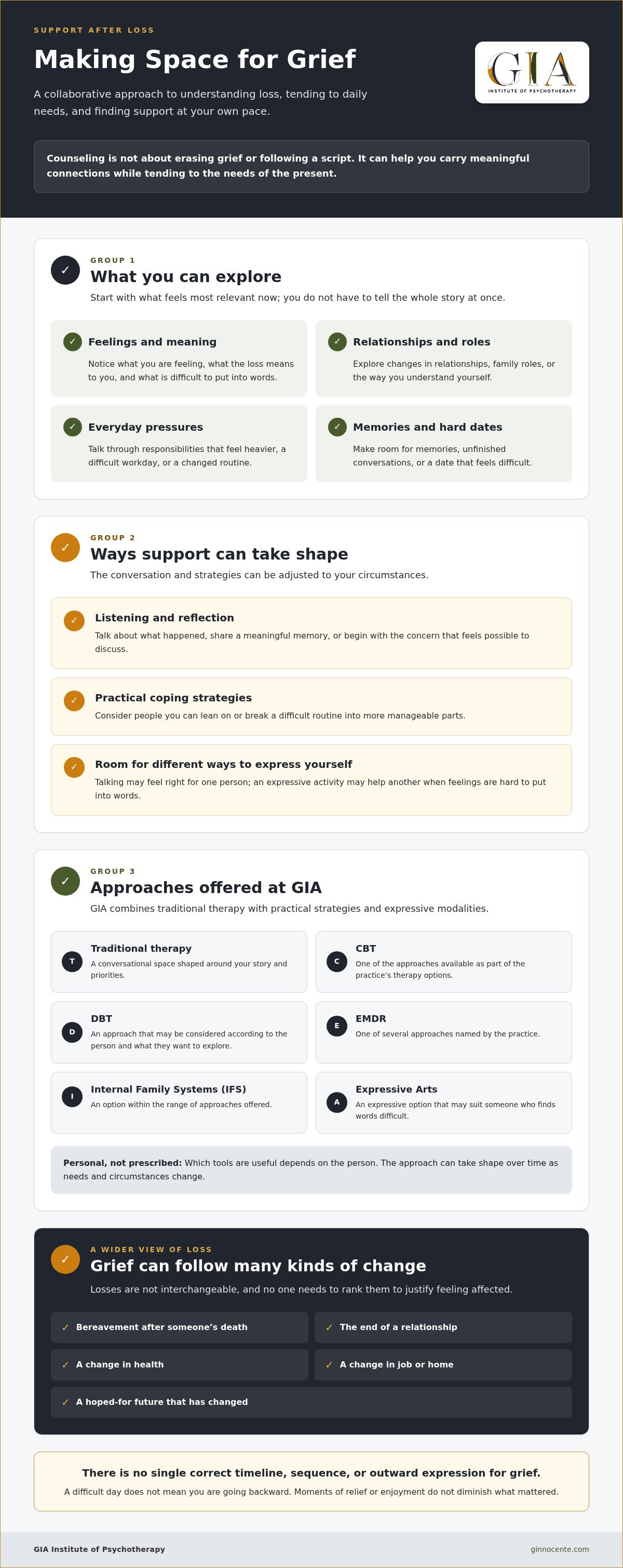
There’s no single correct timeline, sequence, or outward expression for grief. Some people want to talk; others need time before they can put the experience into words. A difficult day doesn’t mean you’re going backward, and moments of relief or enjoyment don’t diminish what mattered. Counseling isn’t about being told to forget, recover on schedule, or feel a prescribed emotion. It makes room for your experience without comparing it with anyone else’s.
For people in Egg Harbor Township, support from a local practice can make a first conversation feel more approachable. The Grief counseling overview describes support for people responding to loss. In therapy, the conversation can focus on your relationships and what feels most pressing now. The aim isn’t to erase grief, but to explore how it can exist alongside the rest of life.
What can grief counseling help with?
Grief counseling is a collaborative conversation about loss, its meaning, and its effects at a pace that feels manageable. You might talk about memories, unfinished conversations, or how responsibilities have changed. A counselor can listen and help you notice what you’re feeling and needing, without assuming there’s one right way to make sense of it.
That reflection can also help you consider coping strategies that fit your circumstances. For instance, you might identify people you can lean on or break a difficult routine into more manageable parts. Strategies are considered together, rather than handed down as a fixed formula.
Grief can follow many kinds of loss
Bereavement after someone’s death is one form of grief, but people may also grieve the end of a relationship, a change in health, a job or home, or a hoped-for future. These experiences aren’t interchangeable, and no one needs to rank them to justify feeling affected. Each loss has its own history and meaning.
If the distress feels difficult to carry alone, you don’t have to wait until you can explain it neatly to seek support. GIA Institute of Psychotherapy provides individual therapy for adults, children, and teens in Egg Harbor Township, with family therapy for loved ones who want space to understand one another’s experiences. Starting with what feels hardest today is enough.
How Grief Counseling Can Help You Make Space for Loss
Grief can change over time, and the support you need may change with it. Counseling is shaped by your story, priorities, and pace, rather than by a script you’re expected to follow. You might begin by talking about what happened, or start with a practical concern, such as getting through a difficult workday or figuring out how to respond to family members. You can begin wherever it feels possible.
Listening and reflection can help you notice connections between your emotions, relationships, and everyday challenges. A counselor might invite you to consider what feels especially hard right now, what has helped before, and what kind of support would feel useful. Practical coping strategies can emerge from that conversation. They can be adjusted to your circumstances, rather than treated as a checklist everyone must complete.
Grief counseling can support adaptation to life after loss without asking you to erase the love, memories, or meaning the loss holds. Making space for grief doesn’t mean letting go of someone or something important. It can mean finding ways to carry those connections while tending to the needs of the present.
What may happen during grief counseling?
You can share what feels most important, including thoughts that are difficult to explain or don’t yet have clear words. A clinician may help you explore feelings, changes in relationships, and practical pressures, such as responsibilities that now feel heavier. You don’t have to tell the whole story at once. The focus can shift as your circumstances and needs change.
For example, a conversation might begin with a meaningful memory and then turn to how a changed family role is affecting your week. Later, you may want to revisit a difficult date or consider a strategy for handling a particular routine. Your goals can evolve; what matters is that the work reflects what feels relevant to you.
Finding an approach that feels personal
There isn’t one method that fits every person or every kind of loss. GIA Institute of Psychotherapy combines traditional therapy with practical strategies and expressive modalities, alongside approaches such as CBT, DBT, EMDR, and Internal Family Systems (IFS). The practice also offers Expressive Arts. Which tools are useful depends on the person and what they want to explore.
Choosing an approach can be collaborative. Talking may feel right for one person, while another may find an expressive activity helpful when feelings are hard to put into words. Neither response is more valid. The approach can take shape over time instead of being prescribed in advance.
Support can reflect who is affected by the loss. Adults, children, and teens can use individual therapy to explore their experiences in ways suited to their needs. Family therapy creates room to understand different reactions within a household. If you’re seeking grief counseling Egg Harbor Township NJ, GIA serves Egg Harbor Township and nearby South Jersey communities, including Ocean City, Linwood, Margate, Ventnor, Upper Township, and Galloway. Explore individual and family counseling to consider what kind of support fits your situation.
Will Grief Counseling Make You Move On? What Support Does and Does Not Mean
No. Grief counseling shouldn’t require you to forget someone, stop loving them, or follow a schedule for feeling better. Support can help you understand what the loss means in your life now, while leaving room for memories and continuing bonds. It can’t promise to eliminate sadness or produce a predictable recovery. Grief may change, but that doesn’t mean it has to disappear.
There may be stretches when daily life feels steadier, followed by a hard day prompted by a song, an anniversary, a family gathering, or a change the person you lost would have shared. That return of pain doesn’t automatically mean you’ve lost progress. Counseling can offer space to explore what a reminder brings up and consider how you want to care for yourself through it, without judging the feeling or treating it as a setback.
Some people prefer to carry grief privately, draw on family, friends, faith, or personal rituals, and seek counseling only if their needs shift. Others find it helpful to talk with a therapist as they make sense of the loss. Neither choice is a measure of strength or love. Support is an option, not a test you must pass, and you don’t have to prove that your grief is severe enough to deserve attention.
Does grief follow predictable stages?
Popular descriptions of grief stages can offer language for experiences like anger or sadness, but they aren’t a required sequence or a universal measure of progress. Feelings may overlap, change, or return in different circumstances. You might feel relief alongside sorrow, or find that a new responsibility brings the loss into focus again. A short description can’t determine what your grief means or what support you need.
When might extra support feel helpful?
Consider counseling if grief feels difficult to carry alone, you’re increasingly isolated, or everyday responsibilities have become hard to manage. You don’t need to wait for a particular amount of time to pass or reach a crisis point. A conversation can help you describe what’s weighing on you and explore whether support fits your needs. Seeking help is a choice, not a judgment about how well you’re coping.
Grief counseling is different from emergency care. If you or someone else is in immediate danger, call 911. If you’re thinking about suicide or need urgent emotional crisis support, call or text 988 to reach the 988 Suicide & Crisis Lifeline. These resources address urgent safety needs; ongoing counseling can provide a separate space to work through grief.
If you’re considering grief counseling Egg Harbor Township NJ, you can begin by naming what feels hardest right now, even if the answer is simply, “I’m not sure.” The first conversation doesn’t need to settle what grief should look like. It can be a place to talk through what you’re experiencing and consider, at your own pace, what kind of support may help.
Preparing for Grief Counseling in Egg Harbor Township, NJ
Getting ready for counseling doesn’t mean finding the perfect words for your loss. You can arrive unsure, emotional, quiet, or uncertain about what you hope to get from the conversation. A few simple notes may help you begin, but they’re optional. Share only what feels manageable and let the discussion unfold at a pace that feels respectful to you.
What to bring into a first conversation
If it feels useful, take a moment before the conversation to jot down a few thoughts. You might consider:
- What feels hardest right now, including a feeling or concern that keeps returning.
- Which relationships, routines, or responsibilities have been affected by the loss.
- What kind of support you’re hoping for, even if the hope is simply to feel heard.
- Any questions about counseling or anything that would help you feel more comfortable speaking openly.
These notes aren’t a script or a complete account of what happened. They’re there in case it’s difficult to remember what you wanted to say in the moment. You can mention that a subject feels painful, ask to pause, or choose to return to it later. Not knowing where to begin is a valid place to begin.
You may find it helpful to think beyond the loss itself. Has a role in your family changed? Are ordinary tasks taking more energy? Does a particular time of day or responsibility feel different now? You don’t need to prepare a full explanation. A small, honest starting point can show the counselor what matters most to you today.
How to notice whether the process feels supportive
As counseling unfolds, notice whether you feel listened to, respected, and able to speak honestly, including when you’re unsure or disagree. Support should make room for your perspective rather than pressure you to share more than you’re ready to share. You can offer feedback about what feels helpful, what doesn’t, or what you’d like to focus on next. That feedback helps shape a collaborative process that can adjust as your needs change.
For children and teens, preparation may look different from an adult’s. A young person might find it easier to talk about a specific change in routine or use age-appropriate ways to express what’s difficult. A parent or caregiver can share observations while still making room for the child’s own experience. Family therapy can also help loved ones talk about how grief is affecting the household, without assuming everyone feels the same way.
GIA Institute of Psychotherapy serves Egg Harbor Township and nearby South Jersey communities, including Ocean City, Linwood, Margate, Ventnor, Upper Township, and Galloway. The practice provides counseling for adults, children, teens, couples, and families. If you’re considering grief counseling Egg Harbor Township NJ, explore counseling at GIA Institute of Psychotherapy and reflect on what kind of support may feel right for you.
Finding Grief Counseling in Egg Harbor Township with GIA Institute
Choosing support after a loss can feel like a significant decision, especially if you’re unsure what counseling will involve. GIA Institute of Psychotherapy is a local practice serving Egg Harbor Township and nearby South Jersey communities. Its warm, collaborative approach creates space to explore what the loss means to you rather than applying a single script for grief.
A compassionate, individualized counseling relationship
Each person brings a different history, set of relationships, and way of expressing grief. A counseling conversation can begin with what feels most pressing, then develop around your needs and priorities. You might want to talk through memories, understand changes in a relationship, or find practical ways to manage a difficult part of daily life. You can help shape the focus as your concerns shift.
GIA Institute of Psychotherapy brings together traditional therapy, practical strategies, and expressive modalities. Its approaches include CBT, DBT, EMDR, Internal Family Systems (IFS), and Emotionally Focused Therapy (EFT) for couples, alongside Play Therapy and Expressive Arts. These are approaches used within the practice’s counseling work, not a prescribed formula or a guarantee of a particular result. The process is guided by your circumstances and the conversation between you and your therapist.
Support can reflect who is seeking help. Adults may benefit from individual psychotherapy, while children and teens may need age-appropriate ways to communicate what’s changed. When a loss affects a household, family therapy can make room for different experiences and help loved ones understand one another. Couples can also talk about how grief is affecting their relationship. There’s no expectation that everyone in a family will feel or respond in the same way.
A gentle next step for local readers
Reaching out doesn’t mean you’re ready to resolve everything, and it doesn’t mean grief has to be absent before counseling can begin. It can simply start a conversation about what you’re carrying and what support might feel useful. You can share a little at a time, ask questions, and take space to consider what feels right.
For people seeking grief counseling Egg Harbor Township NJ, GIA Institute of Psychotherapy provides counseling for adults, children, teens, couples, and families in Egg Harbor Township and nearby communities, including Ocean City, Linwood, Margate, Ventnor, Upper Township, and Galloway. If learning more feels like a manageable next step, take a first step toward counseling at your own pace.
Let Your Next Step Be Small and Yours
You don’t have to know what healing should look like before you seek support. Perhaps your next step is noticing what you wish someone understood, or deciding you’d like a place to speak without having to make your experience sound clear or complete. That intention is enough to begin exploring grief counseling Egg Harbor Township NJ.
It’s okay to move thoughtfully. You can take time to learn about a counseling practice, consider what would help you feel comfortable, and reach out when you’re ready. Asking for support doesn’t lessen your connection to the person or life you’ve lost. It can be one way to care for yourself as you find your footing in what comes next.
If you’d like to explore whether counseling feels like a helpful next step, explore counseling with GIA Institute of Psychotherapy. Contact GIA Institute of Psychotherapy to take that first step. You deserve space to approach grief in your own way, one gentle step at a time.
Frequently Asked Questions
Is grief counseling only for people who have lost someone to death?
No. Bereavement is a common reason to seek support, but grief can also follow a relationship ending, a major health change, or another deeply felt loss. If you’re looking for grief counseling Egg Harbor Township NJ, you don’t need to compare your experience with anyone else’s or prove it is serious enough. A counselor can help you explore what the change means to you and what feels difficult now.
Can grief counseling help if the loss happened a long time ago?
Yes. People may seek support months or years after a loss, including when a new life change brings old feelings into focus. For example, becoming a parent, moving, or facing a milestone can make someone wish the person they lost were there. The time that has passed doesn’t invalidate what you’re feeling. Counseling can focus on what’s happening in your life now, without requiring you to reach a particular kind of closure.
How long does grief counseling take?
There isn’t one timeline that applies to everyone. The length of counseling can depend on your needs, circumstances, and goals, which may change over time. Someone might want help thinking through a specific challenge, such as returning to a meaningful place, while another person may want ongoing space to reflect. You can talk with your clinician about what you hope to focus on and revisit those goals as your situation evolves.
Can children and teens receive support for grief?
Yes. Children and teens can experience grief in ways shaped by their age, relationships, and understanding of what happened. GIA Institute provides counseling for children and teens, and support may help a young person express feelings or help caregivers respond with care. Families in Egg Harbor Township, Ocean City, Linwood, Margate, Ventnor, Upper Township, and Galloway can access the practice’s local counseling services.
What if I do not know what to say in grief counseling?
That’s okay. You could begin with a simple sentence such as, “Something has felt different lately,” or describe a moment that caught you off guard. You don’t have to explain the whole loss or make your thoughts sound organized. If speaking feels difficult, you can say so. Writing a few words in your phone before the conversation is one option, but you can also start without notes.
Is grief counseling covered by health insurance?
Coverage depends on your specific plan, benefits, and provider arrangements, so there isn’t a universal answer. Before beginning care, review your behavioral health benefits and any plan requirements. You can ask your insurer whether psychotherapy is covered, which clinicians are in network, whether a referral is needed, and what costs may apply to you. Don’t assume grief-related care is automatically covered or excluded.
What should I do if grief makes it hard to function or I feel unsafe?
If grief is making daily responsibilities difficult, speaking with a mental health professional may help you consider what support could be useful. If you may harm yourself or someone else, or face immediate danger, call 911. In the United States, call or text 988 for crisis support. These resources are for urgent safety needs. For ongoing grief, a counseling conversation can focus on your needs and what feels manageable.


