
What if the same argument isn’t the whole problem, but part of a cycle you and your partner keep getting pulled into? When disagreements return without resolution, or one of you feels unheard or emotionally distant, it can be hard to know where to begin. Marriage counseling Upper Township NJ can offer a space to understand what’s happening between you, without turning the conversation into a search for someone to blame.
It’s understandable to wonder whether counseling can help, or whether both partners need to feel completely ready before taking a first step. Couples work can begin with curiosity about your relationship patterns and what each of you needs to feel heard. At GIA Institute of Psychotherapy, couples counseling includes Emotionally Focused Therapy, an approach that helps partners explore the emotional patterns beneath conflict.
This article will help you recognize when counseling may fit your needs, understand what couples work can involve, and consider a local option for Upper Township and nearby South Jersey communities. A healthier way forward doesn’t require having every answer today. It can begin with a willingness to understand the cycle together.
Key Takeaways
- Recurring conflict, growing distance, or trouble reconnecting after disagreements can be reasons to explore support, not signs that a couple has failed.
- Couples counseling offers a guided space to understand relationship patterns. GIA Institute of Psychotherapy includes Emotionally Focused Therapy among its approaches.
- Counseling can focus on the dynamic between partners rather than assigning blame. Premarital counseling may address different relationship questions.
- Before starting, name a shared concern, clarify what you hope to understand, and bring a specific example instead of building a case against each other.
- Explore how marriage counseling Upper Township NJ can help you consider a manageable next step with GIA Institute of Psychotherapy.
When can marriage counseling help couples in Upper Township, NJ?
Seeking support doesn’t mean a couple has failed, and there’s no requirement to be in crisis before talking with a counselor. Partners may simply notice that their usual ways of handling tension aren’t helping them feel close or understood. Marriage counseling Upper Township NJ offers a collaborative setting to slow down and explore what’s happening between partners, rather than deciding that one person is the problem.
There isn’t a short checklist that can determine whether counseling is right for a particular marriage. The same disagreement can reflect different needs, expectations, or ways of expressing hurt. A therapist can help partners discuss their concerns and examine how they interact, without diagnosing either person based on a few experiences. That conversation can help clarify what each person wants to work on and whether working together feels useful now.
Couples therapy is a broad form of guided support for relationship concerns, with approaches that vary in how they help partners understand and work with their patterns. The Couples therapy overview describes a range of methods, including approaches focused on emotional connection. Exploring counseling isn’t about proving that a marriage is broken. It’s about making room for a more thoughtful conversation about what each partner is experiencing and what they want to change.
Relationship patterns that may signal a need for support
Notice what happens before, during, and after tension rises. Do conversations about responsibilities, family, or time together repeatedly end in the same stalemate? Does one partner try to explain while the other withdraws, leaving both feeling misunderstood? Pay attention to what tends to set off the disagreement, how each of you responds, and whether you find a way to reconnect afterward. Those details can help you describe the pattern more clearly.
Distance can show up quietly: less sharing, unresolved tension after an argument, or uncertainty about how to reconnect. These experiences are prompts for reflection, not proof that a marriage is beyond repair. A useful question may be, “Can we talk about this pattern together, or do we keep getting stuck in it?”
Why couples do not need to wait for a crisis
Partners can consider counseling while they’re still trying to make sense of a concern, rather than waiting for a major rupture. Support may be relevant when a recurring issue is taking up more emotional space, or when attempts to talk leave one or both partners feeling more alone. Starting earlier doesn’t promise a particular outcome. It creates an opportunity to examine the relationship with care and decide what you want to address.
Bringing up counseling can feel vulnerable, especially if one partner sees a need and the other doesn’t. Frame the idea as an invitation to understand the relationship, not an accusation or a demand to agree on everything first. Each person can have questions and mixed feelings. A counselor can help make room for those differences and keep the conversation focused on what each partner wants understood.
In brief: Consider professional support when conflict keeps repeating, distance is growing, or repairing after disagreements feels difficult. These concerns deserve curiosity, not a verdict about either partner or the future of the marriage.
How couples counseling and EFT help partners understand recurring conflict
Couples counseling is guided therapeutic work in which partners explore relationship concerns with support from a therapist. Rather than focusing only on who is right about a particular disagreement, the conversation can make room for how each person experiences the issue and how their responses affect one another. This can help couples look beyond the surface topic to the pattern they encounter when tension rises.
For couples considering marriage counseling Upper Township NJ, understanding that pattern can be a useful place to begin. GIA Institute of Psychotherapy offers couples counseling, including Emotionally Focused Therapy (EFT). EFT helps partners explore the emotions and relationship patterns connected to how they respond to one another. It isn’t a promise of a particular result. It offers a way to bring attention to what may be happening beneath repeated conflict.
Understanding the cycle beneath an argument
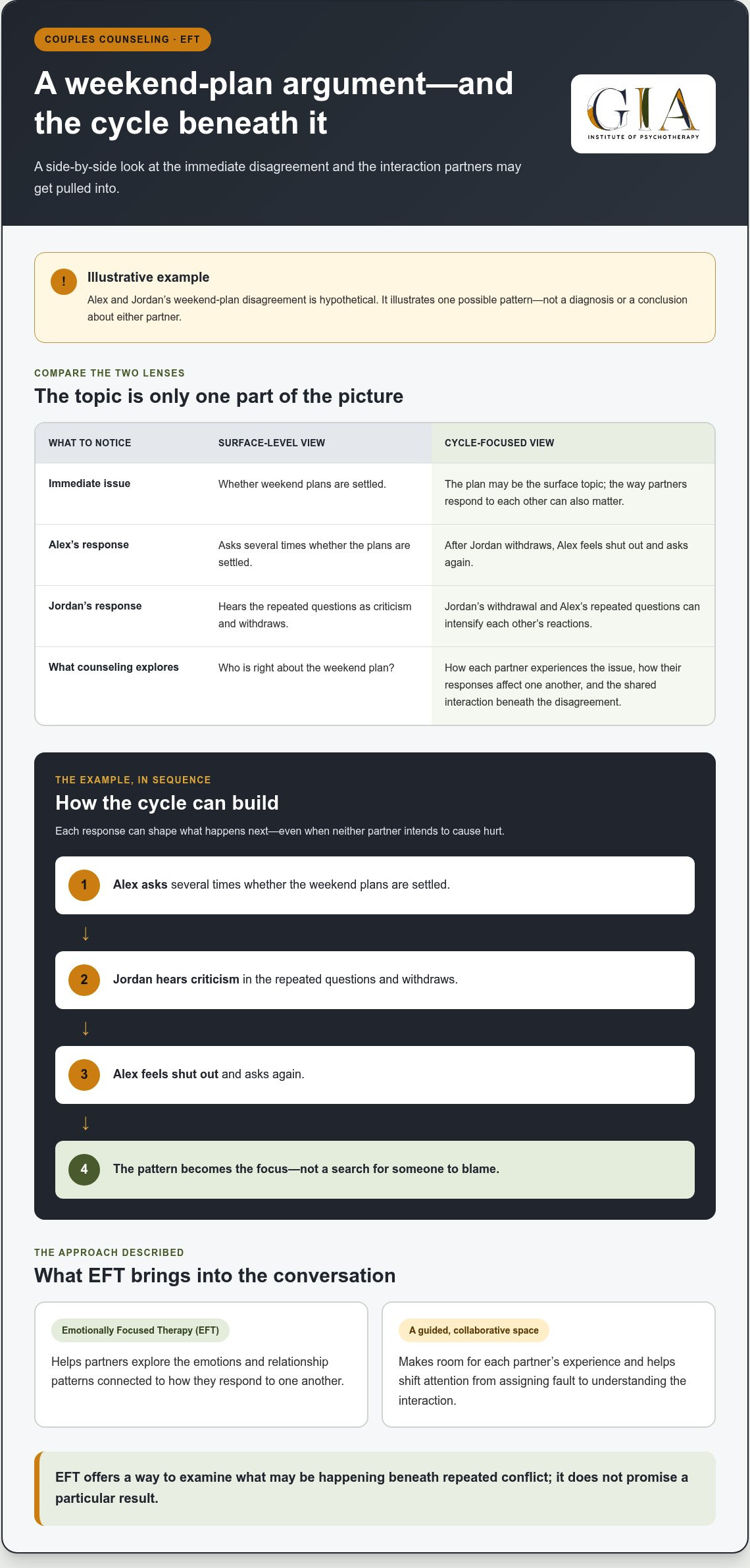
A disagreement about chores, plans, or time together may involve more than the immediate decision. One partner may push for discussion because they want reassurance that the issue matters; the other may go quiet because the conversation feels overwhelming. Each response can intensify the other’s reaction, even when neither person intends to cause hurt. A therapist can help shift attention toward this shared interaction instead of assigning fault.
Hypothetical example: Alex asks several times whether weekend plans are settled. Jordan hears the repeated questions as criticism and withdraws. Alex then feels shut out and asks again. The couple may be arguing about plans while also experiencing a cycle in which one seeks engagement and the other pulls back. Looking at both experiences helps keep the discussion curious rather than accusatory.
This doesn’t mean both partners feel the same way or have equal responsibility for every concern. It means their perspectives can be explored with care, including what each person is trying to communicate and what gets lost in the exchange. Recognizing a cycle can give couples a clearer shared description of the problem than labels like “too demanding” or “uncaring.”
What an EFT-informed couples approach can focus on
EFT can help partners explore the emotional experiences connected to moments of disconnection. What does each person feel when a conversation turns tense? What response follows, and how does that response affect the other partner? These questions can help make the interaction easier to understand without treating either person’s feelings as the whole story.
In this work, couples may examine what happens when one reaches for closeness and the other steps away, or when both partners protect themselves in different ways. The focus is on understanding the pattern and each person’s experience within it, not promising that conflict will disappear or prescribing a fixed sequence of sessions. GIA’s couples counseling provides a collaborative setting for this exploration.
If this approach feels relevant, learn about GIA’s couples counseling, which serves partners in Upper Township and nearby South Jersey communities. Considering the approach can help you identify what you’d want a therapist to understand about your relationship and the moments when connection feels difficult.
Marriage counseling concerns: blame, readiness, and whether both partners must agree
Considering marriage counseling Upper Township NJ can bring up questions before a couple even begins: Will the therapist take sides? What if one partner is more willing than the other? These concerns are understandable. Counseling is not a courtroom where someone has to prove their version of events. It offers a structured setting to explore how each partner experiences the relationship and what happens between them during difficult moments.
Will counseling take sides or decide who is right?
Partners can remember or interpret the same disagreement differently. One may feel they were trying to solve a problem; the other may have experienced the conversation as criticism. Exploring both perspectives doesn’t require pretending every action has the same impact. It allows the conversation to include each person’s experience and the interaction itself, rather than reducing the issue to a winner and a loser.
A counselor’s role is to support exploration, not to promise that every conflict will be resolved or that both partners will see events alike. If you’re worried about being blamed, say so directly and describe what would help you feel able to speak openly. Naming that fear gives the conversation a practical starting point: what you need in order to participate honestly.
What if one partner feels unsure about attending?
Readiness can differ. A hesitant partner may be worried about being criticized, unsure what sessions involve, or unconvinced that talking together will help. Those feelings don’t make that person the obstacle. Ask what each of you hopes might change and what feels uncomfortable about counseling. Listen for the concern beneath the position, without turning the discussion into pressure to agree.
One partner’s willingness to explore support doesn’t guarantee the other will change their mind. Still, a calm conversation can clarify what each person is open to and what they would want understood. If both are considering counseling, bringing those hopes and reservations into the discussion can give the work a more honest starting point.
It may also help to distinguish couples counseling from premarital counseling. The names suggest different stages, but the central question is what you want support with: concerns in an ongoing relationship, or conversations about expectations and decisions before marriage. The focus depends on the couple’s questions, not on a judgment about whether the relationship is doing well.
| Concern | A balanced perspective |
|---|---|
| “The counselor will blame me.” | Share the concern and explore each partner’s experience and the relationship dynamic. |
| “We remember the argument differently.” | Different perspectives can be discussed without deciding that one person’s experience must erase the other’s. |
| “My partner isn’t ready.” | Readiness can vary; an open conversation about hopes and concerns may clarify what each person is willing to consider. |
| “We’re not sure which kind of counseling fits.” | Start by naming the relationship questions you want to explore, whether you’re preparing for marriage or addressing concerns in an ongoing partnership. |
You don’t have to settle every question before considering support. A useful first step is naming what feels uncertain and making room for both partners to be heard.
Starting marriage counseling near Upper Township: what couples can do first
Preparing for counseling doesn’t mean arriving with a polished explanation or a plan to fix everything. A little reflection can help you begin with what matters most, especially if it’s difficult to talk about the relationship without slipping into blame. If you’re exploring marriage counseling Upper Township NJ, think of preparation as a way to make room for both partners’ experiences, not as a test you have to pass.
Preparing for an initial conversation about counseling
Before raising the idea, each partner can privately name one concern and one change they hope to explore. Then choose a calm moment to share them, describing personal experiences rather than assigning motives. For example, “I miss having time to talk” opens a different conversation than “You never make time for me.” This preparation is optional. You don’t have to resolve the issue before seeking support.
A simple sequence can make the first discussion feel more manageable:
- Name a shared concern. Find a neutral description of what feels difficult, such as “We get stuck when we discuss household responsibilities.” You don’t need to agree on every detail to identify a topic you both want to understand.
- Clarify your hopes. Each partner can say what they’d like to explore, such as listening with less defensiveness, feeling more connected, or finding a calmer way to discuss decisions. Treat these as hopes for the conversation, not promises about what must happen.
- Consider what you want understood. Use a specific moment as an example: what was happening, how you felt, and what you needed. Avoid assembling a list of your partner’s mistakes. One clear example often gives more to work with than a case built to prove who is right.
Questions couples may want to reflect on together
Open-ended questions can help you approach counseling with curiosity rather than pressure. You might ask: What feels hardest between us right now? What happens just before we lose the ability to hear each other? What would a more constructive interaction look or feel like? What do I hope my partner understands about my experience? There are no right answers, and the questions aren’t a measure of commitment.
You can also bring uncertainty directly into counseling. Perhaps you’re unsure what to focus on, or you have different ideas about what improvement would mean. Those differences are part of the conversation, not evidence that you should have everything figured out first. A practical starting point is agreeing to describe one recent moment as honestly and specifically as you can, while leaving room for your partner’s perspective.
GIA Institute of Psychotherapy provides couples counseling, including Emotionally Focused Therapy, for people in Upper Township and nearby South Jersey communities. Its warm, collaborative approach makes space to explore concerns and consider practical strategies together. Explore GIA’s couples counseling to take a next step.
Marriage counseling for Upper Township couples with GIA Institute of Psychotherapy
For couples in Upper Township, finding a thoughtful place to talk about relationship concerns can make counseling feel more approachable. GIA Institute of Psychotherapy provides couples counseling for people in Upper Township and nearby South Jersey communities. Its warm, collaborative approach creates space for partners to explore what they’re experiencing and what they hope might change.
There’s no need to arrive with a single shared explanation of the problem. One partner may want to discuss communication, while the other is focused on feeling distant or stuck in recurring tension. Counseling can bring those concerns into the same conversation, with attention to each person’s perspective and the relationship patterns affecting them both.
A supportive, collaborative approach to relationship concerns
GIA’s couples work combines professional therapy with practical strategies. Emotionally Focused Therapy (EFT) is one of the approaches offered. It provides a way to explore emotional experiences and patterns that emerge when partners feel disconnected, without promising a particular outcome. The work can stay connected to the couple’s concerns and goals rather than following a one-size-fits-all script.
For example, partners might want to understand why discussions about everyday decisions become tense, or how they can express needs in a way that invites conversation. Practical strategies can support this reflection, while the therapeutic conversation allows each partner to describe what the situation means to them. The focus is on understanding and exploring possible change together, not assigning blame.
Couples may also have different hopes for counseling. One might want to feel closer, while the other hopes to communicate more constructively. Naming those differences can clarify what each person wants the process to make room for. A collaborative setting gives partners an opportunity to bring those aims into the conversation, even if they haven’t settled on a shared goal yet.
Taking the next step from Upper Township
Starting can be simple: learn about the practice and its couples counseling, then consider what you’d like support to help you explore. You don’t need to prepare a complete account of the relationship or decide in advance how every concern should be addressed. A question, a recurring situation, or a hope for a more connected way of relating can be a meaningful place to begin.
If you’re considering marriage counseling Upper Township NJ, GIA Institute of Psychotherapy offers couples counseling for partners seeking a warm, professional space to work through relationship concerns. Learning about the approach can help you decide whether it aligns with what you and your partner want to explore.
Ready to take a manageable next step? Connect with GIA about couples counseling and learn how the practice can support your relationship goals.
Make room for a different kind of conversation
A next step doesn’t have to settle the future of your relationship. It can create room to listen with more care, name what matters, and approach a difficult conversation with curiosity instead of a verdict. If you and your partner aren’t in the same place yet, that difference can be part of what you’re trying to understand, not a reason to dismiss the possibility of support.
As you consider marriage counseling Upper Township NJ, ask yourselves what you’d like to make more possible between you: greater honesty, more patience, or a renewed sense of being on the same side. You don’t need a perfect answer. A sincere question can be a beginning.
If you’re ready to explore guided support, explore couples counseling with GIA Institute of Psychotherapy. Take a thoughtful step toward understanding by bringing the concerns and hopes you and your partner want to discuss.
Frequently Asked Questions
Can marriage counseling help if we are not on the verge of divorce?
Yes, couples can seek counseling while they’re still deciding what concerns they want to address. A change in work, parenting responsibilities, or plans for the future can bring differences into focus even when neither partner is considering divorce. You might use the opportunity to talk through a decision that keeps resurfacing and understand what matters to each of you. Support doesn’t require a relationship to be at a breaking point.
What happens in marriage counseling?
Marriage counseling gives partners a supported setting to discuss relationship concerns and consider how they want to approach them. A conversation may include each person’s view of a challenge, what they hope will be different, and practical strategies to try between discussions. You can bring a specific question, such as how to make a decision together when your priorities differ. There’s no need to arrive with a complete account of the relationship.
Do both partners have to attend couples counseling?
Couples counseling is generally centered on both partners participating in the work, but that doesn’t mean both must feel equally certain about counseling or agree about every issue. Partners may enter with different concerns and still discuss what they each want help understanding. If one person is hesitant, start by naming that uncertainty and what would make a conversation feel more manageable, rather than treating agreement as a test of commitment.
Is marriage counseling the same as couples counseling?
The terms are often used similarly, though “marriage counseling” specifically refers to support for married partners, while “couples counseling” can describe work with partners whether or not they’re married. The most useful distinction is often the question you want to bring, such as navigating a change in the marriage or discussing shared expectations. Describing your relationship and concern in everyday language can help clarify the focus you’re looking for.
How does Emotionally Focused Therapy help couples?
Emotionally Focused Therapy, or EFT, offers a way to explore the feelings and relationship responses that arise when partners feel disconnected. A couple might reflect on what each person experiences during a difficult exchange and what they hope the other will understand. EFT doesn’t guarantee a particular outcome. GIA Institute of Psychotherapy offers EFT in its couples counseling, so partners can explore concerns with professional support.
Can couples counseling help if one partner is reluctant?
It may still be possible to have a useful conversation about counseling, even if one partner isn’t ready to attend. Ask what feels concerning, then share why you’re considering support without demanding an immediate yes. For instance, you might say, “I’d like us to find a better way to talk about this, and I want to understand your reservations.” That conversation can clarify each person’s hopes without guaranteeing a change of mind.
Where can couples in Upper Township, NJ, find marriage counseling?
GIA Institute of Psychotherapy provides couples counseling for people in Upper Township and nearby South Jersey communities, including Ocean City, Linwood, Margate, Ventnor, Egg Harbor Township, and Galloway. The practice offers Emotionally Focused Therapy as one couples approach. If you’re looking for marriage counseling Upper Township NJ, explore GIA’s couples counseling and its collaborative approach to relationship concerns.


