
Did you know that during moments of high stress or trauma, the brain's speech center often shuts down, leaving us in a state of speechless terror? It's a biological reality that explains why you might feel like talk therapy only scratches the surface of your deepest struggles. You've likely spent hours trying to find the right words, only to find that your most complex emotions remain locked away, leaving you feeling burnt out by traditional clinical settings.
We understand that healing isn't always a linear conversation. Through expressive arts therapy NJ, we invite you into a restorative space where creativity and neuroscience meet to bridge the gap between what you feel and what you can say. This approach helps you release emotional tension, discover new tools for growth, and find the parts of yourself that words cannot reach. In the following sections, we'll explore how these non-verbal mediums help you feel seen and understood, offering a steady, calming presence as you navigate your journey toward internal clarity and relational health.
Key Takeaways
- Learn how expressive arts therapy NJ uses a multimodal approach to reach deep-seated emotions that traditional talk therapy might miss.
- Discover the science of "bottom-up" healing and how creative expression bypasses verbal filters to help regulate the nervous system.
- Explore how various modalities, from visual arts to movement, provide a safe way to externalize complex emotions and internal "parts."
- Understand why artistic skill is entirely irrelevant to the therapeutic process, focusing instead on the restorative power of the creative journey.
- Find a compassionate guide and a safe harbor for your transformation at GIA Institute of Psychotherapy, serving families and individuals across South Jersey.
What is Expressive Arts Therapy? Defining the Creative Path to Wellness
Think of a moment when you felt an emotion so big that words felt small. Traditional talk therapy relies on our ability to verbalize, but healing often requires a different language. expressive arts therapy is a multimodal approach that uses various creative tools to help you process what's happening inside. While traditional art therapy often focuses on a single medium like painting, expressive arts therapy NJ is interdisciplinary. It allows you to move between drawing, movement, music, or writing in a single session. This flexibility ensures that the therapy adapts to you, rather than forcing you to adapt to a specific tool.
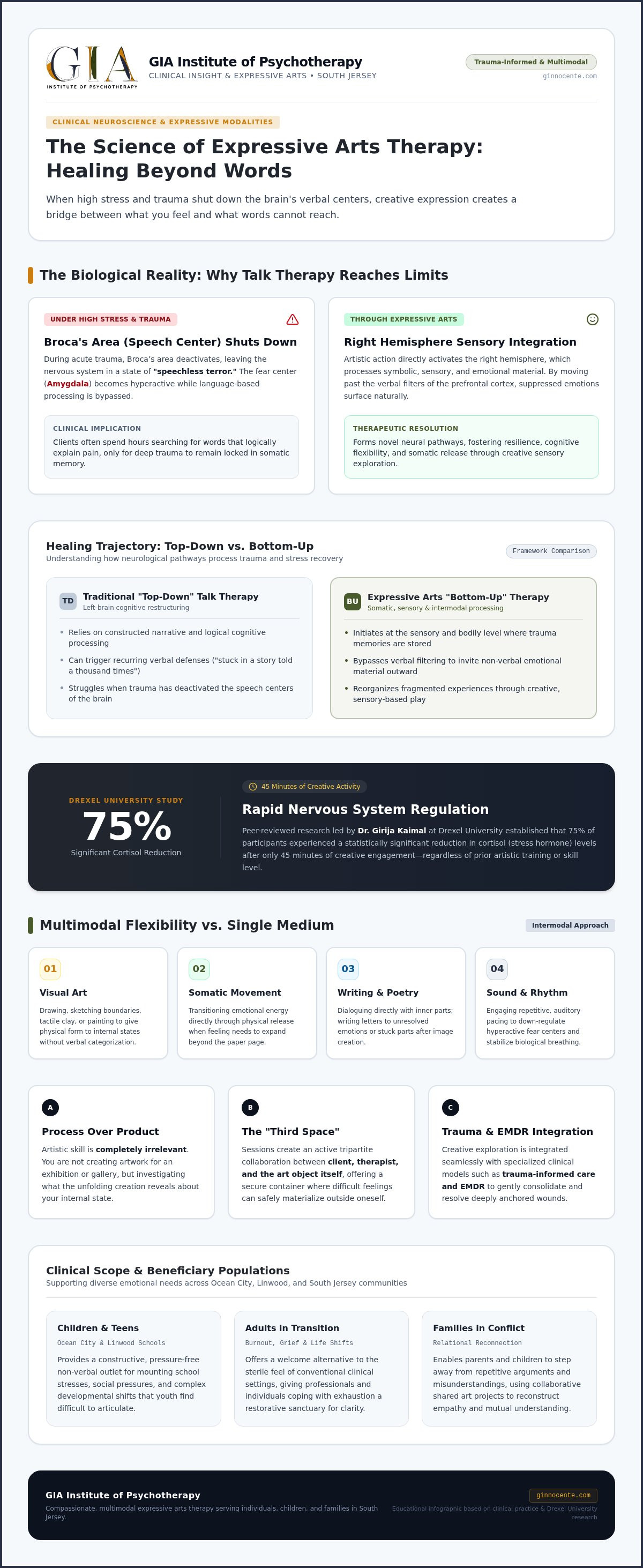
In this space, we follow a "process over product" philosophy. You aren't here to create a masterpiece for a gallery or to demonstrate technical skill. Instead, you're here to see what the act of creating reveals about your inner world. This creates a "third space," a collaborative area where you, the therapist, and the art itself work together to find clarity. It's a non-judgmental container where feelings can take shape safely, allowing for a deeper exploration of the self.
The Multimodal Nature of Expression
Sometimes a feeling starts as a color on a page but needs to become a movement in the body to be fully released. This fluidity is a core strength of expressive arts therapy NJ. You might begin by sketching a boundary and then transition into writing a letter to a part of yourself that feels stuck. This approach is incredibly effective for those navigating life transitions in South Jersey, as it offers the flexibility to meet emotions exactly where they are. By engaging multiple senses, we tap into a deeper level of self-discovery and somatic release that logic alone cannot provide.
Who Can Benefit from Expressive Arts in New Jersey?
This path is open to anyone seeking a more resonant way to heal. For children and teens in Ocean City and Linwood schools, it provides a safe outlet for pressures that are hard to name. Adults facing burnout, grief, or relationship shifts often find that these creative tools offer a restorative break from the clinical feel of traditional offices. Families also use these sessions to find new ways to connect. It helps them communicate through shared creation rather than just heated debates. Whether you're a parent or an individual seeking growth, this modality acts as a safe harbor for your transformation.
The Science of Creative Healing: How Art Rewires the Brain
Healing often begins where words fail. While traditional talk therapy works from the "top-down" by engaging the logical mind, expressive arts therapy NJ utilizes a "bottom-up" approach. This means we start with the body and the senses to reach the deeper, non-verbal parts of the brain where trauma and complex emotions are stored. When we experience intense stress, the amygdala, the brain's fear center, becomes hyperactive while the Broca’s area, responsible for speech, often deactivates. This biological reality is why you might feel unable to verbalize your pain; your brain has literally shifted away from language-based processing.
Creative play encourages the brain to form new neural pathways, fostering resilience and cognitive flexibility through the safe exploration of novel sensory experiences. By engaging in intermodal expressive arts modalities, we invite the brain to reorganize and integrate these fragmented experiences. This scientific foundation is why we integrate these creative tools with trauma-informed care and specialized models like EMDR to support your recovery.
Bypassing the Verbal Defense
Have you ever felt like you were "stuck" in a story you've told a thousand times? The left hemisphere of our brain is excellent at constructing narratives, but it can also become a defense mechanism that keeps us from feeling our true emotions. Creative expression taps into the right hemisphere, which processes symbolic, sensory, and emotional data. By using imagery or movement, we bypass the verbal filter of the prefrontal cortex. This allows suppressed insights to surface naturally, helping you bridge the gap between your internal experience and your conscious understanding.
Regulating the Nervous System
The act of making art is inherently rhythmic and grounding. Research led by Dr. Girija Kaimal at Drexel University found that 75% of participants experienced a significant reduction in cortisol levels after just 45 minutes of creative activity. Whether it's the repetitive motion of a paintbrush or the tactile sensation of clay, these actions signal safety to the autonomic nervous system. Using color and texture allows you to externalize internal chaos, turning an overwhelming feeling into something tangible you can manage. If you're ready to move beyond the limits of talk therapy, you can explore how our collaborative approach supports your unique path to regulation and peace.
Exploring the Modalities: More Than Just Painting
Does your internal world ever feel too crowded for a single medium to capture? While many people associate creative healing with a simple sketchbook, expressive arts therapy NJ offers a much wider palette of tools to help you navigate your journey. We don't limit you to one form of expression. Instead, we follow your lead as you move between different modalities to find what resonates in the moment. This interdisciplinary approach ensures that you have every possible resource to externalize what's happening within.
Visual arts like painting, sculpting, and collage serve as powerful methods of externalization, allowing you to take an abstract feeling and turn it into a tangible object. This process helps create a healthy distance between you and your challenges, making them easier to witness and understand. Current research on the healing power of art suggests that these activities do more than just relieve stress; they facilitate essential non-verbal communication that supports your overall psychological well-being.
- Movement and Dance: These practices help you access the wisdom of the body, releasing stored tension and processing emotions that live in your physical form.
- Music and Sound: Using rhythm and melody allows you to explore internal states, providing a steady cadence for emotional regulation.
- Creative Writing: Through journaling or bibliotherapy, you can begin rewriting your internal narrative and gaining agency over your story.
Play Therapy and the Inner Child
Play isn't just for children; it's a vital language for humans of all ages. In our South Jersey practice, we integrate play therapy to help both pediatric and adult clients reconnect with their most authentic selves. Sandtray therapy is a particularly effective tool here, as it creates a physical map of the psyche using small figures and symbols. This "safe play" in a therapeutic environment allows you to explore complex dynamics without the pressure of direct confrontation, fostering a sense of lightness and possibility.
Drama and Role-Play in Therapy
Have you ever wished for a "re-do" in a difficult conversation? Drama and role-play provide a safe stage to practice new communication strategies and build empathy for yourself and others. By externalizing different "parts" of the self, we can engage in creative enactment that mirrors the work done in Internal Family Systems (IFS). This modality helps you see your internal conflicts from a new perspective, transforming abstract struggles into manageable, relatable scenes that lead to real-world growth and relational health.
Is Expressive Arts Therapy Right for You? Practical Guidance
One of the most common hesitations people have is the belief that they aren't "artistic" enough for this work. It's time to set that myth aside. In expressive arts therapy NJ, your technical skill or lack thereof is completely irrelevant to the healing process. You don't need to be a painter, a dancer, or a writer to find value here. The goal isn't to create something beautiful; it's to create something honest. If you can make a mark on paper or move your hand through the air, you have all the talent required to begin.
A typical session in our South Jersey practice often begins with a gentle check-in to see where you are emotionally. From there, we move into a creative exercise that feels right for that moment. This could look like choosing colors to represent your current mood or using clay to give shape to a difficult memory. This approach beautifully complements structured modalities like CBT or DBT. While those tools help you manage thoughts and behaviors, expressive arts allows you to process the underlying emotional energy that words can't always reach.
Before you start your creative journey, ask yourself a few reflective questions:
- Do I feel like I've hit a plateau in traditional talk therapy?
- Is it hard for me to find words for my deepest feelings or complex traumas?
- Am I ready to explore my internal world through a more tactile, sensory lens?
- Do I feel burnt out by traditional clinical settings and need a more restorative approach?
The Role of the Expressive Arts Therapist
Your therapist acts as a compassionate guide and a steady presence, not an art critic. We're here to help you translate creative symbols into meaningful life insights. At GIA Institute, we follow a collaborative "Safe Harbor" approach. This ensures you feel supported as you navigate your internal narrative. We don't interpret your work for you. Instead, we help you discover what your own creations are trying to say about your path toward relational health.
Transitioning from Talk to Expression
If you're already in therapy, telling your provider you'd like to try a different approach can feel daunting. Simply share that you're looking for a more somatic or creative way to process your emotions. This modality is also incredibly effective when integrated into couples counseling for those in Ventnor or Margate. It helps partners communicate through shared imagery when verbal arguments have reached a stalemate. If you're ready to see how this can transform your path, we invite you to reach out to our team today to begin your collaborative healing journey.
Beginning Your Journey at GIA Institute in South Jersey
Finding a space where you feel truly seen is the first step toward lasting change. At GIA Institute, we've created a restorative environment that serves as a safe harbor for our neighbors in Ocean City, Linwood, and throughout South Jersey. Our practice is designed to be a warm, inviting refuge from the stressors of daily life, providing a physical space where your healing journey can finally take root. When you choose expressive arts therapy NJ at our center, you're stepping into a collaborative partnership focused on your long-term well-being and internal clarity.
Scheduling your first session is a straightforward process designed to minimize stress. You don't need to worry about bringing art supplies, special tools, or prior experience; you only need to bring yourself. We provide all the materials and guidance necessary to begin your exploration. Over time, integrating these creative practices into your mental health routine does more than just offer temporary relief. It helps you build a sustainable foundation for emotional regulation, relational health, and a deeper connection to your own agency. Is it time to move beyond the limits of language and explore what your inner world is ready to reveal?
Our Compassionate Approach to Healing
We believe that true transformation happens when high-level clinical expertise meets a gentle, human-centric touch. Our team blends specialized training in modalities like EMDR, DBT, and IFS with the intuitive power of the arts. This unique combination allows us to support families and individuals as they navigate life’s most difficult transitions. Whether you're a parent seeking advocacy for your child or an adult looking to heal old wounds, our commitment to the South Jersey community remains steady, patient, and deeply rooted in hope.
Take the First Step Toward Creative Clarity
Are you ready to discover the best parts of yourself? Reaching out to our South Jersey offices is the first act of agency in your new narrative. We understand that starting therapy can feel like a vulnerable step, but you don't have to navigate this path alone. Our collaborative approach ensures that you're supported by a wise guide every step of the way. By choosing this creative path, you're not just seeking a diagnosis; you're seeking a vision of a healthier, more vibrant future. We're here to help you find the peace and clarity you deserve, ensuring your voice is heard even when words are not enough.
Embracing a New Language for Your Healing
Healing is more than just talking through your past; it's about finding the medium that finally allows you to be heard. We've explored how the intersection of creativity and neuroscience offers a way to bypass verbal barriers and regulate the nervous system. Whether you're navigating a life transition or seeking to resolve deep-seated trauma, expressive arts therapy NJ provides a safe harbor where you can externalize your internal world. You don't have to carry your burdens alone or find the "perfect" words to start your transformation.
At GIA Institute, our team brings authentic, relatable clinical expertise to every session. By blending specialized models like EMDR, DBT, and IFS with creative modalities, we serve individuals and families across Ocean City, Linwood, and all of South Jersey. It's time to move toward a vision of health that feels as restorative as it is effective. Begin your restorative journey today; schedule a consultation with GIA Institute to discover the best parts of yourself. Your story is still being written, and we're here to help you find the colors and rhythms that bring it to life.
Frequently Asked Questions
Do I need to have artistic talent to try expressive arts therapy?
You don't need any artistic talent or prior experience to benefit from expressive arts therapy NJ. The focus is entirely on the process of creation rather than the technical quality of the final product. In our South Jersey studio, we use these tools to help you externalize internal feelings. Whether you're doodling or sculpting, the goal is discovery and emotional release, not making a masterpiece.
Is expressive arts therapy only for children, or do you treat adults in NJ too?
We provide therapeutic support for children, teens, and adults across South Jersey communities like Linwood and Margate. While many people associate creative modalities with play therapy for younger clients, adults find it equally restorative for processing burnout, grief, or relationship transitions. Creative expression offers a vital outlet for anyone who feels that traditional talk therapy only scratches the surface of their complex emotional experiences.
How is expressive arts therapy different from a regular art class?
A regular art class focuses on teaching technical skills and aesthetic outcomes, whereas expressive arts therapy is a clinical modality centered on your internal healing. In a therapeutic setting, your therapist acts as a guide to help you translate creative symbols into personal insights. We use these expressive tools to help you navigate life's transitions and find the best parts of yourself in a non-judgmental space.
Can expressive arts therapy help with anxiety and depression?
Yes, expressive arts therapy NJ is highly effective for managing anxiety and depression by providing a tactile way to regulate the nervous system. Engaging in rhythmic creative activities can lower cortisol levels and provide a sense of agency when you feel overwhelmed. By externalizing internal chaos through color or movement, you gain a new perspective on your challenges and discover practical strategies for finding clarity.
Will my insurance in New Jersey cover expressive arts therapy sessions?
Most insurance plans in New Jersey cover these sessions when they're billed as standard outpatient psychotherapy by a licensed clinician. At GIA Institute, our therapists use expressive arts as a specialized tool within evidence-based treatments like CBT or DBT. We recommend checking with your provider to confirm your specific benefits for mental health services in the Ocean City or Egg Harbor Township areas.
How long does it take to see results with this type of therapy?
Every healing journey is unique, but many clients experience a sense of emotional release after just one session. Research suggests that as little as 45 minutes of creative activity can significantly reduce stress hormones in the body. For long-term growth and the rewriting of your internal narrative, consistent weekly sessions allow you to integrate these creative insights into your daily life and relational health.
Is expressive arts therapy effective for trauma and PTSD?
It's particularly effective for trauma because it bypasses the brain's speech centers, which often shut down during traumatic recall. By using non-verbal sensory modalities, we can safely process "speechless terror" without causing re-traumatization. We often blend these expressive tools with EMDR and Internal Family Systems to help you heal old wounds and find a steady, calming presence within yourself in Ventnor or Galloway.
What happens if I feel uncomfortable or "stuck" during a creative activity?
Feeling "stuck" is a natural part of the therapeutic process and often provides the most significant opportunities for growth. Your therapist acts as a compassionate guide, helping you sit with that discomfort rather than rushing past it. We might shift to a different medium, such as moving from painting to music, to help you find a new way to flow through the resistance safely and authentically.


