

What if therapy’s value isn’t measured by a quick fix, but by whether it helps you feel clearer, cope differently, or move through daily life with more support? If you’re asking, “is therapy worth the money,” it makes sense to want more than hopeful promises. Session fees can add up, progress may take time, and it’s hard to know what change will look like before you begin.
Therapy offers space to understand what’s weighing on you, build practical ways to respond, and work toward goals that matter in your life. The experience is personal: the approach, relationship with your therapist, needs, and budget all shape its value. You deserve to consider those factors without pressure or assumptions about how long care should last.
This guide explores what therapy can offer, what affects its value, and practical ways to discuss goals, progress, and affordability. GIA Institute of Psychotherapy provides individual, couples, and family therapy, with approaches tailored to different needs and life stages. Use this framework to decide whether therapy feels like a fitting next step for you.
Key Takeaways
- To decide whether is therapy worth the money, define what meaningful progress would look like for you rather than expecting a guaranteed outcome.
- Use goals, reflection, and practice between sessions to make therapy a purposeful, collaborative process.
- Compare therapy with personal support and self-guided resources by considering what each can offer and whether they might complement one another.
- Assess fit and affordability by naming your concern, setting a goal, discussing expectations, and reviewing progress together.
- GIA Institute of Psychotherapy serves children, teens, adults, couples, and families in Ocean City, Linwood, Margate, Ventnor, Egg Harbor Township, Upper Township, and Galloway, New Jersey.
Is therapy worth the money? Start with what value means to you
There isn’t one answer to “is therapy worth the money” because value depends on what you hope will change and whether the process feels useful and sustainable. Rather than measuring worth by a cure or a set number of sessions, consider whether therapy supports progress toward goals that matter in everyday life. Those goals might be small and practical, or connected to long-standing patterns.
Therapy is a collaborative process, not a purchase with a guaranteed result. You bring your experiences and priorities; a therapist works with you to explore them and shape the work. Books, self-guided tools, and conversations with trusted people can also offer meaningful support, but they differ from working through concerns with a therapist. The Psychotherapy overview describes the range of approaches and goals. What feels relevant depends on your needs and preferences.
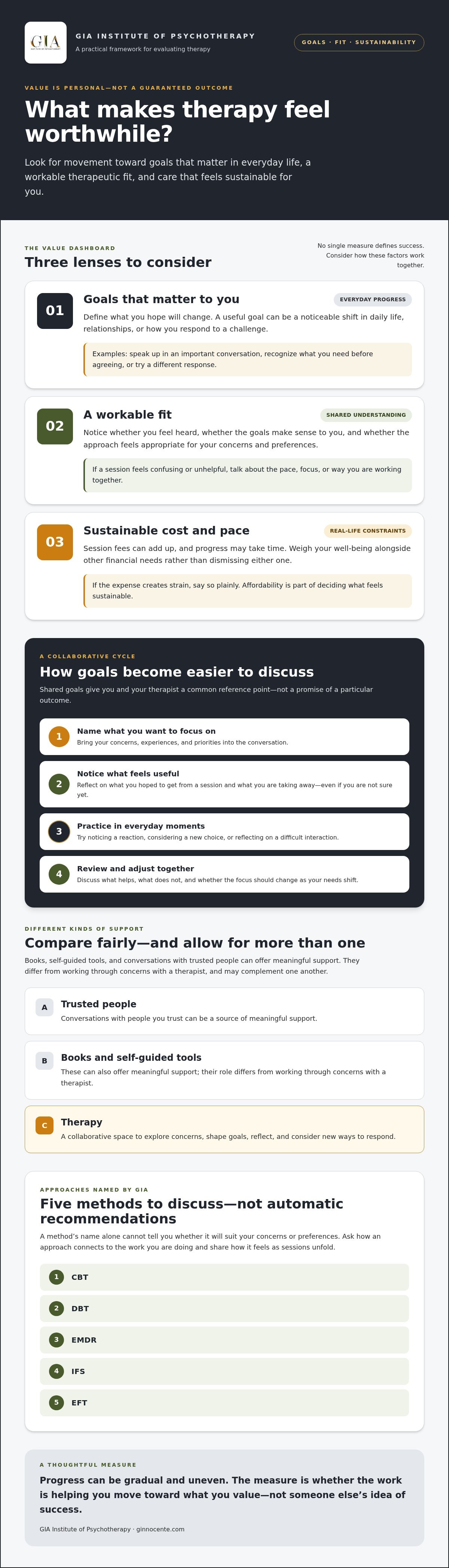
Therapy’s value rests on whether it supports goals that matter to you, feels like a workable fit, and can be sustained without adding unmanageable strain.
What can make therapy feel worthwhile?
Value may show up in practical, emotional, or relational changes. You might hope to set clearer boundaries at work, find coping strategies for stressful moments, understand a recurring reaction, or communicate more openly with a partner or family member. Progress could mean noticing a feeling sooner or making a different choice, not having every difficulty disappear.
Change can be gradual and uneven. One week may feel clarifying; another may bring up questions that take time to sort through. Your priorities may shift as you learn more about what you need. The measure is not someone else’s idea of success, but whether the work is helping you move toward what you value.
When might the cost feel hard to justify?
A limited budget deserves real consideration. Therapy may also feel difficult to evaluate when your goals are unclear or sessions don’t seem useful. Those doubts are valid signals to bring into the conversation, not proof that you’ve failed or that therapy has failed. You can talk about what feels helpful, what doesn’t, and whether the focus needs to change.
Try noticing what you hoped to get from a session and what you’re taking away, even if the answer is “I’m not sure yet.” If the expense is creating strain, say so plainly as part of deciding what feels sustainable. It’s reasonable to weigh your well-being alongside other financial needs rather than dismissing either one.
Value can also depend on fit: whether you feel heard, whether the goals make sense to you, and whether the approach feels appropriate. If something feels off, a candid conversation can help clarify what’s happening and what adjustments may be possible. You don’t have to treat uncertainty as a pass-or-fail verdict. It can be part of making a thoughtful decision about care.
How therapy creates value through goals, support, and practice
Therapy’s value can become easier to recognize when sessions connect to goals you care about and give you ways to reflect and practice between appointments. If you’re weighing “is therapy worth the money,” look beyond whether every session brings an immediate breakthrough. Notice whether the conversations help you understand your responses, consider new choices, or approach a recurring challenge with greater intention.
The work is collaborative. You and your therapist can identify what you’d like to focus on, discuss what feels useful, and adjust the direction as you learn more. Practice outside sessions might mean pausing to notice a reaction, trying a new way to respond, or reflecting on what happened in a difficult interaction. These steps should connect to your goals, not feel like a one-size-fits-all assignment.
Therapy methods vary, and a method’s name alone can’t tell you whether it will suit your concerns or preferences. The Mental Health America overview The Science Behind Therapy discusses how therapy works and the research behind it. That broader evidence can be informative, while your own experience and conversations with your therapist help shape what feels relevant to your care.
Shared goals make progress easier to discuss because they give you and your therapist a common reference point, not a promise of a particular outcome.
How goals help make progress visible
A useful goal describes a change you can notice in daily life, relationships, or how you respond to a challenge. For example, you might hope to speak up in a conversation that matters or recognize what you need before agreeing to something. Progress could include attempting a new response, even if it still feels difficult. Goals can be revisited together as circumstances or priorities change.
At GIA Institute of Psychotherapy, approaches include CBT, DBT, EMDR, IFS, and EFT. These are different therapeutic methods, not automatic recommendations. The concerns you bring and what feels comfortable are part of the discussion. A therapist can connect an approach to the work you’re doing and make space to talk about how it feels as sessions unfold.
Why the therapeutic fit matters
Trust, clear communication, and feeling heard can shape how comfortable you feel taking part in therapy. If a session feels confusing or unhelpful, saying so can open a conversation about the pace, focus, or way you’re working together. You’re allowed to ask questions and share what isn’t making sense. That feedback can help clarify the next step.
GIA supports children, teens, adults, couples, and families through individual, couples, and family therapy. If you’re considering whether this kind of collaborative work fits your needs, you can explore therapy options at GIA Institute of Psychotherapy and consider what you’d want to work toward.
Therapy versus other ways to seek support: compare value fairly
Therapy isn’t the only way to seek support, and it doesn’t need to be judged against every other option as if they all do the same thing. A self-guided resource may help you explore a topic at your own pace. A trusted person can offer connection and perspective. Therapy provides a dedicated working relationship, while other professional care may address different needs. Some forms of support can complement one another.
Use this comparison to consider what each option offers, rather than treating it as a ranking. Personalization and costs vary, so the table describes general differences, not guarantees.
| Support option | Personalization | Structure | Ongoing effort | Out-of-pocket considerations |
|---|---|---|---|---|
| Self-guided resources | You choose what feels relevant. | Usually self-directed. | You set the pace and follow-through. | Resources may be free or paid. |
| Trusted personal support | Based on your relationship and what the person can offer. | Often informal. | Depends on when and how you connect. | Usually no direct session fee, though circumstances vary. |
| Therapy | Work is shaped around your concerns and goals. | Sessions provide a dedicated, ongoing framework. | May include reflection or practice between sessions. | Fees and any coverage or payment arrangements vary. |
| Other professional care | Depends on the service and your needs. | Follows the purpose of that care. | Varies by service and plan. | Costs and coverage depend on the care and your arrangements. |
When therapy may offer something distinct
Therapy can provide focused time to reflect with a professional and work together on concerns that feel hard to shift alone. You might explore a recurring disagreement, notice what happens before you withdraw from a conversation, or consider a different response to stress. These are possibilities to explore, not predicted outcomes. If you’re asking, “is therapy worth the money,” consider whether this kind of ongoing, collaborative attention matches what you’re looking for.
How to think about cost without guessing
Look beyond a single session fee and consider whether the full arrangement feels manageable over time. Other expenses, such as transportation or time away from work or caregiving, may matter in your situation. Financial stability matters too; support should not require ignoring essential expenses or putting yourself under unsustainable pressure.
Before deciding, review the relevant coverage and payment details in your own plan or arrangements, including what you may pay and how often. Clear information can help you compare options on realistic terms. Therapy, personal support, self-guided tools, and other professional care can serve different purposes, and your choice can reflect both your needs and what you can sustain.
How to decide whether therapy is worth it for you in South Jersey
A decision about therapy can feel less overwhelming when you break it into questions you can answer. If you’re considering counseling in South Jersey, think about what you need, what feels financially manageable, and how you’ll know whether the work is serving you. This isn’t a test you have to pass before seeking support. It’s a way to make a choice with your priorities in view.
- Name the concern. What’s taking up emotional space or affecting your daily life? You don’t need a perfect explanation. A recurring worry, strained relationship, or difficult transition can be a starting point.
- Set a goal. Imagine a small, meaningful change you’d like to work toward, such as feeling more able to speak up or responding differently during conflict.
- Consider affordability. Look at the financial commitment in the context of your other needs. A plan that creates ongoing strain may not be sustainable, and that deserves consideration.
- Discuss expectations. Talk about how you and the therapist might shape goals, what the work could involve, and how practical constraints may affect your ability to participate.
- Review progress. At intervals that make sense for your work, reflect together on what feels useful, what remains difficult, and whether your priorities have shifted.
Questions to bring into an initial conversation
You might ask, “How would we decide what to focus on?” or “How do you adapt the work to a person’s needs?” You can also ask how and when you might return to your goals together. These questions aren’t demands for a forecast; they help you understand how collaboration could feel. Share practical considerations, such as travel, scheduling, or budget, that may shape what’s manageable.
For local counseling, logistics matter too. Consider how getting to sessions would fit into your routine and what would make attendance realistic. GIA serves people in Ocean City, Linwood, Margate, Ventnor, Egg Harbor Township, Upper Township, and Galloway, New Jersey. Being open about practical details can help make expectations clearer from the outset, without requiring you to have every answer before the conversation begins.
Signs to revisit the plan
If your goals feel vague, sessions seem hard to connect to your concerns, or your circumstances change, bring that into the conversation. You might say, “I’m not sure what we’re working toward right now,” or “Could we talk about the pace?” Reviewing priorities, approach, and expectations together can help clarify the work. It doesn’t require a pass-or-fail judgment or a predetermined decision about what comes next.
GIA Institute of Psychotherapy supports children, teens, adults, couples, and families across South Jersey. If you’re ready to explore whether therapy fits your needs, explore therapy services with GIA Institute.
How GIA Institute makes therapy a thoughtful investment in South Jersey
Deciding whether therapy is worth the money involves more than comparing a fee with a hoped-for result. It also means considering whether care speaks to your circumstances, gives you room to work toward personally meaningful goals, and feels manageable as part of your life. GIA Institute of Psychotherapy provides counseling for children, teens, adults, couples, and families across South Jersey, with support shaped around different needs and stages of life.
GIA’s therapy services include CBT, DBT, EMDR, IFS, and EFT, as well as Play Therapy and Expressive Arts. These are different ways of engaging in therapeutic work, not a checklist every person needs. What feels relevant depends on the person and their concerns. A thoughtful starting point is a conversation about what you’d like help with and what you hope to understand or work toward.
Care is a shared process. Your priorities and feedback help shape the focus, while conversations about progress make space to notice what feels useful and what may need adjusting. There’s no promise of a particular result or schedule. The intention is to make the work responsive to your goals and revisit the direction together as your needs become clearer.
Support for different people and life circumstances
GIA offers individual psychotherapy for adults and individual therapy for children and teens. Couples counseling focuses on concerns within a relationship, while family therapy offers a setting for working with family dynamics together. The people involved and the relationships they’re navigating can shape what support looks like.
School advocacy is a separate offering from therapy. It can support families around school-related concerns. These different services let families consider what kind of help best matches the situation, rather than assuming every concern calls for the same form of care.
Taking a gentle next step with GIA
GIA serves Ocean City, Linwood, Margate, Ventnor, Egg Harbor Township, Upper Township, and Galloway, New Jersey. If you’re considering local counseling, reflect on what you’d want to discuss, what kind of support feels appropriate, and what practical considerations matter to you. You don’t need a perfect plan before exploring your options.
When you feel ready, explore GIA Institute of Psychotherapy and consider whether its services feel aligned with your needs. Taking time to learn about care is a meaningful step, and the decision remains yours.
Take the next step at your own pace
You don’t have to know exactly how therapy will help before exploring it. Begin with one question you’d like to understand better, then decide whether the conversation feels relevant to your needs and circumstances. Asking “is therapy worth the money” doesn’t require a permanent yes or no. It can be an ongoing reflection as you learn what support feels like in practice.
Give yourself permission to make a thoughtful choice rather than one driven by pressure, guilt, or the expectation of an instant answer. If you’re curious about working with GIA, explore what care could involve and whether it feels like a meaningful next step for you. There’s no need to have everything figured out first.
Explore therapy services with GIA Institute to consider what kind of support might fit this moment in your life. Whatever you decide, your needs and well-being deserve care.
Frequently Asked Questions
Is therapy worth the money if I am not in crisis?
Yes, therapy may be worth considering even when you’re not in crisis. You might want support with a life transition, recurring conflict, or a pattern you’re beginning to notice. A useful first step is to describe one situation you’d like to handle differently and discuss what support could look like. GIA Institute of Psychotherapy serves people in Ocean City, Linwood, Margate, Ventnor, Egg Harbor Township, Upper Township, and Galloway, New Jersey.
How can I tell whether therapy is working?
Look for changes in how you understand or respond to specific situations, rather than expecting every week to feel better. For example, you might notice tension building before an argument, pause before reacting, or find it easier to ask for what you need. Jot down a brief note after a challenging moment and bring it to a session. Discuss what you notice with your therapist and consider whether your current goals still fit.
Can therapy be worth it if I have tried it before and it did not help?
Yes, a past experience that didn’t feel useful doesn’t determine what another experience will be like. It may help to identify what felt missing: perhaps you weren’t sure what the sessions were focused on, or the pace didn’t suit you. Use those observations to explain what you hope will be different now. Past disappointment is a valid part of your story, not a reason you must rule out support.
How much should I budget for therapy?
There’s no single budget that works for everyone, so base your decision on your own finances rather than a generic estimate. Consider what you could set aside while still meeting essential expenses, and account for practical costs such as travel or time away from other responsibilities. Review any relevant coverage and payment details before you begin. If the numbers feel tight, explain your constraints during the initial conversation so they can inform planning.
What happens if therapy does not feel worth the money?
Start by describing what feels unclear or unhelpful, ideally with a recent example. You might say that you leave sessions unsure what the focus was, or that a goal no longer reflects what you need. This gives you and your therapist something specific to discuss, including whether priorities, pace, or the way you work together should be revisited. You don’t have to treat doubt as a verdict; it can help clarify what support would feel useful.
Can therapy be worth the cost for couples or families?
It may be worth considering when partners or family members want help understanding a shared concern and having more focused conversations. For instance, a couple may want to discuss recurring misunderstandings, while family members may be working through a change affecting the household. The value depends on the concerns and whether participants find the process constructive. Before starting, discuss what the sessions might focus on and how everyone’s goals can be heard.
Is therapy more valuable than self-help resources?
Not necessarily; each can serve a different purpose. A book or app may offer ideas to explore privately and at your own pace. Therapy gives you a place to discuss how an idea applies to your circumstances and what might get in the way of using it. You might try a self-guided exercise and bring your questions to a session, or choose one option based on your current goals, preferences, and budget.


