

What if you didn’t need to know exactly what to say before your first therapy session? If you’re wondering how to prepare for your first therapy session, it’s understandable to feel unsure about what to share, whether your concerns are serious enough, or what might happen if you become emotional. You don’t have to perform therapy “correctly” or arrive with everything figured out. A little preparation can help you bring what matters and find a gentler place to begin.
A few simple steps can help you feel more grounded, but you can always share at your own pace. Jot down what’s been weighing on you, note questions you’d like to ask, and consider what would help you feel comfortable. There’s no perfect list, and you don’t need to tell your whole story in one sitting.
This guide offers practical ways to gather your thoughts, prepare for the appointment, and understand what a first session may involve. You’ll also learn how therapy can become a collaborative process shaped around your concerns, whether you’re seeking support for yourself, your child, your relationship, or your family.
Key Takeaways
- Learn how to prepare for your first therapy session by choosing a simple starting point instead of rehearsing a perfect explanation.
- Use brief notes to identify what’s troubling you, how it affects daily life, and what you hope might change.
- You can share personal history gradually and name uncertainty or discomfort during the conversation.
- A short checklist of appointment details and questions can help you feel more settled on the day.
- Therapy with GIA in South Jersey offers a collaborative starting point for children, teens, adults, couples, and families.
How to Prepare for Your First Therapy Session When You Feel Nervous
Starting therapy can bring several feelings at once: relief that you’re seeking support, hope that something may shift, and vulnerability about what you’ll be asked to share. You might wonder whether your concerns are “serious enough,” worry about being judged, or feel unsure where to begin. These reactions are understandable, though everyone’s experience is different. Feeling uncertain doesn’t mean you’re unready. It may simply mean this step matters to you.
Why starting therapy can bring up mixed feelings
Talking with someone new about personal experiences can feel exposing, even when you want help. You may have a clear reason for coming, such as ongoing stress, or only a sense that something doesn’t feel right. Either can be a starting point. You don’t need a diagnosis, polished goals, or a complete timeline of your life before you begin. A general overview of Psychotherapy can offer background on what therapy may involve, but your own questions and concerns matter, too.
If you’re worried about how you’ll come across, you can say so. For example: “I’m nervous and not sure what I’m supposed to talk about,” or “I’m worried you’ll think this is a small problem.” Naming the fear helps your therapist understand what’s happening for you, rather than leaving you to manage the worry alone. You don’t have to arrive feeling confident to take part.
What preparation can, and cannot, do
Thinking ahead can make the first step feel more manageable, but preparation can’t control how the session unfolds. You don’t have to rehearse every detail or make sure your story comes out in the right order. First-session preparation is about clarity, not having every answer. Consider what feels most present today, even if you can describe it in only a few words.
You remain an active participant in the conversation. If a question feels difficult, you can pause, ask why it’s being asked, or take a moment to find your words. You can also say, “I’m not ready to talk about that yet,” or ask to return to the subject later. Being honest about discomfort can help shape a more useful, collaborative conversation.
So, how can you prepare for your first therapy session without putting pressure on yourself? Choose one concern you’d like to start with, and remind yourself that it’s okay to be unsure. You can share more as trust develops; you don’t need to settle everything in one meeting. For now, showing up with a starting point is enough.
How to Organize Your Thoughts Before a First Therapy Appointment
You don’t need a complete account of your life to make the conversation meaningful. A few words about what’s been difficult lately can give you and your therapist somewhere to begin. If your thoughts feel tangled, jot down short phrases instead of trying to write a polished explanation. A few honest notes can turn a difficult-to-name concern into a starting point.
Choose one or two things you want your therapist to understand
Think about what has felt hardest recently and when it tends to arise. You might notice worry before work, low mood that makes everyday routines harder, tension during conversations with a partner, or uncertainty after a major life change. If relevant, note how it affects sleep, relationships, work, school, or daily responsibilities. Your first concern doesn’t have to explain everything.
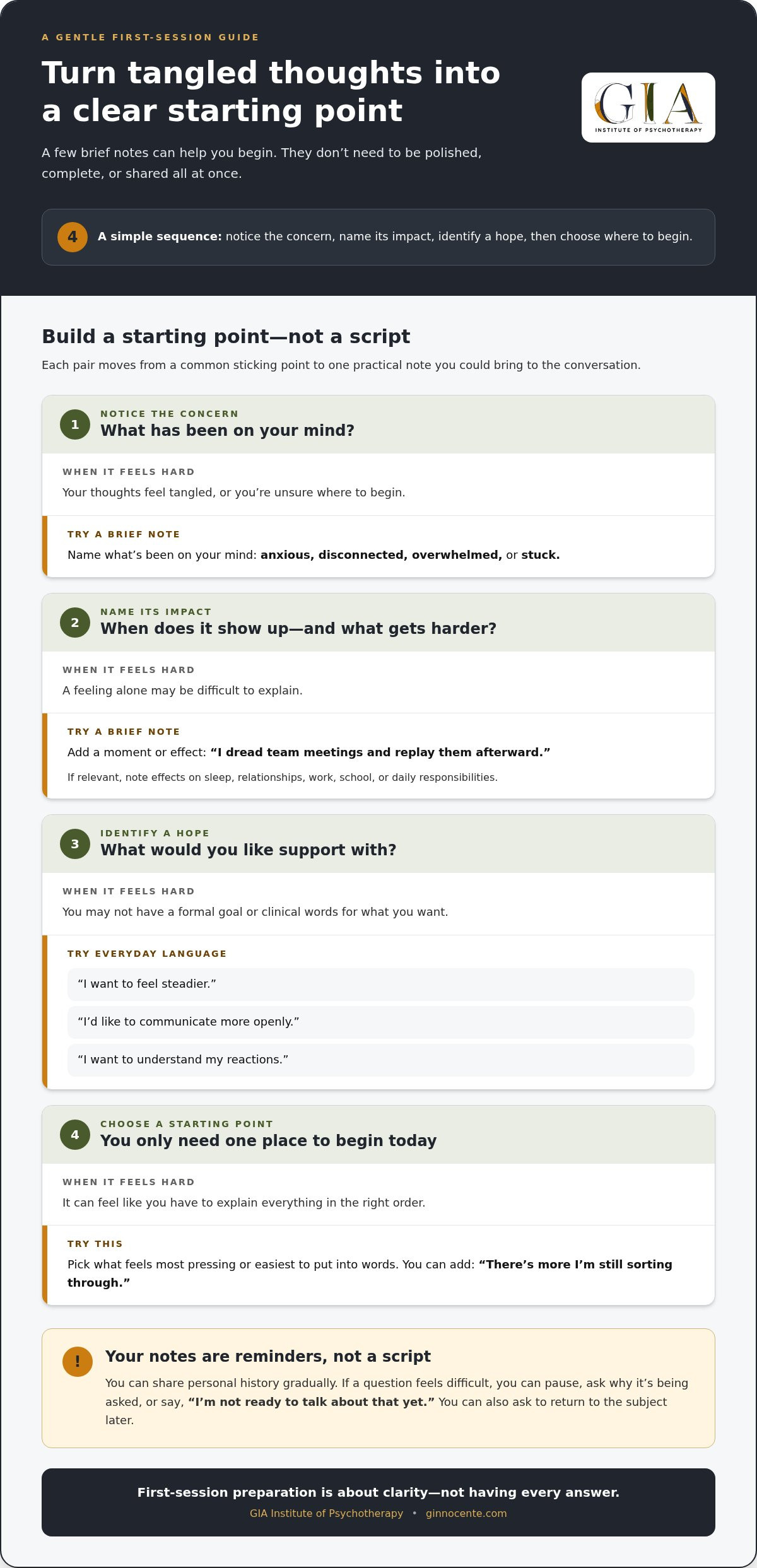
Try this short sequence to organize your thoughts:
- Notice the concern. Name what’s been on your mind, such as feeling anxious, disconnected, overwhelmed, or stuck.
- Name its impact. Briefly describe when it shows up and what it makes harder. For example, “I dread team meetings and replay them afterward,” or “I’ve stopped looking forward to things I used to enjoy.”
- Identify a hope. Consider what you’d like support with, even if your hope is broad. You might want to feel steadier, communicate more openly, or understand your reactions.
- Choose a starting point. Pick the concern that feels most pressing or easiest to put into words today. You can mention that there’s more you’re still sorting through.
These notes aren’t a script. They’re reminders you can glance at if you lose your train of thought or aren’t sure what to say next. The Ohio State University Wexner Medical Center offers helpful expectations for your first counseling session, including the role of building rapport. Your notes can help you begin, while the conversation unfolds naturally.
Name what you hope might feel different
Describe your hopes in everyday language, not clinical terms. “I want to cope better when anxiety rises,” “I’d like us to argue less and listen more,” or “I need help finding my footing after a change” are all useful ways to express what matters. You don’t have to set a formal goal before you arrive. Your priorities can become clearer and shift as you talk.
If you’re exploring individual therapy support, consider bringing a few notes about what you’d like help understanding or changing. Keep them brief, leave room for questions, and let your therapist help shape a starting point with you.
What to Share, and What You Can Keep Private at First
A first therapy session doesn’t require you to reveal every painful detail or explain your entire personal history. You can begin with what’s happening now, such as feeling overwhelmed at work, struggling in a relationship, or not knowing why your mood has changed. Background may become useful over time, but you can share it gradually as you feel ready. A helpful conversation can start with a summary, a question, or simply, “I’m not sure how to talk about this.”
How to talk about something difficult without telling the whole story
If a topic feels too tender to describe in detail, say so. You might use broad language like, “Something from my past is affecting me,” without explaining what happened. You can ask to slow down, take a pause, or return to it another time. Sharing at a manageable pace is different from avoiding therapy; it gives you room to notice what feels safe enough to discuss.
You don’t have to push through discomfort silently. Try saying, “I’m finding this hard to talk about,” or “Can we stay with what’s happening now?” That lets your therapist know what you need in the moment. The goal isn’t to disclose as much as possible. You can begin with the concern that brought you in while trust and understanding develop through collaboration.
Questions you may want to bring to your therapist
As you consider how to prepare for your first therapy session, remember that asking questions is part of getting oriented, not a test of your therapist. You can ask how you’ll work together to set goals, talk about progress, and decide what to focus on. If a term or approach is unfamiliar, ask what it means and how it might relate to your concerns.
- “How do we decide what to work on first?”
- “How will we talk about whether therapy is helping?”
- “What does confidentiality mean in therapy, and what circumstances might limit it?”
- “Could you explain the approach or language you’re using?”
Confidentiality is a reasonable subject to clarify early. Ask your therapist to explain what information is private and the circumstances in which they may need to share information. Details can depend on the situation, so invite them to describe how confidentiality works in your care. Understanding these boundaries can help you make informed choices about what you’re ready to discuss.
Keep these questions in your notes and choose one to ask if that feels manageable. You’re not expected to cover everything at once, and you can ask for clarification at any point. The first conversation is a chance to begin understanding each other and how you might work together, with your pace and boundaries in view.
A Simple First Therapy Session Preparation Checklist for the Day
A little planning can ease the practical rush and help you feel more present. The goal isn’t to make the day go perfectly. It’s to give yourself enough breathing room to arrive, settle, and begin without unnecessary pressure. Use this checklist as a menu, not another set of rules.
What to bring or have ready
Before you leave or sign in, review the appointment instructions and practical details you’ve received. If you’ve written notes or questions, keep them somewhere easy to find. You can refer to them if your mind goes blank, or set them aside if the conversation takes a different direction.
- Review the appointment details and any instructions you’ve received.
- Bring brief notes about what you’d like to discuss, if writing them down helps.
- Keep a short list of questions you want to remember, such as how you and your therapist might decide what to focus on.
- If practical, leave a little transition time before the appointment rather than rushing straight from another demand.
- Choose one small grounding routine, such as taking a few slow breaths or noticing the colors and shapes around you.
Keep it simple. You don’t need to gather every thought or prepare a detailed script. A few reminders can help you feel oriented, and it’s okay if you don’t use them. If you’re wondering how to prepare for your first therapy session, think of this checklist as support for your comfort, not a measure of whether you’re ready.
How to make room for your feelings afterward
If possible, avoid scheduling something demanding immediately after the appointment. A little space can help you shift back into the rest of your day. You might take a quiet walk, sit somewhere peaceful, or give yourself a few unhurried minutes before returning to your usual routine. Choose what feels realistic.
You may leave with a clear thought, mixed feelings, or no immediate answer to your questions. Try not to judge the session’s value by how resolved you feel right away. Instead, make a private note about what felt important, what felt comfortable, and what still feels unresolved. This isn’t a performance review. It’s a way to notice what you may want to return to.
Be patient with yourself if emotions linger or you need time to process. You don’t have to explain your reaction to anyone or decide what it means on the spot. A first appointment is a beginning, and your experience can unfold at a pace that respects your needs.
If you’re ready to explore support shaped around your concerns, explore therapy and support at GIA.
Beginning Therapy with GIA in South Jersey: Take the Next Step at Your Pace
Preparing for a first appointment can help you find a place to begin, but therapy isn’t a promise of instant change or a test you need to pass. It’s a collaborative process: you bring your concerns and perspective, and your therapist works with you to understand what support may be useful. Start with what feels most present and let the conversation develop at a manageable pace.
Therapy can meet people at different ages and starting points
People seek support for many reasons, including anxiety, depression, relationship strain, and life transitions. GIA Institute of Psychotherapy provides therapy for children, teens, adults, couples, and families in South Jersey. An individual may want space to understand their feelings, partners may want to explore communication together, or a family may want to look at patterns affecting the household. Each situation has its own context, so support is shaped through conversation rather than assumed in advance.
GIA’s clinical approaches include CBT, DBT, EMDR, IFS, EFT, Play Therapy, and Expressive Arts. These approaches offer different ways of engaging with concerns, from structured reflection to creative or expressive work. The approach depends on the person, relationship, and goals being discussed. You don’t need to arrive knowing a therapy method or deciding which one is right. Describe what’s bringing you in and ask questions as you learn more.
Taking a first step in the South Jersey community
GIA supports people in Ocean City, Linwood, Margate, Ventnor, Egg Harbor Township, Upper Township, and Galloway. Wherever you’re beginning from, bring the concern you have today, even if you’re still making sense of it. A first conversation can help you and your therapist understand what matters to you and consider possible next steps together. There’s room to ask questions, share what feels comfortable, and take time to build a working relationship.
If you’re still thinking about how to prepare for your first therapy session, a few honest words about what you hope to discuss are enough to start. You don’t have to feel completely ready or know exactly what you want from therapy. Beginning can simply mean being willing to explore what’s going on, one conversation at a time.
For another overview of getting started, continue with How to Start Therapy in NJ: A Gentle Guide to Your Journey. When you feel ready to explore support, learn about therapy with GIA Institute of Psychotherapy and take the next step at your own pace.
Let Your First Step Be Enough
You don’t have to feel completely ready before beginning. Readiness can look like a small choice: deciding to speak with someone, making room for a question, or admitting that you’d like things to feel different. If you’re still wondering how to prepare for your first therapy session, remember that preparation can support you without being perfect. You’re allowed to arrive with uncertainty and discover what matters as you talk.
Therapy is a relationship that takes shape through conversation, reflection, and shared understanding. Bring your perspective, ask questions, and take time to consider what feels useful. There’s no need to measure your progress against anyone else’s or expect every answer to come at once. A beginning can be modest and still matter.
When you feel ready, explore therapy and support at GIA. Take a simple next step and begin a conversation at your own pace.
Frequently Asked Questions
Is it normal to feel nervous before your first therapy session?
Yes, it’s normal to feel nervous about beginning a personal conversation with someone new, even if you’re hopeful about getting support. You don’t have to wait until the anxiety disappears. If your mind is racing or you feel tense on the way there, try naming the experience rather than judging yourself for it. You can tell the therapist you’re nervous and take a moment to settle before continuing.
Can I bring notes to my first therapy session?
Yes, bringing notes can help you keep track of what matters. A short reminder like “trouble switching off after work” or “want to talk about tension with my sister” can be easier to use than a full written account. Glance at your notes if you lose your train of thought, or leave them in your bag if you’d rather talk freely.
What if I cry during my first therapy session?
Crying is one possible response to a meaningful or stressful conversation, and it doesn’t mean you’re doing anything wrong. If emotion rises, you can pause, breathe, take a sip of water, or say, “I need a moment.” You don’t have to turn tears into a full explanation. If you’re unsure what you need, saying so can help the conversation slow down.
Do I need a mental health diagnosis before starting therapy?
No, you can start without a diagnosis or clinical label. To prepare for your first therapy session, focus on describing what you’ve noticed in everyday language: perhaps you feel on edge most mornings, have less energy than usual, or find conflict harder to resolve. You and your therapist can explore what may be contributing to these experiences without deciding in advance what they mean.
Can I bring someone with me to my first therapy session?
Whether someone else can join depends on the appointment and who is receiving care. If you’re considering bringing a support person, think about whether you’d want them to help explain your concerns, offer comfort, or simply accompany you. For a child or teen, couples, or family appointments, each person’s participation may look different. You can raise the question when arranging or beginning the appointment.
Will I have to commit to long-term therapy after my first session?
No, one session doesn’t mean you must decide on a long-term plan immediately. Use the conversation to consider what you want help with and what pace feels manageable, then reflect on how it felt afterward. GIA serves people in Ocean City, Linwood, Margate, Ventnor, Egg Harbor Township, Upper Township, and Galloway, and possible next steps can be part of the conversation.


