

Can counseling help you live with chronic illness without questioning or minimizing what you physically feel? It can offer space for the emotional weight of illness while respecting that your symptoms and medical care are real. If you’re exploring coping with chronic illness counseling Margate NJ, you may be looking for support with uncertainty, grief, changing relationships, or the strain of managing day-to-day life. Those feelings deserve attention, too.
Counseling isn’t a replacement for medical care, and it doesn’t promise to cure an illness. It can help you make room for your emotions, find ways to communicate your needs, and strengthen the support around you. GIA Institute of Psychotherapy provides individual, couples, and family counseling for people in Margate and nearby South Jersey communities. Sessions can focus on the concerns and goals that matter to you.
In this article, you’ll learn what counseling can address alongside medical treatment, how it may support you and your relationships, and how to prepare for a first conversation. The goal isn’t to reduce you to a diagnosis. It’s to support the whole person living with it.
Key Takeaways
- Learn how chronic illness can shape emotions, relationships, identity, and everyday choices, and where counseling may offer support.
- Understand what therapy can help you explore, and how it works alongside rather than in place of medical care.
- See how a collaborative counseling relationship can make room for your physical experiences and personal goals.
- Explore a manageable way to consider coping with chronic illness counseling Margate NJ, even when energy or schedules vary.
- Discover how individual, couples, or family therapy at GIA Institute may support different parts of life with illness.
Coping with Chronic Illness in Margate, NJ: Why Emotional Support Matters
Living with an ongoing illness can reach beyond physical symptoms. Appointments and changing routines may affect work, family roles, social plans, and choices that once felt simple. You might feel frustrated one day, grieve a change the next, or focus on getting through the week. You might also feel steady or hopeful. There’s no single emotional response everyone with a chronic condition should have. The condition is part of your life, but it doesn’t define all of who you are.
A chronic condition generally continues over time, unlike an acute condition that is shorter-term. The chronic condition overview offers background on the term and examples. Coping-focused counseling addresses emotional and relational experiences that may accompany illness. It isn’t medical treatment for the condition, and it doesn’t replace guidance from your healthcare team. It can give you room to understand what you’re carrying and decide what support might help.
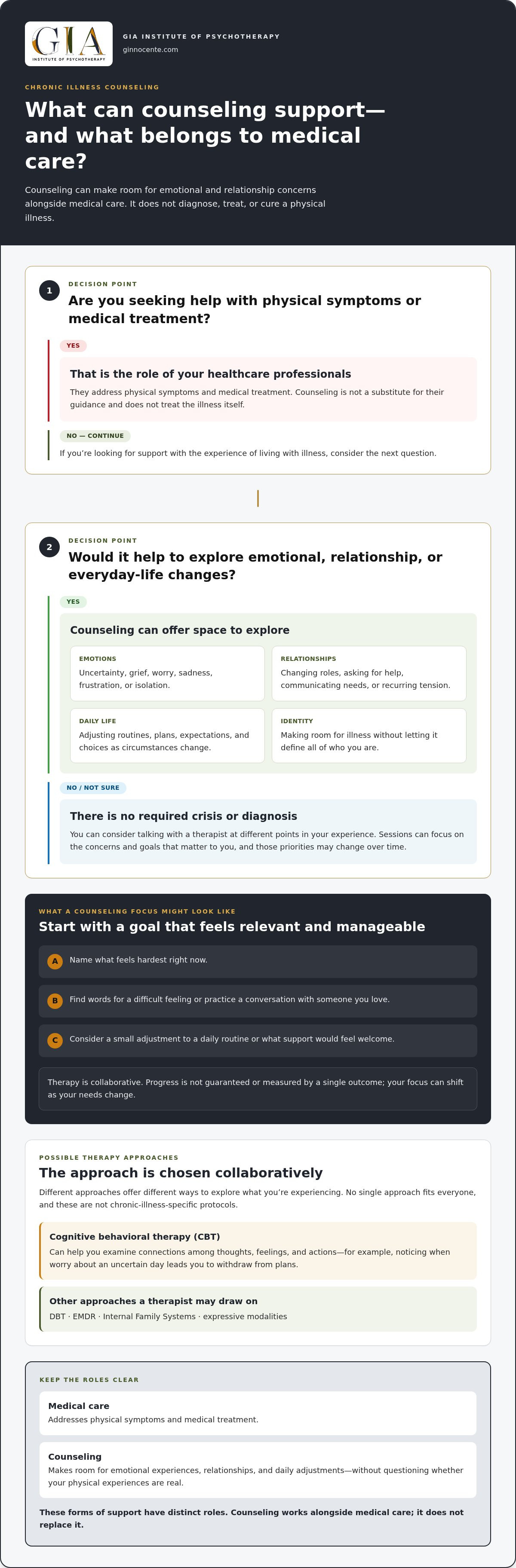
Counseling can support emotional wellbeing alongside medical care; it doesn’t diagnose or treat the physical illness itself. You don’t need to be in crisis or have a particular diagnosis to consider talking with a therapist. Seeking support can be a thoughtful choice at any point, whether you’re adjusting to a new routine or have been living with illness for years.
The emotional weight of living with ongoing illness
Uncertainty can make planning feel difficult. You may wonder how symptoms will affect an upcoming commitment, feel disappointed when plans change, or grieve abilities and routines that no longer fit. These experiences can coexist with gratitude, connection, and moments of joy. There’s no requirement to feel one way about illness.
Relationships and identity can shift, too. Someone who once managed every household task may need to ask for help, while loved ones may be unsure how to offer it. Counseling can make space for those changes without reducing you to a diagnosis or assuming what your experience means.
When counseling may feel helpful
You might consider support if worry, sadness, frustration, or isolation feels difficult to carry alone, or if conversations about illness repeatedly lead to tension. That doesn’t mean you’re weak or coping badly. It may simply mean you’d like a place to sort through what’s changed and what matters now.
In therapy, you can explore goals at a manageable pace. You might start by naming what feels hardest, identifying a need you want to communicate, or considering a small adjustment to a daily routine. With coping with chronic illness counseling Margate NJ, the focus can stay on you and the emotional support you want, not on questioning whether your physical experiences are real.
What Chronic Illness Counseling Can Address, and What It Cannot
Living with an ongoing medical condition can raise questions that aren’t answered by a medical appointment alone: How do I talk with my partner about what I need? How can I adjust plans without feeling that illness is taking over my identity? What do I do with fear or frustration when it returns? Counseling offers a place to explore these emotional and relational concerns and shape goals around what matters to you.
Those goals might include finding words for a difficult feeling, practicing a conversation with a loved one, or noticing what helps you feel more grounded during a demanding stretch. Your therapist can work with you to identify a focus that feels relevant and realistic. Progress isn’t guaranteed or measured by a single outcome. Therapy is collaborative, and your priorities may change over time.
Counseling can help you care for your emotional wellbeing while you continue medical care; it doesn’t diagnose, treat, or cure the physical illness. It also shouldn’t require you to prove that symptoms are real. The American Psychological Association’s guidance on coping with chronic illness diagnosis discusses the emotional adjustment that can accompany diagnosis and the role of coping support.
How therapy approaches may support personal goals
Different approaches offer different ways to explore what you’re experiencing. Cognitive behavioral therapy (CBT), for example, can help you examine connections among thoughts, feelings, and actions. If worry about an uncertain day leads you to withdraw from plans, therapy might help you notice that pattern and consider responses that feel more supportive.
Depending on your needs and goals, a therapist may also draw on DBT, EMDR, Internal Family Systems, or expressive modalities. These aren’t chronic-illness-specific protocols, and no single approach fits everyone. The focus is on choosing an approach collaboratively, rather than expecting you to fit a predetermined method.
Working alongside medical care
Medical care and counseling have distinct roles. Your healthcare professionals address physical symptoms and medical treatment; counseling creates space to explore emotional experiences, relationships, and daily adjustments. One form of support doesn’t replace the other.
You might use therapy to prepare for a conversation with family, reflect on changing expectations, or explain what kind of support feels welcome. A therapist can listen without treating emotional distress as evidence that symptoms are imagined. For someone exploring coping with chronic illness counseling Margate NJ, this distinction clarifies the purpose: supporting the person, not taking the place of medical care.
GIA Institute of Psychotherapy offers individual counseling in Margate and nearby communities, with goals and therapeutic approaches shaped around the person.
Does Counseling Dismiss Chronic Illness? Finding the Right Kind of Support
It shouldn’t. Making room for fear, sadness, anger, or relationship strain doesn’t mean physical symptoms are imagined, exaggerated, or “all in your head.” Emotional support and the reality of illness can coexist. Counseling can acknowledge what you’re experiencing physically while helping you explore how illness affects your inner life and connections with other people.
A respectful therapist listens before drawing conclusions. You can describe what daily life is like, what you want understood, and what you hope to work on. For example, you might say, “I want help talking with my family about the support I need, but I don’t want my symptoms reduced to stress.” Your goals can guide the conversation, and you can speak up if a question or suggestion doesn’t feel useful.
Support can also take forms beyond therapy. The Administration for Community Living describes chronic disease self-management education, which can include learning and peer support. Counseling is a separate space for emotional and relational concerns, shaped around what you want to discuss.
Individual, couples, and family counseling
Individual therapy gives you room to explore emotions, identity, changing expectations, and coping goals without needing to manage anyone else’s response in the moment. You might want to understand what feels hardest or find language for a need you’ve been holding back.
Couples or family sessions can focus on how illness affects shared routines and communication. A conversation might help loved ones understand what kind of support feels welcome or make space for different reactions to changing plans. The aim is shared understanding, not assigning blame or asking anyone to speak for the person living with illness.
What a respectful counseling relationship can feel like
There’s no required script for explaining your experience. You might begin with what you wish people understood, what topics feel difficult, or what you don’t want counseling to assume. If a conversation feels off track, you can say so. For example, “I’d like to stay with how this change affects me emotionally,” or “That doesn’t match my experience.” These words can help bring the focus back to your priorities.
A therapist may ask curious questions, reflect what they hear, and work with you to clarify goals. That doesn’t mean every session will feel easy or that you must agree with every observation. It does mean your perspective belongs in the conversation. Notice what feels supportive and what doesn’t, then discuss how to adjust the work together.
For someone exploring coping with chronic illness counseling Margate NJ, support can start with naming what you need to feel heard. Individual, couples, or family counseling may offer a way to explore that need while keeping your experience and choices at the center.
Preparing to Explore Chronic Illness Counseling in Margate, NJ
You don’t need to arrive with a complete account of your health or a perfectly formed goal. A little reflection can help you use an initial conversation to share what matters, while leaving room for your needs to unfold over time. Try the steps below in whatever way fits your energy and circumstances.
- Notice what’s asking for attention. Jot down a few words about emotions, relationship changes, or daily adjustments on your mind. Perhaps you’re carrying worry about plans, feeling alone in a family conversation, or trying to make sense of a changed routine. A short note on your phone, or simply thinking it through, is enough.
- Choose one manageable starting goal. Rather than preparing your whole history, consider what would feel useful to discuss first. You might want to feel more understood by someone close to you, make space for grief, or find words for a need. Your goal doesn’t have to be a solution. It can be a question you’d like to explore.
- Decide what you hope a counselor understands. Think about what living with illness is like for you, including what others may not see. You could mention that your energy varies, plans sometimes change, or you want emotional support without having physical symptoms questioned. Share only what feels comfortable; you can add context at your own pace.
- Name preferences and boundaries. It may help to say whether you prefer a slower conversation, time to think before answering, or direct questions. You can also mention topics you’re not ready to discuss and who currently supports you, if anyone. These details help shape a conversation around your needs instead of asking you to adapt to a fixed script.
- Take a first step that feels realistic. If you’re in Margate or a nearby South Jersey community, that could mean making a brief note, talking with a trusted person about the idea, or reaching out to GIA Institute. If a phone call or longer appointment feels like too much today, choose a smaller step and return to the rest when it suits you.
Preparation is an invitation, not a test. You can bring a few notes, arrive with one concern, or begin by saying, “I’m not sure where to start, but I want to talk about how illness is affecting me.” The conversation can develop from there. Exploring coping with chronic illness counseling Margate NJ can begin with an honest account of what you hope to feel heard about, not a polished explanation.
Explore counseling with GIA Institute for people in Margate and nearby communities.
Chronic Illness Counseling with GIA Institute in Margate and South Jersey
For people in Margate and nearby South Jersey communities, GIA Institute of Psychotherapy offers a place to explore the emotional and relationship experiences that can accompany ongoing illness. Counseling doesn’t treat the medical condition; it supports the person living with it. Your concerns, priorities, and lived experience can help shape what sessions address. GIA Institute of Psychotherapy serves people in Margate, Ocean City, Linwood, Ventnor, Egg Harbor Township, Upper Township, and Galloway.
A compassionate, collaborative approach to counseling
There isn’t one emotional response to illness or one therapy plan that suits everyone. Clinicians at GIA Institute of Psychotherapy draw on approaches that include cognitive behavioral therapy (CBT), dialectical behavior therapy (DBT), EMDR, Internal Family Systems, and expressive modalities. These approaches can be selected in response to a person’s needs; they aren’t protocols designed specifically for chronic illness.
In practice, your goals can guide the work. You might want to make room for difficult feelings, reflect on a change in identity, or understand how illness is affecting family life. A therapist can listen, ask questions, and work with you to identify a helpful focus. The approach may shift over time as your needs or priorities change.
Therapy is distinct from medical care. Your physical symptoms and treatment remain part of your healthcare journey, while counseling provides space to attend to emotional wellbeing and relationships. There’s no promise of a particular result; the aim is a thoughtful, person-centered process rather than a one-size-fits-all plan.
Different forms of support for individuals and relationships
Individual therapy can center on your feelings, sense of self, and personal coping goals. Couples counseling may give partners space to talk through how illness affects shared decisions, changing routines, or the ways support is offered. Family therapy can help family members listen to one another and build a clearer understanding of how illness touches family life.
These options aren’t interchangeable. You might prefer to begin with a space focused on your individual experience or decide that a relationship conversation would be more useful. The choice can depend on what you hope to address and who you want involved. Each format can keep the person living with illness, their voice, and their goals at the center.
Taking a next step from Margate, NJ
Considering coping with chronic illness counseling Margate NJ doesn’t mean you need to know exactly what to say or which therapy approach will fit. You can begin with the question you’re carrying now and allow the conversation to take shape from there. GIA Institute of Psychotherapy provides individual, couples, and family counseling for people in Margate and nearby South Jersey communities.
You can start by identifying one concern you’d like to bring to counseling, such as a difficult conversation, changing expectations, or feeling isolated. That gives you a practical starting point without requiring you to explain everything at once.
Make Space for Support at Your Own Pace
You don’t have to decide what every next step will look like before reaching out. Counseling can begin with a question, a feeling you’d like room to explore, or simply the wish to have someone listen. Your needs may shift as life with illness changes, and it’s okay for support to shift with them.
If you’re considering coping with chronic illness counseling Margate NJ, let your first step be small enough to feel possible. You might write down one thing you want understood or take a moment to consider what kind of support would be useful right now. You remain the expert on your own experience, and you can move at a pace that respects it.
GIA Institute of Psychotherapy provides individual, couples, and family counseling in Margate and nearby South Jersey communities. Connect with GIA Institute of Psychotherapy to explore counseling and take a first step toward support shaped around your needs.
Frequently Asked Questions
Can counseling help me cope with a chronic illness?
Yes. Counseling can help you explore emotional challenges that arise as you adjust to life with an ongoing condition. You might work on uncertainty around plans, a changing role at home, or ways to stay connected to parts of life beyond illness. You don’t need to arrive with a specific goal; a question or concern can be a useful place to begin.
Does chronic illness counseling mean my symptoms are psychological?
No. Seeking emotional support doesn’t mean physical symptoms are imagined or caused by emotions. Counseling focuses on emotional wellbeing and relationships, not diagnosing the source of physical symptoms. You can make clear that you want to discuss how illness affects your life without treating your symptoms as a psychological problem. For questions about physical symptoms, continue to discuss them with your medical care team.
What happens during counseling for chronic illness?
Counseling starts with a conversation about what feels important to you, and the focus can take shape over time. You might talk through a recent moment, such as feeling misunderstood after changing plans, then consider what you needed in that situation. A therapist may ask questions and help you reflect on possible ways to respond. You can share at a comfortable pace and return to topics as needed.
Can couples or family counseling help when someone has a chronic illness?
It can offer loved ones a shared space to talk about how illness affects daily life and connection. For example, a couple might discuss handling plans when energy is unpredictable, while family members might work on offering help without making assumptions. GIA Institute of Psychotherapy provides couples and family therapy. Sessions can center on a specific shared concern without requiring everyone to agree about every aspect of the illness.
How can CBT support someone coping with chronic illness?
CBT can help someone notice links among thoughts, feelings, and actions. For example, after needing to cancel an outing, a person might notice thoughts of being a burden, feelings of guilt, and a tendency to withdraw from loved ones. In therapy, they can examine that pattern and consider a response that fits their values. CBT is one possible approach, not a treatment for the physical condition or a fit for everyone.
Can counseling replace medical treatment for a chronic illness?
No. Counseling isn’t a substitute for medical diagnosis or treatment. It addresses emotional concerns and relationship experiences, while medical professionals provide care for physical health needs. Some people find it useful to keep these roles clear and bring different questions to each setting. Therapy can support reflection on the emotional side of living with illness, but it doesn’t promise to change the condition or its physical symptoms.
How do I find chronic illness counseling in Margate, NJ?
If you’re looking for coping with chronic illness counseling Margate NJ, GIA Institute of Psychotherapy provides counseling in Margate and nearby South Jersey communities, including Ocean City, Linwood, Ventnor, Egg Harbor Township, Upper Township, and Galloway. The practice offers individual, couples, and family counseling, with approaches such as CBT, DBT, EMDR, and Internal Family Systems selected around a person’s needs. You can begin by considering which concern you’d like support with first.


