

What if feeling overwhelmed as a parent isn’t proof you’re failing, but a sign you’ve been carrying too much without enough room to recover? When meals, work, school, bedtime, and everyone else’s needs keep coming, it can be hard to pause long enough to think clearly. You may love your child deeply and still feel stretched thin. Those feelings can coexist, and they don’t make you a bad parent.
Parenting can feel overwhelming for many reasons, from relentless daily demands to limited rest or support. This article can help you spot what may be adding to the pressure and choose one manageable step for today. It also covers how to tell whether you’re in a difficult stretch or could benefit from more support. You don’t need to build a perfect routine or try harder. You might start by making a little room to breathe, asking someone to share a specific task, or talking with a therapist about what’s been weighing on you.
Key Takeaways
- Feeling overwhelmed as a parent can reflect demands exceeding your current capacity, not a lack of love or ability.
- Notice how recurring responsibilities and limited recovery time may be adding to the pressure.
- Choose one manageable next step: pause, identify what you need most, ease one demand, or ask for specific help.
- Persistent distress, difficulty functioning, or growing disconnection can be reasons to seek support, not proof that you’ve failed.
- Counseling can offer a collaborative space to explore parenting stress and family relationships when extra support feels helpful.
Feeling Overwhelmed as a Parent: What This Feeling Can Mean
Feeling overwhelmed as a parent can mean that the emotional and practical demands in front of you feel bigger than your current capacity to manage them. You might feel tense, foggy, impatient, tearful, or unable to decide what needs attention first. There’s no single way overwhelm has to look, and it can change from day to day.
This feeling doesn’t measure how much you love your child, how committed you are, or how capable you are as a parent. Caregiving often brings a steady stream of decisions and responsibilities. Work, disrupted sleep, appointments, meals, school needs, and household tasks all compete for limited time. When there’s little opportunity to rest or recover, even familiar tasks can start to feel heavier.
Parents can have conflicting emotions: affection alongside frustration, gratitude alongside exhaustion, or a wish for quiet alongside a strong desire to be present. These feelings can coexist. An overview of parenting stress describes how caregiving demands can affect a parent’s well-being. Recognizing strain doesn’t mean you’re doing something wrong. It can help you see what you’re carrying and what might need to change.
Why can parenting feel overwhelming even when you love your child?
Love doesn’t make ongoing demands effortless. You might be thinking about a child’s appointment while preparing dinner, tracking a school deadline, responding to work messages, and remembering what the family needs tomorrow. Each task may seem manageable on its own, but switching between them again and again leaves little room to pause. Feeling overloaded can reflect the weight of responsibility, not the depth of your affection.
A difficult day or a pattern that deserves attention?
Some pressure may ease when a demanding week passes, a child’s needs change, or someone steps in to help. At other times, distress keeps returning or begins to affect rest, patience, relationships, or everyday functioning. There’s no universal timeline for when a hard stretch becomes concerning. Notice what’s been happening and how it’s affecting you, without turning those observations into a diagnosis or a judgment about your parenting.
You might ask yourself: Do I feel more settled when circumstances ease, or does the strain remain? Am I getting chances to recover? Have I started pulling away from people or activities that usually matter to me? The answers aren’t a test. They’re clues that can help you decide whether you need a small adjustment, more support from people around you, or a conversation with someone you trust.
Why Parenting Overwhelm Builds: Demands, Expectations, and Support
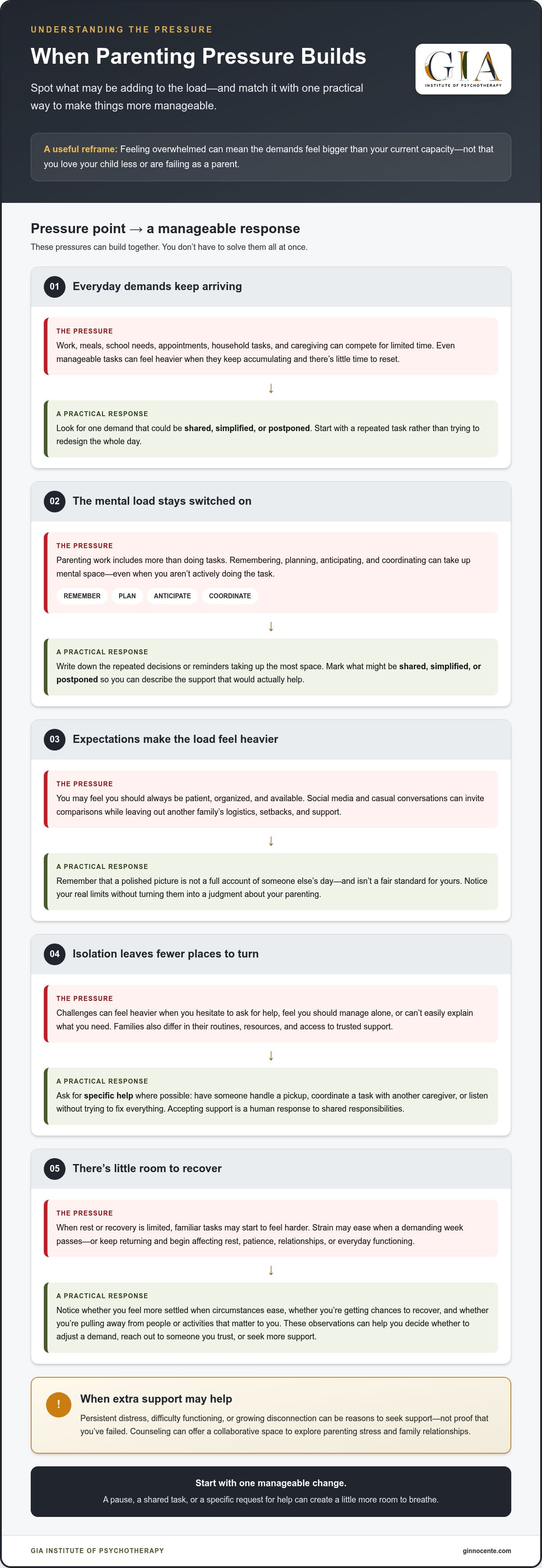
Parenting pressure often grows through accumulation. A permission slip, a work deadline, a grocery run, and a child who needs extra help may each seem manageable on their own. When tasks keep arriving and there’s little time to rest between them, the mind and body have fewer chances to reset. Strain can build even when no single moment seems like “the reason.”
Families’ routines and resources differ, so the sources of pressure aren’t the same for everyone. Work schedules, caregiving arrangements, finances, a child’s changing needs, and access to trusted support can all affect how much a parent is carrying. Feeling overwhelmed as a parent may reflect this mix of demands, not a personal shortcoming.
The mental load behind everyday parenting tasks
There’s work in doing a task, and there’s work in remembering, planning, anticipating, and coordinating it. You might be tracking a toddler’s supplies, a school-age child’s activity schedule, or a teen’s appointments and changing commitments. In some families, one person holds much of that planning; in others, responsibilities are shared unevenly. Ask yourself: What takes up the most space in my mind, even when I’m not actively doing it?
Noticing that invisible work can make it easier to describe what support would actually help. Instead of saying, “I have too much to do,” identify the repeated decisions or reminders wearing you down. You could write them down, then mark what can be shared, simplified, or postponed. That won’t remove every constraint, but it can show where a task or piece of planning might be made more manageable.
When expectations and isolation add another layer
Some parents feel pressure to stay patient, organized, and available at all times, even when they’re tired or facing real limits. Social media and casual conversations can invite comparison while showing little of the logistics, setbacks, or support behind another family’s day. A polished picture isn’t a full account of someone else’s life, and it isn’t a fair standard for yours.
Isolation can make ordinary challenges feel heavier. You may hesitate to ask for help because you think you should manage alone, or because it’s hard to explain what you need. Accepting support is a human response to shared responsibilities, not evidence of poor parenting. Depending on what’s possible, you could ask someone to handle a pickup, coordinate a task with another caregiver, or listen without trying to fix everything.
Practical help or connection can create breathing room, though it can’t erase every source of stress. If expectations or family relationships are adding to the strain, counseling for parents and families can offer a collaborative space to explore what’s happening and consider workable ways forward.
What to Do When You Feel Overwhelmed as a Parent Today
When feeling overwhelmed as a parent, a long self-care checklist can feel like one more responsibility. You don’t have to reset your whole day. If it feels possible, try this flexible sequence and stop after any step that helps:
- Pause: Take a quiet moment or a few slow breaths if your surroundings allow. The aim isn’t to make stress disappear, just to create a little space before deciding what comes next.
- Name what’s most pressing: Ask yourself, “What am I feeling right now?” and “What do I need in the next few minutes?” Maybe you’re frustrated and need a brief break, or anxious and need to clarify one immediate task.
- Reduce one demand: Choose something that can wait or be made simpler. A nonessential errand, a less-than-perfect dinner, or a household task might be postponed without solving everything else.
- Ask for one specific kind of help: If someone is available, name a concrete task they could take on, such as picking up groceries or handling school pickup.
Pick one step, not all four, if that’s what fits today. A small reduction in pressure can be more realistic than a complete reset. If deciding feels difficult, list what needs attention and separate immediate needs from tasks that can wait. You don’t have to complete the whole list to make the next hour easier.
A brief pause before deciding what comes next
If you can safely pause, let your shoulders drop and take a few slower breaths. Then name the strongest feeling without judging it: “I’m worried,” “I’m irritated,” or “I’m exhausted.” Follow with one immediate need, such as water, a snack, a moment of quiet, or help with the next task. This pause won’t remove the underlying stress, but it may help you choose your next move with a little more clarity.
Ask for help in a way someone can act on
A clear request can be easier to respond to than a general “I need help.” You might ask someone to bring a meal, run one errand, watch the children while you rest, or listen for a few minutes without offering solutions. Shared support isn’t available to everyone, and that can make the load harder. If you don’t have a personal support network, community resources or professional counseling may be options to explore.
Match the request to what would ease the pressure most right now. If dinner is the immediate problem, asking for help with that may be more useful than trying to reorganize the whole week. If you’re unsure, consider what you’re using the most energy to hold in mind. Then ask whether that responsibility can be delayed, simplified, or shared.
These are invitations, not rules. A pause may not be possible while you’re caring for a child, and asking for help may take time or feel uncomfortable. Adapt the steps to your circumstances, or leave them for another moment. If overwhelm continues to affect your well-being or family relationships, counseling for parents and families can provide a collaborative space to explore what’s contributing to the strain and consider workable strategies.
When Parenting Overwhelm Keeps Returning: Signs to Seek More Support
A hard day can leave you depleted, but the feeling may soften after rest, a change in circumstances, or practical help. If distress keeps returning, grows more intense, or starts affecting how you move through everyday life, it may be worth paying closer attention. That doesn’t mean you’ve failed or that something is “wrong” with you. It means your experience deserves care.
There’s no universal timetable or checklist that determines when a parent should seek support. You might notice that you’re struggling to get through routine responsibilities, finding it harder to rest, reacting more sharply than you want to, or feeling increasingly distant from your child or other loved ones. These are prompts to check in with yourself, not diagnostic criteria.
Questions that can help you notice the impact
Consider how long the strain has been present and whether it’s easing, staying about the same, or intensifying. Has it affected your sleep, your ability to manage everyday responsibilities, or your connection with people you care about? You don’t need perfect answers. If reflecting feels difficult alone, try talking with someone you trust and describe what you’ve noticed.
It’s understandable to think you should be able to handle parenting stress on your own, especially if asking for help feels unfamiliar or uncomfortable. But needing support isn’t evidence that you should have managed better. Parenting involves care and responsibility, and no one has unlimited capacity. Sharing what’s difficult can be a way to look after yourself and the relationships that matter to you.
Support can begin with a trusted person, a practical conversation with someone involved in caregiving, or professional counseling. You don’t have to wait until you’ve reached a breaking point to talk. If the pressure is recurring or affecting family relationships, making room to understand what’s happening may help you identify what kind of support would feel useful.
What professional support can offer a parent
Therapy can provide a collaborative space to explore sources of stress, understand how they’re affecting you, and consider strategies that fit your circumstances. It can also offer a place to talk through family relationships with care and curiosity, rather than blame. Seeking therapy is a choice, not a requirement for every parent who has a difficult stretch.
GIA Institute of Psychotherapy offers individual and family counseling in South Jersey, including Ocean City, Linwood, Margate, Ventnor, Egg Harbor Township, Upper Township, and Galloway. If you’re considering a supportive conversation about parenting stress, explore supportive therapy at GIA.
Finding Support as a Parent in South Jersey
Support doesn’t have to be a last resort, and exploring it doesn’t mean you’ve decided you can’t cope. It can be one choice among several, alongside help from people you trust, practical changes at home, or community connection. If feeling overwhelmed as a parent keeps affecting your well-being or family relationships, talking with someone may help you make sense of what’s weighing on you and consider what could make daily life more manageable.
There’s no single path that fits every parent. You might want space to reflect on your own stress, or you may want to talk together with family members about how pressure is shaping your relationships. Start with what feels hardest right now, even if you’re not sure what kind of support you need. Naming the concern is enough to begin a conversation.
How therapy can fit into a parent’s support system
Therapy can complement, rather than replace, practical help and personal connection. Individual counseling offers a place to explore your feelings and consider strategies that fit your circumstances. Family counseling can make room to talk about shared stress, communication, and relationships. Neither is a required step for every parent, and you don’t need to have everything figured out before considering whether it might be useful.
At GIA Institute of Psychotherapy, counseling for adults and families provides a collaborative space to explore parenting stress and reflect on workable next steps. The conversation can begin with the concerns you bring, whether you’re feeling depleted, looking for more clarity, or noticing tension in family relationships. Support is personal. The choice to seek it, and what you hope to discuss, belongs to you.
A gentle next step toward feeling less alone
If reaching out feels like a big step, write down one sentence about what has been hardest lately. Perhaps it’s the constant planning, a difficult change in your family, or the sense that there’s little room to recover. You can bring that starting point into a conversation without needing a polished explanation or a plan for everything that comes next.
GIA serves families and individuals in Ocean City, Linwood, Margate, Ventnor, Egg Harbor Township, Upper Township, and Galloway, New Jersey. If learning about counseling feels like a helpful next step, you’re welcome to Learn about counseling and support at GIA. You don’t have to decide everything today. One thoughtful conversation can begin with simply sharing what’s been on your mind.
Make Room for Support, One Step at a Time
Feeling overwhelmed as a parent doesn’t have to be something you hide or solve all at once. Begin by noticing what feels hardest and considering what kind of support would help. That may be a conversation with someone you trust, a change in how responsibilities are shared, or professional counseling. Choosing support is a way to care for yourself and your family, not a measure of whether you’ve been strong enough.
For parents who want to explore counseling, GIA’s therapeutic approaches include CBT, DBT, EMDR, Internal Family Systems, Play Therapy, and Expressive Arts. These approaches offer different ways to work through concerns. A conversation can start with your experience and questions, then focus on what feels relevant to you and your family.
You don’t need a perfect plan before taking a next step. If you’re ready to explore counseling, learn about supportive counseling at GIA. Start with what’s been weighing on you and take the conversation one step at a time.
Frequently Asked Questions
Is it normal to feel overwhelmed as a parent?
Yes, it can be normal to feel overloaded by parenting at times, and the feeling alone doesn’t mean you’re doing something wrong. Parents have different temperaments, demands, and resources, so there’s no single way this should feel or a fixed point at which it becomes unusual. If shame is making it hard to talk about, consider how you’d respond to a friend describing the same day.
Can feeling overwhelmed affect my relationship with my child?
It can influence how much patience or attention you have available, especially during a demanding stretch, but that doesn’t define your relationship. A tense interaction doesn’t erase the care between you. When you’re ready, a simple repair can help: acknowledge that you sounded frustrated, reassure your child that it wasn’t their job to manage your feelings, and reconnect in a way that feels natural for their age.
How can I ask for help when I feel overwhelmed as a parent?
Make the request specific and clear about what would help. For example, you could say, “Could you pick up the prescription on your way home?” or “Can you stay with the kids while I make this call?” A concrete request gives the other person something manageable to respond to. If they can’t help, you can ask whether they know someone or another resource that might.
What if I do not have a support system as a parent?
Not having nearby family or trusted friends can make parenting feel more isolating, but support can come from more than one place. You might explore a community group, a school or community resource, or professional counseling. GIA Institute of Psychotherapy offers individual and family counseling in South Jersey, including Ocean City, Linwood, Margate, Ventnor, Egg Harbor Township, Upper Township, and Galloway.
Can parenting overwhelm happen even when everything seems fine?
Yes. A family may appear to have a steady routine while a parent is privately carrying worry, loneliness, pressure to meet personal standards, or the strain of a life transition. There may be no obvious crisis or single event to point to. Your feelings still matter. Rather than judging whether you “should” be stressed, notice what has been taking energy and what you may need more of.
When should I consider therapy for parenting stress?
You might consider therapy if stress is lingering, feels difficult to manage alone, or is affecting how you function or relate to loved ones. You don’t need to wait for a crisis or arrive with a clear diagnosis. Counseling can be a place to talk through what’s happening, understand your needs, and explore practical ways forward. It’s one possible form of support, not a requirement for every parent.


