

What if a blended family could grow closer without asking anyone to feel close before they’re ready? Household changes can bring tension between adults, children, and step-siblings, especially when expectations differ or someone feels caught between loyalties. Seeking blended family counseling Galloway NJ doesn’t mean anyone is to blame. It can give family members a supportive place to understand recurring disagreements and make room for each person’s perspective.
It’s natural to hope a new household will begin to feel like one family, while recognizing that trust and belonging take time. Counseling can help you communicate more clearly, work through competing expectations, and build connection at a pace that respects everyone. GIA Institute of Psychotherapy offers family therapy for people in Galloway and nearby South Jersey communities, using practical strategies to support families through life transitions and relationship challenges.
In this article, you’ll learn how counseling can support adjustment, address loyalty conflicts, and help family members develop relationships without pressure to follow the same timeline.
Key Takeaways
- Care, loyalty, grief, uncertainty, and hope can all be present during a family transition. Making space for these feelings can clarify what each person needs.
- Notice recurring conflict patterns and describe specific situations to make conversations more useful and less focused on blame.
- Blended family counseling Galloway NJ can help families work through differing expectations and find communication strategies that fit their relationships.
- Prepare by naming your main concerns, noticing when tension tends to arise, and choosing one realistic goal for your first conversations.
- GIA Institute of Psychotherapy offers family therapy to support Galloway families through relationship challenges and change with practical, collaborative care.
Why blended family counseling in Galloway, NJ can help during family transitions
A family’s structure can change faster than its relationships. Adults may be building a partnership while children adjust to new routines, unfamiliar roles, or changes in time with a parent. Even when people care about one another, the transition can bring grief about what has changed, loyalty to important relationships, uncertainty about what comes next, and hope for the future. These feelings can coexist; none means a family is doing something wrong.
Blended-family counseling supports communication, adjustment, and relationships as a family system changes. The goal isn’t to assign fault or make everyone feel the same way. Counseling creates space for family members to understand one another and work toward clearer, more workable ways of relating.
There’s no single timetable for feeling at home together. One child may welcome a step-sibling while another needs more time. An adult may be ready to share family traditions before a child feels comfortable with them. Different paces aren’t proof that the transition has failed. In blended family counseling Galloway NJ, families can explore what each person is experiencing and consider next steps without treating closeness as something that can be demanded.
For a broader overview of family structures and dynamics, see this guide to understanding stepfamilies. Every family’s experience is individual, but recognizing that roles and relationships may shift can help explain why ordinary changes sometimes feel emotionally charged.
Why a new family structure can feel complicated
New household routines, expectations, and relationships can reshape familiar roles. A parent might be figuring out how to set limits with a partner’s child, while a child wonders whether welcoming a stepparent means being disloyal to a parent elsewhere. These tensions don’t arise in every family, and they don’t necessarily mean anyone is acting in bad faith.
People may show uncertainty in different ways. A child might withdraw, argue about a new rule, or repeatedly ask what will happen next. An adult may focus on schedules or discipline while privately feeling unsure about how to belong. Looking beyond the immediate reaction can help reveal the concern it may be communicating.
What counseling can make room for
A therapeutic setting gives family members room to describe their experiences and listen without having to settle every disagreement immediately. With support, they can identify misunderstandings, name needs more clearly, and talk through expectations about routines, privacy, responsibilities, or family time.
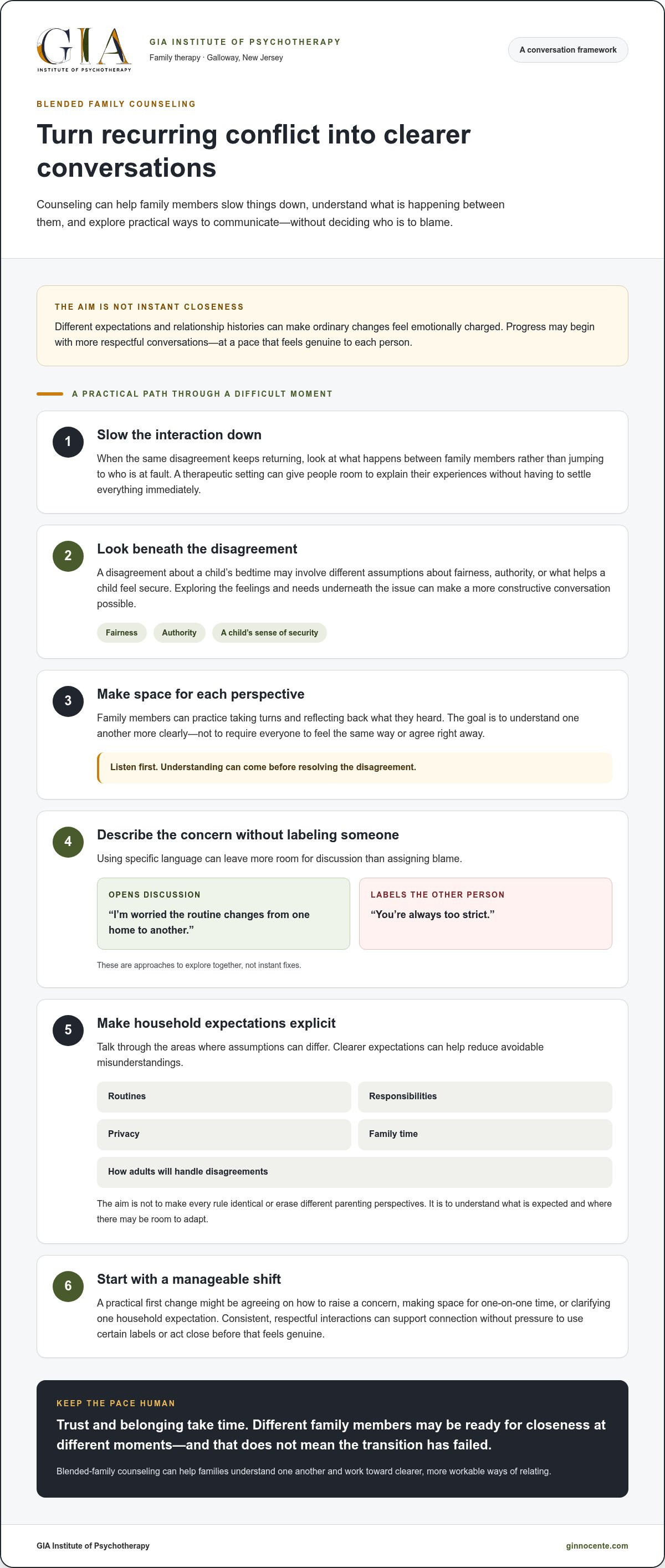
Progress can begin with modest, practical shifts: agreeing on how to raise a concern, making space for one-on-one time, or clarifying a household expectation. Connection can grow through consistent, respectful interactions, not pressure to use certain labels or act like a close-knit family before that feels genuine.
Family therapy can make recurring patterns easier to discuss and give each person’s perspective a place in the conversation. For families in Galloway, NJ, this support can offer a thoughtful starting point for understanding the transition and deciding what feels manageable next.
How blended family counseling supports communication and trust
Recurring conflict can make it seem as though family members disagree about everything. Counseling offers a chance to slow the interaction down and look at what happens between people, rather than deciding who is at fault. An argument about a household rule, for example, may involve different assumptions about fairness, authority, or what helps a child feel secure. Understanding those layers can open the way to a more constructive conversation.
In blended family counseling Galloway NJ, the work can be collaborative: family members share their perspectives, listen to one another, and consider practical ways to communicate. Progress may mean having more respectful conversations before anyone feels close.
Turning recurring conflict into clearer conversations
Imagine adults disagreeing about a child’s bedtime. One may value a consistent routine, while another worries a new rule feels too strict or was introduced without enough discussion. Rather than treating the disagreement as proof that someone is unreasonable, counseling can help the family explore the feelings and needs underneath it.
With support, family members might practice taking turns, reflecting back what they heard, or describing a concern without labeling another person. For example, “I’m worried the routine changes from one home to another” leaves more room for discussion than “You’re always too strict.” These approaches are options to explore together, not instant fixes. A therapist can help families consider which words and habits feel useful in their own conversations.
Clear communication also means making expectations explicit. Talking through routines, responsibilities, privacy, and how adults will handle disagreements can reduce avoidable misunderstandings. The aim isn’t to make every rule identical or erase different parenting perspectives. It’s to help people understand what’s expected and where there may be room to adapt.
Building trust while respecting different relationships
A stepparent doesn’t have to immediately mirror a parent-child bond. Relationships have their own histories and develop through shared experience. Children can be encouraged to treat a stepparent respectfully while maintaining important connections with a parent. Respecting those existing bonds can help new relationships grow without making anyone feel asked to replace or choose between people they care about.
Trust is often supported by ordinary, repeated moments: following through on an agreement, listening without rushing to correct, or allowing a child time to get comfortable. Counseling can help families discuss what respect and belonging might look like in their household, rather than relying on assumptions about how a family should act.
Shared expectations can help adults coordinate how they respond to conflict while leaving space for each relationship to be different. One person may be ready for more shared activities; another may prefer a slower introduction. Naming those preferences can make it easier to find manageable ways to spend time together without turning participation into a test of loyalty.
For families who want support putting these conversations into practice, family therapy support provides a collaborative setting to work on communication and trust at a pace that respects each person.
Is blended family counseling in Galloway right for your family?
A common worry is that family counseling will identify one person as the problem. It doesn’t have to work that way. Family therapy can focus on relationships and interactions across the family, making room for different perspectives rather than deciding who is at fault. The question isn’t whether one person needs to change. It’s whether your family could use support understanding what’s happening between you and finding a workable way forward.
You don’t need to wait until every relationship feels strained. Support may help when disagreements keep returning, adults struggle to align expectations, or family members find it hard to talk about changing roles. A major transition can also bring questions even when arguments are infrequent. Seeking support can be a thoughtful way to make sense of change, not a sign that your family is failing.
Common concerns that may bring a blended family to counseling
Families may want help with recurring tension around communication, boundaries, household routines, or who takes the lead in a particular situation. Sometimes the concern is less about conflict and more about uncertainty: a parent may be unsure how to introduce a new expectation, or a stepparent may be trying to understand their role. These questions can be explored without treating ordinary adjustment as evidence that someone is behaving badly.
Consider whether the concern is affecting how family members relate, make decisions, or spend time together. You might notice that a conversation about responsibilities regularly turns into an argument, or that people avoid raising a sensitive topic altogether. Those patterns can offer a starting point for discussion, not a diagnosis of any child or adult.
Responding to worries about blame or forced closeness
It’s understandable if someone feels hesitant. They may worry that a therapist will take sides, that they’ll be expected to share more than feels comfortable, or that counseling will demand affection before a relationship is ready. Reluctance can reflect uncertainty or a need to feel safe. It doesn’t automatically mean a person doesn’t care about the family.
In blended family counseling Galloway NJ, the shared focus can be how family members communicate and what kind of respect they want to build, rather than requiring instant affection or agreement. Family therapy brings attention to relationships and patterns across the household. Individual therapy, by contrast, centers on one person’s experiences and goals; couples counseling focuses on the couple’s relationship. Each form of support has a different focus.
Before deciding, you might ask yourselves: What keeps coming up? Is there a change we’re finding difficult to talk about? What would make a conversation feel more respectful? You don’t need identical answers. A first step can simply be recognizing that the family is facing a shared adjustment and that each person may describe it differently.
Choosing counseling doesn’t mean everyone has to feel ready at once or share the same goal. It can begin with a willingness to understand one another more clearly, while keeping expectations grounded in what feels possible now.
How to prepare for blended family counseling in Galloway, NJ
You don’t need a polished account of every disagreement before beginning family therapy. A few honest observations can help you describe what feels difficult and what you’d like to understand. Preparation isn’t about proving who’s right. It’s a way to arrive with a starting point while staying open to what other family members may be experiencing.
Try this simple sequence:
- Identify a concern: Name one issue you’d like to discuss, such as confusion about household expectations or difficulty bringing up a sensitive subject.
- Notice the pattern: Consider when the issue tends to arise, how people respond, and what happens afterward.
- Choose a first goal: Pick something realistic, like having a calmer conversation about a routine or understanding another person’s perspective more clearly.
Choose a starting point without rehearsing a perfect story
Each person can consider what they hope might feel different at home. One adult may want clearer communication about parenting decisions, while a child may wish for less tension during shared activities. If it helps, jot down recurring situations, moments when the family works well together, and questions you’d like to ask the therapist. You don’t need a complete solution or matching goals before you begin.
Specific descriptions make a useful starting point. Instead of saying, “My stepchild is selfish,” you might explain, “We argue about sharing the living room after school.” That shift keeps the focus on an experience the family can explore rather than a fixed judgment about someone’s character. Include strengths, too: perhaps one family member is good at checking in, or a routine already helps mornings go smoothly.
Make room for children and adults to participate
Children and adults may need different ways to express themselves. A therapist can help consider developmentally appropriate ways to hear each person, so a child isn’t expected to explain a complicated situation in adult terms. Before sessions, adults can invite children to share what they think without suggesting the “right” answer. Listening with curiosity can help children feel that their perspective matters, even when adults see events differently.
Who participates can depend on the family’s concerns and therapeutic goals. The whole household doesn’t have to fit one fixed formula. Some conversations may involve several family members; others may focus on a smaller group or a particular relationship. Those choices can be discussed in therapy with attention to what feels useful and manageable for the family.
Families seeking blended family counseling Galloway NJ may also be adjusting to new routines, school schedules, or time between households across Atlantic County. For families in Galloway, Egg Harbor Township, Upper Township, Linwood, Margate, Ventnor, and Ocean City, bringing up these practical details can help the therapist understand the setting around the family’s concerns and tailor the conversation to daily life.
If you’re ready to talk through a starting point with a family therapist, connect with GIA Institute of Psychotherapy about family therapy support.
Take a supportive next step with GIA family therapy in Galloway
Blended family changes can raise questions that don’t have simple, immediate answers. GIA Institute of Psychotherapy offers family therapy for families in Galloway, NJ, and nearby South Jersey communities, including Ocean City, Linwood, Margate, Ventnor, Egg Harbor Township, and Upper Township. The practice approaches family concerns with warmth and collaboration, helping people explore relationships and life transitions without turning therapy into a search for someone to blame.
Each family brings its own history, strengths, and hopes for what home can feel like. Rather than expecting everyone to share the same perspective, therapy can make room for those differences and identify what the family would like to work on together. A first conversation can start with one concern, even if you’re still figuring out what support might look like.
A collaborative approach to family relationships
Family therapy can help family members notice recurring patterns and consider new ways of relating. GIA works with children, teens, adults, couples, and families, supporting people across relationships and life stages. The focus can stay on your family’s goals, existing strengths, and evolving needs, with practical strategies to support understanding and communication.
GIA’s approach blends traditional therapy with neuroscience-informed perspectives. Expressive modalities may also be incorporated when appropriate to individual needs. These approaches support the therapeutic process; they aren’t a one-size-fits-all formula for blended families. The work can be shaped around the questions and relationships your family brings, while respecting that each person may engage or adjust at a different pace.
For example, a family might want to understand why a recurring interaction feels difficult while finding a more useful way to talk about expectations. Therapy can hold both aims: building personal understanding and exploring practical steps that fit daily life. The focus remains on making sense of relationship patterns, not assigning each person a fixed role.
Begin with a conversation about what your family needs
You don’t have to wait until conflict feels unmanageable to seek support. Reaching out during a transition can give a family room to talk about what’s changing and what feels uncertain. Parents, stepparents, and children may not describe the concern in the same way, and that’s a reasonable place to begin.
As you consider blended family counseling Galloway NJ, you might share the situation you’d like help understanding, what you hope could feel different, or what makes starting therapy feel difficult. You don’t need to arrive with a complete plan. A conversation can help clarify what matters to your family and what a thoughtful next step could be.
If your family is ready to explore support, reach out to GIA Institute of Psychotherapy to begin a conversation about family therapy.
Take one thoughtful step toward connection
Your family doesn’t need to have every answer before moving forward. A helpful next step can be choosing one question you’d like to approach with more care, such as how to make a difficult conversation feel safer or how to honor different needs at home. That intention can give you a place to begin without asking anyone to predict how quickly relationships will change.
Blended family counseling Galloway NJ can offer a space to explore that next step with curiosity and support. You can arrive with uncertainty, mixed feelings, or simply a wish to understand one another a little better. The process can start with what matters to your family now, while leaving room for goals to take shape over time.
If you’re ready to explore support, contact GIA Institute of Psychotherapy to begin a conversation about family therapy. Building connection doesn’t require a perfect beginning. A thoughtful conversation can be one.
Frequently Asked Questions
Does blended family counseling require every family member to attend?
No, every family member doesn’t necessarily need to attend each session. Participation can be considered in light of the concern, everyone’s needs, and the goals being discussed. For example, parents might begin by describing a scheduling challenge before deciding whether a child’s perspective would be helpful in a later conversation. Families in Galloway and nearby Egg Harbor Township can raise questions about participation early, without needing to settle the format themselves.
Can blended family counseling help if a child does not want a stepparent relationship?
Yes, counseling can support a family without expecting a child to feel affection on demand. A child’s hesitation might reflect uncertainty about a changing routine, discomfort with a new role, or a wish to protect an existing relationship. Adults can explore how to respond with care while making everyday interactions respectful. The aim can be to understand the child’s experience and support trust, not demand that a particular bond form.
What if one parent or stepparent is unsure about counseling?
It’s okay to be unsure, especially if someone worries that therapy will take sides or turn concerns into accusations. A helpful place to start is naming that worry directly: “I want us to talk about this without deciding who’s at fault.” Even if family members aren’t aligned about attending, they can clarify what feels uncomfortable and what they would need from a conversation to feel heard.
Is blended family counseling the same as couples counseling?
No, the focus is different, though family and couple concerns can overlap. Couples counseling centers on the partners’ relationship, while family therapy can examine interactions and expectations involving other family members. For instance, a disagreement between partners about how to respond to a child may affect both the couple and the wider household. Describing where tension shows up can help clarify which relationships the family wants to focus on first.
Can counseling help when step-siblings have trouble getting along?
It can help family members look at what may be shaping step-siblings’ interactions, such as shared-space expectations, different routines, or uncertainty about how to spend time together. The goal doesn’t have to be friendship. A practical starting point might be agreeing on how to ask before borrowing belongings or how to handle disagreements over a shared room. Those agreements can support respectful interaction while the relationship develops naturally.
How should we explain counseling to children before the first visit?
Use straightforward language that suits the child’s age, such as, “We’re getting help talking about changes at home.” Reassure them that they’re not in trouble and that adults are also working on family relationships. Invite questions without promising that everyone will agree afterward. A child might want to know whether they can share their own view; you can explain that their feelings matter and they can talk about what’s on their mind.
How long does blended family counseling take?
There isn’t one timeline that fits every family. The process can depend on what the family wants to address, who is involved, and how needs shift as conversations unfold. Rather than trying to predict a fixed number of sessions, consider what you’d notice if counseling were useful, such as being able to discuss a recurring concern with less avoidance. Families in Linwood, Margate, Ventnor, Upper Township, and Ocean City can also bring local routines and transitions into those discussions.


