

What if asking for support doesn’t mean something is wrong, but simply that you’d like more room to understand what you’re carrying? College can bring academic pressure, changing relationships, new independence, and big questions about the future, sometimes all at once. If you’re exploring therapy for college students Egg Harbor Township NJ, you may be wondering whether your concerns are “serious enough” or what you’d be expected to share.
You don’t need a diagnosis or a crisis to begin a thoughtful conversation. Therapy can offer a respectful space to make sense of stress, recognize emotional patterns, and consider practical ways to cope. You can ask questions, share at a pace that feels comfortable, and work collaboratively toward greater clarity.
This article explains how therapy may support college-aged adults through school, relationships, and life transitions, what sessions can involve, and how different approaches may fit your needs. You’ll also find practical ways to prepare for a first conversation, even if you’re not sure where to start.
Key Takeaways
- Understand how therapy can help college-aged adults work through everyday pressures without treating normal challenges as a diagnosis.
- Turn concerns about classes, relationships, or life changes into manageable goals you can revisit over time.
- Compare common therapy approaches, including CBT, DBT, EMDR, and Internal Family Systems, to understand what each may bring to the conversation.
- Explore therapy for college students Egg Harbor Township NJ as a collaborative way to build practical strategies and emotional clarity.
- Prepare for a first conversation by noting what feels difficult and what you hope might change.
When college life feels heavy: how therapy can help students near Egg Harbor Township
College can bring freedom and possibility alongside pressure, uncertainty, and change. A student may be building independence while keeping up with classes, relationships, work, or family expectations. For students attending Stockton University or Atlantic Cape Community College, these experiences may be part of a broader transition into adulthood. Therapy for college students Egg Harbor Township NJ can provide time to pause and reflect, without treating ordinary challenges as proof that something is wrong.
Therapy isn’t a test or a judgment. It can be a collaborative space to understand emotions, explore what may be contributing to stress, and consider practical ways to respond. The mental health of college students is shaped by personal and environmental factors, and each student’s experience is different. The examples below are possible topics for conversation, not a checklist for diagnosing yourself.
What college students may bring to therapy
Academic pressure may show up as difficulty concentrating, falling behind, or feeling unsure about motivation. Students might also want to talk about anxiety, loneliness, conflict with friends or partners, or changing relationships as schedules and priorities shift. Transitions can be challenging even when they’re expected. Moving away, returning home between semesters, or reconsidering a major or future plan can bring up mixed feelings.
Sometimes the hardest part is not knowing how to describe what feels wrong. A student doesn’t need one clear problem or a polished explanation to begin. Therapy can help them sort through a general sense of being overwhelmed and identify which concerns feel most important to address.
When support may feel worth exploring
It may be worth considering support when distress keeps returning, feels difficult to manage, or starts to make everyday routines harder. That could mean trouble getting started on tasks, withdrawing from people, or struggling to make time for rest. These experiences don’t automatically point to a diagnosis. They can simply be a reason to make space for reflection and consider new ways forward.
Reaching out can be a proactive choice, not a sign of failure. Students can bring questions, set the pace of the conversation, and decide what they feel ready to share. Therapy is collaborative support for understanding your emotions and considering practical changes that fit your life.
What college student therapy can work on: stress, relationships, and transitions
College student therapy is individualized support for emotional well-being and the challenges that can come with this stage of life. The focus isn’t to fit a student into a label. It’s to understand what matters to them, consider what they’d like to feel or handle differently, and explore useful steps at a pace they help set.
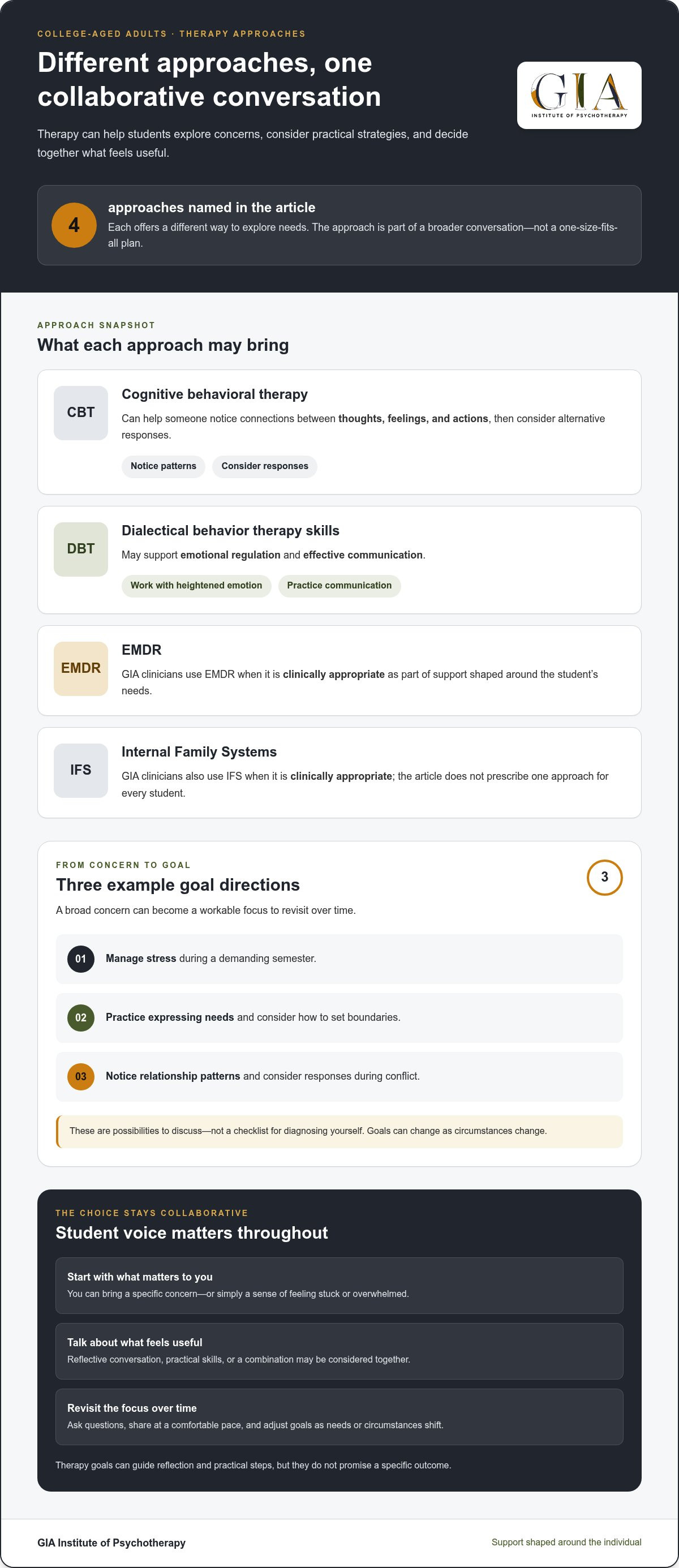
A concern may start out broad: “I feel stuck,” “I’m overwhelmed,” or “I keep having the same argument.” In therapy, a student and therapist can shape it into a workable goal, such as finding ways to manage stress during a demanding semester, practicing how to express needs, or noticing patterns in relationships. Goals can change as circumstances do. A concern that feels central during finals may look different after a break or a change in plans.
Turning an overwhelming concern into a workable therapy goal
Goals don’t need to be ambitious or permanent. A student might begin by exploring what makes it hard to start assignments, then later focus on balancing school with rest. Another may want to understand why setting boundaries feels uncomfortable or how to respond during moments of heightened emotion. These are possibilities to discuss, not signs that ordinary stress automatically calls for clinical treatment. The student can revisit what feels useful and adjust the focus with the therapist.
How therapy approaches can support different needs
Different approaches offer different ways to explore concerns. Cognitive behavioral therapy (CBT) can help someone notice connections between thoughts, feelings, and actions, then consider alternative responses. Dialectical behavior therapy (DBT) skills may support emotional regulation and effective communication. At GIA Institute of Psychotherapy, clinicians also use EMDR and Internal Family Systems (IFS) when clinically appropriate. The approach is part of a broader conversation about the student’s needs, not a guarantee of a particular result.
Therapy goals can guide reflection and practical steps, but they don’t promise a specific outcome. The student’s voice matters throughout: they can talk about what feels comfortable, ask questions, and help decide what to focus on next. For those exploring therapy for college students Egg Harbor Township NJ, this collaborative process can make support more personal than a one-size-fits-all plan.
GIA’s adult individual psychotherapy offers college-aged adults a supportive setting to work through life changes, use practical strategies, and understand emotional patterns.
Choosing therapy in Egg Harbor Township: what helps a college student feel understood?
A helpful fit starts with the student, not a therapy label. Consider what feels most important to discuss, what kind of support would feel respectful, and whether you’re looking for time to reflect, practical skills, or a combination. You don’t need to know which approach is right before beginning. A therapist can explain how different approaches may relate to your concerns and make room for your questions.
Questions a student can use to reflect on fit
Ask yourself: What would I like help understanding? Do I feel listened to rather than judged or rushed? Can I share my preferences and help shape the focus? Trust doesn’t have to appear all at once. A respectful, collaborative conversation can help shared goals take shape over time. It’s also okay to say when something doesn’t feel comfortable or useful.
Therapy approaches aren’t competing labels that a student has to choose perfectly. They offer different ways of working, and a therapist may draw on an approach based on the person, their concerns, and what feels appropriate.
| Approach | Common emphasis | A student might explore |
|---|---|---|
| CBT | Connections between thoughts, feelings, and actions | How self-critical thoughts affect motivation or stress |
| DBT | Emotional regulation and effective communication skills | Ways to manage intense feelings or express needs |
| EMDR | Working with distress connected to difficult experiences | Whether past experiences may be affecting present well-being |
| IFS | Understanding different inner reactions or “parts” | Why conflicting feelings may arise around choices or relationships |
These are broad descriptions, not promises of a particular result or instructions for self-diagnosis. The approach should support the student’s goals and comfort, and the conversation can adjust as needs become clearer.
Individual therapy and campus or community support
Individual therapy can offer space to explore emotional well-being and personal concerns. Academic advising generally focuses on educational planning, while campus-based support has its own role within a college community. Students near Stockton University or Atlantic Cape Community College can consider how these forms of support relate to their needs.
If you’re considering therapy for college students Egg Harbor Township NJ, GIA Institute of Psychotherapy provides adult individual psychotherapy for college-aged adults navigating change. The practice’s empathetic, collaborative approach makes room for practical strategies and emotional understanding. Explore adult individual psychotherapy as a place to begin.
Starting therapy while in college: practical steps for students around Egg Harbor Township
Getting started doesn’t require a complete plan. Begin by identifying one concern, choosing a small initial goal, and taking a first step toward a conversation. The concern might be feeling stuck with coursework, tension in a relationship, or uncertainty about what comes next. A goal could be understanding what contributes to that feeling or considering one practical way to respond.
A low-pressure first step is to name what’s been hard and what you’d like to understand better. You can start there, even if the next steps aren’t clear yet.
Preparing for an initial therapy conversation
A brief note can help organize your thoughts, but it doesn’t need to be polished. Jot down what’s been weighing on you, questions you have about therapy, and what you hope could change. For example: “I’ve been overwhelmed keeping up with classes, and I want to understand what might help.” If you’re unsure how to explain things, you can simply begin with “I’m not sure where to start.”
The conversation can develop from there. Share at your own pace, ask questions, and talk about what feels important or difficult to discuss. You don’t have to tell your whole story at once or arrive with a clear label for what you’re experiencing.
Making room for therapy alongside college responsibilities
Classes are only part of student life. Work shifts, commuting, family commitments, and time to rest may also shape what feels manageable. When considering ongoing support, think about the routines and responsibilities it needs to fit alongside. A realistic plan should take your circumstances into account rather than add unnecessary pressure.
Therapy goals can connect with everyday situations between conversations. A student might notice when stress rises before a deadline, try expressing a need more clearly in a relationship, or reflect on what helps them feel grounded during a demanding week. These observations can become useful topics to revisit, without expecting change to happen all at once. Commuters, residential students, and students balancing work may have different routines, so the focus can be shaped around the individual.
If you’re exploring therapy for college students Egg Harbor Township NJ, GIA Institute of Psychotherapy offers adult individual psychotherapy for college-aged adults navigating life changes. The work can focus on practical strategies and emotional understanding. Explore adult individual therapy with GIA and begin with what feels most important to you.
How GIA Institute supports college-aged adults in Egg Harbor Township
College-aged adults may be balancing new independence with questions about relationships, emotional well-being, and what comes after school. GIA Institute of Psychotherapy provides adult individual psychotherapy, including support for anxiety, depression, and life transitions. For students considering therapy for college students Egg Harbor Township NJ, this offers a place to explore what’s happening without needing to arrive with a diagnosis or a complete plan.
GIA’s empathetic, collaborative style keeps the student’s perspective at the center. A conversation can begin with what feels most pressing, then develop around the student’s priorities and goals. As circumstances shift, the focus can shift too. The aim is to build understanding and practical strategies that feel relevant to the student’s life, rather than impose a fixed path or pace.
A collaborative approach to student concerns
Therapy can make room to explore emotional patterns and consider how they connect with everyday challenges, such as responding to stress, communicating in relationships, or adjusting to a major life change. The student helps shape what gets discussed and can raise questions along the way. There’s no need to share everything immediately. A steady, respectful conversation can support greater clarity while honoring each person’s readiness.
Therapeutic approaches can inform the work
GIA’s clinicians use approaches including cognitive behavioral therapy (CBT), dialectical behavior therapy (DBT), eye movement desensitization and reprocessing (EMDR), and Internal Family Systems (IFS). These approaches can inform therapeutic conversations and support. For example, CBT may help explore patterns among thoughts, feelings, and actions, while DBT may inform work with emotional regulation and communication skills. EMDR and IFS may also be considered when clinically appropriate. No approach guarantees a particular outcome; the focus is on what may fit the person and their concerns.
Adult individual therapy may be relevant for a college-aged adult who wants help making sense of a transition, persistent worry, low mood, or relationship concerns. You don’t need a perfect explanation before beginning. It’s enough to bring a question, a feeling, or a sense that something has been difficult lately.
If you’re ready to explore support at your own pace, learn about GIA’s therapy services and consider whether adult individual psychotherapy feels like a helpful next step.
Take a thoughtful next step toward support
College can bring pressure, changing relationships, and questions about the future, but you don’t have to make sense of every challenge alone. Therapy can offer space to understand what’s affecting you, set goals that fit your life, and explore practical ways forward. You can begin without a diagnosis or a perfectly worded explanation.
For therapy for college students Egg Harbor Township NJ, GIA Institute of Psychotherapy offers adult individual psychotherapy and support for life transitions. Conversations are collaborative, with approaches such as CBT, DBT, EMDR, and Internal Family Systems informing the work when appropriate. GIA serves Egg Harbor Township, Ocean City, Linwood, Margate, Ventnor, Upper Township, and Galloway.
If you’re ready to explore whether this kind of support feels right, explore therapy with GIA Institute of Psychotherapy. Start with one question or concern and take the next step at your own pace.
Frequently Asked Questions
Can college students benefit from therapy even if they are not in crisis?
Yes. Therapy can support a student before concerns reach a crisis point. A student might want help understanding stress, adjusting to greater independence, or making sense of changing relationships. These experiences don’t automatically mean someone has a mental health diagnosis. Individual therapy can provide a supportive setting to reflect, clarify priorities, and consider practical ways to respond, whether the student is facing one clear challenge or simply wants more emotional clarity.
What issues can therapy help college students work through?
Therapy can help students explore concerns such as academic stress, anxiety, low mood, loneliness, motivation, and relationship changes. It may also offer support during transitions, such as moving away from home, returning home, or reconsidering future plans. The student and therapist can identify what feels most pressing and shape a manageable focus. These examples are possible topics for conversation, not a checklist for self-diagnosis or a sign that every challenge requires treatment.
How does therapy work for a college student in Egg Harbor Township, NJ?
Therapy for college students Egg Harbor Township NJ can begin with a conversation about what the student wants help understanding or changing. In adult individual psychotherapy, the student’s concerns and priorities guide the work, and goals can evolve as circumstances shift. GIA serves Egg Harbor Township and nearby communities, including Ocean City, Linwood, Margate, Ventnor, Upper Township, and Galloway. The practice’s approach is empathetic and collaborative, with attention to emotional understanding and practical strategies.
What type of therapy may be helpful for a college student?
The right approach depends on the person, their concerns, and what feels appropriate. CBT may help a student notice connections between thoughts, feelings, and actions. DBT may inform work on emotional regulation and communication skills. GIA clinicians also use EMDR and Internal Family Systems (IFS) when clinically appropriate. These approaches aren’t competing labels or guarantees of a particular outcome; they can help shape a collaborative conversation about the student’s needs.
Can a college student start therapy if they are unsure what to talk about?
Yes. A student doesn’t need a perfect explanation or a single clearly defined problem to begin. They might start by saying they feel overwhelmed, unsure, or simply not like themselves lately. Writing down a few questions or concerns can help, but it’s optional. The conversation can unfold gradually, with the student deciding what they feel ready to share and helping shape the focus as their needs become clearer.
How can a student fit therapy into a busy college schedule?
Start by considering the routines and responsibilities that shape the week, such as classes, commuting, work, family commitments, and time to rest. Thinking about those demands can help a student consider what feels manageable when exploring ongoing support. Therapy goals can connect with everyday situations, such as noticing stress around deadlines or practicing clearer communication. Each student’s circumstances differ, so the approach should make room for their real-life commitments.


