

What if a change in your child’s behavior is a reason to get curious, not a reason to jump to a diagnosis? If you’re considering a child therapist Galloway NJ families can turn to, it’s natural to wonder whether your child needs extra support and whether therapy will feel safe rather than blaming. Children can face difficult feelings and transitions without those experiences defining who they are.
Child therapy can offer a supportive space to express emotions, make sense of challenges, and build coping strategies at a pace that respects each child’s needs. Depending on the child and the therapeutic work, sessions may involve conversation, play, or expressive approaches. Parents can be included in ways that support progress while honoring the child’s space.
This article explores what child therapy may offer, what the process can involve, and how GIA Institute of Psychotherapy supports children and families in Galloway through child and teen therapy, family therapy, and school advocacy services. GIA also serves families in Ocean City, Linwood, Margate, Ventnor, Egg Harbor Township, and Upper Township. The focus is on understanding your child’s context and finding thoughtful next steps together, not rushing to label ordinary struggles.
Key Takeaways
- Changes in mood, behavior, or daily routines can be worth exploring without assuming they point to a diagnosis.
- A child therapist Galloway NJ families work with can tailor the process to a child’s age, concerns, and ways of communicating.
- Questions about blame, comfort, or fit can guide conversations about what therapy explores with your family.
- Before seeking support, note examples of what feels difficult at home, school, or in relationships, and identify what you’d most like help understanding.
- GIA’s child and teen therapy, family therapy, school advocacy, and varied therapeutic approaches can support different family needs.
When can a child therapist in Galloway, NJ, help?
There isn’t one behavior that automatically means a child needs therapy. Seeking support can be a thoughtful way to understand what’s changing and help a child feel heard. A child therapist Galloway NJ families consider may be helpful when worries, sadness, irritability, or behavior changes persist, feel difficult to manage, or begin affecting everyday life.
Look at the broader pattern. Is your child having a harder time participating in activities, connecting with friends, concentrating at school, or settling into familiar routines? A difficult transition or stressful period can affect a child without indicating a disorder. If distress continues or creates strain at home, school, or with peers, discussing support can help clarify what the child and family need.
Signs a child may benefit from additional emotional support
Pay attention to shifts in mood, sleep or other routines, relationships, and participation. A child who once enjoyed an activity may pull away; another might seem more frustrated or worried than usual. These changes are reasons to pause and listen, not proof of a diagnosis or a prescription for a particular treatment.
Notice whether a change happens occasionally or forms a pattern over time, and invite your child to describe what feels hard in their own words. What’s happening around them? What do they wish felt different? Their perspective adds important context to what caregivers observe.
How a child’s age and surroundings shape their needs
Children don’t all express distress the same way. Some can describe their feelings directly; others may communicate through play, behavior, or withdrawal. A younger child may have trouble naming a worry, while a teen may feel more comfortable talking after trust and privacy have been established. A warm, developmentally attentive approach makes room for these differences.
Family changes, school experiences, and peer relationships can all shape how a child feels. A move, conflict with friends, or classroom challenges may affect a child’s sense of safety and belonging. Child psychotherapy offers a broad introduction to the field and its goals, though each child’s circumstances are individual.
GIA Institute of Psychotherapy serves children and teens in Galloway and nearby communities, including Ocean City, Linwood, Margate, Ventnor, Egg Harbor Township, and Upper Township. This information is general guidance, not an assessment of any individual child. If you’re weighing whether to seek support, your observations and your child’s experience can be a helpful place to begin.
What child therapy in Galloway may look like
Child therapy is shaped around a young person’s concerns, developmental stage, and way of communicating. Rather than expecting a child to explain everything right away, a therapist can make room to explore what’s happening through conversation, play, or expressive activities, depending on the child and the therapeutic work.
Early conversations can help the therapist and family understand what feels difficult and identify goals together. A goal might be helping a child name feelings, work through a stressful situation, or find ways to respond to strong emotions. Goals can shift as the therapist learns more. Therapy doesn’t promise a particular outcome or follow one fixed path.
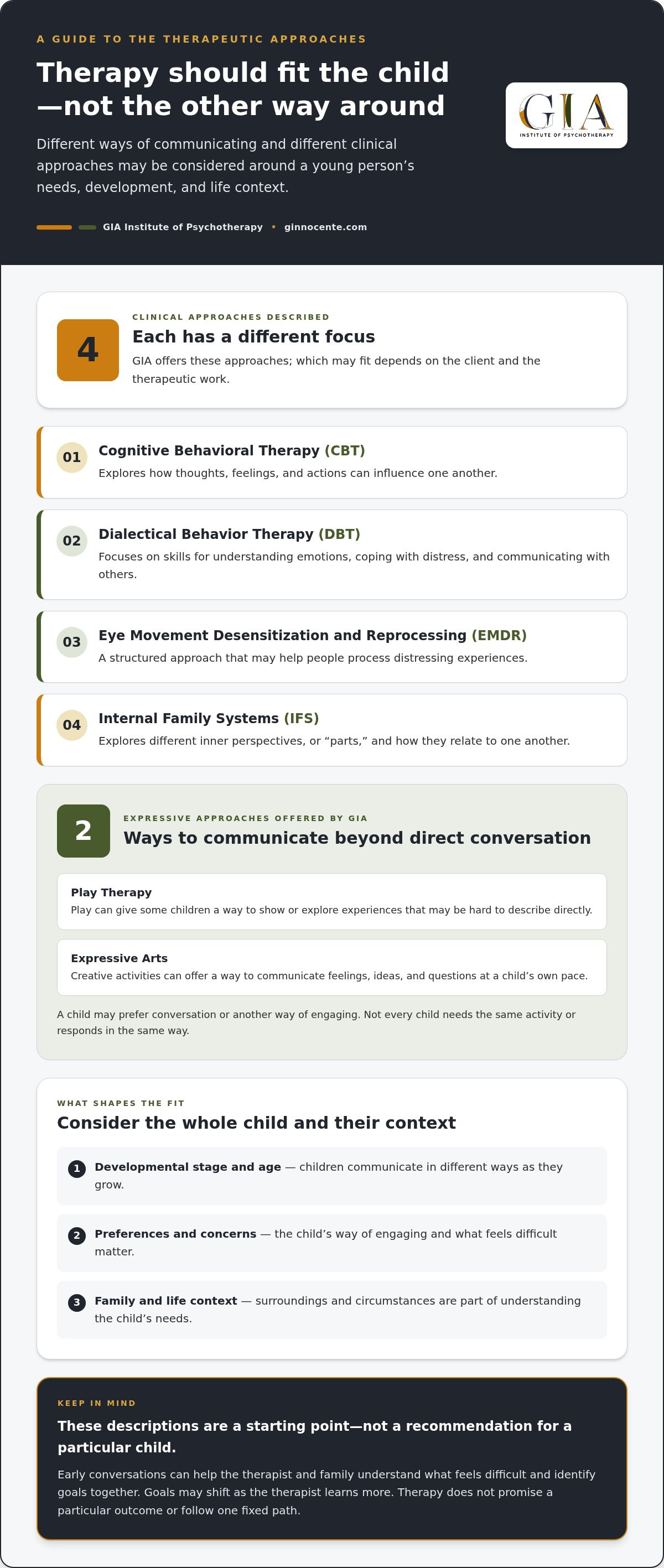
Therapy approaches should fit the child’s needs, developmental stage, and life context, not the other way around.
Play Therapy and expressive ways for children to communicate
Some children find it easier to show or explore an experience through play or creative activities than to describe it directly. Play Therapy and Expressive Arts can offer ways to communicate feelings, ideas, and questions at a child’s own pace. A therapist may use these approaches when they fit, while making space for a child who prefers conversation or another way of engaging.
GIA offers Play Therapy and Expressive Arts as part of its therapeutic approaches. Not every child needs the same activity or responds in the same way. The therapist considers the young person’s age, preferences, concerns, and family context when shaping the work.
Where CBT, DBT, EMDR, and IFS may fit
GIA also offers several clinical approaches that may be considered according to the client and therapeutic work. Their focuses differ:
- Cognitive Behavioral Therapy (CBT) explores how thoughts, feelings, and actions can influence one another.
- Dialectical Behavior Therapy (DBT) focuses on skills for understanding emotions, coping with distress, and communicating with others.
- Eye Movement Desensitization and Reprocessing (EMDR) is a structured approach that may help people process distressing experiences.
- Internal Family Systems (IFS) explores different inner perspectives or “parts” and how they relate to one another.
These descriptions are a starting point, not a recommendation for any particular child. Some approaches may be more appropriate than others depending on age, needs, and clinical context. A child therapist Galloway NJ families work with should tailor the process rather than assume one modality fits everyone. To learn more about individual therapy for children and teens, explore how GIA’s services support young people and their families.
How to think about fit when seeking a child therapist in Galloway
Therapy isn’t about blaming a child or deciding that a difficult moment defines who they are. It’s a chance to understand what may be behind a concern and consider supportive next steps. A good fit begins with a child being treated with warmth and respect, and caregivers being included in a thoughtful conversation about the child’s needs.
As you consider a child therapist Galloway NJ families may work with, focus on whether the approach makes space for your child’s perspective, communicates clearly, and takes their age and circumstances into account. The table below offers starting points for conversations, not conclusions about what a child needs.
| Caregiver concern | Possible support need | Questions therapy can explore |
|---|---|---|
| My child seems worried or withdrawn. | Space to express feelings and understand what feels difficult. | What situations feel hardest? What helps your child feel supported? |
| We’re having frequent conflict at home. | Support with communication, emotions, or family relationships. | What patterns are affecting connection? What might help conversations feel safer? |
| School or friendships seem stressful. | A chance to explore experiences across settings and identify concerns. | What does your child say is happening? Where do they feel understood? |
Can therapy help without making a child feel singled out?
How caregivers introduce therapy can shape how a child understands it. Use honest, age-appropriate language: “We’ve noticed things feel tough lately, and we’d like someone to help us understand what might make them easier.” Invite questions and listen to your child’s reaction. They may feel unsure or need time to warm up. Reassurance and patience can help without promising they’ll feel comfortable right away.
How parents and caregivers can be part of the process
Caregiver insight can help a therapist understand a child’s everyday world, while the child’s needs and voice remain central. Collaboration may mean sharing observations, thinking together about goals, and considering how support can carry into family life. If relationships or communication at home are part of the concern, GIA Institute of Psychotherapy also provides family therapy.
GIA offers individual therapy for children and teens, family therapy, and school advocacy services. Its warm, collaborative approach recognizes that a young person’s well-being is connected to relationships and surroundings. Fit isn’t about finding a perfect phrase or expecting immediate change. It’s about building a respectful process where the child and family can explore what support may be useful.
Preparing for child therapy in Galloway, NJ
Getting ready doesn’t mean you need to have every answer. Begin with what you’ve noticed and what you hope might feel different for your child. A few simple notes can help organize your thoughts, while leaving room for your child and a therapist to add their perspectives.
- Notice what’s changed. Think about mood, routines, participation, or relationships, and whether the concern appears in particular situations.
- Talk with your child. Use calm, age-appropriate language and invite their view. You might say, “I’ve noticed school has felt stressful lately. What’s that been like for you?”
- Identify your priorities. Consider what you’d like help understanding, such as strong emotions, family tension, or a difficult transition.
- Explore support. Share your observations and questions with a child therapist Galloway NJ families can turn to, without needing to name a diagnosis or select a treatment approach yourself.
What to discuss before starting
Plain language is enough. Describe what you’ve seen, how long it seems to have been going on, and what you’ve already tried. Note concrete examples, such as a child becoming upset before school, pulling away from a favorite activity, or struggling after disagreements with friends. You can also mention relevant changes in family life, school, or routines. These details provide context, not a diagnosis.
Make space for your child’s own account, too. What do they say feels hard? Are there moments when things feel easier? Caregivers can share important background while recognizing that a child may describe the same situation differently. Both perspectives can build a fuller understanding.
Connecting therapy with school and family support
Observations from home, school, and relationships can help adults notice where a child feels supported and where challenges arise. A child may seem relaxed at home but become quiet when discussing school, or tension may show up most during family routines. Sharing these patterns can help clarify what questions to explore.
If school-related concerns are part of the picture, GIA offers school advocacy services as a distinct support option. This is separate from individual therapy for children and teens or family therapy, which may be relevant when emotional concerns or family communication are central. The right support depends on the family’s priorities and the child’s context.
You don’t need a perfect plan before taking a next step. To explore care for children, teens, and families, learn about GIA’s therapy services.
Child and family therapy with GIA Institute in Galloway
Finding support can begin with a simple question: what would you hope feels easier for your child or family? Perhaps your child is struggling to express what’s wrong, everyday interactions have become tense, or school concerns are affecting their well-being. You don’t need to arrive with a diagnosis or a complete plan. Sharing what you’ve noticed and what matters to your family is a meaningful place to start.
GIA Institute of Psychotherapy provides individual therapy for children and teens, family therapy, and school advocacy services. These options address different parts of a family’s experience. Individual therapy centers on the young person’s concerns; family therapy can support work on relationships or communication; school advocacy may be relevant when school experiences are part of the picture.
A collaborative approach for children, teens, and families
Care begins with listening to the child and caregiver, while recognizing that each family has its own history, strengths, and pressures. A child may be more comfortable expressing themselves through conversation, play, or creative activities. GIA offers approaches including Play Therapy and Expressive Arts, alongside other clinical approaches. The fit depends on the child and the therapeutic work, rather than assuming a single method suits everyone.
That flexibility matters. A young person’s needs can’t be understood through a behavior alone; relationships and circumstances also shape their experience. Support can make room for the child’s voice and caregiver observations without promising a particular plan, outcome, or timeline. If family communication is one of your concerns, GIA’s family therapy offers a way to include that part of the picture.
Finding support close to home in Galloway and nearby communities
GIA serves children, teens, and families in Galloway, Ocean City, Linwood, Margate, Ventnor, Egg Harbor Township, and Upper Township. For families looking for a child therapist Galloway NJ residents can consider, knowing that the practice serves the area is a useful starting point. Care is rooted in a warm, relatable approach that considers a young person within their family and community, not in isolation.
You can begin by sharing what you hope might change or feel easier, even if you’re still sorting through the questions. There’s no need to have everything figured out before exploring support. When you feel ready, connect with GIA Institute of Psychotherapy to learn more about care for children, teens, and families.
Take a thoughtful next step for your child
Seeking support doesn’t mean your child has been judged or labeled. It can be a way to better understand what they’re experiencing and consider what might help. Notice patterns over time, listen to your child’s perspective, and remember that therapy can be shaped around their age, needs, and way of communicating.
For families considering a child therapist Galloway NJ, GIA Institute of Psychotherapy offers individual therapy for children and teens, family therapy, and school advocacy services. GIA serves Galloway and nearby communities, including Ocean City, Linwood, Margate, Ventnor, Egg Harbor Township, and Upper Township, with a warm, collaborative approach to supporting children and families.
You don’t need every question answered before exploring care. Sharing what you hope might feel easier can be a meaningful first step. Connect with GIA Institute of Psychotherapy to learn more about support for your child and family.
Frequently Asked Questions
How do I know if my child needs a therapist?
A child may benefit from additional support when emotional or behavioral changes persist, cause distress, or make daily life at home, school, or with peers harder. If you’re considering a child therapist Galloway NJ families can access, notice patterns and ask your child what feels difficult. No single behavior proves a disorder or means therapy is required; a conversation can help you explore what support, if any, may be useful.
Can child therapy help with anxiety or difficult life changes?
Therapy can give children a supportive place to explore worries and adjust to changes, such as a family transition, a new school experience, or challenges with friends. The therapist can work with the child and family to understand what feels hard and consider goals together. Each child’s needs are different, so the process is tailored rather than based on a guaranteed result or a fixed timeline.
What happens during child therapy?
Child therapy is shaped by the child’s concerns, age, and ways of communicating. Sessions may involve conversation, play, or expressive activities, depending on what fits the therapeutic work. A therapist may help the child explore feelings, experiences, or coping strategies, while caregivers share relevant context. The process can develop over time, and the approach may be adjusted as the child’s needs become clearer.
Should parents participate in their child’s therapy?
Caregivers can be an important part of understanding and supporting a child’s needs. Sharing observations about home, school, or relationships may provide context, while the child’s perspective remains central. How family collaboration looks can depend on the child and the therapeutic work. GIA Institute of Psychotherapy also offers family therapy when family relationships or communication are part of the concern.
Is play therapy appropriate for every child?
No. Play Therapy is one option, not a universal fit. Some children may find play or creative activities helpful for expressing experiences, while others may prefer conversation or another approach. GIA offers Play Therapy and Expressive Arts, with approaches tailored to the individual and the work. A child’s age, preferences, concerns, and circumstances all matter when shaping therapy.
Can a child therapist in Galloway work with school-related concerns?
Yes. School experiences can be part of understanding a child’s well-being, and GIA offers school advocacy services as a distinct support option. The practice serves families in Galloway and nearby communities, including Egg Harbor Township, Upper Township, Ocean City, Linwood, Margate, and Ventnor. Sharing observations about what a child experiences at school can help clarify which kind of support may be relevant.
Does child therapy mean my child has a mental health diagnosis?
No. Considering therapy doesn’t mean a child has a diagnosis, and a difficult feeling or behavior alone doesn’t establish one. Therapy can be a way to explore what a child is experiencing, build understanding, and consider supportive strategies without treating ordinary challenges as proof of a disorder. GIA provides individual therapy for children and teens, with care shaped around the child’s needs and context.


