

What if a conversation through a screen could still feel personal, steady, and meaningful? It’s understandable to wonder whether virtual counseling will feel distant, or to feel unsure about the technology, privacy, or what to say. For people exploring virtual counseling Ocean City NJ, support can begin without having perfect words or rearranging the whole day to travel to an appointment.
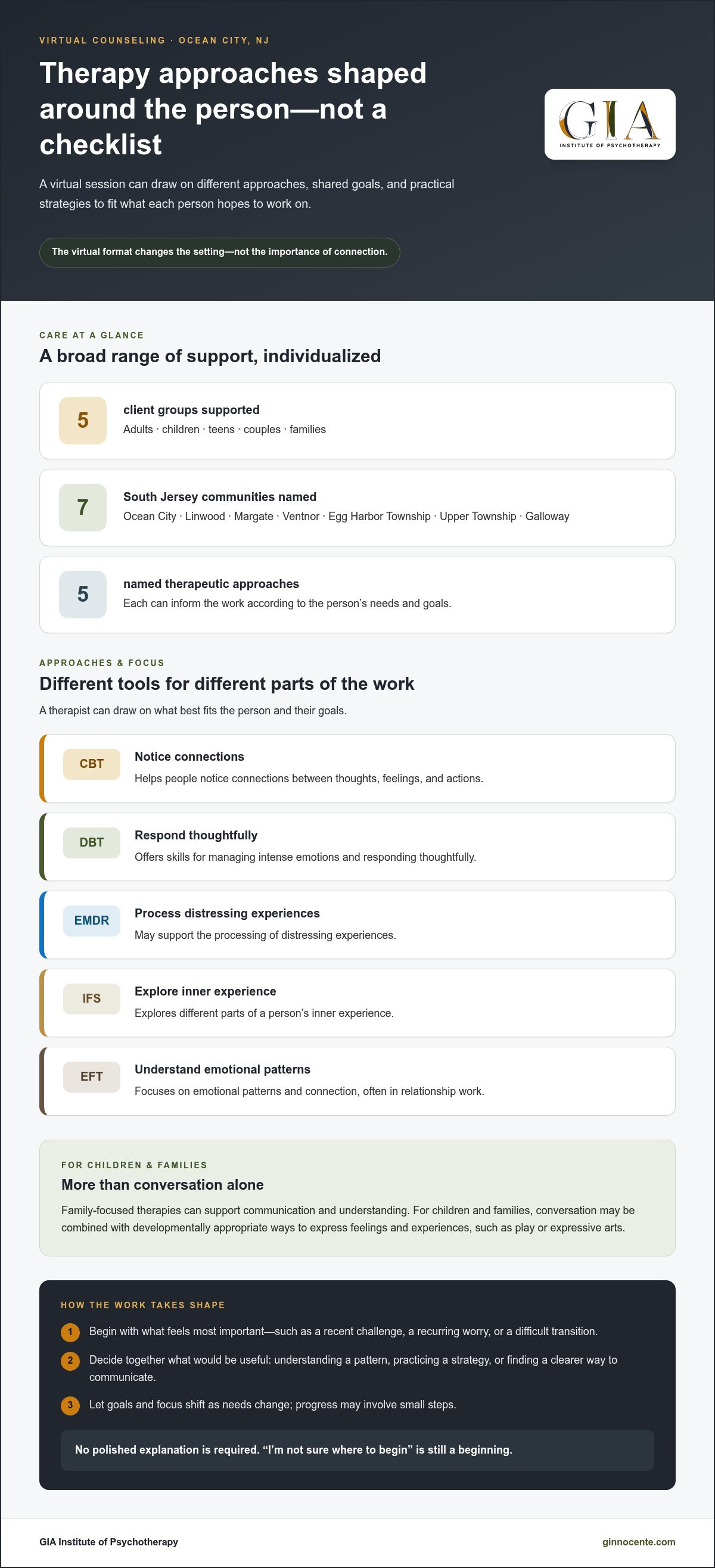
At GIA Institute of Psychotherapy, virtual counseling offers a collaborative space to explore what’s weighing on you and build practical ways forward. The practice supports adults, children, teens, couples, and families in Ocean City and nearby South Jersey communities, including Linwood, Margate, Ventnor, Egg Harbor Township, Upper Township, and Galloway. Approaches such as CBT, DBT, EMDR, and family-focused therapies can be part of care shaped around each person’s needs.
This guide explains what a virtual session may involve, how to prepare, and what to consider about privacy and technology. You’ll also find ways to decide whether remote counseling suits your routine and preferences, so getting started feels more manageable.
Key Takeaways
- Virtual counseling offers a way to explore emotional concerns remotely, with support tailored to different ages and relationships.
- Sessions can build connection through shared conversation, reflection, and collaboratively chosen next steps.
- Compare virtual and in-person therapy by considering your privacy, routine, travel needs, and preferred way to communicate.
- A few simple preparations can make virtual counseling Ocean City NJ feel more comfortable, even if you’re unsure what to say at first.
- Learn how GIA Institute of Psychotherapy brings evidence-based approaches, practical strategies, and expressive modalities to support people in Ocean City and nearby communities.
Virtual Counseling in Ocean City, NJ: What It Is and Who It Can Support
Virtual counseling is therapeutic support provided remotely, often through video sessions where a client and therapist talk together. Unlike self-guided articles or apps, it involves an ongoing conversation with a therapist who can listen, ask questions, and shape the work around the person’s needs. The broader term Online counseling can include different remote formats, while virtual counseling commonly refers to meeting face to face through video.
For someone looking into virtual counseling Ocean City NJ, meeting remotely may make support easier to fit into daily life. Getting to an appointment might feel difficult, or connecting from a familiar place might feel more comfortable. Others may prefer avoiding a drive when they already have a full schedule. There’s no single reason to consider remote care, and choosing counseling doesn’t require being in crisis.
Virtual describes how counseling happens, not a promise about what it will accomplish. Meaningful work grows through a thoughtful relationship, shared goals, and a pace that respects each person’s experience.
What happens during virtual counseling?
A therapist and client meet remotely for a supportive conversation. They may begin with a check-in, then explore what feels most important that day. One session might focus on a recent challenge; another could make room to notice patterns, reflect on progress, or consider a new response. There isn’t one script everyone has to follow.
Over time, the therapist and client can develop goals and choose a focus together. You don’t have to arrive with a polished explanation. Starting with “I’m not sure where to begin” is still a beginning.
Who may consider virtual counseling near Ocean City?
Adults may seek support while working through anxiety, depression, relationship concerns, or a life transition. Teens may want a space to talk about changing relationships, school pressures, or feelings that are hard to put into words. Counseling can offer children age-appropriate support, while couples and families may use sessions to strengthen communication and understand each other’s perspectives.
People in Ocean City, Linwood, Margate, Ventnor, Egg Harbor Township, Upper Township, and Galloway may consider virtual counseling for different reasons and at different stages of life. GIA Institute of Psychotherapy supports adults, children, teens, couples, and families, with care shaped around the person or people taking part. You can begin with a concern you can name or simply a sense that something could use attention.
How Virtual Counseling Sessions Build Connection and Support Change
A virtual session can begin with a few moments to settle in and notice what’s on your mind. You and your therapist might explore a recent interaction, a recurring worry, or a transition that feels difficult. Together, you can decide what would be useful to focus on, whether that means understanding a pattern, practicing a strategy, or finding a clearer way to communicate.
Virtual format changes the setting, not the importance of connection. Trust grows through a collaborative relationship, not through a screen-specific technique. The APA Guidelines for Telepsychology offer professional guidance for psychological services delivered remotely. In practice, feeling heard, communicating clearly, and shaping goals together can help counseling feel purposeful. Progress may involve small steps, and the focus can shift as your needs change.
Can counseling feel personal through a screen?
Sharing personal thoughts over video may feel unfamiliar at first. You can take time to adjust, let your therapist know what feels comfortable, and ask for clarification if something doesn’t come across clearly. Attentive listening and shared goals can support connection, though each person’s preferences differ. If virtual care doesn’t feel like the right fit, discuss that as part of finding a helpful path forward.
How therapeutic approaches can inform virtual sessions
The approach can reflect what you’re hoping to work on. CBT can help people notice connections between thoughts, feelings, and actions. DBT offers skills for managing intense emotions and responding thoughtfully. EMDR may support the processing of distressing experiences, while IFS explores different parts of a person’s inner experience. EFT focuses on emotional patterns and connection, often in relationship work. These approaches aren’t a checklist; a therapist can draw on what best fits the person and their goals.
For children and families, conversation may be combined with developmentally appropriate ways to express feelings and experiences, such as play or expressive arts. The aim is to meet people where they are, rather than expect everyone to communicate in the same way.
For those considering virtual counseling Ocean City NJ, GIA Institute of Psychotherapy brings evidence-based approaches, practical strategies, and expressive modalities into individualized care. Explore GIA’s psychotherapy approach to learn more about the practice’s supportive work with individuals, couples, children, teens, and families.
Virtual Counseling or In-Person Therapy: Which Format Fits Your Needs?
Choosing a counseling format isn’t about finding a universally better option. Consider what helps you feel comfortable speaking openly and returning to the work. Virtual counseling may feel convenient and familiar, while an in-person office can offer a dedicated space away from home. Neither format is automatically impersonal or more meaningful; connection depends on the people and the therapeutic relationship.
| Consideration | Virtual counseling | In-person therapy |
|---|---|---|
| Privacy | You’ll need a private place where you can speak comfortably. | A counseling office provides a separate setting for the session. |
| Routine | May fit more easily into a day spent at home or nearby. | Traveling to an appointment can help mark a clear transition into therapy. |
| Travel | Removes the need to travel to the session, though your own setup still matters. | Requires getting to the office, which some people may prefer as part of their routine. |
| Familiarity | Meeting from a familiar space may feel reassuring to some. | A dedicated counseling setting may feel more separate from everyday life. |
| Communication | Works through a screen and depends on a reliable connection. | Allows conversation in the same room, which some people find more natural. |
When virtual counseling may feel like a practical fit
Connecting from a private space can make counseling more workable for people in Ocean City and nearby communities such as Linwood, Margate, Ventnor, Egg Harbor Township, Upper Township, and Galloway. Avoiding travel may help when schedules or transportation make an office visit challenging, though the time saved depends on individual circumstances. A quiet place and reliable internet connection can reduce interruptions and make it easier to stay present.
When an in-person setting may feel more comfortable
Some people value stepping into a dedicated counseling space, especially if home feels busy or privacy is hard to find. Others simply feel more at ease having a face-to-face conversation in the same room. Those preferences matter. Consider where you can speak most freely, feel most settled, and give counseling a consistent place in your routine.
Ask yourself: Which setting would make it easier for me to speak openly and return consistently? Your answer can help clarify what feels like a supportive starting point. For people considering virtual counseling Ocean City NJ, format is one part of the decision; comfort, personal needs, and day-to-day circumstances matter just as much.
How to Prepare for Virtual Counseling in Ocean City and Nearby Towns
A little preparation can make the first few minutes feel less unfamiliar, but you don’t need a perfect setup or a carefully rehearsed story. Whether you’re joining from Ocean City, Ventnor, Egg Harbor Township, Galloway, Linwood, Margate, or Upper Township, focus on creating a setting where you can participate comfortably. These simple steps can help:
- Choose a private spot. Find a quiet room or another place where you can speak comfortably. If privacy at home is limited, consider when and where interruptions are least likely.
- Set up your device. Place your phone, tablet, or computer somewhere stable, and check that its camera, microphone, and internet connection are working. Keep a charger nearby if you may need it.
- Reduce distractions. Silence notifications, close unrelated tabs, or let others know you need uninterrupted time. Headphones may help you focus or feel more comfortable, if you prefer them.
- Keep a few notes nearby. Jot down a concern, question, recent change, or hope you’d like to discuss. Notes can be a helpful prompt, not a script you have to follow.
Create a comfortable and private space
Your setting doesn’t need to look a certain way. A quiet corner can work just as well as a separate room if you can speak freely and feel reasonably settled there. Make small adjustments that suit you, such as turning your chair away from household activity or putting your phone on silent. The goal isn’t a perfect room; it’s a little more space to focus on the conversation.
Make the first conversation easier to begin
Starting can feel hard, especially if several concerns have been building at once. You might consider: What feels difficult lately? What has changed? What would I hope could feel different? You can also begin with “I’m not sure where to start.” Pauses, uncertainty, and changing your mind about what to discuss are all okay. The conversation can take shape together.
Preparing for virtual counseling Ocean City NJ can be as simple as setting aside a private moment and bringing one question to mind. You don’t need to arrive with a diagnosis, a complete explanation, or a finished goal. If you’re ready to learn about individualized support for yourself or your family, explore counseling support with GIA.
Starting Virtual Counseling with GIA Institute of Psychotherapy
For people exploring virtual counseling Ocean City NJ, GIA Institute of Psychotherapy offers a supportive place to begin. The practice serves adults, children, teens, couples, and families in Ocean City and nearby communities, including Linwood, Margate, Ventnor, Egg Harbor Township, Upper Township, and Galloway. Whether you’re facing anxiety, depression, relationship concerns, or a life transition, counseling can provide space to understand what’s happening and consider a way forward that feels right for you.
A collaborative approach to therapy
Therapy begins with listening. Your experiences, priorities, and questions help shape the conversation, and goals can take form together rather than arriving fully decided. The focus may be individual, relational, or family-centered, depending on who is seeking support and what feels most pressing.
GIA’s clinical approaches include CBT, DBT, EMDR, IFS, and EFT. These can help people explore thought and behavior patterns, build skills for managing difficult emotions, process distressing experiences, or better understand relationship dynamics. The therapist can draw on approaches that fit the person’s concerns instead of treating a particular method as a one-size-fits-all answer. For children and families, Play Therapy and Expressive Arts can offer developmentally appropriate ways to communicate and explore feelings. Practical strategies can also help bring insights into everyday life.
Care is individualized across life stages and relationships. An adult may want to work through a personal transition, a couple may hope to understand recurring conflict, or a family may be seeking new ways to communicate. The work can develop at a pace shaped by those involved, with room to revisit goals as needs change.
Take a thoughtful next step from Ocean City, NJ
Starting doesn’t require certainty about what you need or a firm commitment to a particular goal. You can begin with a question, a concern that’s been on your mind, or a wish to understand what counseling might involve. GIA’s regional community includes Ocean City as well as Linwood, Margate, Ventnor, Upper Township, Egg Harbor Township, and Galloway.
Choosing support is a personal step, and it’s okay to take it at your own pace. If you’re ready to learn more about counseling with GIA Institute of Psychotherapy, connect with GIA Institute of Psychotherapy.
Take the Next Step Toward Support That Fits
Choosing virtual or in-person counseling is a personal decision. What matters is finding a setting where you can speak openly, feel respected, and work toward goals that matter to you. A virtual session can still offer meaningful connection, and a few simple preparations may help you feel more at ease as you begin.
For those exploring virtual counseling Ocean City NJ, GIA Institute of Psychotherapy serves Ocean City and nearby South Jersey communities, including Linwood, Margate, Ventnor, Egg Harbor Township, Upper Township, and Galloway. The practice offers counseling for individuals, children and teens, couples, and families. Care may draw on approaches such as CBT, DBT, EMDR, IFS, EFT, Play Therapy, and Expressive Arts, shaped around each person’s needs and experiences.
You don’t need a perfect plan or the right words to take a first step. A question or concern is enough to begin learning what support might look like. Connect with GIA Institute of Psychotherapy to learn about counseling support.
Frequently Asked Questions
Is virtual counseling effective for anxiety or depression?
Virtual counseling provides a way to work with a therapist on concerns such as anxiety and depression, but no format guarantees a particular outcome. Your experience can depend on your goals, needs, and the relationship you build with your therapist. Together, you can shape a collaborative approach and talk about whether meeting remotely feels comfortable for the support you’re seeking. It’s okay to revisit that question as your needs become clearer.
Can I attend virtual counseling from Ocean City, New Jersey?
Yes, virtual counseling lets you meet with a therapist remotely rather than travel to a session. GIA Institute of Psychotherapy serves Ocean City and nearby communities, including Linwood, Margate, Ventnor, Egg Harbor Township, Upper Township, and Galloway. The remote format lets you take part from a location that works for you. A private space and a device ready for the session can help you settle in.
What happens during a virtual counseling session?
A virtual counseling session is a conversation with a therapist about what’s happening in your life and what kind of support may help. You might talk through a concern, identify goals, or explore practical strategies together. The focus can develop at a manageable pace and doesn’t have to follow a fixed script. You don’t need to prepare a perfect explanation; beginning with “I’m unsure where to start” is completely okay.
How do I prepare for my first virtual counseling session?
Choose a comfortable, private place where you can speak with as few interruptions as possible. Check that your device is ready, and consider silencing notifications or using headphones if they help you focus. You might jot down a few concerns or questions, such as what’s been difficult lately or what you hope could change. There’s no need to organize everything beforehand; the first conversation can help clarify what feels important.
Is virtual counseling private?
Privacy matters in counseling, and your surroundings are one practical part of a remote session. Choose a place where you can speak comfortably and reduce the chance of being overheard; headphones may help if they suit your situation. If you have questions about privacy or how remote sessions are handled, raise them as you begin care. You deserve clear information and a setting that feels as comfortable as possible.
Can children, teens, couples, or families use virtual counseling?
GIA Institute of Psychotherapy provides counseling for children, teens, adults, couples, and families. The focus can be shaped around who is participating and what support they’re seeking. A child’s needs and communication style may differ from a teen’s, while couples or families may want space to work on shared concerns. Virtual care isn’t automatically the right fit for everyone, so comfort and individual circumstances matter.
How do I know whether virtual counseling or in-person therapy is right for me?
Consider where you feel most comfortable speaking openly, what privacy you can create, and which format fits your routine. Some people appreciate meeting remotely, while others feel more at ease in a dedicated counseling space. Neither option is automatically best for everyone. If you’re exploring virtual counseling Ocean City NJ, reflect on your preferences and discuss them with your therapist to find a supportive starting point.


