

What if the heavy fog of depression and the racing heartbeat of anxiety aren't signs that you're broken, but rather signals from a system that is simply overwhelmed? For many, seeking psychotherapy for anxiety and depression feels daunting because of the fear of being judged or pathologized. It's exhausting to stay caught in a loop where one day feels like a frantic race and the next feels like you can't get out of bed. You might even feel confused by the complex alphabet soup of modern treatments like DBT, EMDR, or IFS.
We're here to tell you that healing is possible and it doesn't have to be cold or clinical. This article will show you how modern therapy can help you reclaim your sense of self and move toward a life filled with agency and internal clarity. We'll explore how neuroscience-based approaches provide practical strategies for emotional regulation, how specialized modalities offer a path to relief, and how a restorative connection with a trusted professional can help you rewrite your internal narrative. It's time to move beyond survival and start a journey toward genuine well-being.
Key Takeaways
- Learn how to recognize and break the "anxiety-depression loop" that often leaves you feeling stuck, exhausted, and overwhelmed.
- Discover how neuroscience-based psychotherapy for anxiety and depression provides a clear, evidence-based roadmap for emotional regulation and long-term stability.
- Gain clarity on specialized modalities like DBT, EMDR, and IFS so you can feel confident choosing the path that best fits your personal needs.
- Explore what to expect in a restorative therapeutic environment where your story is heard with deep compassion rather than clinical judgment.
- Understand how a relational approach helps you reclaim your sense of agency and begin rewriting your internal narrative toward a future of hope.
Understanding the Intertwined Nature of Anxiety and Depression
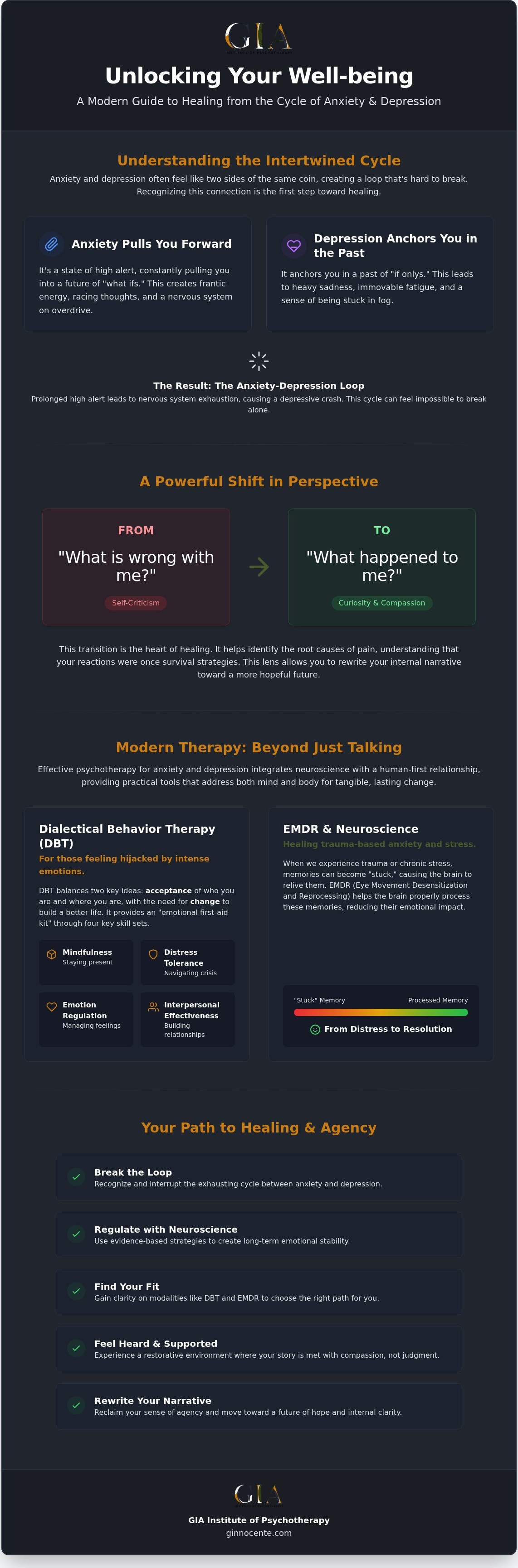
Does it feel like your mind is a pendulum, swinging between frantic worry and a heavy, immovable sadness? This experience is common, yet it can feel incredibly isolating. For many, anxiety and depression aren't separate islands. They're more like two sides of the same coin. While anxiety pulls you into a future of "what ifs," depression often anchors you in a past of "if onlys." This invisible link creates a heavy burden that affects your work, your relationships, and your sense of self. Recognizing this connection is the first step toward finding a path out of the fog.
A "one-size-fits-all" approach often fails because it treats these conditions as isolated symptoms. You aren't a checklist of diagnostic criteria; you're a complex human being with a unique history. When we look only at the surface, we miss the underlying story. Effective Modern Therapeutic Approaches must be as nuanced as the people they serve. By seeing the person behind the symptoms, we can create a collaborative plan that honors your specific journey toward healing.
The Anxiety-Depression Loop: Why They Often Appear Together
When your nervous system stays in a state of high alert for too long, it eventually reaches a point of exhaustion. Think of it like a car engine that's been redlining for hours. Eventually, it has to shut down. This physiological "fight-or-flight" exhaustion is why periods of intense, racing thoughts are so often followed by a deep depressive crash. Comorbidity simply means that these two conditions often walk hand-in-hand, sharing space in your daily life and influencing one another. Chronic stress disrupts the brain's ability to regulate mood, creating a cycle that feels impossible to break alone. Utilizing psychotherapy for anxiety and depression helps address this biological burnout by teaching your system how to return to a state of calm and safety.
Rewriting Your Internal Narrative
Healing involves a fundamental shift in how you view your own struggle. We move from asking "What is wrong with me?" to exploring "What happened to me?" This transition is powerful. It replaces self-criticism with curiosity and compassion. Psychotherapy for anxiety and depression provides the tools to identify the "old wounds" or past experiences that continue to drive today's symptoms. When you understand the roots of your pain, the narrative begins to change. You start to see that your reactions are often survival strategies that once served a purpose but are no longer helping you thrive. Through this lens of self-compassion, you can begin to dismantle the cycle of self-judgment and start writing a new, more hopeful chapter of your life.
Modern Therapeutic Approaches: Moving Beyond "Just Talking"
Have you ever felt like you've talked your problems to death without actually feeling better? While traditional talk therapy has its place, modern psychotherapy for anxiety and depression has evolved to include the wisdom of neuroscience. We now understand that emotional pain isn't just in your head; it's often stored in your nervous system. By blending evidence-based strategies with a human-first clinical relationship, we move beyond circular conversations and toward tangible, lasting change. This integrated approach provides a clear roadmap for emotional stability by addressing both the mind and the body.
Research from institutions like Harvard highlights several effective therapeutic approaches that offer more than just a sympathetic ear. These modalities provide practical tools for the "here and now" while still allowing space for deep emotional exploration. If you're curious about how these methods work in practice, exploring adult individual psychotherapy can help you find the specific blend that resonates with your unique story.
The Power of Dialectical Behavior Therapy (DBT)
Dialectical Behavior Therapy, or DBT, is a transformative tool for anyone who feels hijacked by intense emotions. The term "dialectics" refers to the balance of two seemingly opposite truths: acceptance and change. It's the idea that you can be doing your absolute best right now and still need to learn new skills to move forward. DBT focuses on four key pillars: mindfulness, distress tolerance, emotional regulation, and interpersonal effectiveness. These skills act as an emotional first-aid kit, helping you stay grounded when life feels overwhelming.
EMDR and Neuroscience: Healing Trauma-Based Anxiety
When we experience chronic stress or trauma, those memories can become "stuck" in the brain's limbic system, keeping us in a perpetual state of high alert. Eye Movement Desensitization and Reprocessing (EMDR) is a gentle yet profound way to help the brain reprocess these memories. Unlike traditional methods that require you to recount every detail of a painful event, EMDR focuses on the physical and emotional charge of the memory. It helps your nervous system recognize that the danger is in the past, allowing you to finally feel a true sense of safety in the present.
Internal Family Systems (IFS) and the "Parts" of You
Internal Family Systems (IFS) invites you to look at your personality as a collection of different "parts." You might have a "Protector" part that uses anxiety to scan for danger, or a "Manager" part that uses perfectionism to keep you from feeling low. Often, these parts are in conflict, leading to internal exhaustion. IFS therapy helps you access your "Self," which is the calm, curious, and compassionate core of your being. From this center, you can lead your parts toward harmony, reducing self-criticism and fostering a deep sense of internal clarity.
Comparing Modalities: Finding the Right Fit for Your Journey
Choosing the right type of psychotherapy for anxiety and depression can feel like trying to find your way through a dense forest without a map. With so many acronyms and clinical terms, it's natural to feel a bit lost. The truth is that your journey is unique, and the best approach is often one that adapts to your specific needs rather than forcing you into a rigid box. How do you begin to distinguish between these paths and find the one that resonates with your soul?
Choosing Your Path: A Comparison Framework
While many approaches overlap, they often prioritize different aspects of your well-being. Understanding these nuances can help you feel more empowered during your search for a therapist. Consider these common frameworks:
- Cognitive Behavioral Therapy (CBT): Best for those who want to identify and shift the specific thought patterns that fuel worry or low mood.
- Dialectical Behavior Therapy (DBT): Ideal if you feel frequently hijacked by intense emotions and need a concrete toolkit for regulation and mindfulness.
- EMDR: A powerful choice if your anxiety feels rooted in past trauma or "stuck" memories that traditional talk therapy hasn't quite reached.
- Emotionally Focused Therapy (EFT): Often utilized in couples counseling or family therapy to heal relationship-based stress and build secure attachments.
It's common for a skilled professional to blend these modalities. For instance, you might use DBT skills to find immediate stability before moving into deeper EMDR work to address the root causes of your distress. This collaborative blending ensures that your treatment is as multifaceted as you are.
The Role of Expressive Arts and Play Therapy
Sometimes, the most profound parts of our experience simply don't have words. This is where expressive modalities become essential. Through art, movement, or music, you can bypass the logical mind and access emotions that have been hidden beneath the surface. For adults, this offers a bridge to deeper self-discovery and a way to rewrite your internal narrative without the pressure of "saying the right thing."
In our South Jersey community, these approaches are particularly vital for younger generations. Individual therapy for children and teens often incorporates play therapy, allowing them to process complex feelings in their most natural language: play. Whether you are a parent seeking help for a child or an adult looking for a more creative path to healing, these non-verbal tools provide a safe harbor for expression.
As you begin your search, remember that the initial consultation is your space to advocate for yourself. Don't hesitate to ask a potential therapist how they blend different styles or why they believe a specific modality fits your goals. The most important factor isn't just the technique; it's the sense of safety, presence, and connection you feel with the person sitting across from you.
Navigating the Path to Healing in South Jersey
Finding a space to heal shouldn't feel like a cold transaction with a national directory. It's about finding a "safe harbor" right in your own backyard. For those living in Linwood, Ocean City, or Margate, the journey toward better mental health is deeply connected to the community we call home. Seeking psychotherapy for anxiety and depression is a brave step, and doing so within a local, community-minded practice ensures that your therapist understands the unique rhythm of life in South Jersey. From the seasonal shifts of shore life to the specific pressures within our local school systems in Upper Township, having a provider who is a neighbor can make all the difference in feeling truly seen.
Starting Therapy in Your Community
Local accessibility matters more than we often realize. When your therapist is located in Linwood or Galloway, the logistics of care become a manageable part of your routine rather than another source of stress. A community-minded practice like GIA Institute of Psychotherapy doesn't just offer clinical expertise; it offers a relational home. This local connection fosters a sense of accountability and trust that national telehealth platforms often lack. It's about building a steady, intentional rhythm for your long-term well-being right where you live, surrounded by the familiar sights and sounds of the South Jersey area, from Ventnor to Egg Harbor Township.
Your First Session: A Gentle Introduction
It's natural to feel a flutter of nerves before your first appointment. Many people worry that the "intake" process will feel like a clinical interrogation or a cold review of their darkest moments. We want to demystify this experience. Your first session is simply a gentle conversation. It's an opportunity for us to begin understanding your story and for you to see if our presence feels like a restorative fit for your heart and mind. We focus on comfort and connection from the moment you walk through the door.
You don't need to have all the answers or a perfectly polished history ready. Instead, try to approach the meeting with curiosity. You might ask about how we approach psychotherapy for anxiety and depression or how we blend different modalities to suit your needs. This initial meeting is the foundation of a collaborative partnership. If you're ready to take that first step toward clarity, you can explore our specialized programs for men and women to see how we can support your specific journey toward transformation.
Why GIA Institute is Your Partner in Transformation
At GIA Institute of Psychotherapy, we believe that you aren't a diagnosis to be managed, but a person to be understood. We provide a space where you can breathe, reflect, and grow without the fear of being pathologized. Our approach to psychotherapy for anxiety and depression is rooted in the belief that everyone possesses an inner resilience, even when it feels buried under layers of worry or sadness. We don't just look at what's "wrong"; we work with you to discover the best parts of yourself that have been waiting to emerge.
Our environment is intentionally authentic and relatable. We avoid the cold, clinical distance often found in larger institutions. Instead, we offer a steady, calming presence that prioritizes your comfort. Whether we're utilizing DBT to build your emotional toolkit, EMDR to process stuck memories, or IFS to harmonize the different parts of your personality, our goal remains the same: to help you rewrite your internal narrative with clarity and compassion. Choosing psychotherapy for anxiety and depression is an investment in your future self, and we're honored to walk that path alongside you.
A Compassionate and Wise Guide
Led by Gina Innocente, our practice has built a reputation in the South Jersey community for being both highly skilled and deeply human. Healing is never a top-down process here; it's a collaborative journey. We understand that your health is intertwined with your family and social systems. That's why we offer specialized care across the lifespan, ensuring every member of our community has a safe harbor to turn to. Our services include:
- Individual therapy for children and teens navigating school and social pressures.
- Adult individual psychotherapy focused on life transitions and personal growth.
- Family therapy and couples counseling to strengthen relational health and connection.
Take the Next Step Toward Your Best Self
Transformation doesn't happen overnight, but it does begin with a single, intentional choice. You don't have to navigate the "anxiety-depression loop" alone anymore. Are you ready to trade exhaustion for agency? Can you imagine a life where you feel grounded, present, and hopeful? We're here to act as your steady guide, providing the professional expertise and restorative connection you deserve. Your story isn't finished yet, and the next chapter can be one of profound healing.
Begin your journey with GIA Institute of Psychotherapy today and discover the path to healing and hope that awaits you in our South Jersey offices.
Embarking on Your Journey Toward Renewal
Healing isn't about erasing your past; it's about learning to carry your story with a new sense of ease and agency. We've explored how the intertwined cycles of worry and low mood can be dismantled through a blend of neuroscience and deep emotional work. By understanding the specific roles of modalities like EMDR, DBT, and IFS, you can move from a place of confusion to one of internal clarity. Whether you're in Linwood, Ocean City, or the surrounding South Jersey area, you don't have to navigate these complexities alone.
Choosing psychotherapy for anxiety and depression is a profound act of self-care that honors your inherent strength. At GIA Institute, our authentic and growth-oriented philosophy ensures you're met with a steady, compassionate presence rather than a clinical checklist. We're dedicated to providing the specialized care you need to rewrite your narrative and reclaim your well-being. If you're ready to find your safe harbor, we invite you to Schedule a Consultation with GIA Institute today. You deserve a life filled with presence, connection, and hope.
Frequently Asked Questions
Is psychotherapy effective for both anxiety and depression simultaneously?
Yes, psychotherapy for anxiety and depression is highly effective at addressing both conditions because they often stem from the same underlying nervous system dysregulation. At our Linwood and Ocean City offices, we use an integrated approach that targets the "anxiety-depression loop." By treating the root causes rather than just isolated symptoms, you can experience relief from both frantic worry and low mood. This holistic method helps you build a steady foundation for long-term emotional health.
How long does it typically take to see progress in therapy?
Progress in therapy is a deeply personal journey, but many clients in the South Jersey community begin to feel a shift in their internal clarity within the first few months of consistent sessions. While some practical coping strategies offer immediate relief, deeper transformation and "rewriting" your internal narrative often take longer. We focus on a methodical and patient rhythm that allows you to process information at a pace that feels safe and restorative for your specific needs.
Can therapy help if I don’t want to take psychiatric medication?
Absolutely, many individuals find profound healing through psychotherapy without the use of medication. Our practice focuses on neuroscience-based modalities like EMDR and DBT that help your brain and body find a sense of safety naturally. While we don't provide medication management, we offer a "safe harbor" where you can develop agency and emotional regulation skills. We respect your choice to pursue a non-pharmaceutical path to wellness and support your journey toward internal clarity and balance.
What is the difference between DBT and traditional talk therapy?
Traditional talk therapy often focuses on insight and exploration, whereas Dialectical Behavior Therapy (DBT) is more skill-based and practical. DBT provides a concrete toolkit for mindfulness, distress tolerance, and emotional regulation. It's particularly helpful for those who feel overwhelmed by high-intensity emotions. In our Margate and Ventnor area sessions, we often blend these skills with traditional reflection to ensure you have both the understanding of your past and the tools for your present.
How do I know if I need individual therapy or family counseling?
Individual therapy is ideal if you're looking to focus deeply on your own internal narrative and personal growth. Family therapy is better suited when the stressors involve relational health or communication patterns within the household. If you're unsure, a consultation at our Linwood office can help clarify which path is right. We often work with families in Egg Harbor Township to determine if individual support for a child or a collaborative family approach is most beneficial.
Is EMDR therapy safe for someone with severe anxiety?
Yes, EMDR is a gentle and safe approach even for those experiencing severe anxiety. Unlike some methods that might feel overwhelming, EMDR doesn't require you to recount every painful detail. Instead, it helps your nervous system "reprocess" stuck memories that fuel your current anxiety. Our clinicians in Galloway and Upper Township ensure you feel grounded and safe throughout the process, moving at a pace that honors your comfort and promotes a restorative sense of peace and internal safety.
What should I do if I feel nervous about my first psychotherapy session?
It's completely normal to feel a flutter of nerves before starting psychotherapy for anxiety and depression. We recommend arriving a few minutes early to our Linwood or Ocean City locations to breathe and settle into the space. Remember that the first session is simply a gentle conversation focused on connection, not an interrogation. You're in control of the pace, and our goal is to make you feel seen, understood, and validated from the very first moment.


