

Have you ever found yourself staring at a directory of names, wondering if the person on the other side of the screen will truly understand the weight of your story? It's a heavy feeling that often accompanies the search for how to find a therapist in NJ, particularly when you're met with a confusing alphabet soup of acronyms like DBT, EMDR, and IFS. You aren't just seeking a clinical provider; you're looking for a safe harbor where you can feel seen, heard, and validated. You deserve a space where your experiences are honored rather than just diagnosed.
With approximately one in five adults in New Jersey experiencing mental health challenges each year, you're certainly not alone in this search. It's natural to feel overwhelmed by the complexities of insurance or the quiet anxiety of being judged during your first appointment. We believe that your path should lead toward restoration, clarity, and renewed strength. This guide offers a step-by-step framework to help you move through the local mental health landscape with ease. You'll learn how to ask the right questions, identify a South Jersey professional who fits your unique needs, and manage the transition from searching to your very first session.
Key Takeaways
- Learn how to identify your core needs and distinguish between short-term counseling and deep-seated psychotherapy to set a clear intention for your growth.
- Gain clarity on specialized clinical approaches like DBT, EMDR, and IFS, ensuring you find a modality that speaks to your unique emotional experiences.
- Discover how to move through the New Jersey insurance landscape and leverage out-of-network benefits to access high-quality, specialized care.
- Understand why the therapeutic alliance is the most vital predictor of success and learn the right questions to ask during a consultation call.
- Access a steady, intentional roadmap for how to find a therapist in NJ who can provide the clinical expertise and relational warmth you need to thrive.
Understanding Your Needs: The First Step in Your NJ Therapy Search
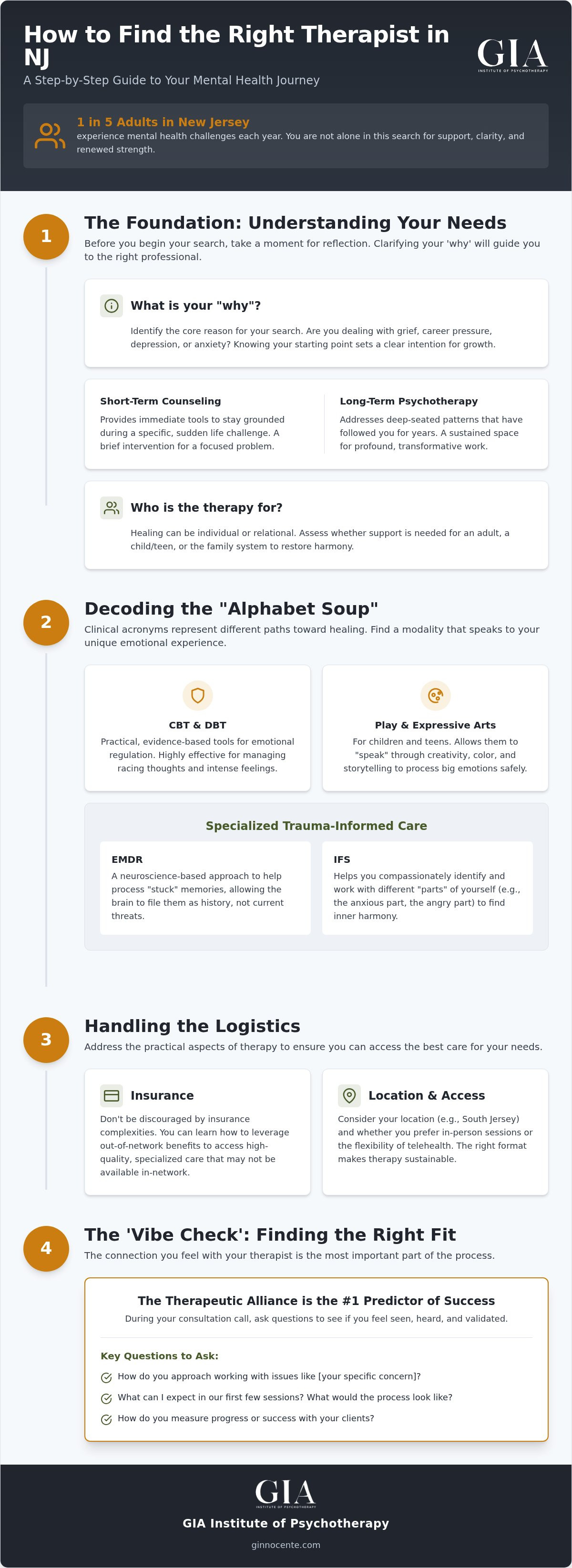
Finding the right path begins with a moment of quiet reflection. Are you feeling weighed down by a persistent cloud of sadness, or perhaps a racing heart that makes everyday tasks feel like mountains? Identifying the core reason for your search is the first step in learning how to find a therapist in NJ who can meet you where you are. Whether you're navigating the grief of a loss, the pressure of a career shift, or the heavy fog of depression, your "why" matters. Psychotherapy is a collaborative journey to heal old wounds and discover your best self. It's about moving beyond surviving and toward a life where you feel truly alive and present.
Sometimes, life throws a sudden curveball where short-term counseling provides the immediate tools you need to stay grounded. Other times, you might realize that certain patterns have followed you for years, requiring the deeper, transformative work of long-term psychotherapy. By Understanding Mental Health Treatment Options, you can better decide if you need a brief intervention for a specific problem or a sustained space for profound internal growth. This distinction helps you narrow your search and find a professional whose approach aligns with the depth of work you're ready to do.
Individual vs. Family Support: Who is the Therapy For?
Healing rarely happens in a vacuum. You might be seeking Adult Individual Psychotherapy to reclaim your own voice and agency after years of putting others first. However, if you notice your child or teen struggling with school anxiety or social withdrawal, they may need specialized support tailored to their unique developmental stage. Family therapy serves as a vital bridge, helping to restore household harmony by addressing the invisible threads that connect you to one another. Assessing the needs of your entire system ensures that everyone receives the care they deserve, whether it's for an individual's growth or the healing of a relationship.
Setting Your Intentions for Healing
What does success look like for you? It's often more than just fixing symptoms or silencing a loud inner critic. It's about rewriting your internal narrative so you can view yourself with compassion instead of judgment. Your specific goals will influence the type of professional you choose. Some people seek clarity during a major life transition, while others want to build better emotional regulation skills. Remember that hope is a vital ingredient in this early stage. You aren't just looking for a name on a list; you're looking for a partner in your transformation who can help you navigate how to find a therapist in NJ with confidence and peace of mind.
Decoding the Alphabet Soup: Finding the Right Clinical Match
When you start looking at how to find a therapist in NJ, you might feel like you've walked into a library where all the books are written in code. Acronyms like CBT, DBT, and EMDR can feel cold and clinical, but these terms actually represent different paths toward your restoration. Evidence-based approaches like Cognitive Behavioral Therapy (CBT) and Dialectical Behavior Therapy (DBT) are highly effective for emotional regulation. They provide practical tools to help you manage racing thoughts or intense feelings, acting as a steady anchor when your internal world feels chaotic. By understanding these modalities, you can move from feeling diagnosed to feeling empowered.
For younger clients, traditional talk therapy often isn't enough. Children and teens process their world through action and creativity. This is why expressive arts and Play Therapy are so vital; they allow a child to "speak" through movement, color, and storytelling. These modalities create a bridge between a child's internal experience and the therapist's guidance, offering a safe space where they can process big emotions without the pressure of finding the "right" words. Finding a professional who understands these developmental nuances is a key part of your search.
Trauma-Informed Care: EMDR and IFS Explained
If you're carrying the weight of old wounds, you may need a path that addresses how your body holds onto the past. Eye Movement Desensitization and Reprocessing (EMDR) is a neuroscience-based approach that helps process "stuck" memories, allowing your brain to finally file them away as history rather than current threats. Similarly, Internal Family Systems (IFS) helps you identify different "parts" of yourself; the part that's anxious, the part that's angry, or the part that's trying to protect you. This compassionate work requires a specialized guide who can hold space for your complexity with patience and skill.
Relationship and Communication Modalities
Healing often involves the people we love most. Emotionally Focused Therapy (EFT) is a powerful tool for Couples Counseling, focusing on rebuilding the secure bond that may have frayed over time. It moves beyond simple communication tips to address the deep emotional needs beneath the surface. Our specialized programs for men and women also address unique life transitions, blending traditional talk therapy with modern, practical strategies. As you look for clinical alignment, you can explore our approach to healing to see how these modalities might weave into your own story. Each session is an opportunity to rewrite your narrative in a way that feels authentic, sustainable, and hopeful.
Navigating the Logistics: Insurance, Location, and Advocacy in NJ
Once you've identified the type of support you need, the practical details of how to find a therapist in NJ can feel like another hurdle to clear. You aren't just looking for a clinical expert; you're looking for a partner who fits into the rhythm of your life. This includes understanding the financial landscape and ensuring your therapist is accessible to your home or your child's school. Logistics shouldn't be a barrier to your healing, but rather a bridge that leads you to a safe harbor.
Insurance and Budgeting for Your Mental Health
New Jersey's insurance market is often shaped by providers like Horizon Blue Cross Blue Shield. While many people start by searching for in-network providers, it's vital to look at your out-of-network benefits too. Did you know that many plans reimburse a significant percentage of the cost for specialized care? Using these benefits allows you to access highly trained clinicians who specialize in complex trauma or family systems. When you call your insurance company, ask specifically about your behavioral health deductible and reimbursement rates for out-of-network psychotherapy. Viewing these costs as an investment in your long-term emotional health can shift the perspective from a monthly expense to a life-changing ROI.
The Local Advantage: Why South Jersey Expertise Matters
For parents in South Jersey, therapy often extends beyond the office walls. If your child is struggling, they need an advocate who understands the local school systems in Ocean City, Linwood, or Galloway. A therapist who is familiar with the nuances of our local districts can provide essential support for IEP and 504 plan meetings. This level of school advocacy ensures that your child's mental health needs are respected and supported in the classroom.
Proximity matters for your own consistency as well. Finding a practice in the Egg Harbor Township or Margate areas makes it easier to prioritize your sessions amidst a busy schedule. A local professional understands the unique culture and transitions of our community, providing a level of relatability that a distant provider might lack. This local expertise creates a sense of stability, helping you feel grounded as you begin your work. We believe that therapy should be a source of relief, not another source of stress in your calendar.
The 'Vibe Check': How to Know You’ve Found the Right Fit
Beyond the logistics of insurance and location, there is an intuitive layer to your search that matters just as much as a clinician's degree. You might find the most experienced professional in the state, but if the "vibe" isn't there, the work will feel like climbing a mountain in the dark. This connection is known as the therapeutic alliance. It's the most powerful predictor of success in your healing journey. When you are exploring how to find a therapist in NJ, remember that you are interviewing a partner for your transformation, not just a service provider.
The ultimate goal of your first meeting is to leave with the profound sense of being seen and understood, knowing that your story is held with respect rather than judgment. This feeling of resonance is what allows you to let your guard down and begin the deep work of rewriting your internal narrative. If you leave a consultation feeling lighter or even just a little more hopeful, that's a powerful green flag.
Questions to Ask Your Potential Therapist
During a discovery call or first session, don't be afraid to take the lead. You deserve to know how a therapist’s clinical style will mesh with your personality. You might ask: "How do you approach my specific struggle with anxiety or this life transition?" or "What does a typical session look like with you?" If you're seeking support for a minor, ask how they involve the family or school system in the treatment. A therapist who welcomes these inquiries shows they value the collaborative nature of the healing process. Their answers should feel transparent and grounded, helping you visualize the path ahead.
Assessing Presence and Empathy
Presence is something you feel in the quiet moments between words. Does the therapist feel like a steady, calming presence? Whether you're meeting in a physical office in South Jersey or via a virtual platform, the environment should feel like a non-judgmental space where you can be your authentic self. Look for a relatable guide who avoids cold, clinical jargon and instead uses language that resonates with your human experience. If you're ready to see if our team is the right fit for your story, you can schedule a consultation with GIA Institute to begin your journey. Trust your intuition; your internal compass knows when you've found a safe harbor.
Beginning Your Journey with GIA Institute of Psychotherapy
At GIA Institute of Psychotherapy, we believe that the search for healing is ultimately a search for your own inner strength. We don't just focus on the symptoms that brought you here; we look at the whole person. Our philosophy centers on healing old wounds while simultaneously helping you discover the most vibrant, resilient parts of yourself. For those exploring how to find a therapist in NJ, our practice serves as a safe harbor in the heart of South Jersey, including Ocean City, Linwood, and the surrounding areas. We combine deep clinical expertise with a relatable, authentic presence that makes the therapeutic journey feel like a collaborative partnership rather than a medical diagnosis.
Our approach is rooted in a unique blend of neuroscience and human connection. By utilizing practical strategies alongside expressive arts and play, we ensure that every client has the tools they need to thrive. We understand that your story is complex, and your treatment should be just as nuanced. Whether we are working with an adult navigating a major life transition or a child processing big emotions, we remain dedicated to a pace that allows for true processing and long-term well-being.
Our Specialized Clinical Programs
We provide a range of services designed to meet you at any stage of life. Our Adult Individual Psychotherapy addresses the persistent weight of anxiety, the fog of depression, and the stress of life’s transitions. For families, we offer specialized Individual Therapy for Children and Teens, which often includes vital School Advocacy Services to ensure your child is supported in every environment. Couples can also find a path back to relational health through our counseling services, which utilize Emotionally Focused Therapy (EFT) to rebuild secure bonds and restore deep emotional resonance.
Your First Step Toward Transformation
The process of beginning therapy should feel as intentional and steady as the sessions themselves. Our intake process is methodical, designed to ensure we match you with the clinician who best understands your unique story and goals. When you walk into our South Jersey locations for your first session, you can expect a space that is warm, non-judgmental, and deeply supportive. This is your time to begin rewriting your internal narrative in a setting that values your agency and your spirit. If you've been wondering how to find a therapist in NJ who truly "gets" you, your search can end here. We invite you to take a breath and reach out when you're ready.
Schedule your restorative journey with the GIA Institute today and discover the possibility of a healthier, more grounded future.
Your Path Toward Restoration and Clarity
You've taken a brave step by simply showing up for yourself today. Understanding your unique needs and decoding the clinical modalities that best support your story are the foundations of a successful search. Whether you're navigating the complexities of insurance or looking for a local advocate who understands the South Jersey school system, remember that you don't have to walk this path alone. Learning how to find a therapist in NJ is about more than just checking boxes; it's about finding a relational and clinical match that feels like a safe harbor for your transformation.
Our authentic and relatable clinical team is here to guide you with specialized treatments like EMDR, DBT, and IFS, alongside dedicated school advocacy for your family. We believe that every individual has the capacity to rewrite their narrative and discover their best self. Are you ready to move from searching to healing? We invite you to Begin your healing journey with GIA Institute today. Your story is worth the investment, and a brighter, more grounded future is waiting for you.
Frequently Asked Questions
How much does therapy cost in New Jersey without insurance?
Average therapy rates in New Jersey typically range from $100 to $250 per session when paying out of pocket. For clinicians with specialized training or advanced certifications, rates can reach up to $350. Initial mental health evaluations often cost between $250 and $500 without insurance coverage. While these figures represent the state average, many find that the long-term emotional health benefits provide a significant return on their investment in themselves.
What is the difference between a psychologist and a licensed clinical social worker (LCSW) in NJ?
Psychologists in New Jersey hold a doctoral degree and often focus on psychological testing and research alongside therapy. Licensed Clinical Social Workers hold a master's degree and specialized training in clinical social work. Both are qualified to provide psychotherapy and diagnose mental health conditions. When you're looking at how to find a therapist in NJ, your choice often depends on the specific clinical approach or specialty you need for your healing journey.
Can I find a therapist in NJ who offers both in-person and telehealth sessions?
Yes, many local practices offer a hybrid model to accommodate your schedule. New Jersey law requires insurance plans to reimburse for online therapy at the same rate as in-person services, making telehealth a highly accessible option. At GIA Institute, we provide both in-person sessions at our South Jersey locations and secure virtual appointments. This flexibility ensures you can maintain consistency in your care whether you're at home in Galloway or visiting our office.
How long does it typically take to see progress in psychotherapy?
Progress is a deeply personal experience that varies based on your unique goals and the complexity of your story. Some people feel a sense of relief after just a few sessions, while others require several months to process deep-seated trauma or old wounds. We focus on a methodical and intentional pace that allows you to integrate new strategies into your daily life. Success is often measured by your increased clarity and emotional resilience over time.
How do I know if my child needs therapy or if it is just a phase?
It's natural for parents to wonder if behavioral shifts are temporary. You might consider professional support if your child's struggles interfere with their school performance, social relationships, or daily happiness. Persistent signs like withdrawal, intense emotional outbursts, or school refusal are often indicators that they need a safe space to process their feelings. We utilize Play Therapy and expressive arts to help children in Ocean City and Linwood communicate what they can't yet put into words.
What should I do if I don’t feel a connection with my therapist after the first session?
Trusting your intuition is a vital part of the healing process. If you don't feel a sense of safety or resonance after your initial meeting, it's perfectly acceptable to seek a different match. The therapeutic alliance is the greatest predictor of success, so finding someone who truly understands you is essential. A professional therapist will understand this and may even offer referrals to help you find the right clinical and relational alignment for your needs.
Does the GIA Institute help with IEP and 504 school advocacy in NJ?
Yes, we specialize in helping families navigate the complexities of the New Jersey school system. Our team provides expert support for IEP and 504 plan meetings to ensure your child's mental health needs are addressed in the classroom. We serve districts across South Jersey, including Linwood and Ocean City. This advocacy bridges the gap between clinical therapy and academic success, providing a comprehensive support system that honors your child's unique developmental path.
How do I check if my NJ insurance covers EMDR or DBT therapy?
You should contact your insurance provider directly to ask about your behavioral health benefits. Inquire specifically about outpatient mental health coverage and mention the specific procedural codes for psychotherapy. Many New Jersey plans, including Horizon Blue Cross Blue Shield, cover evidence-based treatments like EMDR and DBT. Understanding how to find a therapist in NJ who accepts your plan or provides documentation for out-of-network reimbursement can help you manage your budget effectively.


