
What if the persistent feeling of being lost during a major life change isn't a sign that you're failing, but a signal that your old internal map no longer fits your new terrain? You might feel like you've misplaced your sense of identity after a sudden career shift, the quiet of an empty nest, or the heavy weight of a loss. It's deeply exhausting to wake up every day feeling as though you're standing on shifting sand while the rest of the world moves forward with certainty. You're likely struggling with high anxiety about what comes next, finding it difficult to regulate your emotions, or noticing that your closest relationships are feeling the strain of your personal upheaval.
We understand that these moments of transition are when you're most vulnerable, yet they also hold the greatest potential for transformation. Specialized therapy for life transitions provides a safe harbor where you can process these shifts with grace. By blending the insights of neuroscience with evidence-based strategies like EMDR and Internal Family Systems, you can begin to find internal clarity, develop practical coping tools, and heal from the past to embrace your future. This article explores how professional psychotherapy helps you navigate the "neutral zone" of change, allowing you to emerge with stronger bonds, emotional resilience, and a renewed sense of purpose.
Key Takeaways
- Understand why your brain’s natural craving for certainty triggers stress during change and how to calm your internal alarm system.
- Discover how specialized therapy for life transitions validates the unique pressures of both difficult losses and positive milestones like marriage or new careers.
- Learn about the "Neutral Zone," the critical period between your old life and the new, where the most significant personal transformation happens.
- Explore how evidence-based tools like EMDR and IFS help you rewrite your internal narrative and find a sense of peace during upheaval.
- See why a "safe harbor" approach to psychotherapy provides a compassionate, relatable space for individuals and families in South Jersey to heal.
What is Therapy for Life Transitions and Why Does It Matter?
Life rarely moves in a straight line. Instead, it's a series of chapters, some ending abruptly while others begin before we're ready. Therapy for life transitions acts as a specialized support system for these "in-between" spaces. It's for the moments when the ground feels shaky and the old ways of coping don't seem to work anymore.
We often assume that only tragic events require professional help. However, even joyous milestones like a wedding, a new baby, or a long-awaited promotion can trigger deep anxiety and a sense of loss for your previous self. You aren't failing because you feel overwhelmed by a positive change. You're simply adjusting to a new version of your life, which requires time, patience, and a bit of grace.
There is a significant difference between white-knuckling your way through a shift and moving through it with therapeutic intention. While grit might get you to the other side, it often leaves you exhausted and disconnected from your own needs. Engaging in Transformative Learning Theory through therapy allows you to consciously reframe your beliefs and assumptions. This ensures you don't just survive the change but actually grow from it. Therapy for life transitions is a collaborative process designed to align your internal identity with your evolving external reality.
The Four Types of Transitions You May Encounter
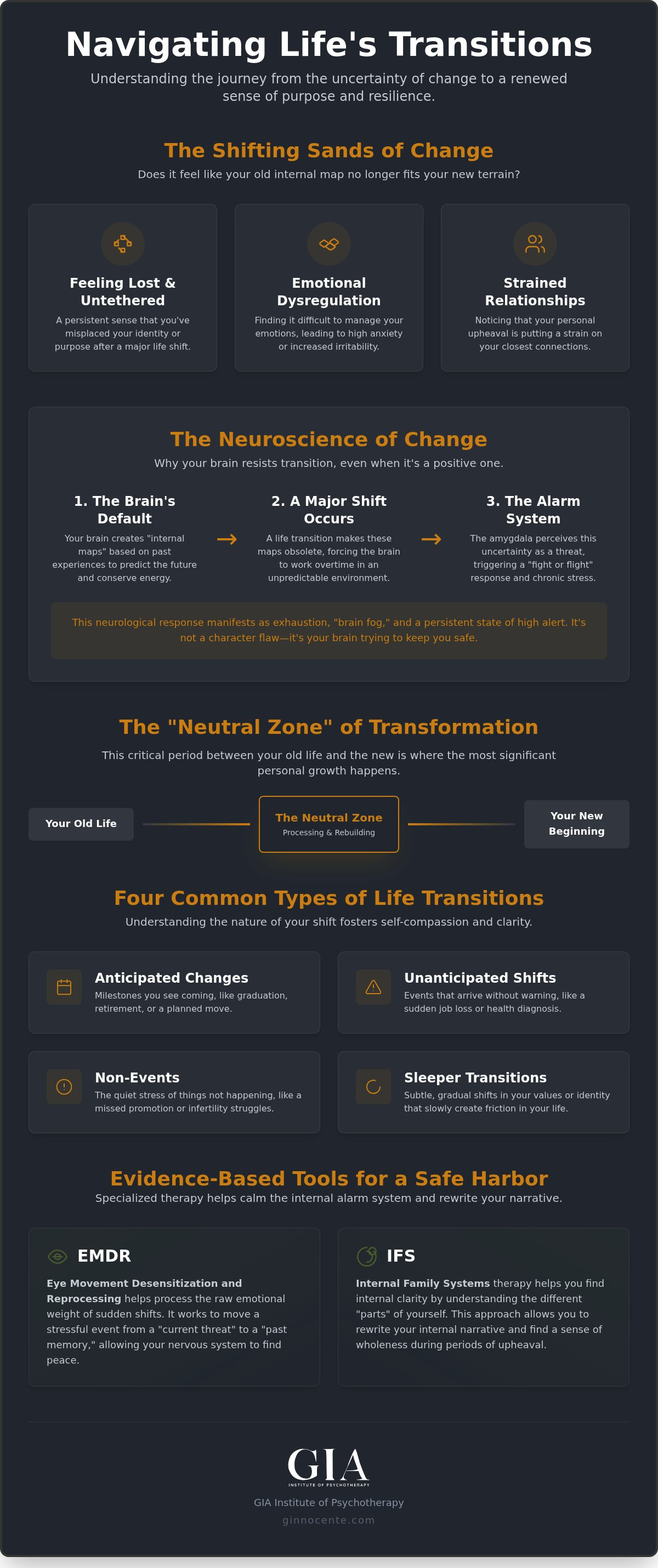
Transitions aren't one-size-fits-all. Understanding the nature of your shift can help you approach it with more self-compassion and clarity.
- Anticipated changes: These are the milestones you see coming, like retirement, graduation, or finally making that planned move to the Jersey Shore.
- Unanticipated shifts: These arrive without warning, such as a sudden job loss, a health diagnosis, or the unexpected end of a long-term relationship.
- Non-events: This is the quiet stress of things not happening, like struggling with infertility or missing out on a promotion you worked years to earn.
- Sleeper transitions: These are the subtle, gradual shifts in your values or identity that eventually create friction in your daily life.
Signs You Could Benefit from Professional Support
How do you know when it's time to reach out for a steady hand? If you're feeling like an imposter in your own skin, or if you're experiencing persistent brain fog that makes small decisions feel impossible, you don't have to carry that weight alone. Other common signs include:
- Increased irritability with your loved ones in Ocean City or Linwood.
- Physical symptoms of stress, such as chronic tension headaches, stomach upset, or insomnia.
- A lingering sense of being untethered from your previous identity or purpose.
- Difficulty regulating your emotions when faced with minor setbacks or future uncertainty.
The Neuroscience of Change: Why Your Brain Resists Transition
Have you ever wondered why even a "good" change feels so heavy? It's because your brain is wired for efficiency through a process called predictive processing. To save energy, your mind creates internal maps of what to expect from your daily life. When a major shift occurs, those maps become obsolete. Your brain has to work overtime to interpret new, unpredictable data, which often manifests as deep exhaustion or persistent "brain fog."
When your environment changes, your amygdala, the brain's alarm system, often perceives the unknown as a threat. This triggers a persistent state of fight or flight. You might find yourself snapping at family or unable to sleep because your nervous system is on high alert. This isn't a character flaw; it's a neurological response to a perceived lack of safety. At the GIA Institute, we use a blend of neuroscience and therapy to help you calm this alarm system, moving you from a state of upheaval back into a sense of groundedness.
How EMDR and IFS Help "Unstick" Transition Stress
Traditional talk therapy is a powerful tool, but sometimes the "shock" of a life change is stored in the body's nervous system. We use EMDR (Eye Movement Desensitization and Reprocessing) to help process the raw emotional weight of sudden shifts. This modality helps the brain move a stressful event from a "current threat" to a "past memory," allowing you to breathe again.
Similarly, Internal Family Systems (IFS) allows us to meet the "parts" of you that are terrified of the new chapter. Perhaps there's a part of you that deeply misses your old identity or a part that feels like an imposter in your new role. By acknowledging and validating these parts, we create internal harmony rather than internal conflict. If you're feeling stuck in these conflicting emotions, our Adult Individual Psychotherapy provides a space to explore these parts with compassion.
Moving from Survival Mode to Self-Discovery
Navigating this "messy middle" is explained beautifully in William Bridges' Transition Model, which highlights the Neutral Zone as a space for reorientation. While your amygdala wants you to stay in survival mode, therapy for life transitions uses neuroplasticity to build new, healthier neural pathways. We focus on "bottom-up" regulation first, which means we work to calm the body and the nervous system before we attempt to change complex thoughts.
Once you feel safe, you can begin to shift the internal narrative from "this is happening to me" to "this is happening for my growth." This shift doesn't happen overnight, but through intentional practice, you can find the best parts of yourself in the midst of chaos. We're here to guide you as you rewrite your story, ensuring that your transition becomes a bridge to a more authentic version of yourself.
Specialized Therapy for Major Life Milestones
Every milestone carries its own unique frequency. Because of this, therapy for life transitions must be as nuanced as the people experiencing them. At GIA Institute, we act as a full-family resource, offering specialized support for children, teens, and adults alike. We believe the goal isn't just to get through a difficult period. Instead, we want to help you emerge with a more authentic sense of self and a clearer vision for your future.
Consider a family relocating to a quiet shore town like Linwood. While the move might be a positive step, the sudden loss of a familiar social circle can leave children feeling untethered and parents feeling professional isolation. A therapist provides the necessary space to process this emotional dip, ensuring the move becomes a foundation for growth rather than a source of chronic stress. Understanding the stages of adjustment is a vital part of Coping with Change, as it allows you to normalize the internal friction you're feeling during the move.
Relationship Shifts: Divorce, Marriage, and New Parenthood
Relationships are often the primary mirrors of our internal shifts. We utilize Emotionally Focused Therapy (EFT) to help couples navigate shared transitions, ensuring that a new marriage or the arrival of a baby strengthens your bond rather than creating distance. For those healing after a divorce in Ventnor or Margate, we focus on the "new chapter" of your life. We help you process the identity shift that occurs when you move from being part of a couple to rediscovering your individual agency and voice.
Career Transitions and Retirement
Your professional life is often deeply tied to your sense of purpose. When burnout or "quiet quitting" begins to drain your vitality, we use DBT skills to help you regain emotional balance and set healthy boundaries. For those facing the "Identity Crisis" of retirement, therapy offers a space to find purpose beyond a professional title. We also provide school advocacy and transition support for children and teens in Egg Harbor Township or Galloway, helping them find their footing in new academic or social environments.
Grief, Loss, and the "Empty Nest"
Processing the loss of a loved one or even a beloved pet is a fundamental life shift that requires a gentle, patient approach. Similarly, the "Empty Nest" transition can be surprisingly jarring as you redefine yourself when the primary role of parent changes. We use Expressive Arts and Play Therapy to help children process family changes, while offering parents a safe harbor to explore their own evolving roles. This specialized therapy for life transitions ensures that every member of the family feels seen and supported as the household dynamic shifts.
Practical Strategies for Navigating the "Neutral Zone"
What if the most uncomfortable part of your journey is actually where you are being reshaped? William Bridges describes the "Neutral Zone" as the messy middle between the ending of an old chapter and the beginning of a new one. It often feels like a void, a place of confusion and uncertainty where you no longer have your old identity but haven't yet formed a new one. While it's tempting to rush through this phase to find solid ground, this is the most critical time for therapy for life transitions. This space isn't just a waiting room; it's a creative crucible where real transformation happens.
At GIA Institute, we believe that navigating this gap requires more than just patience. It requires a set of practical tools to manage the emotional weight of being "in-between." By using Dialectical Behavior Therapy (DBT), we help you build a bridge of skills that support you until the new shore comes into view. If you're currently feeling untethered, our Adult Individual Psychotherapy offers a structured path through the unknown.
DBT Skills for Emotional Regulation
When the future feels terrifying, your mind tends to race ahead to "worst-case" scenarios. DBT provides three core pillars to keep you grounded during these turbulent times:
- Mindfulness: This involves staying present in the current moment without judgment. It helps you notice your anxiety without becoming consumed by it, allowing you to breathe through the uncertainty.
- Distress Tolerance: Transitions often come in waves. These skills teach you how to handle intense emotional surges without making the situation worse, allowing the wave to pass naturally.
- Interpersonal Effectiveness: Your relationships often change during a shift. We help you learn how to communicate your needs clearly to family and friends, ensuring your support system remains strong.
Creating a Transition Toolkit
Stability during a shift often comes from the small things you can control. Establishing "Anchor Habits" is a powerful way to provide your nervous system with a sense of safety. These are tiny, non-negotiable routines, such as a morning walk by the ocean or a nightly gratitude practice, that remain constant even when your career or family life is in flux.
We also encourage the use of Expressive Arts to name feelings that don't have words yet. Whether through journaling, sketching, or music, creativity allows you to externalize the chaos and see it from a new perspective. Finally, we work with you to identify your core values. These values act as a compass, guiding your decisions and ensuring that your "new beginning" is built on a foundation that truly reflects who you are today.
Finding Your Safe Harbor: Therapy for Life Transitions in South Jersey
When you're in the middle of a life storm, you don't need a cold, clinical diagnosis. You need a safe harbor. GIA Institute of Psychotherapy serves as that steady, calming presence for residents in Ocean City, Linwood, and our surrounding shore towns. We've built our practice on a foundation of professional clinical authority balanced with a gentle, human-centric approach. Our space is designed to feel restorative and inviting, ensuring that you feel seen and understood from the moment you walk through our doors.
By blending the latest neuroscience with deeply empathetic care, we help you navigate the rough waters of change with grace. Whether you're moving through a career shift, a relationship change, or the heavy silence of an empty nest, our specialized therapy for life transitions provides the stability you've been searching for. We believe that effective therapy for life transitions should feel like a partnership where your agency and growth are the primary focus. We aren't just experts; we're your neighbors who understand the unique rhythm of life in South Jersey.
Why a Local South Jersey Therapist Makes a Difference
Choosing a therapist who lives and works in your community adds a layer of understanding that a national platform simply can't provide. We understand the specific stressors of the shore community, from the quiet isolation of the off-season to the high-pressure transitions within our local school systems. There's a profound benefit to in-person connection in an environment that feels like home. Our commitment is to be a compassionate and wise guide, helping you find your footing in the place where you live, work, and raise your family.
How to Start Your Journey at GIA Institute
Taking the first step can feel like the hardest part of the entire transition. We've made our intake process gentle and intentional, focusing on finding the right match for your specific needs. In your first session, you won't find a cold checklist. Instead, you'll find validation for your pain, hope for your future, and a collaborative plan to help you move forward. We're here to help you rewrite your narrative, turning a period of upheaval into a season of profound growth.
If you're ready to find clarity and peace, we invite you to explore How to Start Therapy in NJ: A Gentle Guide to Your Journey. Your new chapter is waiting, and you don't have to navigate the path alone.
Embracing the Strength in Your New Beginning
Life’s biggest shifts don't have to be navigated in isolation or through sheer willpower. We've explored how your brain's natural craving for certainty can make even positive changes feel like a threat, and how the "Neutral Zone" serves as a vital space for personal transformation. By integrating specialized therapy for life transitions into your journey, you can move from a state of survival into one of intentional self-discovery. Whether you're processing a sudden loss or adjusting to a new professional identity, the right support helps you find clarity amidst the chaos.
GIA Institute offers a safe harbor in South Jersey, providing neuroscience-backed, heart-centered care tailored to your unique story. Our expertise in EMDR, DBT, and IFS allows us to meet you exactly where you are, whether you're in Ocean City, Linwood, or the surrounding communities. You have the agency to rewrite your internal narrative and emerge from this transition with a stronger, more authentic sense of self. When you're ready to find your footing again, we're here to walk beside you.
Begin Your New Chapter: Schedule a Consultation with GIA Institute
Your future is still being written, and it holds more possibility than you might currently feel. Take a deep breath; the first step toward peace is often just a conversation away.
Frequently Asked Questions
What is considered a "life transition" in therapy?
A life transition is any period where your external reality changes significantly, requiring you to update your internal map. This includes anticipated milestones like graduation or retirement in Margate, as well as sudden shifts like a health diagnosis or the end of a relationship. Specialized therapy for life transitions helps you process the emotional weight of these changes. It validates that even "good" changes can feel overwhelming, providing a structured way to find your footing again.
How long does life transition counseling typically last?
The duration of counseling is deeply personal and depends on the complexity of the shift you're facing. Some clients find clarity and relief within a few months of focused work on a specific event like a job change. Others choose longer term support to navigate deep identity shifts or family upheavals. We work collaboratively to ensure the pace feels restorative, moving from initial stabilization to long term resilience and growth as you rewrite your narrative.
Can therapy help if I am struggling with a positive life change, like a promotion or marriage?
Absolutely. It's a common misconception that only "bad" events require support. Positive milestones like marriage, a new baby, or a promotion in Egg Harbor Township often trigger significant anxiety because they demand a total rewrite of your daily life and identity. Therapy provides a non-judgmental space to acknowledge the stress of these "happy" changes. We help you navigate the pressure of new expectations while honoring the version of yourself you're leaving behind.
What is the difference between life coaching and therapy for transitions?
While life coaching often focuses on external goals and future action, therapy for life transitions addresses the deeper emotional and neurological roots of change. At GIA Institute, we use clinical modalities like EMDR and IFS to process the "stuck" emotions or trauma that coaching might miss. We look at how your past experiences influence your current transition, helping you heal old wounds while simultaneously building practical strategies for your daily life in South Jersey.
How do I know if my stress is "normal" or if I need professional help?
Stress is a natural part of change, but it may be time for professional help if your symptoms begin to interfere with your daily life. If you're experiencing persistent irritability with loved ones in Linwood, chronic insomnia, or a sense of "imposter syndrome" that won't fade, therapy can offer relief. We look for signs like "brain fog" or an inability to experience joy in your new circumstances. Seeking help is a proactive step toward your long term well-being.
Does GIA Institute offer specialized support for children going through family transitions?
Yes, we provide dedicated support for children and teens navigating family shifts such as divorce, relocation, or loss. Our approach utilizes age-appropriate modalities like Play Therapy and Expressive Arts to help younger clients process feelings they may not yet have the words to describe. We also offer family therapy and school advocacy services in communities like Galloway to ensure children feel supported across all areas of their lives during a difficult transition.
Will my therapist provide practical advice or just listen to me talk?
You can expect a balance of deep, empathetic listening and actionable, practical strategies. While we value the space for you to be heard, we also believe in giving you a "toolkit" for daily life. This includes DBT skills for emotional regulation and distress tolerance. Our goal is to move beyond just talking about the problem. We want to help you develop the internal clarity and external habits necessary to navigate your new chapter with confidence.
How do I explain to my family that I am starting therapy for a life change?
It often helps to frame the conversation around your desire to be the healthiest version of yourself for them. You might explain that you're seeking a "safe harbor" to process a specific shift, like retirement or a move to Ocean City, so you can show up more fully in your relationships. Emphasizing that therapy is a proactive tool for resilience can help normalize the process. Most families are supportive when they see it as a path toward peace.


