

What if the voice telling you you’re not good enough is a learned pattern, not the truth about who you are? Harsh self-criticism, persistent doubt, difficulty accepting compliments, or trouble setting boundaries can weigh on everyday choices and relationships. If you recognize some of these experiences, it doesn’t mean you need to label or diagnose yourself. It may simply be a sign that you deserve more understanding and support, and that therapy for low self-esteem could be worth exploring.
Can therapy help you build a kinder, steadier relationship with yourself? Therapy can offer a collaborative space to notice where self-doubt shows up, understand what may be reinforcing it, and practice responding to your inner critic with greater balance and compassion. Change isn’t a quick fix, and it doesn’t require you to become someone else.
This article explores what low self-esteem can look like in daily life, practical ways to meet negative self-talk without judgment, and how therapy may support the process. You’ll also learn what to expect when exploring therapy, so you can consider your next step with more clarity and less pressure.
Key Takeaways
- Self-esteem reflects how you relate to yourself; noticing self-doubt or fear of judgment doesn’t mean you need to diagnose yourself.
- Repeated messages, relationships, and life experiences can shape beliefs about your worth, but there isn’t one explanation that fits everyone.
- Therapy for low self-esteem can help you explore unhelpful thought patterns and consider approaches that fit your goals and preferences.
- Try noticing what triggers self-criticism, naming the thought, examining the evidence, and choosing a kinder response.
- Consider seeking support if self-criticism is affecting daily choices or relationships; you don’t have to wait until you’re in crisis.
What does low self-esteem feel like in everyday life?
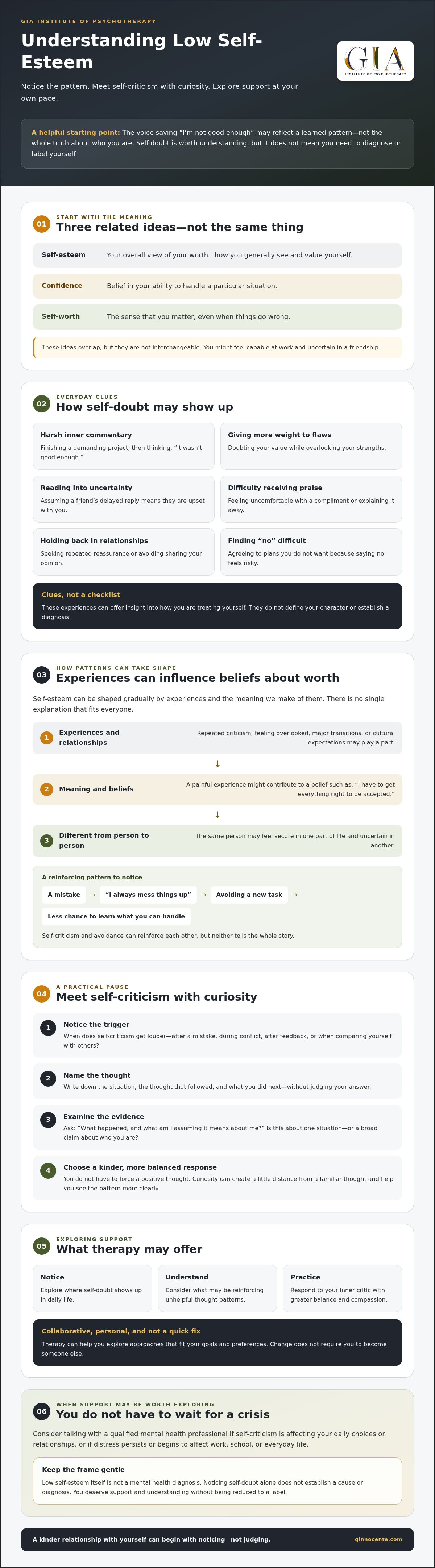
Self-esteem is the way you generally see and value yourself, not a clinical label or a measure of what you can accomplish. A concise way to put it: self-esteem is your overall view of your worth; confidence is belief in your ability to handle a particular situation; self-worth is the sense that you matter even when things go wrong. These ideas overlap, but they aren’t interchangeable. You might feel capable at work and uncertain in a friendship, for example.
Low self-esteem can show up as a pattern of doubting your value or giving more weight to perceived flaws than to your strengths. You might finish a demanding project and think, “It wasn’t good enough,” or assume a friend’s delayed reply means they’re upset with you. A compliment may feel uncomfortable, as if you need to explain it away. These moments can offer clues about how you’re treating yourself, but they don’t define your character. For a broader overview of what self-esteem is, see Wikipedia’s discussion of the concept.
How low self-esteem can show up in thoughts and relationships
In relationships, self-doubt may lead someone to seek repeated reassurance, avoid sharing an opinion, or agree to plans they don’t want because saying no feels risky. At other times, fear of judgment may make a new challenge seem not worth attempting. These are possibilities, not a checklist. Family or peer relationships, criticism, cultural expectations, and personal experiences can all play a part, and the pattern differs from person to person.
Is low self-esteem a mental health diagnosis?
Low self-esteem itself isn’t a mental health diagnosis. It can exist alongside other emotional difficulties, but noticing self-doubt alone doesn’t establish a cause or diagnosis. If distress persists or begins to affect relationships, work, school, or everyday choices, consider talking with a qualified mental health professional. Therapy for low self-esteem can provide space to explore what you’re experiencing without reducing you to a label.
It may help to notice when self-criticism gets louder and what tends to be happening around you. Is it strongest after a mistake, during conflict, or when you compare yourself with others? You could jot down the situation, the thought that followed, and what you did next. There’s no need to judge your answer. Observing the pattern with curiosity can help you describe your experience more clearly if you decide to seek support.
Why self-esteem can become tied to old messages and repeated patterns
Ideas about your worth can take shape gradually through experiences and the meaning you make of them. Repeated criticism, feeling overlooked in a relationship, a major transition, or pressure to meet cultural expectations may influence how you see yourself. A painful experience can leave a lasting belief, such as “I have to get everything right to be accepted,” but it doesn’t affect everyone in the same way or explain every struggle.
Self-esteem develops through the ongoing interaction of our experiences, the beliefs we form about them, and the relationships that shape our sense of belonging. That view leaves room for complexity: the same person may feel secure in one part of life and uncertain in another. The Better Health Channel’s overview of self-esteem and its influences also describes how experiences can affect the way people see themselves.
How negative self-talk can reinforce self-doubt
After making a mistake at work, someone might think, “I always mess things up.” The thought can feel convincing, but it isn’t automatically a fact. If that person then avoids a new task, they lose a chance to discover what they can learn or handle. Over time, self-criticism and avoidance can reinforce each other, even though neither tells the whole story.
Try noticing when a familiar thought appears: after feedback, during disagreement, or before trying something unfamiliar. Rather than forcing a positive thought, ask, “What happened, and what am I assuming it means about me?” Then consider whether the thought describes this one situation or makes a broader claim about who you are. Curiosity can create a little distance from the thought and help reveal patterns worth exploring.
The role of comparison, relationships, and life transitions
Comparing your life with someone else’s can make your own progress seem smaller, especially during change or uncertainty. A move, a new role, a shift in family relationships, or entering a different stage of life may unsettle familiar sources of reassurance. Relationships can also influence self-perception through encouragement, conflict, or the messages people receive, without making any one person solely responsible for how someone feels.
These influences vary across ages, identities, families, and communities. Therapy for low self-esteem may help you explore which experiences and beliefs are relevant to your own story, without assuming a single cause. If you’re considering support, you can learn more about individual psychotherapy and whether it may fit what you’re looking for.
Therapy for low self-esteem: what approaches may help?
There isn’t one therapy plan that fits everyone. A therapist can work with you to understand what you’d like to change, what experiences may be relevant, and what kind of support feels comfortable. The goal isn’t to judge you or prescribe a new personality. It’s to explore your concerns together and consider ways to respond to them that feel useful in your life.
What happens when self-esteem is a therapy goal?
Early conversations may focus on what brings you to therapy, when self-doubt tends to arise, and what you hope might feel different. You and your therapist can also consider your strengths, relationships, and personal history as they relate to your goals. Sessions may include reflection, trying out a skill, or noticing what happens between appointments. You might bring a recent example, such as a moment when you dismissed a compliment or found it hard to speak up, to make the discussion more concrete. The pace and goals are discussed together and can shift as your needs become clearer.
How to think about CBT and other therapy approaches
Cognitive Behavioral Therapy (CBT) is one possible approach. In plain language, it helps you examine how thoughts, feelings, and actions can influence one another. For instance, a belief that a mistake proves you’re incapable might increase anxiety and make you avoid a task. CBT can help you look at that belief more closely and consider a more balanced response, without assuming that every difficult thought is simply inaccurate.
Depending on your goals and preferences, a clinician may also consider approaches such as DBT, IFS, or Expressive Arts. These aren’t ranked choices or guaranteed solutions. A therapist can explain how an approach might relate to what you want to work on and make space for your questions. When comparing options, ask what the work might look like in sessions, how it connects to your concern, and whether the approach feels comfortable to you.
The table offers a starting point for discussion, not a way to choose a treatment on your own.
| Possible focus | Example of the work | Reminder |
|---|---|---|
| CBT: thoughts, feelings, and actions | Notice a self-critical thought and explore a more balanced interpretation. | Fit depends on your needs and preferences. |
| DBT: responding to emotions and relationships | Consider skills for handling distress or communicating needs. | A clinician can discuss whether this focus suits your goals. |
| IFS or Expressive Arts: exploring inner experiences | Use reflection or creative expression to explore feelings and perspectives. | These approaches may be considered when relevant, not prescribed for everyone. |
GIA Institute of Psychotherapy clinicians use approaches including CBT, DBT, IFS, and Expressive Arts. If you’re exploring therapy for low self-esteem, you can ask how a therapist would tailor their approach to your goals, history, and comfort level.
Ways to Handle Self-Criticism and Boost Self-Respect
You don’t have to force yourself to feel confident or replace every hard thought with praise. A gentler starting point is to notice what’s happening, respond with curiosity, and try one small action that reflects how you want to treat yourself. These practices are invitations to experiment, not a substitute for professional care.
A gentle practice for challenging a harsh inner voice
When a familiar critical thought appears, try writing down the thought and what was happening around it. Then pause and move through these steps:
- Notice the trigger: What happened just before the thought showed up?
- Name the thought: Write the words as they came to mind, such as “I can’t do anything right.”
- Examine the evidence: What supports this conclusion, and what might it be leaving out?
- Choose a kinder response: Ask what you’d say to someone you care about in the same situation.
A balanced response doesn’t deny that something was difficult. It might sound like, “I wish that conversation had gone differently. I can think about what I’d try next time, and one hard moment doesn’t erase the ways I show up for people.” The aim isn’t to win an argument with yourself. It’s to make room for a fuller, fairer view.
Small actions that support self-trust
Self-respect can also grow through ordinary choices. Steady self-respect develops through repeated, realistic actions that reflect your needs and values. You might choose one manageable commitment, such as taking a short walk or making time to prepare for a task, then notice how following through feels. Keep it small enough to be realistic, not a new standard to judge yourself by.
Consider what matters to you apart from comparison: perhaps honesty, creativity, connection, or learning. Recording small accomplishments can help you notice effort you might otherwise dismiss. Supportive connection matters, too. Sharing how you feel with someone you trust may make it easier to feel understood. If a request or commitment doesn’t work for you, practicing a respectful boundary can be another way to honor your needs. For example, you might pause before agreeing to a plan and give yourself time to decide.
Adjust or pause any exercise if it increases distress. Therapy for low self-esteem can offer collaborative support for exploring self-criticism and finding practices that fit your circumstances. If you’d like to consider that support, explore individual psychotherapy with GIA Institute of Psychotherapy.
When therapy for low self-esteem may help, and finding support in South Jersey
Therapy may be worth considering if self-criticism keeps returning, makes it hard to make everyday choices, or affects how you connect with other people. You might find yourself holding back from opportunities, struggling to express what you need, or feeling unsettled even when others offer reassurance. You don’t need to wait until things feel unbearable. Support can be an option when you’re curious about understanding your patterns, though therapy is a choice, not a requirement.
As you look for a therapist, it can help to ask a few questions and notice how the conversation feels. You might ask:
- Have you worked with people who want to address self-esteem concerns?
- How would we decide on goals together, and how might we talk about progress?
- What approaches do you use, and how would they connect with what I want help with?
- What should I know about practical details, such as the format of sessions and whether they fit my needs?
You’re allowed to ask questions, take time to consider your options, and pay attention to whether you feel heard and respected. A helpful starting conversation doesn’t require you to have every answer or a perfectly defined goal.
Exploring therapy with GIA Institute of Psychotherapy
GIA Institute of Psychotherapy offers individual therapy for adults, children, and teens. Its clinicians use approaches including CBT, DBT, EMDR, IFS, Play Therapy, and Expressive Arts. These approaches aren’t a guaranteed match for every person or concern. A therapist can discuss your goals and needs with you and explore whether an available approach may fit.
GIA serves communities in South Jersey, including Ocean City, Linwood, Margate, Ventnor, Egg Harbor Township, Upper Township, and Galloway. If you’re comparing support options nearby, consider whether the therapist works with your age group and concerns, and ask which approaches may be available for your needs. Current therapist availability and service options may vary, so check with the practice about what’s available for your circumstances. If you’re considering support, you can learn more about GIA’s individual therapy services or contact the practice to ask questions. There’s no need to have everything figured out before exploring whether a conversation feels right.
Take a compassionate next step toward self-worth
Self-esteem isn’t a fixed measure of your value. It can be shaped by experiences and repeated beliefs, and noticing those patterns may help you respond to self-criticism with more care. Small, realistic actions, such as recognizing your effort, honoring a boundary, or reaching out to someone supportive, can offer ways to practice self-respect.
Therapy for low self-esteem can provide a collaborative space to explore what you’re experiencing and consider goals and approaches that fit your needs. GIA Institute of Psychotherapy offers individual therapy, with clinicians who use approaches including CBT, DBT, EMDR, and IFS. A therapist can discuss whether their approach may fit what you hope to work on, without pressure to have everything figured out first.
If you’re ready to explore support, learn about therapy with GIA Institute of Psychotherapy. You can take this one step at a time. Your worth isn’t defined by doubt, and asking questions about support is a meaningful way to care for yourself.
Frequently Asked Questions
Can therapy help with low self-esteem?
Therapy can help you explore self-doubt, understand patterns that affect how you see yourself, and practice different ways of responding. In therapy for low self-esteem, you and the therapist can identify goals that matter to you, such as feeling more comfortable expressing your needs or responding to mistakes with less harshness. The process is collaborative, and no particular outcome or timeline can be guaranteed.
What type of therapy is best for low self-esteem?
There isn’t one approach that’s best for everyone. CBT may help you examine connections among thoughts, feelings, and actions, while DBT, EMDR, IFS, or expressive approaches may be considered depending on your needs and goals. A therapist can explain how their approach might relate to what you want to work on. At GIA Institute of Psychotherapy, clinicians use several approaches, including CBT, DBT, EMDR, and IFS.
How long does therapy for low self-esteem take?
There’s no set timeline for working on self-esteem. The length of therapy may depend on your goals, personal history, needs, and how you and your therapist decide to work together. You can discuss the pace and check in about whether the work feels relevant as your needs change. Be cautious of promises that therapy will resolve self-esteem concerns within a specific number of sessions.
Is low self-esteem a mental health disorder?
No. Low self-esteem itself isn’t a mental health disorder or diagnosis. It describes a way someone may feel about their worth or relate to themselves. Self-esteem concerns can occur alongside other emotional difficulties, but they don’t establish a diagnosis or explain its cause. If distress persists or affects your daily life, a qualified mental health professional can listen to your concerns and help you consider what support may be appropriate.
Can you improve self-esteem without therapy?
Some people explore self-esteem through practices such as noticing self-critical thoughts, recording small accomplishments, setting a manageable boundary, or talking with someone supportive. These actions may help you reflect on what matters to you and build self-trust over time. There’s no single practice that works for everyone, and you can adapt or pause an exercise if it increases distress. Therapy remains an option, not a requirement.
What should I expect in my first therapy session for low self-esteem?
Your first session is generally a chance to talk about what brings you to therapy, what you hope to work on, and any questions you have. The therapist may ask about relevant experiences and discuss how you might set goals together. You don’t need to arrive with a complete explanation or a clear plan. You can share at a pace that feels manageable and ask how the therapist’s approach works.
When should I consider therapy for low self-esteem?
Consider exploring therapy if persistent self-criticism or self-doubt is affecting your relationships, daily choices, or ability to pursue things that matter to you. You don’t have to wait until you’re in crisis, and seeking support is a personal choice. GIA Institute of Psychotherapy serves communities including Upper Township, Ocean City, Linwood, Margate, Ventnor, Egg Harbor Township, and Galloway, New Jersey. Check with the practice about current therapist availability and service options.


