

What if finding the right anxiety therapist isn’t about choosing a perfect approach right away, but discovering who feels like a good fit? If anxiety is affecting your routines, relationships, work, or school, looking for an anxiety therapist Ocean City NJ can bring up more questions than answers. You may be wondering which kind of therapy to ask about, what to share with a provider, and what happens after you reach out.
Support can begin with a conversation about what you’re experiencing and what you’d like to change. Therapy may help you notice patterns, explore anxious thoughts, and practice practical ways to respond. The approach should be discussed in light of your needs rather than treated as a one-size-fits-all plan.
This guide explains what an anxiety therapist can help you explore, how to compare clinicians and approaches, and what to ask before beginning. It also introduces GIA Institute of Psychotherapy, which serves Ocean City and nearby South Jersey communities, and highlights practical details to confirm when exploring care.
Key Takeaways
- Choosing an anxiety therapist Ocean City NJ can start with identifying what you want help with and what would make therapy feel comfortable.
- Therapy approaches differ. An initial conversation can help you explore which options may fit your concerns and goals.
- Ask about relevant experience, communication style, appointment format, and how you’ll review goals and progress together.
- You can begin with a brief inquiry, ask practical questions, and take time to decide whether to start therapy.
- GIA Institute of Psychotherapy serves Ocean City and nearby South Jersey communities, with therapy options and approaches to discuss with a clinician.
Looking for an Anxiety Therapist in Ocean City, NJ? Start With What You Need
Looking for support can be a meaningful first step, especially if you’ve been carrying worry on your own. You don’t need to have everything figured out before speaking with someone. An anxiety therapist is a mental health professional who helps people understand emotional distress and develop coping strategies that fit their circumstances.
Anxiety can arise during stressful periods, and feeling anxious sometimes doesn’t automatically mean you have a disorder. If you’re learning about the range of experiences that may be involved, Anxiety disorders offers a general overview. When deciding whether to seek support, consider how you’re feeling and whether distress is interfering with the life you want to live.
When anxiety may be affecting everyday life
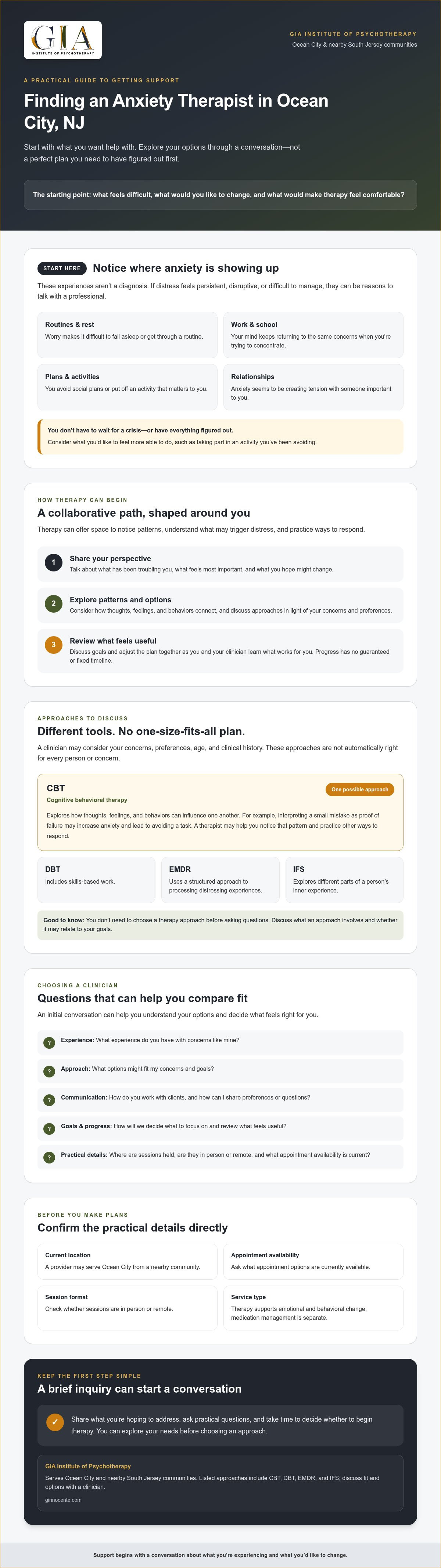
Perhaps worry makes it difficult to fall asleep, or your mind keeps returning to the same concerns when you’re trying to concentrate at work or school. You might avoid social plans, put off an activity that matters to you, or notice anxiety creating tension in a relationship. These experiences aren’t a diagnosis, but they can be reasons to talk with a professional.
You don’t have to wait until you reach a crisis point. If anxiety feels persistent, distressing, or disruptive, a professional evaluation can help you consider what kind of support may be appropriate. To prepare for a first conversation, think about what you’d like to feel more able to do, such as getting through a particular routine or taking part in an activity you’ve been avoiding.
What an anxiety therapist can help you explore
Therapy offers a collaborative space to notice patterns, understand what may trigger distress, and practice ways to respond. You might explore what happens before you avoid a situation, or how anxious thoughts affect your feelings and actions. Goals are personal and may depend on your needs, age, history, and preferences. A therapist can help you clarify priorities and consider an approach with you, rather than assuming one method suits everyone.
Therapy supports emotional and behavioral change; medication management is a separate service. If you’re searching for an anxiety therapist Ocean City NJ, confirm the practice’s current location, appointment availability, and whether sessions are in person or remote. A provider may serve the Ocean City area from a nearby community, so checking these details directly can help you understand your options before making plans.
How Anxiety Therapy Works: Approaches and a Collaborative Care Plan
Therapy often begins by making room for your perspective. In an initial conversation, you and the clinician can discuss what has been troubling you, what feels most important to address, and what you hope might change. You can ask questions and share preferences, too. This discussion helps shape a plan around your circumstances instead of starting with a predetermined formula.
What CBT for anxiety may involve
Cognitive behavioral therapy (CBT) explores how thoughts, feelings, and behaviors can influence one another. For example, someone who interprets a small mistake as proof they’ll fail may feel more anxious and avoid a task. A therapist may help them notice that pattern without judgment, then practice ways to respond that feel more useful. CBT is one possible approach, not a guarantee of results or the right fit for every person. The National Institute of Mental Health provides an overview of anxiety disorders and treatment options for people who want to learn more.
How a therapist considers other approaches
A clinician may consider your concerns, preferences, age, and clinical history when discussing possible approaches. GIA Institute of Psychotherapy lists CBT, DBT, EMDR, and IFS among its approaches, but that doesn’t mean each is appropriate for every client or concern. Broadly, DBT includes skills-based work, EMDR uses a structured approach to processing distressing experiences, and IFS explores different parts of a person’s inner experience. Your clinician can explain what these approaches involve and whether one may relate to your goals.
Therapy goals and approaches are discussed collaboratively, then adjusted as you and your clinician learn what feels useful. You don’t need to choose a modality before asking questions, and progress doesn’t follow a guaranteed or fixed timeline. If you’re exploring an anxiety therapist Ocean City NJ, you can review GIA’s psychotherapy services and ask the practice which options may fit your needs. Focus on understanding what an approach involves, not selecting one based on its name alone.
How to Choose an Anxiety Therapist Near Ocean City, NJ
Choosing a therapist is a personal decision, not a test with one right answer. Along with relevant experience, consider whether the clinician explains options clearly, listens without judgment, and makes it comfortable to ask questions. A respectful first conversation can help you assess whether working together feels possible. No provider can promise a particular result, but you can look for someone who will discuss your goals and review progress with you.
Questions to ask before beginning therapy
Use an initial inquiry to learn how the therapist works and whether practical details fit your needs. You might ask:
| Ask about | What to listen for | What to confirm |
|---|---|---|
| Experience and age group | A clear explanation of relevant experience with anxiety-related concerns | Who would provide care and whether they work with your age group |
| Approach and goals | How the therapist would learn about your concerns and tailor the work | How you’ll discuss goals and review whether therapy feels useful |
| Communication and fit | Respectful, understandable answers that leave room for your questions | How to raise concerns or revisit the plan if your needs change |
| Logistics | Direct answers about how appointments are arranged | Current availability, session format, location, fees, and insurance details |
You’re not expected to know which therapy approach you need before reaching out. Ask how a clinician typically approaches anxiety-related concerns, then share what you hope might change. Notice whether you feel heard, respected, and able to ask for clarification. Those impressions matter alongside practical considerations such as location, format, and whether appointments fit your schedule.
Finding care in Ocean City and nearby communities
If you’re searching for an anxiety therapist Ocean City NJ, nearby communities may also be worth exploring. GIA Institute of Psychotherapy lists Ocean City, Linwood, Margate, Ventnor, Egg Harbor Township, Upper Township, and Galloway among the communities it serves. This service-area information does not confirm the location of a particular appointment or current availability.
Before making plans, contact the practice to verify where sessions take place, whether appointments are in person or remote, and what openings are currently available. Confirming these details directly helps you compare options without relying on assumptions.
What to Expect When You Contact an Anxiety Therapist
Reaching out doesn’t commit you to starting therapy. It’s a chance to ask questions, share only what feels comfortable, and learn whether the provider may be a fit. If you’re looking for an anxiety therapist Ocean City NJ, a little preparation can make that first inquiry clearer and more manageable.
How to prepare for an initial conversation
You don’t need a polished explanation of everything you’re feeling. Before contacting a practice, consider noting what prompted your search and what you hope support might help with. A few brief notes can make it easier to begin, especially if you feel nervous about explaining your concerns.
You might also write down practical questions, such as:
- How does the therapist approach the concerns I’m bringing up?
- Are appointments available for my age group and needs?
- What appointment formats are currently offered, and where do sessions take place?
- What are the fees, and what should I know about insurance?
- What would the next step be if I decide to explore therapy?
At first contact, a brief description is enough. You can share more later if you choose. The purpose is to get the information you need, not to tell your whole story before you feel ready.
What to clarify about local appointments
A practical inquiry can follow a simple sequence: reach out, briefly describe what you’re looking for, ask about appointment details, then consider the options. Confirm whether the practice works with your age group and concerns, whether sessions are in person or remote, and which location applies to your appointment. Availability, format, fees, and insurance details can change, so ask the practice directly before making plans.
For GIA Institute of Psychotherapy, ask about current availability and what the next steps might involve. An initial conversation is a chance to discuss your needs and possible fit. It isn’t a promise of a particular result, and you can take time to decide whether you want to begin.
If you’re ready to learn more, contact GIA to ask about therapy options. You don’t need to have every answer first. One question can be a gentle place to start.
Explore Anxiety Therapy With GIA Institute of Psychotherapy
If you’re considering support, GIA Institute of Psychotherapy is a local practice serving Ocean City and nearby South Jersey communities. Its stated service area also includes Linwood, Margate, Ventnor, Egg Harbor Township, Upper Township, and Galloway. Contact the practice to ask whether its services and current appointment arrangements fit what you’re looking for.
A range of therapeutic approaches and life-stage support
GIA offers individual therapy for adults, children, and teens, along with family therapy and couples counseling. Its listed approaches include cognitive behavioral therapy (CBT), dialectical behavior therapy (DBT), eye movement desensitization and reprocessing (EMDR), and internal family systems (IFS). These are options the practice offers, not a recommendation that every approach is right for every person or anxiety concern.
A clinician can learn about your concerns, preferences, and goals, then discuss what kind of support may be appropriate. Ask what an approach involves, how it might relate to your needs, and whether another option may make more sense. Therapy is a collaborative process, not a promise of a particular outcome.
Your next step toward local support
It’s okay to begin with a general description, such as “I’ve been feeling anxious and would like to understand my options.” You don’t need to have a diagnosis or know which therapy approach you want. Ask whether the practice may be a fit for your concerns and age group, then confirm current appointment openings, session format and location, fees, and insurance details directly before making plans.
If you’re searching for an anxiety therapist Ocean City NJ, reaching out with questions can be a low-pressure way to explore support. You can consider the answers and decide what feels right for you.
Contact GIA Institute of Psychotherapy to ask about therapy options and confirm current details.
Take a Thoughtful Next Step Toward Support
Finding an anxiety therapist Ocean City NJ can begin with a conversation about what you’re experiencing and what you hope might change. The right fit involves more than choosing an approach. Consider whether you feel heard, can ask questions, and understand the practical details before deciding to begin.
GIA Institute of Psychotherapy serves Ocean City and nearby South Jersey communities, offering psychotherapy and counseling for adults, children, teens, couples, and families. Its listed approaches include CBT, DBT, EMDR, and IFS. A clinician can discuss which options may be relevant to your needs, without assuming that one approach suits everyone. Confirm current appointment availability, format, location, fees, and insurance details directly with the practice.
You don’t need every question answered before reaching out. If you’d like to explore whether GIA may be a fit, contact GIA Institute of Psychotherapy to explore your next step. A brief inquiry can be a meaningful beginning, and you can decide what feels right at your own pace.
Frequently Asked Questions
How do I find an anxiety therapist in Ocean City, NJ?
To find an anxiety therapist in Ocean City, NJ, look for a mental health professional whose experience and approach fit your concerns. Ask how they work with anxiety, whether they see your age group, and whether their communication style feels comfortable. If you’re considering GIA Institute of Psychotherapy, confirm current availability, appointment location or format, fees, and insurance details directly. GIA lists Ocean City and nearby South Jersey communities in its service area.
What type of therapist is best for anxiety?
There isn’t one therapist or approach that’s best for everyone. Relevant experience, your goals, and how comfortable you feel speaking with a clinician all matter. Cognitive behavioral therapy (CBT) is one approach a therapist may discuss, but whether it fits depends on your situation. Ask how treatment decisions are made, what alternatives might be considered, and how you and the clinician will revisit your goals as therapy develops.
Does GIA Institute of Psychotherapy offer therapy for anxiety?
Yes. GIA Institute of Psychotherapy provides psychotherapy and counseling for people dealing with anxiety, among other concerns. Its listed approaches include CBT, DBT, EMDR, and IFS, though an approach that may be appropriate for one person may not suit another. A clinician can discuss your needs and possible fit. Contact the practice to confirm which services and clinicians are currently available, along with appointment format and other practical details.
Can I see an anxiety therapist if I live near Ocean City, NJ?
GIA lists Ocean City, Linwood, Margate, Ventnor, Egg Harbor Township, Upper Township, and Galloway among its service-area communities. This doesn’t confirm a specific office location or appointment format in each town. If you live nearby, contact the practice to ask where appointments are available, whether remote sessions are offered, and what openings may be available. Confirm these details before making travel or scheduling plans.
What should I ask an anxiety therapist before starting?
Ask about the therapist’s experience with concerns like yours, the approaches they use, and how you’ll set and review goals together. It’s also reasonable to ask about appointment format, current availability, fees, and insurance. Notice whether the answers are clear and respectful, and whether you feel able to ask follow-up questions. You don’t have to share everything in an initial inquiry. Begin with the questions that matter most to you.
How long does anxiety therapy take?
Anxiety therapy doesn’t follow one set timeline. Its pace may depend on your concerns, goals, circumstances, and how the work develops over time. A therapist can explain how you’ll review progress and discuss next steps, but shouldn’t promise a particular result by a fixed date. You can ask how session frequency is considered and how you and the clinician will check whether your goals or priorities have changed.
Does GIA provide medication management or crisis services?
No. GIA’s listed services focus on psychotherapy and counseling; the practice doesn’t provide psychiatric medication management, inpatient treatment, or 24/7 crisis intervention. For medication guidance, speak with a qualified medical professional. If you’re in immediate danger or need urgent crisis help, contact local emergency services or an appropriate crisis resource rather than waiting for a routine therapy appointment. A practice inquiry is intended for exploring therapy, not urgent crisis support.


