

What if needing support after having a baby doesn’t mean you’re failing to adjust? New motherhood can bring love, exhaustion, uncertainty, and changes in how you see yourself, sometimes all at once. If you’re looking into therapy for new moms Linwood NJ, you may be wondering whether therapy can help with what you’re feeling and whether you can find support without being judged or defined by a diagnosis.
It makes sense to have questions, especially when caring for a baby leaves little time or energy to research your options. You don’t have to find the “right” words before you begin. Therapy can offer a collaborative space to explore the transition, identify what feels difficult, and consider practical ways to care for your wellbeing and relationships.
This article explains how individual, couples, and family therapy can support different needs, what to consider when choosing a format, and how GIA Institute of Psychotherapy serves new mothers in Linwood and nearby South Jersey communities.
Key Takeaways
- Therapy can offer room to explore the emotional, relational, and identity shifts of becoming a mother without reducing your experience to a label.
- Think about what you hope to work on, such as coping strategies, emotional regulation, or changes in close relationships, to clarify what kind of support may fit.
- When exploring therapy for new moms Linwood NJ, compare individual, couples, and family therapy by who participates and which concerns each format may address.
- You don’t need a polished explanation before beginning. Naming one concern or hope can be a manageable first step.
- GIA Institute of Psychotherapy serves Linwood and nearby South Jersey communities, with therapy options for personal, relationship, and family goals.
Therapy for New Moms in Linwood, NJ: When Support May Help
Becoming a mother can bring tenderness and joy alongside overwhelm, worry, sadness, irritability, or loneliness. You may feel close to your baby and still miss parts of your former routine, or notice that your relationships and sense of identity are shifting. These feelings aren’t universal, and experiencing them doesn’t automatically mean something is wrong.
Sleep disruption, new responsibilities, and changes in how time and attention are shared can all shape the adjustment. They’re context, not proof of a mental health condition. For general background on postpartum depression and how it differs from temporary emotional changes after birth, see Postpartum depression. Reading about symptoms can offer context, but it can’t determine what you’re experiencing or diagnose you.
Therapy for new mothers is individualized, nonjudgmental support for exploring feelings, understanding patterns, and building practical ways to cope with the changes motherhood brings. The work is collaborative. You and the therapist can identify what matters to you rather than follow one fixed idea of how a new mother should feel or function.
What emotional changes can accompany new motherhood?
Some mothers notice anxious thoughts, a shorter temper, low mood, or a changed relationship with their own reflection. Others feel isolated even when people are around them. These experiences can fluctuate. A stretch of disrupted sleep or a major routine change may contribute, but it may not explain everything. You don’t have to decide what a feeling “means” before talking it through.
When might a new mom consider talking with a therapist?
Consider a conversation if distress persists, feels hard to manage, or begins affecting daily life, relationships, or your ability to feel present in ways that matter to you. You don’t need a diagnosis, a breaking point, or a complete explanation to begin. Therapy for new moms Linwood NJ can be a place to sort through questions and explore support at your pace.
If you’re unsure, notice what has been weighing on you and whether it’s becoming harder to carry alone. A therapist can help you explore your concerns without assuming they fit a particular label. If you or someone else is in immediate danger, or you’re worried you may harm yourself or your baby, seek urgent help through emergency services or a crisis resource rather than relying on routine therapy alone.
What Therapy for New Moms Can Address Beyond the Postpartum Label
Motherhood doesn’t have to fit a single emotional story. Therapy can focus on what’s meaningful to you, whether that’s settling into new routines, managing intense feelings, reconnecting with your sense of self, strengthening relationships, or finding coping strategies that feel realistic in daily life.
Therapy goals are shaped collaboratively around your concerns, priorities, relationships, and preferred ways of working, then revisited as your needs become clearer. You don’t have to adopt a label or measure yourself against someone else’s idea of successful motherhood to benefit from support.
Therapy can help you explore emotions and patterns, but it isn’t the same as a medical diagnosis or psychiatric medication management. For background on symptoms and treatment for postpartum depression, the U.S. Office on Women’s Health offers an overview of Postpartum Depression. Information can be useful, but a web page can’t determine what’s happening for you. A conversation with an appropriate health professional can help you consider your concerns in context.
Making space for identity, expectations, and changing routines
A new baby can shift priorities, boundaries, and the time available for rest, work, friendships, or personal interests. Therapy may offer space to ask: What feels hardest to carry right now? Which expectations feel like yours, and which feel imposed? What kind of support would make an ordinary day more manageable? There’s no required emotional timeline. Parents vary in how they experience adjustment, including changes in identity, bonding, and routine.
Addressing communication and relationship changes
In individual therapy, you might reflect on how you express needs, respond to stress, or handle moments when support feels uneven. The purpose isn’t to assign blame. It’s to understand what’s happening and consider ways to communicate more clearly. If both partners want help with relationship concerns, couples counseling can provide a shared space to talk through changing responsibilities, closeness, and expectations. Families come in many forms, so the focus depends on the people involved and what they want to address.
If you’re considering therapy for new moms Linwood NJ, begin with the concern that feels most present rather than trying to define the entire experience. Explore individual psychotherapy as one way to learn about support centered on your goals.
How to Compare Therapy Options for New Moms Near Linwood
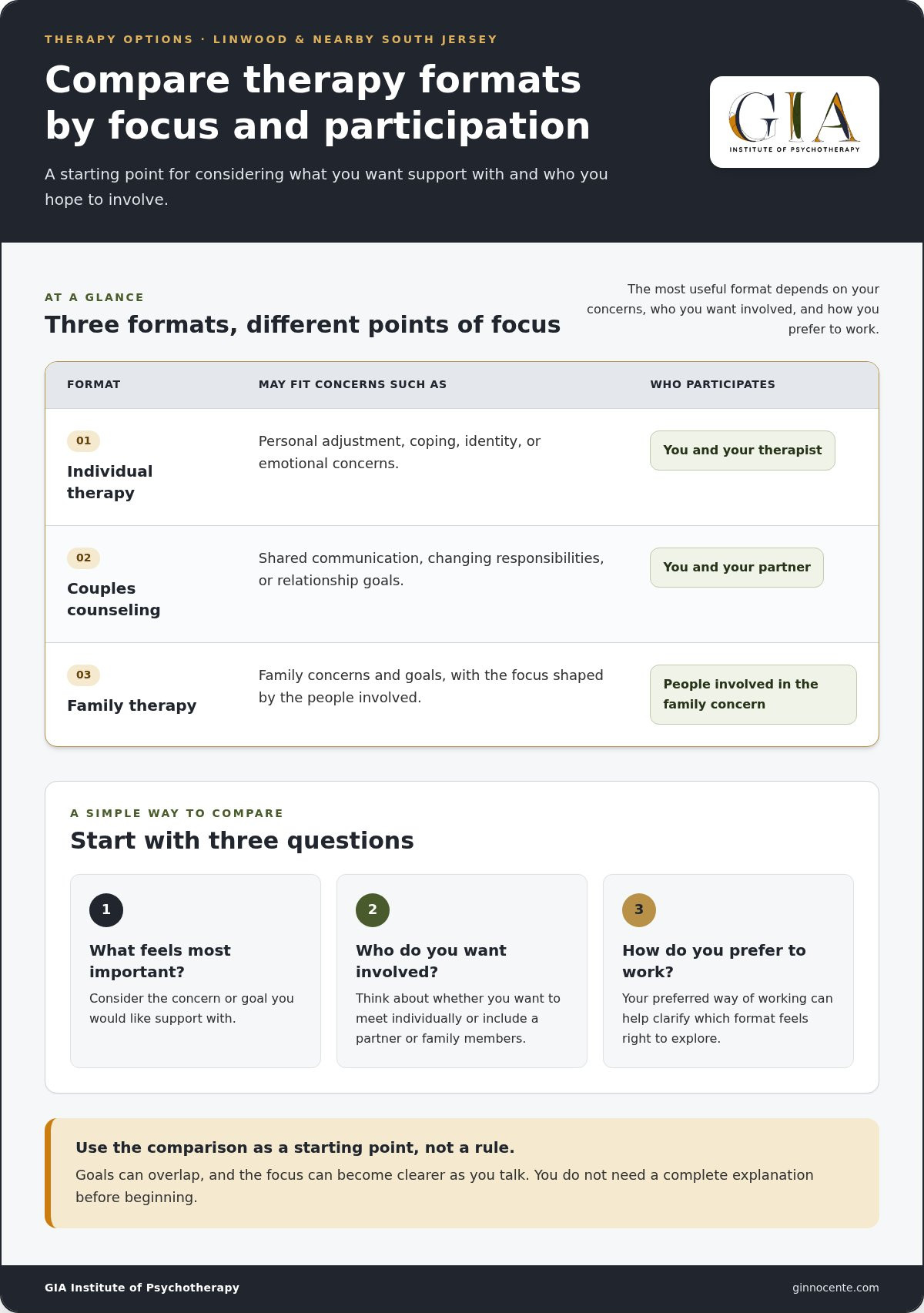
The most useful format depends on what you want support with, who you hope to involve, and how you prefer to work. Use this comparison as a starting point, not a rule. Goals can overlap, and the focus can become clearer as you talk.
| Format | May fit concerns such as | Who participates |
|---|---|---|
| Individual therapy | Personal adjustment, coping, identity, or emotional concerns | You and your therapist |
| Couples counseling | Shared communication, changing responsibilities, or relationship goals | You and your partner, with a therapist |
| Family therapy | Family communication, changing roles, or concerns affecting relationships across the family | Family members relevant to the goals; the baby doesn’t automatically need to attend |
For example, a private space may suit your goal of sorting through your own feelings, while a shared conversation may better fit a concern involving both partners. Family therapy can offer a broader view of how people relate and respond to change. The format isn’t a verdict on your family. It’s a way to match the work to what you hope to explore.
How therapeutic approaches can support different goals
Format is one consideration. The way therapy is approached matters, too. Cognitive behavioral therapy (CBT) is a structured approach that can help people examine connections between thoughts and behaviors. GIA offers CBT, DBT, EMDR, and Internal Family Systems (IFS), as well as Emotionally Focused Therapy for couples. These approaches aren’t postpartum-specific labels or one-size-fits-all solutions. Their fit depends on your needs, preferences, and goals.
As you compare options for therapy for new moms Linwood NJ, consider whether the communication style feels comfortable, whether the approach makes sense for your concerns, and whether the location and session logistics fit alongside caregiving. GIA serves Linwood and nearby South Jersey communities, including Ocean City, Margate, Ventnor, Egg Harbor Township, Upper Township, and Galloway. The practical fit is personal, so consider what would make it easier for you to take part in therapy.
Explore therapy at GIA Institute of Psychotherapy to learn about the practice’s therapy options. For a separate source of maternal mental health support, the Health Resources and Services Administration shares information about the National Maternal Mental Health Hotline.
A Gentle Checklist for Taking the First Step Toward Therapy
Starting a therapy conversation doesn’t require a complete account of everything you’ve felt since becoming a parent. You can begin with one concern, one question, or a sense that you’d like things to feel different. If you’re exploring therapy for new moms Linwood NJ, this short checklist can help you gather your thoughts without turning preparation into another task on an already full day.
- Name one concern. What feels hardest to manage right now: your emotions, a change in routine, a relationship concern, or something else?
- Choose a format to explore. Consider whether you’d prefer to begin with individual therapy, involve a partner in couples counseling, or explore a family concern together.
- Note a question or hope. You might want to understand what therapy could involve, talk about feeling more like yourself, or find ways to express what support you need.
Questions to help clarify what you want from therapy
Try asking yourself: What’s taking the most energy lately? Is there something I wish I could do or feel differently? Are there relationship or routine changes I want space to discuss? A few words on your phone or a note you keep nearby can be enough. Your answers don’t need to sound polished, and your goals can shift as you learn what feels useful.
These prompts are starting points, not a test. If you’re unsure what you want, that uncertainty can be part of the conversation. Your first goal may simply be to describe what has felt difficult and see whether talking it through helps you find a clearer direction.
What to expect when beginning a therapy conversation
An initial conversation can be a chance to share what brings you in, ask questions, and talk about what you hope to work toward. You can start with a small detail rather than explain everything at once. A guide to what to expect in a first psychotherapy session may also help you picture the conversation. You don’t need to memorize a script or arrive with a diagnosis.
For parents in Linwood and nearby South Jersey communities, local therapy is one way to explore support for this transition. Practical details matter, too, so it’s reasonable to consider what feels manageable alongside your responsibilities. A first step can be simple: gather your questions, identify a concern, and let the conversation begin there.
Learn about GIA’s therapy services.
Finding Support for New Motherhood With GIA in Linwood, NJ
Finding support doesn’t require a diagnosis or a complete plan. GIA Institute of Psychotherapy serves Linwood and nearby South Jersey communities, offering adult individual therapy, couples counseling, and family therapy. These formats can make room for different concerns: your own adjustment, a shared relationship goal, or changes affecting family relationships.
A collaborative approach to emotional wellbeing and life transitions
GIA blends traditional therapy with neuroscience, practical strategies, and expressive modalities. In a collaborative therapeutic relationship, you can talk through what feels important, consider your goals, and work with your therapist to shape the conversation around your needs. The aim is to make space for your perspective, not impose a single story about motherhood or what you should be experiencing.
Therapeutic approaches can vary. CBT can help explore connections between thoughts and behaviors, while DBT offers skills-based ways to work with emotions and responses. GIA also uses EMDR and Internal Family Systems (IFS); Emotionally Focused Therapy (EFT) is used with couples. These are approaches within psychotherapy, not postpartum-specific programs. The relevant approach depends on the person, their concerns, and the goals they want to explore.
Explore therapy in Linwood and nearby South Jersey communities
Whether you’re looking for individual space or support involving a partner or family, the format can reflect the concern you want to bring forward. GIA serves Linwood as well as Ocean City, Margate, Ventnor, Egg Harbor Township, Upper Township, and Galloway. For someone seeking therapy for new moms Linwood NJ, this local connection can be a starting point for exploring care while keeping the focus on what feels right for you.
You deserve to be met with curiosity and respect as you make sense of this transition. Take a gentle first step with GIA Institute of Psychotherapy and explore support for your goals.
Take a Supportive Next Step at Your Own Pace
Becoming a mother can bring changes that are hard to name, and support doesn’t require a diagnosis or a perfect explanation. Therapy can help you explore what matters to you, build coping strategies, and consider how the transition is affecting your relationships. The right starting point may be individual therapy, couples counseling, or family therapy, depending on your goals.
If you’re exploring therapy for new moms Linwood NJ, GIA Institute of Psychotherapy serves Linwood and surrounding South Jersey communities. Its approaches include CBT, DBT, EMDR, Internal Family Systems, and Emotionally Focused Therapy for couples. The approach can be considered in relation to your concerns and the goals you choose to explore together.
You can begin with a question, a hope, or simply the feeling that you’d like someone to listen. There’s no need to have everything figured out first. Take a gentle first step with GIA Institute of Psychotherapy and explore support for your transition into motherhood.
Frequently Asked Questions
Can therapy help with the emotional challenges of becoming a new mom?
Yes. Therapy can offer a supportive space to understand emotional changes and explore ways to cope. You might talk about worry, feeling unlike yourself, shifting routines, or how new responsibilities affect relationships. Together with a therapist, you can identify what you hope to work on and consider practical steps that fit your life. You don’t need to know exactly what to call the experience before starting a conversation.
Is it normal to feel overwhelmed as a new mother?
Feeling overwhelmed can happen during the transition to motherhood, but experiences differ from person to person. Sleep changes, new routines, and shifting responsibilities can add strain, yet they don’t by themselves explain every feeling. Consider reaching out for support if distress continues, feels difficult to manage, or affects daily life or relationships. You deserve to be heard without comparing your experience with anyone else’s.
How do I find therapy for new moms in Linwood, NJ?
Start by naming the concern you want to discuss, then consider whether individual therapy, couples counseling, or family therapy feels like a useful format. For therapy for new moms Linwood NJ, GIA Institute of Psychotherapy serves Linwood and nearby communities, including Ocean City, Margate, Ventnor, Egg Harbor Township, Upper Township, and Galloway. Explore the practice’s approach and consider how it aligns with your goals and preferences.
What type of therapy is best for new mothers?
There isn’t one best format for every new mother. The right fit depends on your concerns, goals, relationships, and preferences. Individual therapy can focus on personal adjustment or coping, while couples counseling may address shared relationship goals. Family therapy can make space for concerns involving family relationships. GIA uses approaches such as CBT, DBT, EMDR, IFS, and EFT for couples, with the approach considered in relation to therapy goals.
Can I go to therapy if I am not sure whether I have postpartum depression?
Yes. You don’t need to know whether you have postpartum depression or arrive with a diagnosis to talk with a therapist. You can describe what you’ve noticed, what feels hard, and what kind of support you hope might help. A therapist can explore your concerns with you without assuming a label. If you have concerns about your mental or physical health, a qualified healthcare professional can help assess them.
What happens in the first therapy session for a new mom?
An initial therapy conversation is an opportunity to share what brings you in, ask questions, and discuss what you’d like support with. You might mention a recent change, a relationship concern, or simply that you’re feeling unsettled. You don’t need to prepare a perfect explanation or know your goals in advance. The conversation can help you and the therapist begin identifying what matters to you and what you’d like to explore.
Does GIA Institute of Psychotherapy offer therapy near Linwood, NJ?
Yes. GIA Institute of Psychotherapy serves people in Linwood and nearby South Jersey communities, including Ocean City, Margate, Ventnor, Egg Harbor Township, Upper Township, and Galloway. Its offerings include adult individual psychotherapy, couples counseling, and family therapy. These options can support different goals, from personal concerns to relationship or family dynamics. Therapy can begin with the concerns and priorities you bring to the conversation.


