

Anxiety in children and teens can grow from school pressure, separation, social situations, changes in routine, or a specific fear. Sometimes several stresses overlap. A child anxiety specialist in Ventnor, NJ can help identify what triggers worry and how it affects your child, from avoidance and intense distress to difficulty speaking in certain settings. There isn’t one cause or one path to support.
It can be hard to tell whether a child is reacting to a passing stressor or facing a pattern that disrupts everyday life. The worry is real. Understanding what may be behind it is a compassionate first step toward helping your child feel safer and more capable.
Learn about common sources of anxiety, what exploring triggers may involve, and how a thoughtful therapist match and ongoing support can address anxiety, phobias, and selective mutism. Support can also take your child’s needs into account alongside family and school experiences.
Key Takeaways
- Notice when worry arises and what happens before and after; patterns can help clarify a child’s triggers and support needs.
- Learn how a therapist match can take a child’s age, concerns, and comfort with different ways of communicating into account.
- Explore how phobias and selective mutism may affect a child’s daily experiences, and why patient, individualized support matters.
- Consider how family and school experiences may shape anxiety, and what forms of support can help a child feel more understood.
Therapist matching
A child anxiety specialist in Ventnor, NJ should be a good fit for your child’s age, concerns, and preferred way of communicating. Consider the therapist’s experience and New Jersey credentials, and whether online sessions work for your family.
Experience and New Jersey Licensure
Look for a clinician whose experience includes children or teens and the anxiety concerns your family is seeing. Regional professional profiles range from 6 years to 40 years of experience, so years alone don’t show whether someone is a good match. Consider the clinician’s New Jersey license type, work with young people, and approach to behavioral patterns, coping, and anxious thoughts. A clear match connects credentials with your child’s specific needs.
Support for Children and Teens
Therapy can help children and teens notice what happens before worry rises and practice ways to respond. A therapist may adapt conversations, activities, or expressive approaches to the child’s age and comfort. A younger child, for example, may communicate more readily through play, while a teen may prefer discussing difficult school or social situations. Ask what goals therapy will address and how parents can support coping between sessions. A good match also helps the child feel safe enough to participate.
Nearby Service Areas and Availability
Families in Ventnor, Atlantic City, Margate, and Somers Point may consider local or online therapy. For online sessions, focus on the clinician’s experience with children and teens, New Jersey licensure, and whether the format helps your child engage. New-patient openings depend on current caseload and appointment fit; wait times depend on when a suitable session is available.
For an urgent mental health concern involving a child, Ventnor families can contact the elementary school guidance counselor at extension 5300 or the middle school guidance counselor at extension 5040 about the Crisis Team. These school contacts provide a local route to ask about crisis support.
Childhood phobias and selective mutism
A phobia can make a particular object, place, or situation feel overwhelming. A child might fear dogs, elevators, storms, or speaking in front of classmates. Notice what happens before the fear, what your child avoids, and how worry affects routines, friendships, or school. These details help you describe the concern clearly without dismissing it as misbehavior.
Selective mutism involves a child being unable to speak in certain social situations, despite speaking in other settings. A child may talk comfortably at home but remain silent in class. Silence isn’t necessarily defiance or a lack of knowledge. Note where speech feels easier, who is present, and whether gestures, writing, or brief answers help your child communicate.
Both concerns deserve careful attention to context. A mental health professional can explore the child’s experience, daily functioning, and emotional response, rather than focusing only on visible behavior. Keep a simple record of situations: what happened just before distress, how adults responded, and what helped your child feel safer. Share observations with school staff when they can help support understanding.
Support should build confidence without shaming or forcing a child into a feared situation. Families can agree on calm, consistent responses and coordinate practical accommodations with educators. For instance, a student who struggles to speak in class might communicate through writing while adults create manageable opportunities to participate. Protecting self-esteem matters, since pressure can make communication feel harder.
When fear or silence affects home, school, or relationships, discussing patterns with a therapist can help clarify next steps. Family therapy can give caregivers space to understand their responses and support a child together. The focus is on compassionate communication, workable routines, and helping the child feel understood across settings.
Anxiety and stress support
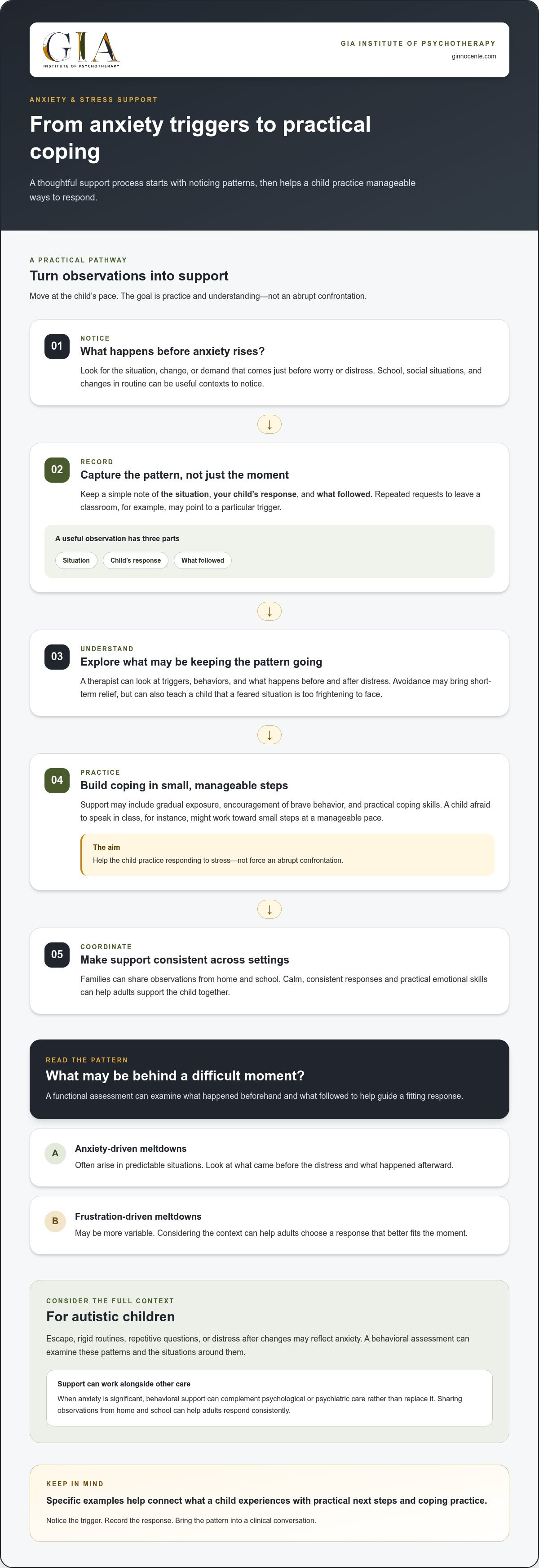
Start by noticing what happens before your child’s anxiety rises. Record the situation, your child’s response, and what followed. Repeated requests to leave a classroom, for example, may point to a particular trigger. Avoidance can bring short-term relief, but it may also teach a child that the feared situation is too frightening to face.
A therapist can use these observations to explore triggers, behaviors, and factors that may keep avoidance going. Support may include gradual exposure, encouragement of brave behavior, and practical coping skills. A child afraid of speaking in class, for example, could work toward small steps at a manageable pace. The aim is to help the child practice responding to stress, not to force an abrupt confrontation.
Patterns can also help adults understand intense reactions. Anxiety-driven meltdowns often arise in predictable situations, while frustration-driven meltdowns may be more variable. A functional assessment can help distinguish the two by examining what happened beforehand and what followed. This can guide a more fitting response, especially when changes in routine or repeated reassurance-seeking create difficult moments.
For autistic children, escape, rigid routines, repetitive questions, or distress after changes may reflect anxiety. A behavioral assessment can examine these patterns and the situations around them. When anxiety is significant, behavioral support can complement psychological or psychiatric care rather than replace it. Families can share observations from home and school to help adults respond consistently and reinforce practical emotional skills.
Keep notes on triggers and responses, then bring specific examples into a clinical conversation. A therapist can help connect those details to next steps and coping practice. If you’re ready to discuss what you’re seeing, consider a guided therapy conversation.
Which child anxiety specialists serve Ventnor from nearby Atlantic City, Margate, and Somers Point?
Families in Ventnor, Atlantic City, Margate, and Somers Point can consider in-person or online therapy options. Choose by the child’s needs, the clinician’s experience with young people, and whether the format feels workable for family routines. A nearby address alone doesn’t show whether a therapist is suited to anxiety, phobias, or communication concerns.
For a practical comparison, consider each clinician’s New Jersey license, experience with children or teens, and approach to anxiety. Then weigh travel time, school schedules, and whether online sessions help your child participate. A teen who speaks more freely from home, for example, may prefer online sessions, while a younger child may engage more easily in person.
School-based support can also be part of the picture. Ventnor families may request an evaluation to determine a child’s eligibility for services. The Ventnor City School District develops an individualized education program with parents, Child Study Team members, and teachers. Depending on the student’s needs, public education supports may include supplementary aids, specialized instruction in a general education or resource program, or a special class in or out of district.
The Ventnor Special Education Parent Advisory Committee meets during the school year and provides resources and information to families. School supports address educational needs, while therapy can focus on emotional concerns and coping beyond classroom accommodations. Coordinating observations from home and school can help adults understand where anxiety appears and what support may help.
To explore a therapy conversation about your child’s needs, reach out about child and teen support.
GIA Institute of Psychotherapy: Adult Individual Psychotherapy
GIA Institute of Psychotherapy offers Individual Therapy for Children and Teens for young people whose anxiety affects everyday life. Sessions can help children explore difficult feelings, understand patterns, and develop practical ways to cope. When a child’s worry also shapes family routines or communication, Family Therapy can help caregivers work together supportively.
Adult Individual Psychotherapy may suit a parent who wants space to address personal stress while supporting a child. Couples Counseling can help partners strengthen communication through a challenging family period. Each offering serves a different need, so consider who would benefit from support and which concerns feel most pressing.
If you’re ready to explore a next step for your child or family, contact GIA Institute of Psychotherapy to schedule an intake call.
Take the Next Step Toward Support
As a parent, you don’t need every answer before beginning a conversation. Your child’s needs can become clearer as they find words, build trust, and practice new ways of responding. Choosing a child anxiety specialist in Ventnor, NJ can be a thoughtful step toward helping your child feel understood and giving your family room to consider what support fits.
GIA Institute of Psychotherapy offers Individual Therapy for Children and Teens, Family Therapy, and Adult Individual Psychotherapy. These options can support a young person directly, help family members work through shared concerns, or give a parent space to focus on personal well-being.
When you’re ready to explore what may be helpful for your family, contact GIA Institute of Psychotherapy. A conversation can be the beginning of a steadier path forward, shaped around your child’s experience and your family’s hopes.
Frequently Asked Questions
How do I get started?
Start by describing what your child is experiencing and how it affects everyday routines. At GIA Institute of Psychotherapy, prospective clients complete a contact form and schedule an intake call. The 15-minute call helps match a person with an appropriate therapist. Before the conversation, jot down your main concern, your child’s preferred way of communicating, and what you hope support will help change.
How do I know if I need (or my child needs) help?
Consider support when worry repeatedly limits your child’s participation at home, school, or with friends. Note recurring avoidance, distress around routine changes, or repeated requests for reassurance. Track what happens, where it occurs, and how it affects daily activities. A child anxiety specialist in Ventnor, NJ can help your family explore these patterns and decide what goals to address in therapy.
Is my child’s meltdown caused by anxiety or something else?
The timing and pattern of a meltdown can offer useful clues, though one episode doesn’t establish its cause. Anxiety-driven meltdowns tend to arise in predictable situations; frustration-driven ones can be more variable. Record what happened beforehand, what your child did, and what followed. For example, note whether distress repeatedly follows a change in plans or appears during different frustrating tasks.
Which child anxiety specialists and pediatric therapists practice in Ventnor, NJ?
GIA Institute of Psychotherapy serves Ventnor and nearby communities, including Ocean City, Linwood, Margate, Egg Harbor Township, Upper Township, and Galloway, from its Somers Point office. The practice also offers online counseling for New Jersey residents. Therapy for children and teens, as well as family support, can help families consider care alongside school and home routines.
What anxiety disorders and age groups do child specialists near Ventnor treat?
GIA Institute of Psychotherapy provides therapy for children and teens ages 4-18, including support for anxiety. Its broader mental health services address concerns such as depression, OCD, trauma, eating disorders, grief, stress, and PTSD. A child’s age and the concern affecting daily life help shape the focus of therapy. Families can also participate through family therapy when shared support fits their needs.
What therapy approaches for childhood anxiety are offered near Ventnor, such as CBT or exposure therapy?
CBT is among the approaches offered by GIA Institute of Psychotherapy. Other modalities include Play Therapy, Expressive Arts, DBT, EMDR, and Internal Family Systems. These approaches give children different ways to explore feelings and practice new responses. Exposure therapy is not named as a specific service; the practice’s stated approaches include CBT and child-centered expressive modalities, with therapy tailored to the person’s concerns.


