
A life change can leave you feeling unsteady. Counseling for life transitions provides space to process emotions, build coping strategies, and set goals as you adjust. GIA Institute of Psychotherapy offers counseling in Egg Harbor Township, NJ and throughout South Jersey
Key Takeaways
- Life transitions can affect relationships, work, health, family roles, or where you live.
- Counseling can help with difficult emotions, coping, and goal setting.
- Support may be individual, couples, or family therapy, depending on your needs.
Emotional distress, anxiety, and depression
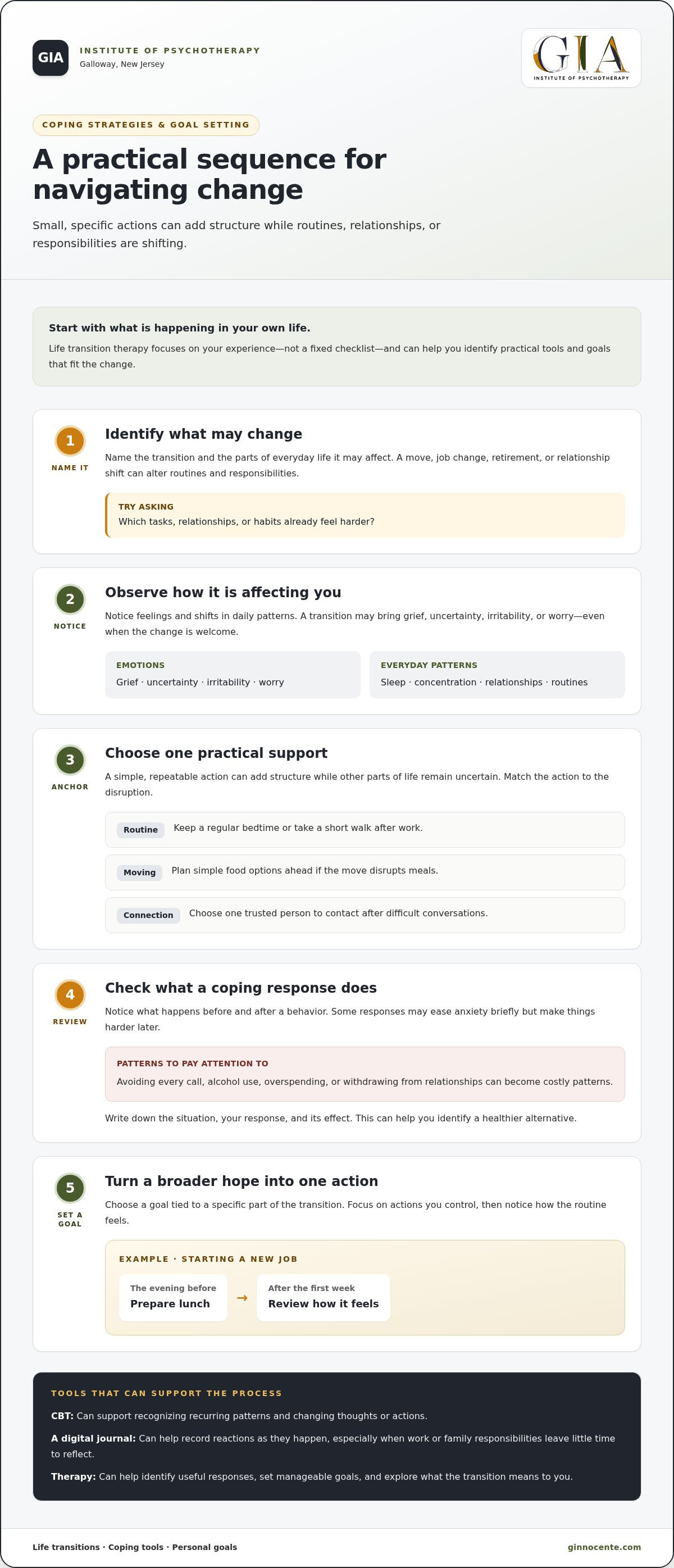
Major transitions can affect sleep, concentration, relationships, and routines. Counseling can help you understand these changes and identify useful support.
Moves, job changes, relationship endings, grief, and new responsibilities may bring anxiety, depression, or uncertainty. Sharing specific changes with a counselor can help clarify what to address.
Grief, relief, confusion, and other mixed feelings can follow a loss or change in role. Naming these feelings can make them easier to understand.
If distress makes daily tasks unmanageable, share a specific example with a counselor. For a mental health emergency, call 988; for a life-threatening emergency, call 911.
Coping strategies and goal setting
Counseling can help you choose practical coping strategies, set manageable goals, and adjust routines during change.
Coping Strategies for Transitions
Start with one daily anchor, such as a regular bedtime, short walk, or planned meal. A trusted person, journal, or predictable routine can also provide structure.
Setting Goals
Choose a goal connected to the transition and break it into an action you can control, such as making an appointment or asking for help. Counseling can help you review progress and adjust the plan.
Counseling for life transitions
Counseling for life transitions connects emotional concerns with practical changes involving grief, relationships, career decisions, or family roles. Counseling may be individual, couples, or family-based.
Approaches may include cognitive behavioral therapy (CBT), dialectical behavior therapy (DBT), and person-centered therapy. The focus centers on your concerns and goals.
Progress varies by person. If you’re ready to discuss a transition, schedule an appointment.
GIA Institute of Psychotherapy: Individual Therapy
GIA Institute of Psychotherapy offers individual therapy for adults and children facing emotional distress, changing roles, or uncertainty. Sessions can help you explore concerns, develop coping strategies, and set goals.
Choose a Supportive Next Step
Start by identifying what feels hardest and what support would be useful. GIA Institute of Psychotherapy offers individual therapy for adults, children, and teens, as well as couples and family therapy.
Frequently Asked Questions
How Do I Find the Right Therapist?
Consider a therapist’s clinical approach and experience. GIA prospective clients complete a contact form and schedule a 15-minute intake call to help identify an appropriate therapist.
How Long Does Therapy Typically Last?
The timeline for therapy looks different for everyone. Some people come in with a specific goal and stay for a shorter time; others choose to go deeper and stay longer. There’s no “right” way to do this—we’ll talk together about what you’re hoping for and shape a plan that supports you.
Most of our clients start out by coming in weekly, depending on what’s going on and what feels sustainable. We’ll check in regularly to make sure the rhythm is working for you.
What Should I Expect During My First Therapy Session?
Your first appointment covers your concerns and goals. At GIA, the first individual session lasts approximately 75–90 minutes.
What is counseling for life transitions and what issues does it address?
Counseling for life transitions addresses emotional and practical concerns related to significant change, including new family roles, grief, relationship shifts, anxiety, depression, trauma, stress, and relationship difficulties.
What are the qualifications and specialties of Egg Harbor Township, NJ counselors for life transitions?
Training and specialties vary. GIA clinicians are trained in interpersonal neurobiology, relational, attachment-based, and regulation theories; many also have certification in DBT, EMDR, and other modalities. We serve people in Ocean City, Linwood, Northfield, Margate, Ventnor, Egg Harbor Township, and Upper Township.
How do I choose a counselor for life transitions in Egg Harbor Township, NJ?
Consider whether individual, couples, or family support, the therapeutic approach, and the session format fit your needs. GIA offers in-person therapy in Somers Point and online counseling for clients in New Jersey.
For a mental health emergency, call 988; for a life-threatening emergency, call 911.


