

Taking away or moving a child’s comfort object abruptly can trigger a major meltdown without helping them adjust. A parenting support therapist in Egg Harbor Township, NJ can help parents consider gradual steps, such as practicing with the object nearby or in a different place.
It makes sense to hope that removing the object will help your child adjust, especially when it disrupts routines. A slower, supportive response can create room for learning without turning a difficult moment into a battle.
This article explores how family counseling can help with parenting stress, challenging behavior, and school struggles, and what to expect as you look for support. You’ll also learn how in-person and online options may fit into the process, so you can consider a next step that feels manageable for your family.
Key Takeaways
- Instead of abruptly removing a comfort object, a gradual approach can help a child practice tolerating it being absent or moved.
- Family counseling can help parents understand behavior patterns, manage stress, and find practical ways to respond to challenging moments.
- When school struggles or emotional changes arise, consider how a child’s thoughts, feelings, body responses, and behavior may be connected.
- The right counseling approach depends on the family’s concerns and goals, including whether support is focused on a parent, child, or family relationship.
- In-person and video sessions offer different ways to take part in therapy, and video sessions can allow a therapist to observe parent-child interactions at home.
Family counseling and parenting stress
Family counseling can help parents and children understand recurring tensions and practice different ways to respond. It can address parenting stress while exploring family patterns that make daily challenges harder.
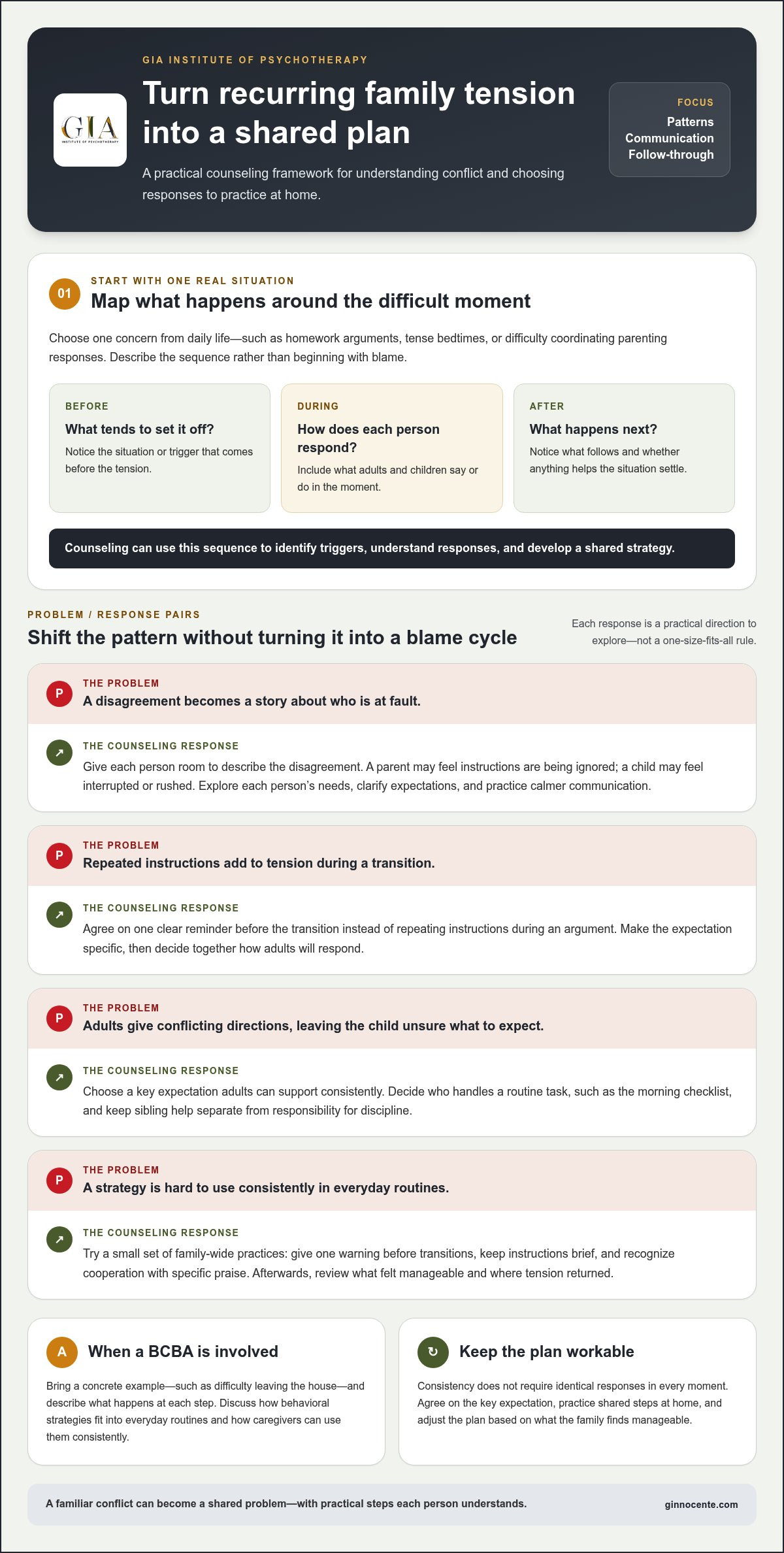
Start by naming one situation you want to change, such as homework arguments or tense bedtimes. Describe what usually happens before, during, and after it. That sequence gives counseling a practical focus: identify triggers, notice each person’s response, and develop a shared strategy. Parents can also explore how stress affects their tone, patience, and follow-through.
Families can focus counseling on the concerns that matter most in their daily lives. For families working with a parenting support therapist in Egg Harbor Township NJ, sessions can center on real concerns at home, such as repeated disagreements over routines or difficulty coordinating parenting responses.
Counseling for Family Conflict
Family conflict counseling can help relatives describe disagreements without reducing them to blame. A parent might say a child ignores instructions, while the child may feel interrupted or rushed. Counseling can identify each person’s needs, clarify expectations, and practice calmer communication. Focus on sessions that explore recurring patterns and help family members agree on a specific response to try at home.
For example, parents can agree on one clear reminder before a transition instead of repeating instructions during an argument. If tension centers on a couple’s communication, couples counseling may help address that relationship dynamic. The aim is to turn a familiar conflict into a shared problem, with practical steps each person understands.
When a child receives behavioral support from a Board Certified Behavior Analyst, or BCBA, families can discuss how strategies fit into everyday routines. A parent can bring a concrete example, such as difficulty leaving the house, and explain what happens at each step. Clear communication among caregivers and the BCBA can help the family understand which strategies are being practiced and how to use them consistently.
Family-Wide Strategies
Family-wide strategies make change a shared practice rather than a task assigned only to the child. A family might agree to give one warning before transitions, keep instructions brief, and recognize cooperation with specific praise. Choose strategies that suit the child’s needs and household routine. After trying them, review what felt manageable and where tension returned.
Consistency does not mean every family member responds identically in every moment. It means adults agree on the key expectation and avoid giving conflicting directions. Caregivers can decide who handles the morning checklist and how siblings can help without taking responsibility for discipline. Shared steps can reduce confusion, support follow-through, and connect counseling to home life.
Child behavior, emotions, and school struggles
A child’s behavior can communicate distress, unmet needs, or difficulty managing a situation. Looking at home, emotional, and school patterns together can help parents decide what support may be useful.
Support for Behavioral Issues
Counseling for behavioral issues can focus on what happens before and after a challenging behavior. For example, parents can note whether refusing a task follows a difficult transition, unclear instructions, or frustration. A therapist can help identify patterns and plan clear, consistent responses instead of repeated corrections that intensify conflict.
Parent-child interaction therapy, or PCIT, is an evidence-based treatment described as effective for children with behavioral problems, children on the autism spectrum, and children who have experienced early childhood trauma. It aims to reduce defiant and aggressive behavior while strengthening communication, following parental instructions, and respecting family rules. These goals can help parents understand what behavioral support works toward.
Before discussing behavioral support, write down a specific example: what happened, where it occurred, and how adults responded. Include the child’s words or actions, the task involved, and what helped the situation settle. If the same difficulty arises during homework and morning routines, that detail can guide a more useful conversation than a broad label like “not listening.”
Emotional and Psychological Challenges
Children may express emotional distress through withdrawal, irritability, worry, or changes in participation. A parent can track when these changes appear, such as before school, during peer activities, or after a family transition. That context helps distinguish a recurring concern from a reaction to a particular event, without treating behavior alone as a diagnosis.
Cognitive-behavioral methods explore links among thoughts, feelings, body responses, and actions. For instance, a child who expects to fail a school presentation may feel tense, avoid preparing, and become more worried. Practicing a small step, such as rehearsing one sentence, can help the child notice how thoughts and actions influence what happens next.
For school struggles, gather concrete examples from home and school, such as difficulty starting assignments, distress during transitions, or reluctance to join class activities. Share the child’s explanation alongside adult observations. This fuller picture can help counseling focus on emotional needs, behavioral patterns, and practical support, rather than judging a child by one difficult day.
ABA strategies for object attachment can include gradually fading an item, teaching tolerance when it is absent or moved, and expanding interests to other objects. These approaches have distinct aims: reducing reliance on an item gradually, addressing its absence or changed position, and broadening interest. Describing the focus clearly keeps the discussion concrete, without turning it into a broad judgment about the child’s behavior.
When discussing these strategies, caregivers can identify whether they are considering fading an item, teaching tolerance when it is absent or moved, or expanding interests to other objects. Keeping the approaches distinct makes it easier to describe the intended change. The focus stays on the object and the strategy, rather than assuming every attachment calls for the same response.
Matching clients with counseling specialists
A parenting support therapist in Egg Harbor Township, NJ can help families focus on parenting strain, anxiety, anger, or stress. To find a licensed therapist in New Jersey, use the state’s official license-verification resources and search by the person’s name and profession.
Matching by Counseling Need
Begin with the concern affecting daily life most. A parent managing anxiety may want help responding calmly, while anger during homework conflicts may call for work on communication and stress patterns. Cognitive-behavioral methods can connect thoughts, feelings, physical responses, and actions. A clear goal makes it easier to discuss what to practice between sessions.
Also consider whether trauma or a family transition shapes the concern. Describe a recent example, such as worry before school or tension during a household change. A trained therapist can use those details to understand the need and shape a focused plan, rather than treating every challenge as the same problem.
Counseling for Mothers and Parents
Parenting counseling gives mothers and other caregivers space to examine pressure, expectations, and responses at home. A mother overwhelmed by morning routines, for instance, can identify which moments raise stress and develop manageable changes. Counseling can address her emotional needs as well as the parent-child relationship, without framing one person as the source of every difficulty.
Parents can bring a specific goal to counseling, such as setting limits without escalating arguments or coordinating responses with a co-parent. If conflict between adults affects parenting, couples counseling may help address communication within the relationship. For adolescents, individual support can center on the teen’s perspective, while family conversations address shared expectations and trust.
Local Therapist and Group Options
Parenting support groups near Egg Harbor Township can give caregivers a place to discuss shared concerns and learn from other parents. Consider whether a group focuses on the issue you want to address, such as adolescent communication or behavior challenges. Its format, facilitator, and relevance to your family’s needs also matter.
For individual counseling, write down your main concern and the changes you hope to make. Then use New Jersey’s license-verification resources to verify the therapist’s credential and listed status. Ask how their approach addresses your goal, such as anxiety during school mornings or stress around boundaries.
A local network can include family members, school contacts, and behavioral support professionals. With your consent, relevant observations can help clarify where a child’s challenges arise. Comparing a parent’s account of homework stress with school-related concerns, for example, may help identify a useful focus for counseling.
Potential benefits for parents and children
Support can help parents respond more calmly while children build communication and coping skills. The right focus depends on the family’s concerns, such as behavior at home, emotional distress, or difficulty at school.
For families near Egg Harbor Township seeking parenting support, look for care that includes parent-child relationship goals and practical ways to respond at home. Child therapy in Egg Harbor Township can also focus on a child’s feelings, behavior, and daily experiences. Share a concrete example, such as recurring arguments over routines, to clarify what support should address.
Parent-child interaction therapy, or PCIT, is an evidence-based treatment described as effective for children with behavioral problems, children on the autism spectrum, and children who have experienced early childhood trauma. It aims to reduce defiant and aggressive behavior while improving communication, cooperation with parental instructions, and adherence to family rules. PCIT sessions typically last 60 to 90 minutes, and treatment lasts 12 to 20 sessions on average. Attendance regularity, progress between sessions, skills being developed, and observed improvement can affect treatment duration.
These skills can support parents as well as children. PCIT has been shown to reduce parental frustration, stress, and depression, while promoting confidence and calm during interactions. Parents may also use learned skills with siblings, responding more consistently across family relationships. For example, clear directions can help during both homework and bedtime routines.
Counseling for children and adolescents can address mental health concerns through age-appropriate conversation and activities. A younger child may express feelings through play, while a teen may want room to discuss peer relationships, school pressure, or family changes. Psychotherapy can help children recognize emotional patterns and practice ways to handle difficult moments. Nearby child therapists may use different approaches, so describe the child’s age, concerns, and everyday challenges when considering a fit.
Insurance coverage for parenting therapy in New Jersey depends on the plan and service. Families can ask about accepted insurance plans or sliding-scale fees if treatment feels financially burdensome.
To learn whether parenting therapists near Egg Harbor Township are accepting new clients, contact a practice directly about current openings. Briefly describe the support you’re seeking, such as parent guidance, child counseling, or help with family stress.
The value of PCIT skills may extend beyond the parent-child interaction at the center of treatment. A parent may apply lessons learned through PCIT while interacting with a child’s siblings and other family members. In this way, the skills can be used in more than one relationship within the family, when the parent chooses to put them into practice.
Families can consider how those lessons might carry over to interactions with siblings, while keeping the focus on the concerns that led them to seek support. Any benefit for siblings depends on the parent applying the learned skills in those interactions.
In-person and online therapist options
Choosing in-person or online counseling often comes down to family routine, privacy, and the support needed. Consider where a parent and child can speak comfortably, participate without interruptions, and practice new skills between sessions. A compassionate setting matters, whether the conversation happens in an office or by video.
In-person sessions give families a shared space to discuss emotional concerns. The setting can help a child become familiar with a routine, while parents can observe how conversations unfold with a therapist present. A family might discuss a difficult transition, clarify expectations, and practice language to use at home.
Online therapy can reduce travel and make it easier to join from home. PCIT can be conducted through video sessions, and observing parent-child interactions at home may give the therapist additional insight. A parent can prepare by choosing a private room, checking the device and connection beforehand, and keeping other household activity from interrupting the session.
Choose a format that fits the therapy goal. If parents want guidance around everyday interactions, a video session may show the home context. If a child engages more easily through play or expressive activities, discuss how those methods fit the chosen setting. Individual therapy for children and teens and family therapy address different needs, so consider who should participate and what the family hopes to practice.
Insurance is another practical factor. Families can ask about accepted insurance plans or sliding-scale fees if treatment feels financially burdensome. Before starting, gather plan details and explain whether the main concern involves a parent, a child, or the family together. This helps clarify the type of counseling to discuss without making cost the only measure of fit.
Think through privacy, technology, travel, and participation before choosing a format. For online sessions, consider whether everyone can speak openly at home. For in-person meetings, consider how travel fits the family’s schedule. A short list of goals, such as calmer communication or support with a child’s behavior, can help make either format more focused and useful.
If you’re ready to explore a setting that fits your family, take the next step toward counseling support.
GIA Institute of Psychotherapy: Adult Individual Psychotherapy
GIA Institute of Psychotherapy offers adult individual psychotherapy for parents seeking space to understand stress, emotional patterns, and personal goals. When parenting challenges affect your wellbeing or family relationships, individual support can help you explore practical strategies and new perspectives.
Support may also involve your child or family. Individual therapy for children and teens gives younger family members space to work through their concerns, while family therapy can focus on communication and shared patterns. Couples counseling may help partners address relationship concerns that affect parenting together.
Consider which concern matters most to address first: your own stress, your child’s needs, or family communication. Contact GIA Institute of Psychotherapy to discuss a possible next step.
Take a Thoughtful Next Step for Your Family
Change can begin with one clear intention: deciding what you want to feel different at home. You might hope for calmer conversations, more confidence responding to your child, or a better understanding of a difficult pattern. Naming that priority can make a first conversation with a parenting support therapist in Egg Harbor Township, NJ more focused and personal.
GIA Institute of Psychotherapy offers adult individual psychotherapy, individual therapy for children and teens, and family therapy. These options support different starting points, whether you want to work on your wellbeing, help your child express their needs, or strengthen family relationships. You don’t need every answer before reaching out; describing what feels hardest is a meaningful first step.
If you’re ready to explore support for your family, contact GIA Institute of Psychotherapy. With care and collaboration, a new way forward can take shape one step at a time.
Frequently Asked Questions
Is it wrong to take away or move my child’s objects?
Not necessarily, but abruptly removing a comfort object can cause distress without helping a child learn a new response. If moving an item is part of a routine change, explain what will happen and introduce it gradually. For example, practice placing a favorite object nearby instead of in its usual spot, then notice how your child responds. Play-based therapy can also help children express feelings around change.


