

School advocacy services in Ventnor, NJ can help families prepare for school meetings, understand evaluations and records, raise concerns, and navigate student plans. When a meeting brings together several school personnel, clear priorities and questions can help keep the discussion focused. Advocacy support can also help families consider next steps after a difficult meeting or when they have concerns about a school decision.
When a child’s needs feel lost in a complicated process, it’s understandable to want clearer answers and a more constructive conversation with the school. You don’t have to sort through every document or concern at once.
This article covers meeting preparation and consultations, how advocacy can relate to complaints, evaluations, records, and student plans, and what to consider when choosing a next step. The goal is to help you feel more prepared to speak up for your child and take part in decisions with greater clarity.
Key Takeaways
- Prepare for school meetings by identifying your main concerns, reviewing the student plan, and deciding what you want clarified or addressed.
- A consultation can help organize questions, documents, and next steps when the school process feels difficult to manage alone.
- Learn how to approach disability discrimination or harassment, intimidation, and bullying concerns with clear records and focused communication.
- Understand how evaluations and student records can inform discussions about a child’s needs and appropriate supports.
- Explore how IEP, 504, I&RS, and intervention plans differ, and consider when therapy may support a child or family through school-related stress.
School meetings and parent representation
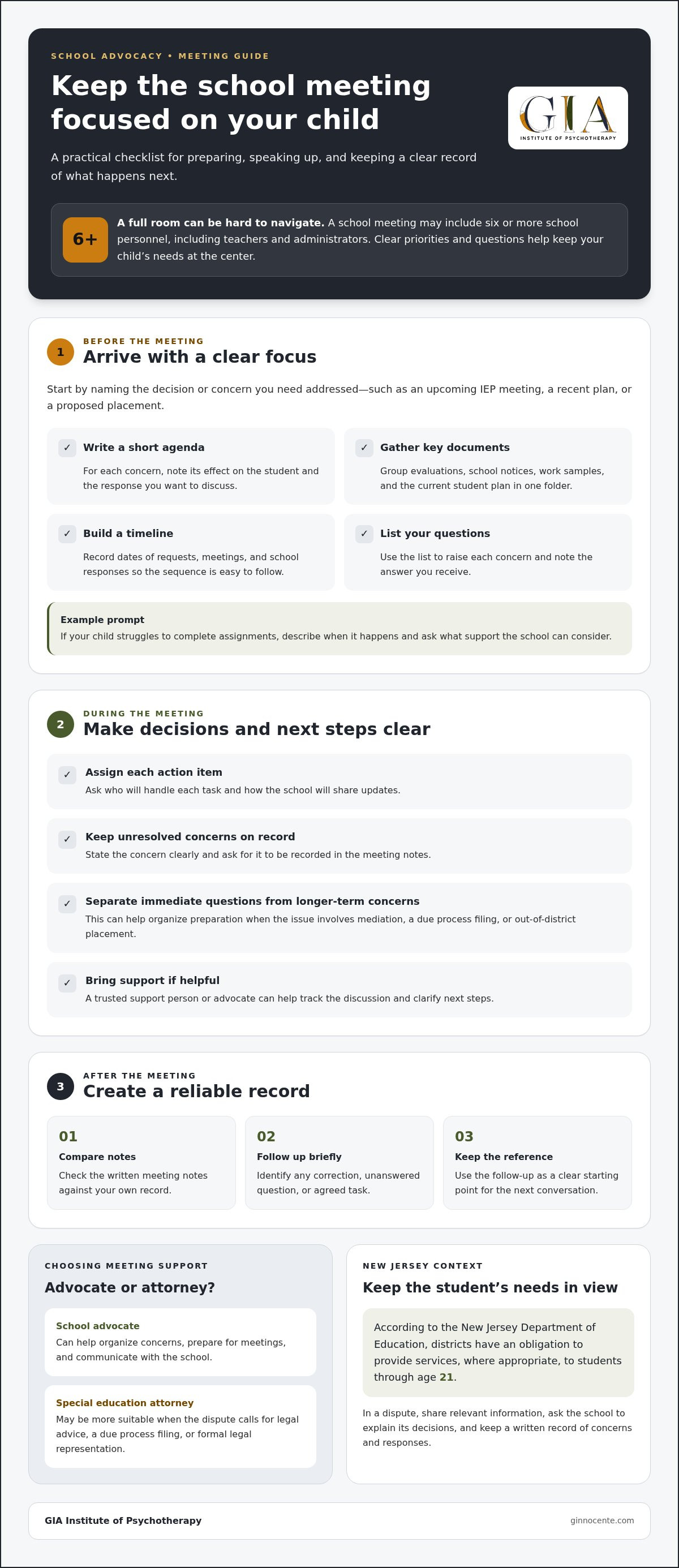
A school meeting can bring together six or more school personnel, including teachers and administrators. For parents, that many perspectives can make it difficult to keep a child’s needs at the center. Families seeking school advocacy services in Ventnor, NJ can prepare by naming the decision they need addressed, such as an upcoming IEP meeting, a concern about a recent plan, or a proposed placement.
How do I choose between a school advocate and a special education attorney? An advocate can help parents organize concerns, prepare for meetings, and communicate with the school. If the dispute calls for legal advice, a due process filing, or formal legal representation, an attorney may be more suitable.
What are parents’ rights in New Jersey special education disputes? According to the New Jersey Department of Education, districts have an obligation to provide services, where appropriate, to students through age 21. In a dispute, parents can focus on sharing relevant information, asking the school to explain its decisions, and keeping a written record of concerns and responses.
What steps should Ventnor parents take to resolve a school dispute? Identify the specific concern and gather related school documents. Then write to the appropriate school contact, request a meeting if it would help, and keep notes of decisions and follow-up tasks.
Bring a short agenda to keep the meeting focused. Note the concern, its effect on the student, and the response you want to discuss. For example, if a student struggles to complete assignments, describe when it happens and ask what support the school can consider. You can also bring a trusted support person or advocate to help track the discussion and clarify next steps.
- Agenda: Keeps the conversation centered on priority concerns and decisions.
- Document folder: Groups evaluations, school notices, work samples, and the current student plan.
- Timeline: Records dates of requests, meetings, and school responses.
- Question list: Helps parents raise each concern and note the answer received.
During the meeting, ask who will handle each action item and how the school will share updates. If a point remains unresolved, state the concern clearly and ask that it be recorded in the meeting notes. If the issue involves mediation, a due process filing, or out-of-district placement, prepare by organizing relevant records, clarifying the outcome you’re seeking, and separating immediate questions from longer-term concerns.
After the meeting, compare the written notes with your own. Send a brief follow-up identifying any correction, unanswered question, or agreed task. This creates a clear reference for the next conversation and keeps the student’s educational needs in view.
Advocate consultations, intake, and follow-up
An initial consultation helps parents define the school concern and decide what support could help. A short introductory meeting can last up to 15 minutes without charge for qualified parents or guardians. Longer consultations may take 1 to 3 hours, including limited document review. Some families need only 1 to 2 hours to organize questions and understand their options. A consultation can be useful when a parent has more than 5 to 10 minutes of questions.
Are there free or low-cost education advocacy services near Ventnor, NJ? Qualified parents or guardians may receive an introductory meeting of up to 15 minutes without charge. SPAN is among the special education advocacy resources families can explore for guidance and resource information.
Intake is more detailed than a first conversation. It usually takes between 6 and 10 hours because the advocate gathers background, reviews records, and understands the family’s priorities. Bring the current student plan, evaluations, school communications, and a brief timeline of key events. A document checklist helps identify missing records, while a dated timeline can show how concerns developed. These tools also help keep the discussion focused on the child’s education needs.
Some consultations divide time between document review and a parent meeting. One example is a 2-hour consultation, with time for each activity. Parents can prepare by writing down the decision they need help understanding, such as a proposed evaluation or a school response. Clear questions help make limited consultation time useful.
Which education advocates serve Ventnor and Atlantic County? Special education advocacy resources include SPAN, ASAH, ACNJ, COPAA, and NJCIE. These organizations can be starting points for finding resources relevant to a family’s concern and location.
- SPAN: A resource for special education advocacy information.
- ASAH: A named resource connected with special education advocacy.
- ACNJ: A resource to consider when seeking advocacy information.
- COPAA: An advocacy resource to include in a search.
- NJCIE: Another named special education advocacy resource.
How can I verify an education advocate’s experience and credentials in New Jersey? Ask about relevant special education work, the advocate’s role, and experience with concerns like yours. Request a clear explanation of what the advocate can do, and distinguish meeting support from legal representation.
After intake, an advocate may prepare an action plan and estimate covering up to the next 30 days. Use the plan to track priorities, documents to gather, and follow-up steps. For example, it can organize questions before a school meeting and record which issues still need attention. Parents can then revisit the plan as the school responds, keeping each next step tied to the child’s needs.
For help organizing school-related concerns, explore school advocacy support as a possible next step.
Disability discrimination and HIB complaints
When a child with disabilities faces barriers at school, describe observable events. A missed accommodation, exclusion from an activity, or repeated peer targeting each calls for different questions. Note what happened, where it occurred, who was present, and how it affected the student’s participation in education. Specific details help explain the concern without relying only on broad labels such as discrimination or HIB.
For a possible disability discrimination concern, connect the event to the student’s needs and school experience. For example, note when an agreed support was unavailable and what task the student could not access. Keep copies of relevant plans, school messages, and work samples. Ask the school contact how the concern was understood and what response is being considered. Clear, specific questions help keep the discussion focused.
For a HIB concern, record each reported incident separately. A child’s account may include the date, location, words or actions, witnesses, and any response from school staff. Avoid asking a child to repeat an account unnecessarily. Instead, record their words as accurately as possible and distinguish what they experienced directly from what someone else reported. An incident log can help parents describe patterns without treating every event as the same.
- Incident log: Organizes dates, locations, people involved, and reported actions.
- Document folder: Keeps school communications, relevant plans, and examples of missed access together.
- Impact notes: Records changes in participation, attendance, assignments, or willingness to attend school.
- Question list: Helps parents ask what the school reviewed and what steps it plans to take.
Start with a written report to the appropriate school contact. State whether the concern involves disability access, peer behavior, or both. Give specific examples and identify the support or response the child needs. Ask the school to explain its process and how it will share updates. Keep a copy of the message and note when the school responds. These steps create a clear record while allowing school staff to investigate and respond.
If the response doesn’t address the concern, follow up by identifying the unanswered point. For example, explain if the response addressed a classroom disagreement but not repeated exclusion from an activity. Request a meeting if a conversation could clarify the facts or supports. Bring the incident log and relevant records, then summarize any agreed actions in writing.
Children may need emotional support alongside school communication. Ask what would help your child feel heard, such as talking with a trusted adult or having a predictable check-in at school. Keep the focus on safety, access, and the child’s experience. A careful record, focused report, and steady follow-up can help bring complex concerns into a clearer conversation.
Evaluations and student-record review
Evaluation reports and school records can show how a student’s needs appear across classes, tasks, and settings. Start by gathering documents related to one concern, such as reading progress or difficulty following classroom directions. Compare the evaluation’s observations with current work samples and teacher updates. For a student in Ventnor, reviewing these side by side can help parents consider whether recommended support addresses the challenges they see at home and school.
Read each evaluation for its purpose, methods, findings, and recommendations. A reading report, for example, may describe strengths as well as areas where a student needs support. Note unfamiliar terms and ask the school team how the findings connect to classroom instruction. If a report identifies a need but the current program doesn’t address it clearly, write down the gap and ask how the team reached its decision.
- Evaluation report: Helps explain the questions assessed, observations, and recommendations.
- Current student plan: Shows which supports the school has documented for the student.
- Work samples: Offer concrete examples of progress, difficulty, or changing performance.
- Communication log: Tracks parent questions, school responses, and follow-up tasks.
Organize records by date and topic before reviewing them. A simple spreadsheet can list the document name, date, concern, and next question. For example, compare a reading evaluation with recent reading assignments and teacher notes. This makes it easier to see whether the same need appears across several sources or only in one setting. Keep original files intact and use a separate page for questions.
During a record review, check whether the documents describe the student consistently. Compare evaluation findings with attendance notes, classroom observations, and reported progress. If one report describes strong performance while work samples show repeated difficulty, ask what conditions differed. Questions about setting, task type, and support can clarify the contrast without dismissing either account.
Before a school discussion, choose the records that directly relate to the concern. Mark the relevant page or section, then write a brief question beside it. For instance, ask how a recommended reading support will be reflected in instruction and how progress will be described. Keep a copy of your questions and note the school team’s answers. This turns a large file into a focused conversation about the student’s needs.
When records are difficult to interpret, an advocate can help parents organize documents, identify unanswered questions, and prepare to discuss evaluations. The aim is to connect each finding to a practical question about the student’s learning, participation, or support.
IEP, 504, I&RS, and intervention plans
An IEP, a 504 plan, an I&RS record, and an intervention plan serve different purposes. Parents can begin by identifying the document guiding the school’s current supports. Then compare its stated needs, strategies, and progress measures with the student’s daily experience. For example, if a student struggles to complete written work, note which plan addresses that concern and what support it describes.
An IEP can document a student’s educational needs, specialized instruction, supports, and goals. Check whether each goal connects to a skill the student needs to build, how the plan describes progress, and which staff members provide support. If a goal says “improve reading,” ask what specific skill the school is addressing and how progress will be described.
A 504 plan generally focuses on supports that help a student access school activities and instruction. Look for accommodations tied to an identified barrier. For example, a student who has difficulty processing spoken directions may need directions presented in another format. Parents can ask how staff will apply the accommodation during classwork, transitions, and assessments.
I&RS is commonly used to organize intervention and referral support within a school. An intervention plan may outline strategies tried, observations, and how staff will review their effects. Ask which concern each strategy addresses and what information the team will use to decide whether it helps. Keep dated notes to compare the plan with classroom updates.
- Plan comparison chart: Shows which document addresses each reported need.
- Progress tracker: Organizes work samples, teacher updates, and changes over time.
- Questions list: Helps parents ask how supports work in specific classes or activities.
- Meeting notes: Captures decisions, responsible staff, and agreed follow-up.
If a student has several plans or records, make a simple chart with columns for the concern, document, support, and question. A student with reading difficulty might have a goal in one document and classroom accommodations in another. The chart can show where supports overlap and where you need clarification. Bring it to the meeting and discuss one concern at a time.
Transition planning also deserves attention as students approach adulthood. According to the New Jersey Department of Education, transition services are required for New Jersey students starting in the school year when they reach age 14. The same department says districts have an obligation to provide services, where appropriate, through age 21. Families can use those milestones to ask how a student’s plan addresses future goals and needed supports.
If you want help organizing plan questions and preparing for a school discussion, get support with school advocacy.
GIA Institute of Psychotherapy: Adult Individual Psychotherapy
GIA Institute of Psychotherapy offers individual therapy for adults experiencing anxiety, depression, or life transitions. School disagreements can also affect family life, disrupt sleep, or leave a parent emotionally overwhelmed. Therapy provides space to explore these experiences and develop practical strategies, while school advocacy focuses on communication and student support at school.
For children or teens affected by school-related stress, individual therapy can provide a place to express feelings and work through challenges. Family therapy can support shared conversations, while couples counseling may help partners address relationship strain. These options support emotional well-being; they don’t replace school processes or legal advice.
If you’d like to explore therapy for yourself or your family, contact GIA Institute of Psychotherapy or visit ginnocente.com.
Choose a Next Step That Supports Your Family
A school concern can affect more than a student’s classroom experience. It may also shape a parent’s confidence, a child’s sense of belonging, or how family members communicate at home. Naming what feels hardest right now can help you choose a next step that fits, whether that means continuing school conversations or seeking emotional support.
School advocacy services in Ventnor, NJ address school-related needs, while therapy can support the people carrying stress around those concerns. GIA Institute of Psychotherapy offers individual therapy for adults, children, and teens, as well as family therapy. These services can provide space to understand feelings, build coping strategies, and strengthen family communication alongside school-focused action.
If you’re ready to explore support for yourself or your family, contact GIA Institute of Psychotherapy. You can take the next step thoughtfully, at a pace that feels right for your family.
Frequently Asked Questions
What school advocacy services are available in Ventnor, NJ?
Families can seek support with special education meetings, IEP and 504 discussions, evaluations, and communication with school staff. School advocacy services in Ventnor, NJ can also help parents clarify what they want a school conversation to address. For example, if a student’s support plan doesn’t reflect changing classroom needs, an advocate can help the family organize concerns and prepare focused questions.
What issues do school advocates in Ventnor help with?
School advocates can help families address disagreements about student supports, evaluation findings, school records, and how a plan responds to a child’s needs. A parent might seek help if a student’s classroom participation changes or the family is unsure how to discuss a school decision. An advocate can help organize the concern and prepare for communication with the school. Advocacy doesn’t replace legal representation when a dispute requires an attorney.
How can I find a special education advocate near Ventnor, NJ?
Look for an advocate experienced in special education planning and parent support, then discuss whether that experience fits your concern. GIA Institute of Psychotherapy’s school advocacy program is led by Jenn Rothwell, a COPAA-certified advocate. The program serves Ventnor, Ocean City, Linwood, Margate, Egg Harbor Township, Upper Township, and Galloway, connecting families across nearby South Jersey communities with advocacy support.
How do I request an IEP or 504 meeting in Ventnor City School District?
Send a written request to your child’s school contact, such as the case manager or principal, and state whether you’re requesting an IEP or 504 meeting. Briefly describe the concern, such as a change in classroom access or a support that needs discussion. Include your availability and ask who will attend. Keep a copy of your message and any reply, so you have a clear record of the request.


