

Family conflict doesn’t mean a family has failed. It may be a sign that people need support hearing one another and working through a problem. Family conflict resolution in Galloway, NJ can help families address disagreements about parenting styles, household rules, and consistency, as well as tensions involving blended families, co-parenting, or different generations. Counseling can also make space to work through sibling conflict, loss, and challenges related to a teen’s behavior.
When arguments keep repeating or everyone avoids a difficult subject, it can be hard to see a way forward. The strain is real, but it doesn’t mean relationships can’t change.
This article covers the household issues family counseling can address, how it can support communication and shared problem-solving, and what to expect when considering therapy for children, teens, adults, couples, or a whole family. It also explains how blended families, co-parents, and relatives across generations can begin building clearer expectations and more respectful ways to handle disagreements.
Key Takeaways
- Identify recurring tensions around household rules, parenting approaches, or family transitions to clarify what needs attention.
- Explore how counseling can help blended families and co-parents develop clearer expectations and more consistent communication.
- Make room for each family member’s perspective so disagreements can shift toward listening and shared problem-solving.
- Consider whether individual, couples, or family therapy best fits the people and concerns involved.
Blended families, co-parenting, and multigenerational households
Blended homes, co-parenting arrangements, and multigenerational households bring different expectations together. Family counseling can help people discuss those differences and work toward practical agreements.
Support for Blended and Multigenerational Families
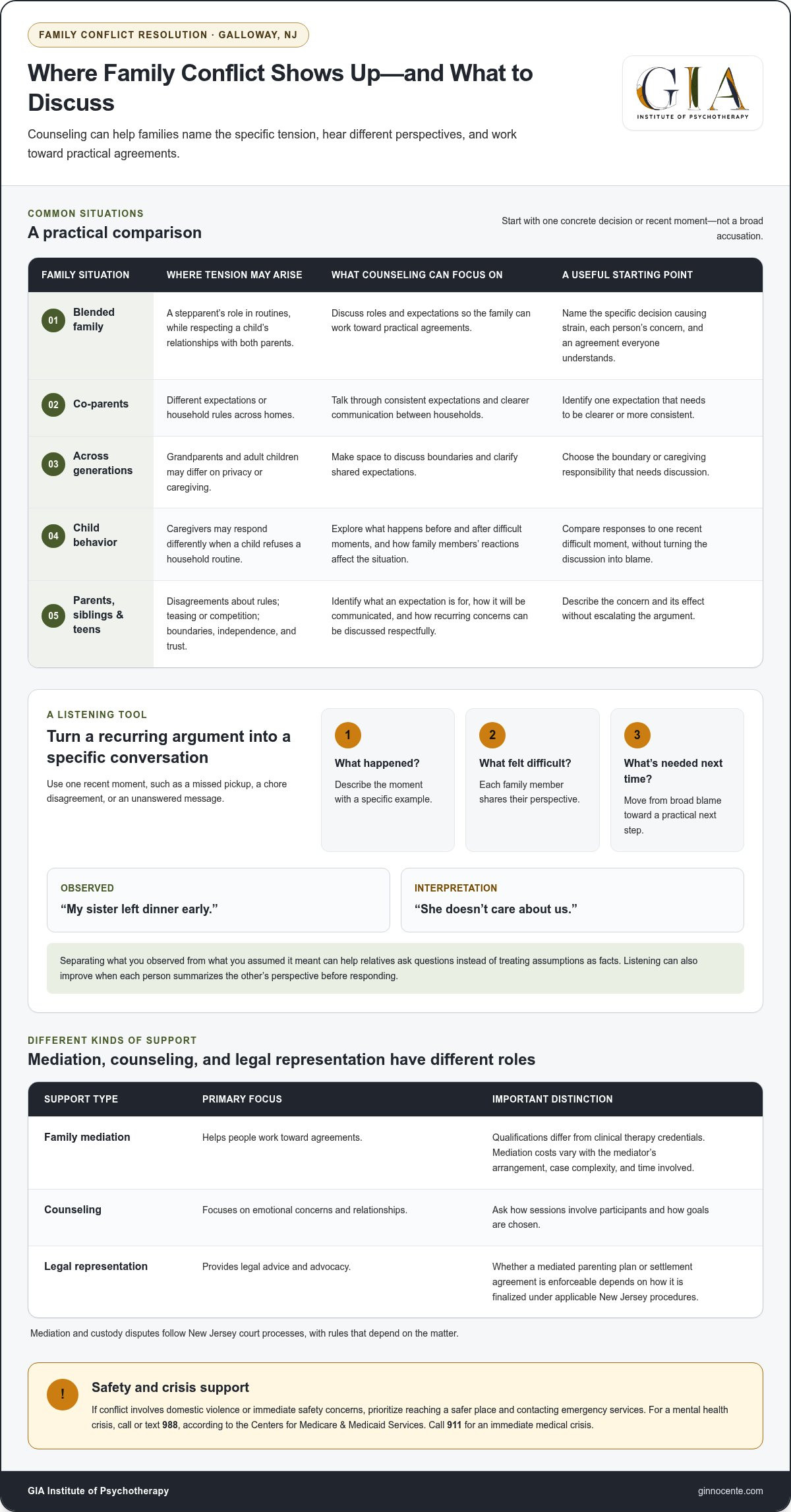
A blended family may need to clarify a stepparent’s role in routines while respecting a child’s relationships with both parents. Co-parents can discuss consistent expectations across households, while grandparents and adult children may need shared boundaries around privacy or caregiving. Start with the specific decision causing strain, each person’s concern, and an agreement everyone understands.
Parenting Challenges and Child Behavior
When a child’s behavior is creating tension, discuss what happens before and after difficult moments. For example, caregivers can compare how they respond when a child refuses a household routine. A therapist can help parents explore different responses and consider how each family member’s reactions affect the situation. This gives parenting conversations a concrete focus instead of letting them turn into blame.
Parent and Sibling Conflict
Parents who disagree about rules can identify the expectation, its purpose, and how they’ll communicate it. Siblings may need help describing how teasing or competition affects them without escalating arguments. Parents and teens can use counseling to discuss boundaries, independence, and trust. Family conflict resolution in Galloway can focus on practicing respectful ways to talk through recurring concerns.
Family mediation helps people work toward agreements, while counseling focuses on emotional concerns and relationships. Legal representation provides legal advice and advocacy. Whether a mediated parenting plan or settlement agreement is enforceable depends on how it is finalized under applicable New Jersey procedures. Mediation and custody disputes follow New Jersey court processes, with rules that depend on the matter. Mediation costs vary according to factors such as the mediator’s arrangement, case complexity, and time involved.
Who Can Benefit From Conflict Resolution Therapy?
Counseling can help when recurring disagreements begin affecting family routines, relationships, or emotional well-being. For families seeking family conflict resolution in Galloway, NJ, therapy offers a structured place to examine what keeps arguments going and practice different responses. Start with one recent example, such as tension over household responsibilities or a parent and teen struggling to discuss boundaries.
Family counseling can help relatives notice conflict patterns, manage stress, and focus on the issue rather than blame. If one family member’s anxiety, depression, or trauma affects communication at home, therapy can make room to discuss both personal needs and the impact on the family. Individual treatment may also accompany family work when someone has concerns they want to explore privately.
Consider counseling when the same problem returns despite attempts to resolve it, conversations are repeatedly avoided, or disagreements disrupt daily life. For example, a family might seek support when discussions about a move turn into arguments every time. Family conflict resolution in Galloway, NJ can help participants clarify what they want to change and develop shared ways to approach difficult conversations.
When considering a family or marriage counselor in Galloway, look for a fit with your concerns, such as parent-teen communication, grief, or relationship strain. Ask how sessions involve participants and how goals are chosen. A clear explanation of the process can help you decide whether counseling suits your family’s needs.
When seeking a New Jersey family mediator, ask about mediation training, relevant family-conflict experience, and professional credentials. Mediation qualifications differ from clinical therapy credentials, so clarify whether the service is mediation or counseling.
If conflict involves domestic violence or immediate safety concerns, prioritize reaching a safer place and contacting emergency services. For a mental health crisis, call or text 988, according to the Centers for Medicare & Medicaid Services; call 911 for an immediate medical crisis.
Understanding family members’ perspectives
Family therapy can create space to compare perspectives without deciding whose feelings are valid. Start with one recent moment: a missed pickup, a chore disagreement, or an unanswered message. Each family member can describe what happened, what felt difficult, and what they need next time. This three-part account turns broad blame into specific concerns and gives the conversation practical direction. In a New Jersey household where relatives share responsibilities, clear examples help reveal where expectations differ.
Try a two-column exercise before discussing a recurring disagreement. In one column, write down what you observed; in the other, note what you assumed it meant. For example, “My sister left dinner early” is an observation, while “She doesn’t care about us” is an interpretation. Separating the two can lower emotional intensity and help relatives ask questions instead of treating assumptions as facts. Listening improves when each person summarizes the other’s perspective before responding.
If one family member refuses to attend, avoid turning the invitation into another argument. Explain the purpose calmly, for example, “I want help discussing how we handle visits.” Then focus on one change you can make in your own communication and record specific examples of what happens. Friends and relatives can offer care, but avoid asking them to take sides or carry messages between family members. That boundary can reduce pressure on relationships.
A family member can begin by naming personal concerns and identifying one desired change. For example, a parent might ask for calmer conversations about school, while a teen may want time to explain their perspective. In therapy, concrete goals give sessions a shared focus, even when relatives see the conflict differently. Family therapy can help people practice respectful turn-taking, clarify what each person heard, and choose a next step that addresses the issue rather than assigning blame.
Mental health services for adults, teens, children, couples, and families
A mental health concern affecting one person can also reshape family routines and relationships. A parent’s stress, a teen’s withdrawal, or a child’s behavior problems may influence how relatives communicate at home. Consider both the individual concern and its effect on the household when deciding what kind of support to seek.
Different therapy formats address different needs. Adult Individual Psychotherapy gives adults space to explore personal concerns and coping strategies. Individual Therapy for Children and Teens can focus on a young person’s emotional or behavioral needs. Couples Counseling addresses relationship concerns between partners, while Family Therapy brings relatives together to work on shared problems and communication. These approaches can complement one another when both individual treatment and family support fit the situation.
A treatment plan organizes support around the concerns a person or family brings to therapy. For example, if disagreements about school affect a teen and parent, goals might include helping them express concerns clearly and agree on a next step. When school-related issues are central, School Advocacy Services may also be relevant. The focus should be on the family’s stated needs, rather than assuming every person needs the same kind of care.
Before an appointment, write down one recurring problem, who it affects, and what change would feel useful. A family might describe arguments that disrupt dinner, a couple might name a pattern of avoiding difficult decisions, or a teen might explain feeling misunderstood. These examples help clarify whether individual, couples, or family support best matches the concerns. Progress can begin with a more specific conversation and a goal each participant understands.
If household conflict is affecting several relationships, explore family therapy options as a way to work on communication and shared concerns.
GIA Institute of Psychotherapy: Adult Individual Psychotherapy
GIA Institute of Psychotherapy offers Adult Individual Psychotherapy for adults who want space to explore personal concerns and develop practical strategies. When household conflict affects your well-being, individual therapy can help you reflect on your responses and identify changes within your control.
Family concerns may call for a different format. Family Therapy supports relatives working through shared dynamics, while Couples Counseling focuses on concerns between partners. Individual Therapy for Children and Teens centers on a young person’s needs. The right starting point depends on who is affected and whether the concern is personal, relational, or shared across the family.
If you’re ready to discuss what kind of support may fit, visit ginnocente.com.
Choose a First Step Toward More Open Conversations
Change often begins with a small, intentional choice: naming what you hope will feel different at home. That goal might be more respectful conversations, clearer boundaries, or a calmer way to approach difficult decisions. Every family member doesn’t need to agree immediately. A shared willingness to try a new approach can create room for trust and understanding to grow.
Seeking family conflict resolution in Galloway, NJ can be a meaningful step when old patterns keep returning and conversations feel difficult to begin. You can start by describing what’s been weighing on you and what you’d like to change. From there, support can help you explore a path that respects each person’s needs and moves at a thoughtful pace.
When you’re ready to take that step, contact GIA Institute of Psychotherapy. A more connected way forward can begin with one honest conversation.
Frequently Asked Questions
What issues does family therapy help with?
Family therapy can help relatives address communication difficulties, anxiety, depression, grief, and stressful life transitions. It can also help when one person’s concerns change how the household functions, such as when a parent’s low mood affects shared routines. Bring a specific example, like tension around family gatherings, to clarify what you want to work on and how it affects those involved.
What if my partner or family member is reluctant to attend therapy?
Start by asking what concerns them about therapy, then listen without trying to argue away those concerns. You might suggest discussing one shared goal, such as making household decisions with less tension. If they aren’t ready to join, you can still seek individual support to reflect on your own needs and responses. Avoid presenting therapy as punishment or proof that someone is at fault.
How do I know if my family needs counseling?
Consider counseling if a concern keeps disrupting family life, even after you’ve tried addressing it together. For example, a child’s school-related distress might create repeated conflict between caregivers, or grief may leave relatives unsure how to support one another. You don’t need to wait for a crisis. A clear goal, such as improving communication around a transition, can provide a starting point.
How is it accomplished?
Therapy generally begins by identifying what brings the family in and what each participant hopes will change. The therapist and family can then set goals, discuss examples, and practice different ways to respond during difficult conversations. Between sessions, family members might try one agreed communication change at home. At a later meeting, they can review what helped and adjust their approach.
How long does family or couples therapy typically last?
At GIA Institute of Psychotherapy, couples and family therapy sessions are 60 minutes. The overall course of therapy depends on the concerns being addressed, the goals participants choose, and how those needs evolve. For instance, relatives working through a recent transition may set different goals from a couple addressing a long-standing communication pattern. Discussing goals helps shape a useful course of care.
What family conflict resolution and mediation services are available in Galloway, NJ?
Therapy and mediation serve different purposes: therapy addresses emotional and relationship concerns, while mediation helps parties work toward agreements. GIA Institute of Psychotherapy offers therapy for individuals, children and teens, couples, and families, but not mediation. Its South Jersey service area includes Galloway, Ocean City, Linwood, Margate, Ventnor, Egg Harbor Township, and Upper Township; virtual counseling is available to New Jersey residents.


