
What if the repetitive arguments that keep you awake at night aren't a sign that your relationship is failing, but a desperate, misdirected cry for connection? It's exhausting to feel like a stranger to the person sharing your dinner table, or to feel the weight of silence in a house that used to be full of laughter. If you're searching for couples counseling South Jersey, you likely want to bridge the gap but feel stuck in cycles that never seem to resolve. You might even feel a sense of anxiety about the vulnerability required to sit on a therapist's couch and be truly seen.
This guide will show you how to choose a therapeutic approach that heals emotional wounds rather than just managing symptoms. We'll look at the science of attachment, the 75 percent success rate of Emotionally Focused Therapy, and how to select a local specialist who acts as a compassionate guide. You'll discover how the right support can transform your communication, restore emotional intimacy, and provide the practical tools needed to rewrite your shared story with hope, clarity, and a renewed sense of safety.
Key Takeaways
- View therapy as a proactive investment rather than a last resort to handle unique local stressors like seasonal transitions and complex family dynamics.
- Explore the science of attachment and why Emotionally Focused Therapy (EFT) is considered the gold standard for rebuilding a secure emotional bond.
- Learn the essential criteria for selecting the best provider of couples counseling South Jersey, focusing on specialized training and a relatable, human-centric approach.
- Prepare for your first sessions by understanding the intake process and how a skilled therapist creates a safe space for both partners to be seen.
- Discover how integrating neuroscience with practical strategies can help you move from repetitive arguments to a restored sense of emotional intimacy.
Understanding the Need for Couples Counseling in South Jersey
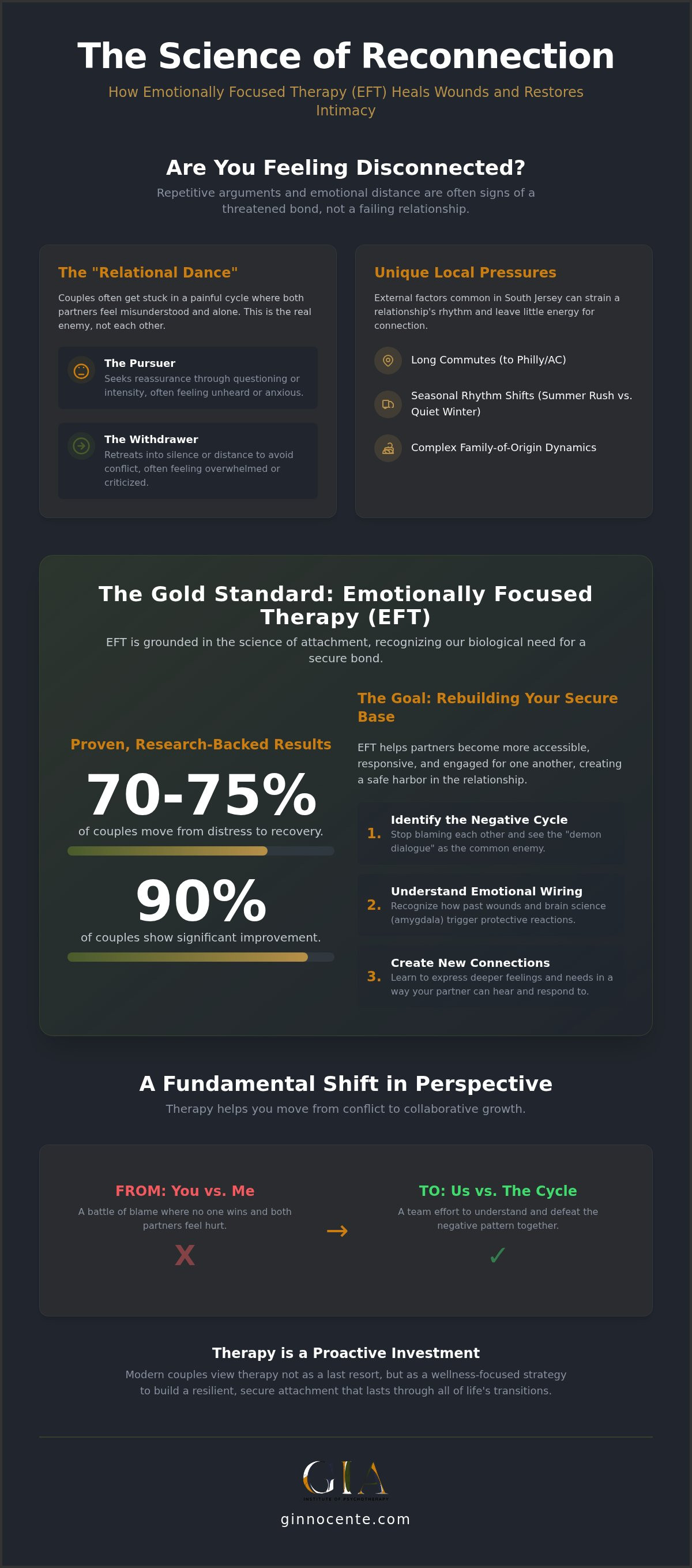
Choosing to seek couples counseling South Jersey isn't an admission of defeat; it's a courageous investment in your future. Many partners find clarity by exploring Emotionally Focused Therapy (EFT), which helps them understand the biological need for connection. It's common for couples in Ocean City, Linwood, and Margate to face unique pressures that strain their bond. The seasonal shift from the intense summer rush to the quiet, isolated winters can disrupt a household's rhythm. Long commutes to Philadelphia or Atlantic City often leave little energy for meaningful conversation at the end of the day. When you add the weight of deep-rooted family-of-origin dynamics common in New Jersey, it's easy to see how partners lose their way.
We often get stuck in what we call the "relational dance." One partner might pursue, seeking reassurance through questioning or intensity, while the other withdraws into silence to avoid conflict. This cycle creates a painful distance where both people feel misunderstood and alone. Validating these feelings is the first step toward healing. You aren't "broken" or "failing" for feeling disconnected; you're simply caught in a cycle that needs a new map.
When is the Right Time to Seek Support?
Emotional drift often happens quietly. You might notice the "safe harbor" feeling of your relationship has been replaced by a sense of walking on eggshells. Significant life transitions, such as welcoming a first child or navigating the shift into retirement, can amplify these cracks and leave you feeling unsupported. Seeking support early allows you to address these shifts before they become ingrained habits. Therapy is most effective when used as a bridge to cross a difficult season before resentment hardens into a permanent wall.
Moving Beyond the Stigma of Relationship Therapy
There's an old belief that therapy is only for relationships on the brink of divorce. In reality, modern couples in South Jersey are shifting toward a wellness-focused mindset. They're moving away from the idea of "fixing problems" and toward the goal of building a secure attachment. This means creating a bond where both partners feel truly seen, heard, and valued. By prioritizing your relational health through couples counseling South Jersey, you're ensuring that your partnership remains a source of strength through all of life's transitions. You're rewriting your shared narrative from one of conflict to one of collaborative growth.
The Science of Connection: Why Emotionally Focused Therapy (EFT) Works
Love is often described as a mystery of the heart, but modern neuroscience reveals it's actually a biological imperative. Emotionally Focused Therapy (EFT) has emerged as the gold standard for restoring relationships because it's grounded in the science of attachment. This approach recognizes that humans have an innate, lifelong need for a "secure base," a partner who is accessible, responsive, and engaged. When this bond feels threatened, our brains register it as a survival emergency. This is why couples counseling South Jersey focuses on more than just "better communication." It's about rebuilding the underlying sense of safety that allows intimacy to flourish.
EFT helps partners identify what are often called "demon dialogues." These are the repetitive, negative cycles where one person pursues and the other withdraws. By mapping out this "dance," couples can stop blaming each other and start seeing the cycle itself as the enemy. Research shows that 70 to 75 percent of couples move from distress to recovery through this method, with about 90 percent showing significant improvement. If you're wondering how to choose a couples therapist, prioritize those who understand these attachment dynamics and the science of the bond.
Understanding Your "Emotional Wiring"
Our current relationship triggers are often rooted in past wounds or family history. When your partner forgets a commitment or seems distant, your amygdala, the brain's alarm system, may trigger a fight-or-flight response. You aren't being "dramatic"; your brain is trying to protect you from perceived abandonment. Understanding this neuroscience reduces blame. Instead of seeing a partner as "angry" or "cold," you begin to see a person who is frightened and trying to find their way back to you. This shift in perspective is a cornerstone of the work at GIA Institute of Psychotherapy, where we help you navigate these complex internal landscapes with compassion.
The EFT Process: From De-escalation to Reconnection
The journey through EFT typically follows three intentional stages. First is de-escalation, where you identify the negative cycle and the vulnerable emotions, like fear or loneliness, hidden beneath the surface. Next is restructuring the bond. This is where partners learn to express their needs in a way that invites their partner in rather than pushing them away. Finally, we move to consolidation. In this stage, the new, positive "dance" of connection becomes a permanent habit, ensuring your relationship remains a safe harbor for years to come. This methodical pace allows for deep, lasting change rather than temporary fixes.
How to Choose the Best Couples Therapist in South Jersey
Finding the right professional for couples counseling South Jersey shouldn't feel like a cold, clinical transaction. It's a deeply personal search for a compassionate guide who can navigate your unique emotional landscape. While online directories offer long lists of names, they often fail to explain what actually makes a therapist effective for your specific relationship dynamic. You deserve more than a generalist; you need a specialist who understands the intricate "dance" of partnership.
Start by looking for specialized training in evidence-based models like Emotionally Focused Therapy (EFT), the Gottman Method, or Internal Family Systems (IFS). These aren't just acronyms. They represent a roadmap for high-conflict situations and deep emotional drift. Beyond credentials, assess the "relatability factor." Does the therapist feel like a steady, human presence or a clinical robot? Whether you prefer in-person sessions in Linwood or Ocean City, or the flexibility of telehealth from your home in Margate, the quality of the connection remains the most important factor. A holistic philosophy that considers your family system and overall well-being ensures that the healing is both comprehensive and lasting.
Key Questions to Ask a Potential Therapist
Before your first session, it's helpful to interview your potential therapist to ensure their style matches your needs. Consider asking these three questions:
- What is your specific approach to working with high-conflict couples?
- How do you handle situations where one partner is more hesitant about therapy?
- Do you focus on short-term tools or long-term emotional healing?
These inquiries help you determine if the provider offers a "quick fix" or a path toward profound transformation. A therapist who can hold space for a hesitant partner without judgment creates the safety needed for both people to engage fully in the process.
Evaluating Clinical Credentials vs. Relational Fit
In New Jersey, you'll encounter various licenses such as LCSW, LPC, or LMFT. While these ensure the provider meets state regulations for clinical expertise, they're only one part of the equation. Research consistently shows that the "therapeutic alliance," the bond and trust between you and your therapist, is the number one predictor of success in counseling. It's the foundation upon which all other work is built.
Finding a practice that understands the local South Jersey community culture adds another layer of resonance. Whether you're navigating the unique stressors of shore-town life or managing complex family-of-origin dynamics, a local expert provides a level of understanding that a distant provider can't match. When you feel "seen" by your therapist, you're much more likely to feel safe enough to be seen by your partner.
Breaking the Cycle: What to Expect in Your First Few Sessions
Entering couples counseling South Jersey for the first time often brings a mix of hope and heavy apprehension. You aren't just walking into an office; you're opening up your most private world to a professional who will act as your guide. The intake process is designed to be a gentle gathering of your shared history and individual perspectives. We focus on identifying your unique relationship goals rather than just listing grievances. This stage is about creating a safe harbor where both partners feel safe, supported, and understood.
One of the most transformative shifts happens when we move away from the "he-said/she-said" dynamic. Instead of focusing on who started the fight, we look at how you both experience the cycle together. You begin to see that the argument is the enemy, not your partner. This de-escalation phase typically lasts between 8 and 20 sessions as you learn to slow down your interactions and recognize the underlying emotions driving the conflict. By seeing the "dance" as the problem, you can finally begin to work as a team again.
The First Session: Setting the Foundation
Many people worry that the therapist will "side" with one person or act as a judge. In a restorative clinical space, the relationship is the client. You can leave the need to "win" the argument at the door. We establish clear boundaries and confidentiality from the start, ensuring that the room remains a protected space for honest exploration. You don't need to bring a list of every mistake your partner has made; just bring your willingness to be present and curious about a different way of relating. This foundation of trust is what allows the real work of healing to begin.
Developing Practical Strategies for Home
Healing doesn't just happen during the 50 minutes you spend in the office. We work on developing practical strategies to handle "hot" conflicts that arise between sessions. You'll learn the importance of "repair attempts," which are small, often subtle gestures or words that signal a desire to reconnect during a disagreement. These might be as simple as a softened tone, a gentle touch, or a shared look that says, "I'm still here." Transitioning these insights into daily relational habits is what builds long-term trust. If you're ready to move past the arguments and find your way back to each other, explore how our approach can help you break the cycle.
Finding Your Safe Harbor with GIA Institute of Psychotherapy
At GIA Institute of Psychotherapy, we believe that every relationship has the capacity for profound transformation. We've seen how the weight of repetitive arguments and emotional distance can leave partners feeling stranded in their own homes. Our practice serves as a restorative space where couples counseling South Jersey is practiced with a unique blend of clinical precision and deep, human empathy. We don't just look at the symptoms of your distress; we look at the heartbeat of your connection. By integrating the science of attachment with a relatable, person-centered approach, we help you rediscover the best versions of yourselves and each other.
Our team acts as wise guides for your relationship's unique journey, offering support that's both highly skilled and deeply relatable. We maintain a strong local presence in communities like Ocean City, Margate, Galloway, and Linwood. This local roots-based approach allows us to understand the specific stressors that South Jersey families face, from the seasonal shifts of shore life to the complexities of local family-of-origin dynamics. When you're ready to explore couples counseling South Jersey, you'll find that our team is dedicated to your long-term well-being, providing a steady and calming presence throughout the healing process.
A Relatable Approach to Professional Healing
GIA emphasizes an authentic, non-judgmental reputation because we know that vulnerability requires a high level of safety. Our team doesn't sit behind a clinical mask; we show up as real people who are dedicated to the collaborative nature of the healing journey. We also understand that traditional talk therapy isn't always the only path to healing. This is why we can integrate expressive modalities to help partners tap into emotions that are often hard to put into words. We also recognize that individual health fuels relational health. By supporting the whole person, we ensure that you have the internal clarity and strength needed to show up fully for your partner and your family system.
Taking the Next Step Toward Reconnection
We encourage you to trust your intuition and the quiet hope that things can be different. The cycles of conflict you're currently experiencing don't have to be the final chapter of your story. Reaching out for a consultation in our Linwood or Ocean City area offices is a powerful step toward rewriting your shared narrative. Whether you're navigating a major life transition or healing from years of emotional drift, we're here to help you find your way back to a secure bond. Your relationship's narrative can be rewritten, and a future filled with restored emotional intimacy and practical communication is entirely possible. We look forward to being part of your journey toward a healthier, more connected future.
Rewriting Your Shared Story with Hope
Your relationship is a living, breathing story that deserves to be nurtured with intention and clinical expertise. By understanding the science of attachment and identifying the negative cycles that keep you stuck, you've already begun the vital work of reconnection. Remember that seeking professional support is a proactive choice to protect your partnership from the inevitable stressors of life. Whether you're navigating major transitions in Ocean City or seeking to restore intimacy in Linwood, the right guidance can help you move from a place of distress to one of lasting recovery.
Choosing couples counseling South Jersey provides you with a dedicated, non-judgmental space to be truly seen by your partner. You don't have to navigate these complicated emotional waters on your own. Our team offers authentic, relatable, and neuroscience-based care tailored to the unique needs of our local shore community families. Are you ready to move past repetitive arguments and find your safe harbor again?
Begin your journey toward reconnection with the GIA Institute and discover how our specialists in Emotionally Focused Therapy (EFT) can help you heal emotional wounds. It's never too late to start a new, more connected chapter together.
Frequently Asked Questions
Does couples counseling work if only one partner is willing to go?
Individual therapy can be a powerful catalyst for change even if your partner is hesitant. When one person shifts their behavior or gains internal clarity, it naturally alters the relational system. At GIA, we offer individual psychotherapy that helps you understand your own attachment triggers. This self-work often invites your partner to eventually join the process once they see the positive shifts in your presence and communication.
How long does it typically take to see results in couples therapy?
Most couples begin to notice a shift in their dynamic within 8 to 20 sessions of consistent work. This duration allows for the de-escalation of repetitive arguments and the start of rebuilding a secure emotional bond. The exact timeline depends on your unique history and the complexity of the issues. We focus on restorative, long-term healing to ensure your relationship remains a safe harbor long after the sessions have ended.
Is couples counseling covered by insurance in New Jersey?
Insurance coverage for relationship support depends on your specific policy and provider. Many New Jersey plans cover family therapy sessions when a mental health diagnosis is present for one partner. You should call your insurance company to ask about out-of-network benefits or specific coverage for family therapy. We focus on providing high-quality, specialized care and can provide the necessary documentation to help you seek reimbursement from your carrier.
What is the difference between marriage counseling and EFT?
Marriage counseling is a general category, while Emotionally Focused Therapy (EFT) is a specialized, science-based approach. EFT focuses on the biological need for attachment and the emotional bond between partners. Unlike traditional methods that only teach communication skills, EFT helps you rewrite the emotional dance of your relationship. This evidence-based model is a primary focus of our couples counseling South Jersey practice, helping couples move from distress to lasting recovery.
Can therapy help us if we are already considering divorce or separation?
Therapy is highly effective for couples standing at a crossroads. We provide a neutral, safe space to slow down the conflict and see if the bond can be restored through neuroscience-based strategies. Even if you've discussed separation, exploring the underlying attachment needs can offer clarity and healing. Our goal is to help you understand the cycle of your distress so you can make an informed, compassionate decision about your future together.
What happens if we feel like our therapist is taking sides?
In a restorative therapeutic space, the relationship itself is the client. If you ever feel that the balance has shifted, we encourage you to share that feeling immediately. Our therapists are trained to remain neutral guides who validate both perspectives without judgment. We strive to ensure both partners in Ocean City or Linwood feel equally heard, seen, and supported as we navigate the complexities of your unique relational journey.
Do you offer virtual couples counseling for South Jersey residents?
We provide virtual sessions for residents throughout the South Jersey shore communities to ensure care is accessible and convenient. Telehealth is an excellent option for couples in Margate, Ventnor, or Galloway who may have challenging schedules or childcare needs. These online sessions maintain the same clinical depth and empathetic connection as our in-person appointments, allowing you to work on your relationship from the safety and privacy of your own home.
How often should we attend sessions for the best outcome?
Weekly sessions are generally recommended during the initial phase of couples counseling South Jersey to build necessary momentum. This consistent rhythm helps you stay focused on breaking negative cycles and practicing new ways of connecting before old habits resurface. As your bond becomes more secure and you feel more confident in your communication tools, we may move to bi-weekly sessions. This intentional pace ensures that the transformation you achieve is both deep and permanent.


