
What if the recurring arguments that keep you awake at night aren't actually about the dishes or the schedule, but a hidden plea for closeness? Perhaps you've started to feel more like roommates than partners, navigating a quiet distance that feels heavy, confusing, and impossible to bridge. It's exhausting to feel trapped in the same cycle, wondering if your relationship is simply beyond repair. For many seeking EFT couples therapy New Jersey provides a specialized, restorative space to finally break these patterns and rediscover the warmth that once felt so natural.
You likely believe that communication is the problem, but it's often the underlying emotional music that needs to change. We understand the pain of feeling disconnected, and we want you to know that transformation is possible. Research from the Sentio Counseling Center indicates that up to 75 percent of couples move from distress to full recovery using this approach. This article will show you how Emotionally Focused Therapy creates emotional safety, provides tools to stop the cycle of conflict, and fosters a deeper understanding of your partner's needs. Together, we'll explore a path toward healing, presence, and clarity that is patient, reliable, and dedicated to your long-term well-being.
Key Takeaways
- Understand why Emotionally Focused Therapy is considered the gold standard for repairing bonds by focusing on the science of adult attachment.
- Learn to identify the "negative cycle" or repetitive dance of conflict that keeps you and your partner feeling stuck and disconnected.
- Discover how EFT couples therapy New Jersey guides you through a structured three-stage journey to de-escalate tension and rebuild emotional safety.
- Explore the differences between EFT and other modalities, shifting the focus from simply changing behaviors to healing the heart of the relationship.
- Find a restorative path forward with specialized care designed to transform your partnership into a secure and lasting connection.
What is EFT Couples Therapy? Understanding the Gold Standard
Have you ever wondered why certain moments with your partner trigger such a deep sense of panic or isolation? Traditional advice often suggests that you simply need better communication skills or a new way to divide household chores. However, at the heart of most relationship distress lies a much deeper question: "Are you there for me?" This is the core focus of Emotionally Focused Therapy. Often called the gold standard of treatment, it's a structured, short-term approach designed to repair the emotional bond between partners. Unlike methods that focus only on surface-level behaviors, What is Emotionally Focused Therapy? is a modality that dives into the root of connection to create lasting change.
Developed by Dr. Sue Johnson in the 1980s, EFT is built upon the rigorous science of adult attachment. The core philosophy is simple yet profound: we are all biologically wired for connection. When we feel that connection is threatened, we often react with "problem" behaviors like shouting, withdrawing, or criticizing. In the context of EFT couples therapy New Jersey, these actions are viewed not as flaws in your character, but as desperate protests against disconnection. It's a shift from seeing your partner as the enemy to seeing the distance between you as the common challenge you must face together.
The Science of Adult Attachment
Our earliest bonds with caregivers create a blueprint for how we give and receive love as adults. Do you find yourself leaning in and seeking reassurance when things get tough, or do you tend to pull away to protect yourself? These patterns often reflect secure, anxious, or avoidant attachment styles. In a marriage, these styles can clash, creating a high-conflict environment where every argument feels like a battle for survival. This intense reaction is what therapists call an "attachment cry." It's a visceral, emotional signal that the safety of the relationship is at risk, and understanding this can help you move from judgment to empathy.
Why EFT is Highly Effective
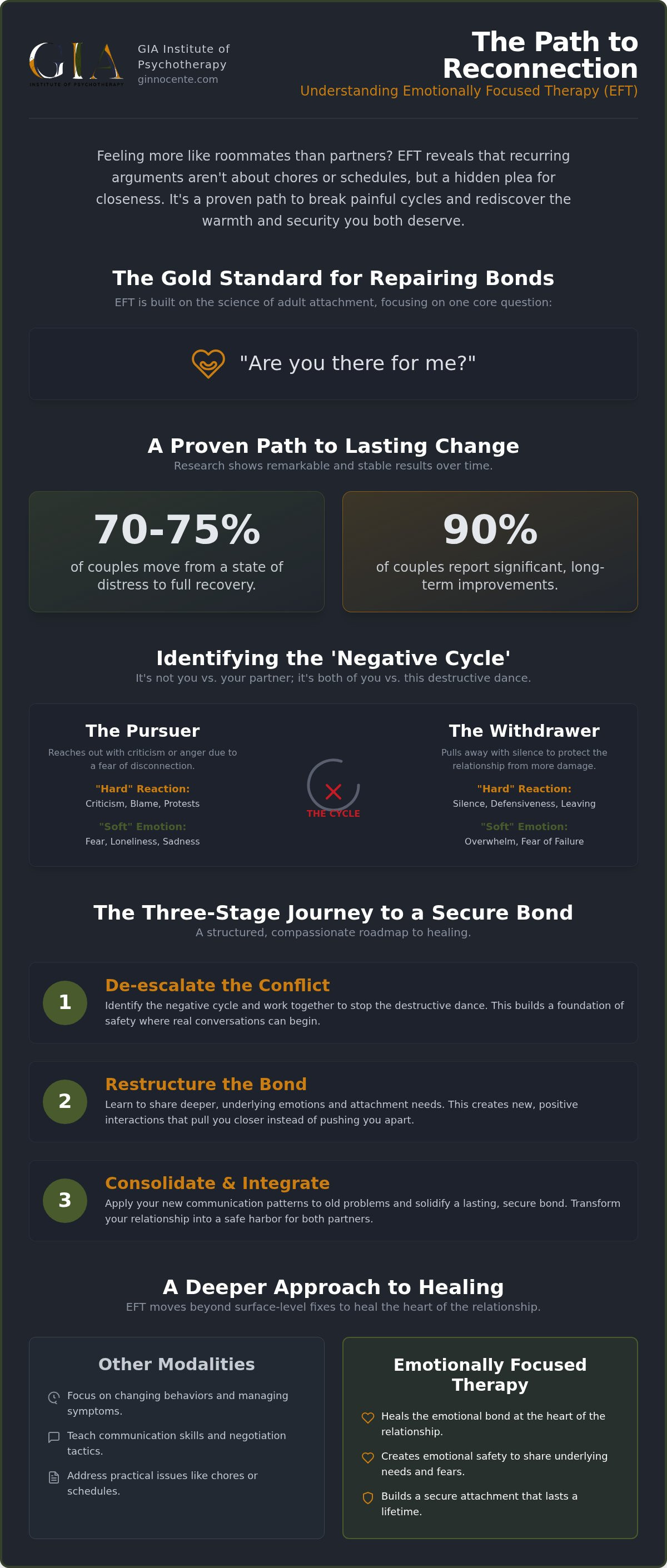
The results of this approach are remarkably consistent and stable over time. Data from the Sentio Counseling Center shows that 70 to 75 percent of couples move from a state of distress to full recovery, with 90 percent reporting significant improvements. This success occurs because the process actually rewires the brain's response to relationship stress, replacing old fears with a sense of security. Emotionally Focused Therapy serves as a clear, compassionate roadmap for achieving emotional accessibility and responsiveness between partners. By choosing EFT couples therapy New Jersey, you're engaging in a collaborative journey that transforms your relationship into a safe harbor, providing the stability and care you both deserve.
The 'Negative Cycle': Identifying Your Relationship's Dance
Why does it feel like you're fighting the same battle every Tuesday night? In many relationships, conflict begins to feel like a scripted play where both actors know their lines too well. We call this the "negative cycle" or the "dance." It's that moment when a simple question about a schedule turns into a weekend-long cold war. When couples seek EFT couples therapy New Jersey, they often arrive feeling like they're failing at love. However, the truth is often much more hopeful: you aren't failing; you're just caught in a loop that has taken on a life of its own.
This dance usually involves two primary roles: the Pursuer and the Withdrawer. One partner might "pursue," reaching out through criticism or high-intensity emotion because they're terrified of losing the connection. The other might "withdraw," going quiet or leaving the room to protect the relationship from further damage. Both are actually trying to save the bond, but their methods inadvertently push the other away. By identifying "soft" emotions like fear or loneliness hidden beneath "hard" reactions like yelling or stony silence, you can start to see each other's humanity again. In this space, the cycle itself becomes the common enemy rather than your partner.
Common Patterns in New Jersey Couples
Couples often fall into specific, painful rhythms. The "Find the Bad Guy" pattern involves escalating blame where both people try to prove they're right, leaving no room for connection. The "Protest Polka" is a classic dynamic where one person reaches out through anger while the other pulls away in defense. Finally, "Freeze and Flee" happens when both partners give up and go silent. This creates a hollow distance where you feel like roommates rather than lovers. If you're ready to stop the dance and find your way back to each other, exploring couples counseling can be the first step toward a more secure bond.
How EFT Interrupts the Loop
Understanding how EFT works helps you see that the therapist acts as a "process consultant" rather than a judge. We don't take sides or look for who's at fault. Instead, we slow the interaction down so you can see the triggers in real-time. We help you recognize the "spark" before the fire starts. The first step is always de-escalation, reducing the heat in the relationship so you can find common ground. This steady, intentional work allows you to step off the merry-go-round of conflict and begin the restorative process of building emotional safety within EFT couples therapy New Jersey.
The Three Stages of the EFT Journey
Healing a relationship isn't a random occurrence; it's a methodical journey with a clear beginning, middle, and end. When you engage in EFT couples therapy New Jersey, you follow a roadmap developed by the official EFT organization that moves you from the chaos of conflict to the peace of a secure bond. This journey is divided into three distinct stages, each serving a vital role in your restorative process. While the work requires patience, having a structured path helps you feel held and supported throughout the transition.
Many couples wonder how long the process takes or what actually happens during a session. While every partnership is unique, the flow typically moves from calming the immediate crisis to deepening the emotional connection, and finally, making those changes permanent. The middle stage is often where the most profound transformation occurs, as it's the point where you stop just managing conflict and start actually healing the wounds that caused it in the first place.
Stage 1: Finding Safety in the Storm
In the initial phase, the primary goal is de-escalation. You'll work with your therapist to identify your negative cycle in the moment it's happening. Instead of feeling like your partner is the problem, you'll begin to see how the cycle itself is the enemy you both need to defeat. We focus on building a "we" against the "cycle" mentality, which creates a sense of shared purpose. Stage 1 is about stopping the bleeding before the deep healing begins. Once you can stop the escalation, you've created the emotional safety necessary for the deeper work to follow.
Stage 2 & 3: Rebuilding and Sustaining
Stage 2 is where the restructuring of your bond takes place. In this safe, guided environment, you'll share deep vulnerabilities that you might have previously kept hidden to protect yourself. You'll learn the art of "Reach and Respond," where one partner reaches out for connection and the other responds with empathy and presence. These re-bonding sessions are the building blocks of trust. They allow you to rewrite your internal narrative about the relationship, replacing fear with a sense of being truly seen and valued by your partner.
Finally, Stage 3 focuses on consolidation. This is where you integrate your new patterns into your daily life in New Jersey. We look at future transitions, perhaps moving to a new home, navigating parenthood, or approaching retirement, and ensure you have the tools to stay connected through them all. You'll learn to:
- Identify triggers before they lead to a full-blown cycle.
- Practice emotional responsiveness during stressful life events.
- Celebrate the new, positive "dance" you've created together.
This final stage is about future-proofing your connection, ensuring that the work you do in EFT couples therapy New Jersey lasts for a lifetime.
Comparing EFT to Other Couples Therapy Modalities
Choosing a therapeutic path can feel overwhelming when you're already drained by relationship stress. While many effective methods exist, understanding the nuances between them helps you find the most restorative fit for your unique bond. For those seeking EFT couples therapy New Jersey offers a distinct approach that prioritizes the emotional heartbeat of the relationship over simple behavioral changes. It's not just about learning how to talk; it's about learning how to connect.
The Gottman Method, for instance, often focuses on teaching couples specific skills to manage conflict and build friendship. While these tools are valuable, EFT goes a step deeper by addressing the underlying attachment bond that makes those skills possible to use in the first place. Similarly, traditional Cognitive Behavioral Therapy (CBT) might help you identify and change negative thought patterns. In contrast, EFT focuses on the "heart" rather than just the "head," helping you navigate the visceral emotional reactions that drive your interactions. This makes it particularly powerful for healing deep wounds like infidelity or attachment trauma, where the sense of safety has been fundamentally shattered.
When to Choose EFT
EFT is often the ideal choice for couples who describe themselves as feeling "lonely together." If you've mastered the logistics of life but lost the sense of being a team, this modality can help you bridge that gap. It creates a "no-blame" zone where neither partner is the villain. Instead, the focus remains on the collaborative journey of healing, allowing you both to lower your guards and speak from a place of genuine need. It's an approach that values safety, trust, and intimacy above all else.
Is EFT Right for You?
Before you begin, it's helpful to ask yourselves a few questions. Are we ready to look beneath the surface of our arguments? Are we willing to prioritize emotional accessibility over the need to be "right"? Lasting change requires a commitment to the process, but the rewards of a secure bond are immeasurable. For local South Jersey couples, working with a specialist who understands the rhythms of our community provides a safe harbor for this deep work. If you're ready to explore how this approach can transform your partnership, we invite you to learn more about our couples counseling services and take the first step toward a restorative path.
Restorative Couples Counseling at GIA Institute
At GIA Institute, we believe that every relationship deserves a space where healing feels both clinical and deeply human. Our philosophy is rooted in an authentic, relatable approach that meets you exactly where you are. We understand that seeking EFT couples therapy New Jersey isn't just about finding a professional; it's about finding a guide who respects the complexity of your shared history. By blending the precision of neuroscience with profound empathy and expressive modalities, we help you rewrite the internal narrative of your partnership. We don't just look at the symptoms of your distress; we look at the heart of your connection.
Our practice is deeply community-focused, serving couples across South Jersey, including those in Ocean City, Linwood, and the surrounding coastal areas. What sets the GIA difference apart? It is our commitment to being a steady, calming presence that integrates practical strategies with emotional resonance. During your first session at our South Jersey practice, you can expect a collaborative mapping of your relationship's unique landscape. We work together to identify triggers and cycles without assigning blame, ensuring that you leave the room feeling seen, validated, and hopeful about the restorative journey ahead.
A Safe Harbor in South Jersey
We are dedicated to making therapy feel human and non-judgmental, providing a safe harbor for couples facing life's most challenging transitions. Whether you are navigating the early years of parenthood, the quiet shift into retirement, or the aftermath of a significant relationship hurdle, we walk alongside you. Our goal is to help local families find stability and clarity amidst the storm. For more details on the logistics of beginning this process, you can explore our guide on how to start therapy in NJ.
Take the Next Step Toward Healing
Choosing EFT couples therapy New Jersey means choosing a partnership in your own healing. We don't stand above you as detached experts; we act as collaborative guides in your relational growth. Our EFT-trained therapists are ready to help you rediscover the emotional safety and secure bond that you both deserve. Are you ready to stop the cycle of conflict and start building a lasting connection? We invite you to reach out and schedule a consultation to see how our restorative approach can support your specific needs. It's time to move toward a future defined by presence, understanding, and love.
Rediscovering Your Shared Story
Your relationship is more than just a series of interactions; it's a living bond that deserves to feel like a safe harbor. By understanding the "negative cycle" that keeps you stuck and embracing the structured stages of Emotionally Focused Therapy, you can move from a place of quiet distance to one of vibrant connection. Remember that the conflict you experience is often a protest against disconnection. With the right guide, those moments can become opportunities for deeper intimacy. For those seeking EFT couples therapy New Jersey provides a specialized path rooted in the science of attachment and the warmth of human empathy.
At GIA Institute, we bring specialized EFT clinical training and a restorative, neuroscience-backed approach to every session. Our trusted reputation in the South Jersey community is built on walking alongside couples as they rewrite their internal narratives. You don't have to navigate this journey alone. Begin your journey to a deeper connection—Schedule a consultation with GIA Institute today. There is always hope for transformation, and your path to a secure, loving bond starts with a single, courageous step toward healing.
Frequently Asked Questions
How many sessions of EFT do we typically need to see results?
Most couples move through the three stages of the process in approximately 8 to 20 sessions. However, the exact timeframe depends on the depth of your distress and the specific goals you set together. Some see a shift in the emotional music of their relationship after just a few meetings, while others prefer a longer, more methodical pace. We prioritize a rhythm that allows you both to feel safe and heard throughout the journey.
Does EFT couples therapy work if only one partner is willing to try?
While this approach is designed as a collaborative journey between two people, it's common for one partner to feel more hesitant. We often suggest starting with an initial consultation to explore those fears in a non-judgmental space. If one partner is completely unwilling, individual psychotherapy can still help you understand your own role in the relationship's dance. However, the full transformation of the bond usually requires both partners to participate and engage together.
What is the success rate of EFT compared to other types of therapy?
Research consistently shows that this modality has one of the highest success rates in the field of relationship repair. Approximately 70 to 75 percent of couples move from distress to full recovery, while about 90 percent report significant improvements. These results tend to be more stable over time compared to behavioral-based therapies. This is because the work rewires the emotional bond rather than just teaching communication tips that might fail during high-stress moments.
Can EFT help us if we have experienced infidelity or a major breach of trust?
Yes, this approach is specifically designed to heal attachment injuries like infidelity or major breaches of trust. These events create deep wounds that make the relationship feel like an unsafe harbor. We use the structured stages of therapy to process the trauma, allow the hurt partner to express their pain safely, and help the other partner offer genuine, restorative comfort. This methodical process helps you rebuild the foundation of trust from the ground up.
Is EFT therapy covered by insurance in New Jersey?
Insurance coverage for EFT couples therapy New Jersey varies significantly depending on your specific plan and provider. Many specialized practices operate as out-of-network providers to maintain a high standard of personalized care. It is often helpful to ask for a superbill, which you can submit to your insurance company for potential reimbursement. We always recommend contacting your insurance carrier directly to verify your out-of-network mental health benefits before beginning your first session.
What is the difference between a 'pursuer' and a 'withdrawer' in EFT?
These terms describe the roles we take when we feel disconnected or threatened. A pursuer often reaches out with high intensity or criticism in a desperate attempt to get a response and feel connected. A withdrawer tends to go quiet, shut down, or physically leave the room to protect themselves or the relationship from further conflict. Neither role is wrong; they are simply different ways of protesting the pain of disconnection and trying to find safety.
Will the therapist take sides or tell us who is 'right'?
Your therapist will never take sides or tell you who is right or wrong in an argument. In the room, we view the negative cycle as the common enemy rather than either individual partner. Our role is to act as a process consultant, helping you both see the triggers and reactions that keep you stuck. We focus on the "we" against the cycle, ensuring that both partners feel equally supported, understood, and validated.
How do we find an EFT-trained therapist near Ocean City or Linwood?
Finding specialized care in South Jersey is straightforward when you look for practices rooted in the local community. GIA Institute provides expert care for couples in Ocean City, Linwood, and surrounding areas like Egg Harbor Township or Margate. You can schedule a consultation directly through our website to begin your journey. We are dedicated to serving our neighbors with authentic support that respects the unique rhythms of life along the Jersey shore.


