
What if the way you love isn't a fixed personality trait, but a survival strategy your brain learned long ago to keep you safe? Perhaps you often feel "too needy" when a partner pulls away, or maybe you feel "cold" and distant when things get too intimate. It's exhausting to repeat the same toxic cycles, constantly bracing for an abandonment that feels inevitable. You aren't broken; you're simply navigating a map that's out of date. Seeking therapy for attachment issues isn't about dwelling on childhood blame or accepting a permanent label. It's about using modern neuroscience and relational presence to update that map for your current life.
We understand how heavy these patterns can feel, but there's a path toward internal clarity and peace. You can learn to communicate your needs without fear and finally find a safe harbor in your relationships. In this article, we'll dismantle five common myths that keep you stuck in old patterns and explore how you can build the secure, lasting connections you deserve. Healing is a collaborative journey, and it begins with understanding that your past doesn't have to dictate your future.
Key Takeaways
- Understand that attachment styles are adaptive survival strategies rather than permanent flaws, allowing you to move beyond restrictive labels.
- Discover how modern therapy for attachment issues uses neuroscience to calm your nervous system and rewire your brain's response to emotional triggers.
- Learn why exploring the past isn't about assigning blame, but about identifying the "internal working model" that currently influences your relationships.
- Explore evidence-based modalities like Emotionally Focused Therapy (EFT) and Internal Family Systems (IFS) that offer practical paths to secure connection.
- Gain the clarity needed to communicate your needs effectively and transform your relationships into sources of stability and support.
What is Attachment Therapy? Beyond the Labels
Have you ever wondered why you react so strongly when a partner doesn't text back? These reactions aren't random personality quirks. They are echoes of your internal working model, a mental blueprint that dictates how you expect others to treat you. What is Attachment Therapy? It is a relational approach that moves beyond clinical diagnosis to heal the deep emotional wounds that keep you stuck. This process shifts the focus from what is wrong with you to what happened to you, replacing shame with genuine understanding. It invites you to rewrite your story with compassion and clarity.
The ultimate goal of therapy for attachment issues isn't just to analyze your past. It is to achieve "Earned Secure Attachment." This means that even if you didn't grow up with a consistent safe harbor, you can build one within yourself as an adult. It requires patience, presence, and professional support to transform these internal echoes into a steady sense of security.
The Four Primary Attachment Styles
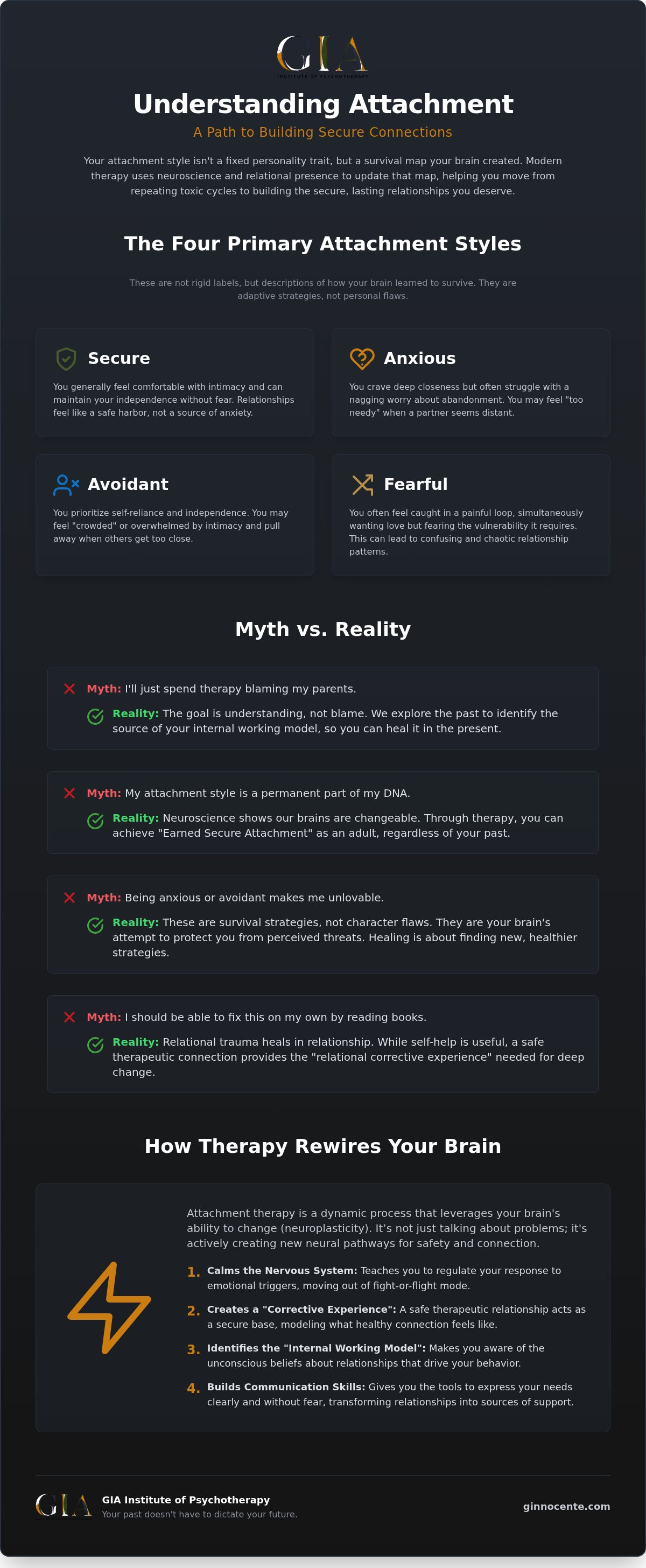
We often view attachment through four distinct lenses. These aren't rigid categories, but rather descriptions of how your brain learned to survive in your early environment. Most people find they are a mix of styles depending on their stress levels or the person they are interacting with.
- Secure: You generally feel comfortable with intimacy and maintain your independence without fear.
- Anxious-Preoccupied: You might crave deep closeness but struggle with a constant, nagging worry about being left.
- Dismissive-Avoidant: You likely prioritize self-reliance and may feel "crowded" or overwhelmed when others get too close.
- Fearful-Avoidant: You often feel caught in a painful loop, wanting love but fearing the vulnerability it requires.
Recognizing these patterns is a vital step toward healing. When you see these styles as survival strategies rather than personality flaws, you open the door to change. You begin to understand that your brain was simply trying to keep you safe in a world that felt unpredictable.
Why Labeling is Only the First Step
It's easy to take an online quiz and feel like you've found the final answer. While these tools offer a helpful starting point, a quiz result isn't a substitute for clinical insight. Self-help books provide a map, but they can't provide the "relational corrective experience" that happens in a safe therapeutic space. Healing relational trauma requires a real, living connection to act as a mirror, a guide, and a witness. Effective therapy for attachment issues is a collaborative journey toward relational safety where you practice a new way of being with another person.
Myth-Busting: 5 Common Misconceptions About Attachment
Many of us carry heavy assumptions that make the idea of seeking help feel more daunting than it truly is. These misconceptions often act as invisible barriers, keeping us trapped in the very cycles we wish to break. When you consider therapy for attachment issues, it's helpful to clear away the myths that suggest you are broken or beyond help. Let's look at five frequent misunderstandings that often cloud the path to healing.
- Myth 1: "I will just spend the whole time blaming my parents."
- Myth 2: "My attachment style is a permanent part of my DNA."
- Myth 3: "If I am anxious or avoidant, I am unlovable."
- Myth 4: "Therapy is only for people with severe childhood trauma."
- Myth 5: "I should be able to fix this on my own by reading enough books."
Do these thoughts sound familiar? It's natural to feel protective of your history or skeptical of your ability to change. However, holding onto these myths only delays the relief you deserve. Healing isn't about dwelling on what went wrong; it's about creating the capacity for what can go right.
Reality: Understanding vs. Blaming
Blame is static, but understanding is dynamic. While we look at your early years, the goal isn't to point fingers or stay stuck in the past. It's to find the source of your current pain so you can address it with precision. This overview of attachment-based therapy clarifies that the process is restorative rather than accusatory. By understanding the "why" of your past, you gain the "how" for your future. The therapeutic relationship itself acts as a safe harbor where you can test new ways of being without the fear of judgment. It's a collaborative space where your history is respected as a map, not a life sentence.
Reality: The Plasticity of Connection
Can we actually change how we love? The answer is a resounding yes. Your brain is neuroplastic, meaning it can create new neural pathways through consistent, safe experiences. "Earned Security" is a well-documented phenomenon where individuals move from insecure patterns to a stable, secure state through deep, intentional work. This growth is possible at any age and in any stage of life. You aren't "wired" to be unhappy; you're simply waiting for the right conditions to bloom. If you're ready to move past these myths, exploring adult psychotherapy can be the first step toward the secure, lasting connection you've been seeking.
The Neuroscience of Healing: How Therapy Rewires the Brain
The brain is an incredibly resilient organ. While early experiences shaped your current responses, they didn't cement them forever. When you engage in therapy for attachment issues, you aren't just talking about your feelings. You're participating in a biological process that physically alters the structure of your brain. At the center of this change is the amygdala, the brain's alarm system. For those with insecure attachment, this alarm is often hyper-sensitive, perceiving a missed call or a quiet partner as a threat to survival. This triggers a "fight or flight" response before your logical mind can even process the situation. This biological shift is why therapy for attachment issues is so much more than a simple conversation; it's a structural renovation of your internal world.
Therapy works by introducing a new, consistent experience called co-regulation. This is the process where the calm, steady presence of a therapist helps soothe your overactive nervous system. As you sit with a compassionate witness, your brain begins to realize that vulnerability doesn't always lead to danger. Repetitive experiences of safety act like water carving a new path through a canyon. Over time, these sessions create new neural pathways that favor stability over chaos. This is the biological foundation of "Earned Security," transforming your internal state from a place of constant alert to a reliable, safe harbor.
Moving from Reactivity to Presence
Why do we often say things we regret during a conflict? It's because the emotional center of the brain works much faster than the rational prefrontal cortex. You react before you can think. Therapy builds a vital "pause" between the trigger and your response. This space allows you to observe your fear without being consumed by it. By rewriting your internal narrative, you move from being a victim of your impulses to being the author of your own presence. You learn to stay grounded, even when the old echoes of abandonment try to pull you under.
The Role of Somatic Awareness
Attachment wounds aren't just stories we tell; they're sensations we feel. You might notice a tightness in your chest or a knot in your stomach when a relationship feels uncertain. Talking alone often isn't enough because these "body memories" live below the level of conscious thought. We must feel safe to truly be safe. This is why specialized approaches like EMDR or Expressive Arts are so effective. They help process the physical tension held in the body, allowing your entire system to finally exhale. When your body and mind both agree that you're secure, true healing begins.
Choosing the Right Path: Modalities for Attachment Issues
Understanding your attachment style is only the beginning of the journey. The real transformation happens when you apply specific clinical tools to your daily life. Professional therapy for attachment issues offers a structured way to move from insight to action. It provides the guidance needed to rebuild trust, both with yourself and with those you love. While every individual’s story is unique, certain evidence-based modalities have proven exceptionally effective in creating lasting relational change.
EFT: Rebuilding the Bond
Emotionally Focused Therapy (EFT) stands as a beacon for couples caught in repetitive conflict. It focuses on identifying the "dance" of disconnection where one partner may pursue while the other withdraws. These moves aren't meant to be hurtful. They are simply ways of trying to manage the fear of losing the connection. By recognizing these patterns, you can stop the cycle and create a secure base within the partnership. At GIA Institute, we specialize in EFT for couples in South Jersey, helping partners turn their relationships into a reliable source of strength.
IFS and EMDR: Healing the Individual
Individual healing often involves looking inward at the different "parts" of our personality. Internal Family Systems (IFS) helps you approach your anxious or avoidant tendencies with curiosity instead of judgment. You might have a "part" that feels desperate for attention or a "part" that wants to hide to stay safe. When you treat these parts with compassion, they no longer need to control your behavior. EMDR serves as a complementary tool, processing the specific trauma memories that fuel attachment fears. This synergy of neuroscience and practical strategy allows you to finally let go of the past. It works. The goal is simple: to help you feel grounded and secure in your own skin.
We also recognize that attachment patterns begin early. For children and teens, Play Therapy and Expressive Arts provide a language beyond words. These modalities allow younger individuals to navigate emotional hurdles in a way that feels natural and safe. By fostering secure connections during these formative years, we help children build a foundation for healthy adult relationships. Whether you're seeking help for yourself, your partner, or your child, there's a specialized path forward. If you're ready to start this collaborative journey, explore our adult and family therapy services to find the right support for your life.
Finding Secure Ground at GIA Institute of Psychotherapy
Choosing to begin therapy for attachment issues is an act of profound courage. It's a decision to stop settling for cycles of fear and to start building a life rooted in stability. At GIA Institute of Psychotherapy, we serve as a safe harbor for individuals and families across South Jersey, including Ocean City, Linwood, and the surrounding areas. We believe that healing happens best in a space where you feel genuinely seen and understood. Unlike generic online platforms that often feel cold or detached, our clinical team offers an authentic and relatable presence. We aren't here to simply observe from a distance; we are dedicated partners in your restorative journey.
Our work is deeply collaborative. We understand that your history is unique, and your path to security should be too. By blending clinical expertise with a human-centric approach, we help you translate the complex language of your emotions into a clear narrative of hope. You don't have to navigate these transitions alone. Whether you're struggling with a fear of abandonment or a tendency to withdraw when things get close, we provide the steady guidance needed to find your way back to yourself and others. We focus on the strength of the human spirit, ensuring you feel validated rather than diagnosed.
Our Approach to Relational Healing
We provide a comprehensive range of services tailored to every stage of life. This includes adult individual psychotherapy, individual therapy for children and teens, and family therapy. Our team utilizes a sophisticated blend of traditional talk therapy and neuroscience-based approaches like EMDR and IFS. We also incorporate expressive arts to help clients process what words sometimes cannot reach. This holistic perspective ensures that we aren't just treating symptoms, but nurturing the whole person. We invite you to discover the best parts of yourself as we work together to rewrite the internal blueprints that no longer serve you.
Next Steps for Your Journey in South Jersey
If you're ready to move toward a more secure way of relating, the path forward is simple and intentional. We maintain a strong presence in local communities like Egg Harbor Township, Margate, and Ventnor to ensure that personalized care is always within reach. Reaching out for an initial consultation is the first step in reclaiming your agency and your peace of mind. We're here to answer your questions, calm your concerns, and provide the professional support you deserve. You've spent enough time feeling stuck; it's time to find solid ground. Schedule a consultation to begin finding your secure love and take the first step toward a healthier, more connected future.
Stepping Into a Future of Secure Connection
Your history has shaped you, but it doesn't have to define the future of your relationships. We've explored how attachment styles are simply adaptive survival strategies and how your brain's neuroplasticity allows for genuine, lasting change. By moving beyond restrictive labels and dismantling old myths, you open the door to "Earned Security" and the deep, reliable connections you've always desired. You aren't broken; you're simply ready for a new way of being.
At GIA Institute of Psychotherapy, we provide the specialized care you need to navigate this transformation with confidence. Our clinical team is highly skilled in evidence-based modalities like EFT, EMDR, and IFS, offering a unique blend of neuroscience and profound compassion. Whether you're in Ocean City, Linwood, or anywhere in South Jersey, we're here to act as your safe harbor. Seeking therapy for attachment issues is a collaborative process, and we're ready to partner with you to rewrite your internal narrative. You don't have to carry the weight of these relational patterns alone.
Begin your journey toward secure connection with GIA Institute. You deserve a life filled with stability, relational clarity, and a love that finally feels safe. It's time to step into the future you've been waiting for.
Frequently Asked Questions
Can you actually change your attachment style in therapy?
Yes, you can absolutely move toward a secure attachment style through dedicated clinical work. This process, often called "Earned Security," relies on the brain's ability to form new neural pathways in response to safe, consistent relational experiences. While your early blueprint provided a map for survival, therapy for attachment issues helps you update that map for the present. Over time, you'll find that your reactions become less impulsive and your sense of internal peace grows stronger.
How long does it take to heal attachment issues?
Healing is a deeply personal journey that doesn't follow a rigid timeline. Some clients notice a shift in their emotional regulation within a few months, while deeper structural changes to your relational blueprint may take a year or more of consistent work. The duration depends on the complexity of your history and your commitment to the collaborative process. We focus on steady, sustainable growth rather than rushed results, ensuring your progress feels integrated and lasting.
Is attachment therapy only for couples, or can individuals benefit too?
Both individuals and couples benefit significantly from this approach. While couples often use Emotionally Focused Therapy (EFT) to repair their bond, individuals can utilize Internal Family Systems (IFS) or EMDR to heal the "parts" of themselves that feel unsafe. Whether you're navigating a specific relationship or seeking to change your internal narrative, therapy for attachment issues provides the tools needed for growth. It's about finding security within yourself as much as with others.
What is the difference between attachment theory and attachment therapy?
Attachment theory is the scientific framework that explains how we connect to others based on early childhood experiences. Attachment therapy is the active, clinical application of those principles to facilitate healing. While the theory provides the "why" behind your behavior, the therapy offers the "how" for transformation. At GIA Institute, we bridge this gap by combining neuroscience with practical strategies to help you move from understanding your patterns to actually changing them.
Do I have to talk about my parents every single week?
No, our sessions aren't designed to dwell on childhood blame. While we look at your history to understand your "internal working model," the primary focus remains on your current life and relationships. We explore how those early echoes manifest in your present day reactions and needs. Understanding the past is simply a tool to help you reclaim your agency now, allowing you to build a future that feels safe and intentional.
What should I look for in a therapist for attachment issues?
Look for a professional who has specialized training in relational modalities like EFT, IFS, or EMDR. Beyond certifications, the most important factor is the therapist's ability to provide a "safe harbor" through their own presence and attunement. You should feel seen, understood, and respected in every session. A skilled guide will emphasize a collaborative journey, helping you navigate life's transitions with a balance of clinical expertise and genuine, human-centric warmth.
Can children benefit from attachment-focused therapy?
Children and teens can benefit immensely from attachment-focused support. Early intervention helps them navigate emotional hurdles before these patterns become deeply ingrained in adulthood. We use age-appropriate modalities like Play Therapy and Expressive Arts to help younger clients build secure connections with their caregivers and themselves. By fostering relational health in South Jersey families, we're helping the next generation grow up with a stable foundation and a clear sense of self-worth.
Is therapy for attachment issues covered by insurance in New Jersey?
Coverage for these professional services varies depending on your specific insurance provider and plan. Many policies in New Jersey offer out-of-network benefits that can significantly offset the cost of counseling. We recommend contacting your insurance carrier directly to verify your mental health benefits for individual or family therapy. Our team at GIA Institute is also available to help you understand the process of seeking reimbursement for our specialized clinical treatments in the South Jersey area.


