

What if the end of your marriage isn't just a painful conclusion, but a profound opportunity to rewrite your own internal narrative? For many in South Jersey, the transition feels less like a new beginning and more like an unraveling of everything they once knew. You might find yourself mourning the loss of shared social circles in communities like Ocean City or Linwood, while feeling an identity crisis that legal papers can't resolve. Seeking therapy after divorce NJ provides a safe harbor where you can process these complex emotions without judgment. It’s a space to acknowledge that while your family structure is changing, your value as an individual remains constant.
We understand the heavy weight of anxiety that comes with co-parenting transitions and the fear of how these changes will impact your children’s school life. In this guide, you'll discover how specialized psychotherapy can help you reclaim your sense of self and find emotional stability. We’ll explore clear strategies for family health, ways to handle the shift in your social landscape, and the path toward a renewed sense of purpose. Together, we can move from the initial shock toward a future built on resilience, clarity, and hope.
Key Takeaways
- Understand why you feel "unmoored" and how to view this transition as a proactive opportunity for identity reconstruction rather than just a legal ending.
- Explore the neuroscience of attachment to understand why moving on feels physically difficult and how the five stages of grief apply to your unique journey.
- Learn to identify the right therapeutic modality for your needs, whether you are seeking individual adult psychotherapy or specialized therapy after divorce NJ for your children.
- Discover a practical roadmap for establishing new daily routines and setting healthy boundaries with ex-partners to protect your emotional stability.
- See how evidence-based approaches like EMDR and Internal Family Systems (IFS) can help you heal old wounds and build a resilient future in South Jersey.
Understanding the Emotional Landscape of Divorce in New Jersey
How do you find your footing when the ground beneath you has shifted so completely? In South Jersey, where our lives are often woven into the fabric of tight-knit communities like Margate or Linwood, divorce can leave you feeling profoundly unmoored. It isn't just a legal procedure; it's a significant emotional upheaval that touches every corner of your existence. Seeking therapy after divorce NJ is about more than just managing stress. It's a proactive tool for identity reconstruction. This journey isn't a straight line from pain to peace. Instead, it's a non-linear process of self-discovery where you learn to sit with the "new" while honoring the "old."
Why Divorce is a Major Life Transition
When a marriage ends, you aren't just losing a partner. You're facing the "loss of the future self," the version of you that existed in the context of that union. Daily rhythms, from morning coffee routines to weekend grocery trips at local South Jersey markets, are suddenly disrupted. This transition often impacts your social support systems, especially in areas where social circles are deeply intertwined. Research into the emotional and psychological effects of divorce suggests that this transition triggers a profound shift in how you see yourself and your place in the world. Divorce-related grief is a multifaceted response to the loss of a primary attachment that reshapes your internal and external reality.
Common Emotional Hurdles in the First Year
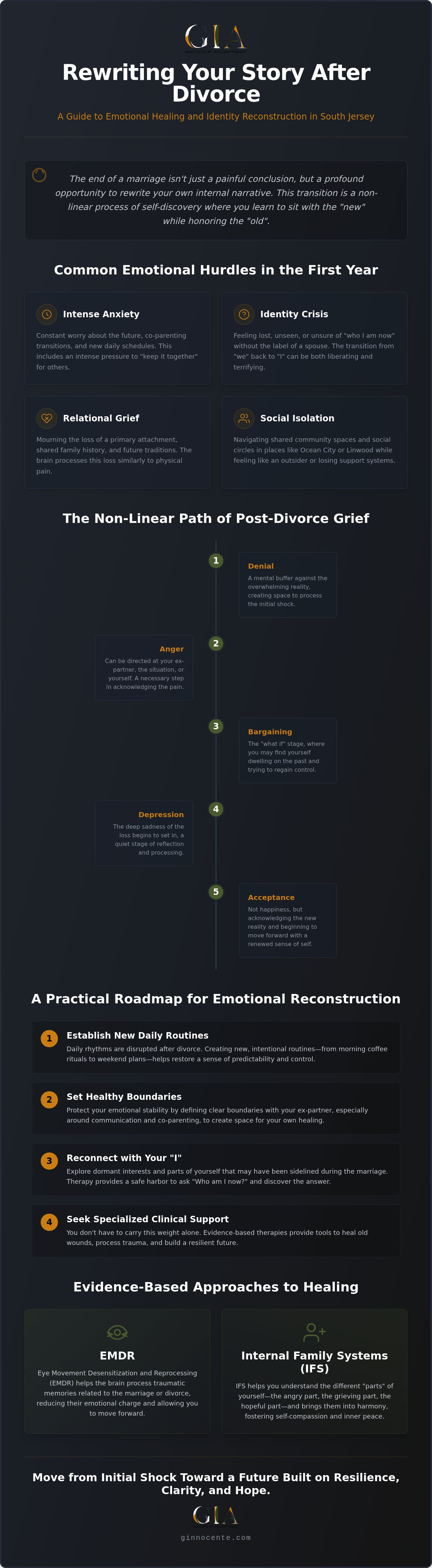
The first twelve months often feel like an emotional kaleidoscope. One day you might feel a surge of relief, followed immediately by a heavy wave of guilt or betrayal. Pervasive anxiety about the future is common. Many of our clients feel an intense pressure to "keep it together" for their children or extended family, masking their own pain to maintain a sense of normalcy for others. This internal conflict can be exhausting. Recognizing these hurdles is the first step toward reclaiming your peace:
- Intense Anxiety: Constant worry about co-parenting transitions and school schedules.
- Identity Crisis: Feeling lost or "unseen" without the label of being a spouse.
- Relational Grief: Mourning the loss of shared family history and traditions.
- Social Isolation: Navigating shared community spaces in South Jersey while feeling like an outsider.
Normalizing the need for professional clinical support is a vital step toward healing. You don't have to carry this weight alone. Adult individual psychotherapy provides the safe harbor needed to navigate these hurdles with clarity and grace. It's okay to ask for help while you're rewriting your story.
The Psychology of Post-Divorce Grief and Identity
The legal decree might signal the end of a contract, but for your heart, the journey is just beginning. Why does it feel like your world has stopped while the rest of South Jersey keeps moving? This sense of stagnation often stems from the fact that our brains are biologically wired for attachment. When a primary bond is severed, the brain processes this relational loss similarly to physical pain. You aren't just "sad"; you are experiencing a physiological withdrawal from a long-standing connection. Understanding this can be the first step toward self-compassion. Many people hesitate to seek support, believing that therapy after divorce NJ is only for couples trying to save a marriage. In reality, specialized psychotherapy is a vital tool for healing the individual, providing a space to re-narrate your story and find your footing again.
Grief in divorce rarely follows a clean, linear path. You might find yourself bargaining with the past or feeling a sudden surge of anger while grocery shopping in Linwood. These stages-denial, anger, bargaining, and depression-are not signs of weakness. They are the mind's way of slowly integrating a new, difficult reality. By acknowledging these feelings, you begin the work of reclaiming your agency and rewriting your internal narrative.
Navigating the "Who Am I Now?" Question
For years, your identity may have been defined by the word "we." Transitioning back to "I" can feel both liberating and terrifying. Who are you when you aren't a spouse? Therapy offers a safe harbor to explore dormant interests and parts of yourself that may have been sidelined during the marriage. We often use Internal Family Systems (IFS) to help clients understand these conflicting internal voices. One part of you might deeply miss the familiar routines of your old life, while another part is eager for a fresh start. Learning to listen to all these parts with curiosity rather than judgment allows you to build a more authentic, unified sense of self. If you're ready to explore these new chapters, adult individual psychotherapy can provide the guidance you need.
The Impact of Divorce Trauma on the Brain
High-conflict separations can trigger a PTSD-like response in the nervous system, leaving you in a constant state of "fight or flight." This emotional upheaval doesn't just affect adults. It's important to consider the mental health risks for children after divorce, as they also navigate this fractured landscape. For parents, developing emotional regulation through DBT skills is essential for maintaining a calm presence during co-parenting transitions. By stabilizing your own nervous system, you create a more secure environment for your entire family to heal and grow.
Choosing the Right Therapeutic Path for Your Healing
How do you know where to start when every part of your life feels like it needs attention? In South Jersey, we often see families struggling with the logistical and emotional shift of moving between homes in towns like Margate or Ocean City. The psychological distress of divorce is real and multifaceted, making it essential to choose a path that addresses your specific needs. Finding the right therapy after divorce NJ depends on whether you are processing personal grief, managing a changing family system, or seeking specialized support for your children. Each modality offers a different type of safe harbor, helping you anchor yourself during the storm.
Individual Therapy vs. Family Therapy
Deciding between individual and family therapy often comes down to where the most immediate "fire" is burning. Adult individual psychotherapy is the space where you can focus entirely on your own healing. It’s an opportunity to examine old wounds that divorce often reopens and to begin the work of identity reconstruction. If you find yourself stuck in cycles of guilt or identity loss, this one on one support is vital. In contrast, family therapy focuses on the system itself. It helps children and parents navigate the complex transition between two households, ensuring that communication remains healthy even when the family structure changes. By working with a therapist who understands local South Jersey family dynamics, you can create a clear plan for long term stability.
Specialized Support for Children and Teens
Children often express their pain in ways that adults might miss. You might notice a sudden drop in grades, school refusal, or increased anxiety about transitions. For younger children, Play Therapy provides a unique language to express what they cannot yet put into words. It allows them to process their feelings about the divorce in a way that feels natural and safe. Teens, on the other hand, face unique social challenges as they navigate their changing family structure alongside their own developing independence. We offer specialized support for children and teens to ensure they have the tools to remain resilient. This often includes school advocacy services to help educators understand the emotional landscape your child is navigating, providing a comprehensive support system that extends beyond the therapy room.
Whether you are seeking clarity for yourself or stability for your family, the goal is the same: to move from a place of survival to a place of thriving. Choosing the right therapeutic path is the first step in reclaiming your story and building a future rooted in hope.
Practical Steps for Emotional Reconstruction and Stability
Rebuilding your life after a major transition is a bit like tending a garden after a storm. It requires patience, steady effort, and a deep sense of self-compassion. While the initial stages of therapy after divorce NJ often focus on processing immediate grief, this phase of the journey is about establishing the "how" of your daily existence. How do you move through your day without the familiar presence of a partner? How do you create a home that feels like a sanctuary rather than a reminder of what was lost? Stability isn't found in grand gestures, but in the small, intentional rituals that anchor your nervous system and remind you of your own agency.
Establishing Your New Normal
Creating stability starts with small, consistent daily rituals. These acts of self-care serve as "safe harbors" when the emotional tide feels high. For those living in South Jersey, this might mean a morning walk on the Ocean City boardwalk or a quiet evening at a local park in Linwood. These physical movements help ground you in the present moment. When intrusive thoughts about the past or future arise, utilize practical strategies from Cognitive Behavioral Therapy (CBT). Try "thought stopping" or redirecting your focus to a sensory experience in your current environment. We also encourage the use of expressive arts or journaling. Putting your internal narrative onto paper allows for a necessary emotional release, helping you untangle complex feelings at your own pace.
Setting healthy boundaries is another crucial step in your reconstruction. This includes boundaries with ex-partners and even well-meaning extended family. Learn to say "no" to social obligations that feel draining, especially during holidays or community events that might still feel tender. Protecting your peace is not selfish; it's a vital part of your healing.
Advocating for Your Children’s Mental Health
Your child’s emotional needs don't stop at the therapy room door. Collaborating with New Jersey schools is essential to ensure they feel supported during this transition. Teachers and guidance counselors can be powerful allies if they understand the changes happening at home. The GIA Institute provides specialized school advocacy services to act as a bridge between parents and educators. This support ensures that your child’s academic and emotional needs are prioritized even as their family structure shifts. When it comes to co-parenting, focus on communication that is brief, informative, and firm. By keeping the focus on your child’s stability, you reduce the likelihood of high-conflict interactions that can stall everyone's progress. If you're ready to build a more resilient future for your family, our Family Therapy services can help you navigate these new dynamics with clarity.
Remember that healing is a non-linear process. Some days will feel like a step forward, while others might feel like a retreat. Treat yourself with the same kindness you would offer a dear friend. You're not just surviving a divorce; you're actively constructing a life that reflects your true self.
How GIA Institute Supports Your New Chapter in South Jersey
How do you move from simply managing your days to truly thriving in your new life? At the GIA Institute of Psychotherapy, we believe that the end of a marriage doesn't have to be the end of your story. Instead, it's an invitation to rediscover the best parts of yourself that may have been lost in the noise of conflict. Our approach to therapy after divorce NJ is designed to serve as a compassionate guide through this uncharted territory. We blend clinical expertise with a deeply human touch, ensuring that you feel seen, heard, and supported as you begin the work of rewriting your internal narrative.
Healing with EMDR and IFS Modalities
We utilize advanced, evidence-based tools to help you navigate the emotional complexity of your transition. For many, a high-conflict divorce leaves behind "stuck" memories that trigger intense anxiety or a pervasive sense of failure. EMDR helps your brain process these traumatic moments, allowing you to move past the pain without being constantly pulled back into the old conflict. Complementing this, Internal Family Systems (IFS) provides a framework for finding internal peace by acknowledging the different parts of your experience. You might feel a part that is grieving, a part that is angry, and a part that is hopeful for the future. The GIA Institute of Psychotherapy's approach is one that honors the depth of your past while providing the tools to build a resilient, purpose-filled future.
A Safe Harbor in Ocean City and Beyond
Our roots are deep in South Jersey, serving families from Margate and Linwood to Egg Harbor Township. We understand that your healing journey is intertwined with your community and your family systems. Whether you are looking for adult individual psychotherapy to reclaim your identity or need play therapy for your children, we are here to provide a steady, calming presence. Finding specialized therapy after divorce NJ means finding a space where your unique story is honored and your growth is prioritized. We invite you to reach out for a consultation to see if our practice is the right fit for your needs. Taking that first step can feel daunting, but you don't have to walk this path alone.
Begin your journey of healing with a compassionate NJ therapist.
Embracing Your New Chapter with Resilience
Divorce marks a significant shift in your internal and external landscape, but it doesn't have to define your future. By choosing a path of intentional healing, you can move from the initial shock of separation toward a life of clarity and purpose. We've explored how specialized therapy after divorce NJ provides the vital tools needed to process deep grief, support your children's emotional health, and reclaim your individual identity. Whether you're navigating social changes in Linwood or seeking stability for your family in Ocean City, professional support offers a safe harbor during this transition.
At the GIA Institute, our clinical care is rooted in an authentic, relatable approach that prioritizes your unique story. With specialized expertise in EMDR and IFS for life transitions, we are dedicated to helping you heal old wounds and build a resilient future. Are you ready to see what's possible on the other side of this transition? Schedule a Consultation at GIA Institute of Psychotherapy and take the first step toward your new chapter. You possess the strength to rewrite your narrative; we are simply here to help you find the pen. You don't have to walk this path alone.
Frequently Asked Questions
Is it normal to feel like I need therapy even if the divorce was my choice?
Yes, it's completely normal to feel a sense of loss even if the divorce was your choice. You're still navigating the dissolution of a primary attachment and the disruption of your daily rhythms in communities like Margate. This transition triggers a complex mix of relief and grief. Individual therapy provides a non-judgmental space to process these conflicting emotions, helping you find clarity and self-compassion as you step into your new reality.
How long does therapy after divorce usually take?
Healing is a deeply personal journey with no fixed expiration date. Some individuals find that a few months of focused work helps them stabilize their routines, while others benefit from longer-term support as they navigate the first year of holidays and co-parenting transitions. We work at your pace, ensuring that the therapeutic process feels restorative rather than rushed. Our goal is to help you build lasting resilience, however long that takes.
Can therapy help me become a better co-parent?
Therapy after divorce NJ is a powerful tool for developing healthy co-parenting dynamics. By focusing on emotional regulation through DBT skills, you can learn to separate your past marital conflicts from your current parental responsibilities. This shift allows you to communicate with your ex-partner more effectively. We help you create a co-parenting plan that prioritizes your child’s emotional stability and minimizes the stress of transitioning between two households in South Jersey.
What is the difference between divorce coaching and divorce therapy in NJ?
While divorce coaching focuses on future-oriented logistics and action plans, therapy at GIA Institute addresses the clinical and emotional roots of your experience. We use specialized modalities like EMDR and IFS to process trauma and identity loss that coaching cannot reach. Therapy provides a deeper level of healing, helping you resolve old wounds and internal conflicts so you can move forward with genuine emotional health rather than just a checklist.
How do I know if my child needs therapy after our separation?
Children often communicate their distress through actions rather than words. You might notice signs of school refusal, increased anxiety, or sudden changes in sleep patterns. If your child seems "stuck" or is struggling to adapt to life in Ventnor or Linwood, it may be time for professional support. Our Individual Therapy for Children and Teens utilizes Play Therapy to help them express complex emotions in a safe, age-appropriate environment.
What therapeutic modalities are most effective for processing a divorce?
We utilize a blend of evidence-based modalities to address the multifaceted nature of divorce. EMDR is highly effective for processing high-conflict trauma, while Internal Family Systems (IFS) helps you find internal peace among conflicting emotions. Additionally, Dialectical Behavior Therapy (DBT) provides practical strategies for managing the intense anxiety that often accompanies major life transitions. These tools work together to help you regulate your nervous system and reclaim your sense of self.
Do you offer online therapy for residents of South Jersey?
Yes, we offer secure telehealth services for residents throughout South Jersey, including Galloway and Upper Township. This allows you to access specialized therapy after divorce NJ from the comfort of your own home, which is often vital for parents managing new schedules. While we also provide in-person sessions in Ocean City, our online platform ensures that high-quality clinical care remains accessible and convenient as you navigate your family's transition.
How can therapy help me deal with the "identity crisis" following a divorce?
Divorce often feels like an unraveling of your very self, especially when your identity has been tied to a partnership for years. Therapy helps you navigate this "identity crisis" by providing a safe harbor for self-reflection. You'll learn to listen to dormant parts of yourself and reclaim interests that may have been sidelined. By rewriting your internal narrative, you can transition from a sense of loss to a renewed feeling of individual purpose.


