
What if the best therapy fit isn’t the program with the most specific label, but the one that makes room for the person behind it? If you’re comparing specialized therapy programs NJ and wondering which option may fit you or someone you love, it’s understandable to feel unsure. You shouldn’t have to self-diagnose before asking for support.
The right next step begins with understanding the choices and having a conversation about what’s happening, what matters to you, and what kind of support feels comfortable. In this article, you’ll learn how approaches such as CBT, DBT, EMDR, IFS, and EFT differ, and how individual, couples, family, child, and teen therapy may address different needs. You’ll also find thoughtful questions to ask a potential therapist, including how their experience relates to your concerns and what their specialized programs for men and women involve.
Whether you’re looking in Ocean City, Linwood, Margate, Ventnor, Egg Harbor Township, Upper Township, or Galloway, you can take time to explore a supportive next step in South Jersey, without pressure to have all the answers first.
Key Takeaways
- Explore specialized therapy programs NJ by considering the person’s concerns, goals, age, relationships, and preferences, not just a label.
- Compare approaches such as CBT, DBT, EMDR, IFS, EFT, Play Therapy, and Expressive Arts to understand their general focus.
- Ask a potential therapist about their approach, relevant experience, qualifications, and how you can discuss whether the fit feels right.
- GIA Institute of Psychotherapy offers counseling for children, teens, adults, couples, and families; ask about current program details and practical arrangements.
- Learn how to take a thoughtful next step with a South Jersey practice serving communities including Linwood, Egg Harbor Township, and Galloway.
What Specialized Therapy Programs in NJ Can Help With
Support can be shaped around what a person is experiencing and what they hope to work toward. That might mean finding ways to manage strong emotions, talking through a life transition, improving communication in a relationship, or helping a child express something that’s hard to put into words. You don’t need to arrive with a diagnosis or know the name of a therapy approach before asking for help.
Specialized therapy is care adapted to a person’s concerns, goals, age, relationships, and preferences. The phrase Psychotherapy covers a range of approaches and ways of working; a particular method describes how a therapist may guide sessions, not a diagnosis or a promise of a specific result. Specialized therapy programs NJ can vary, so it’s useful to ask what a program includes and how a therapist would work with your needs.
What makes a therapy approach specialized?
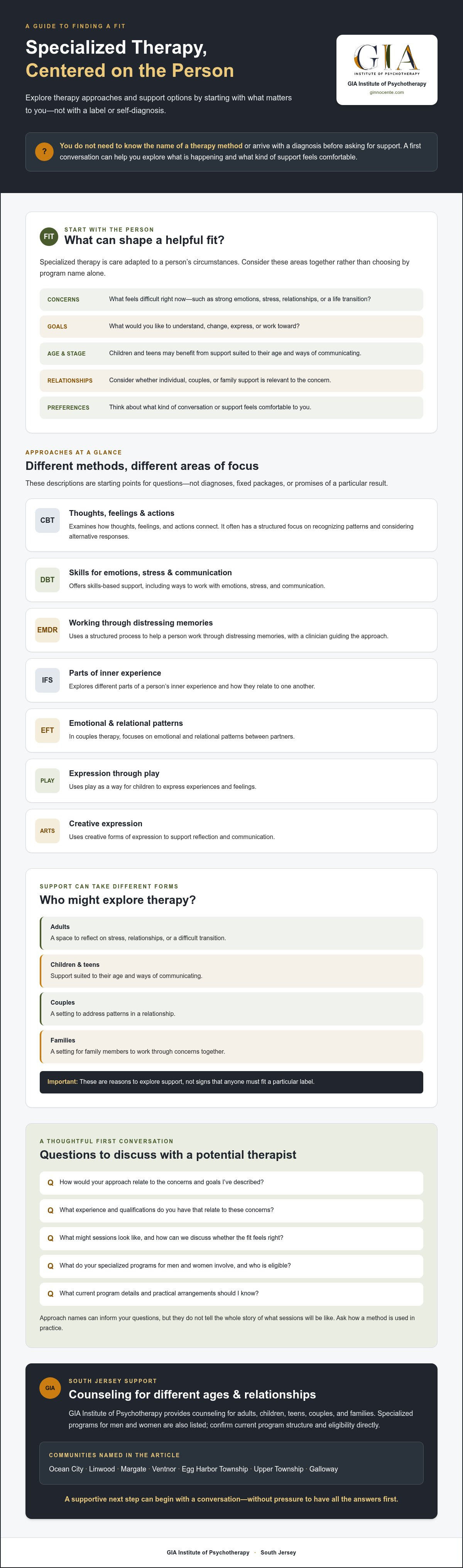
A therapist may draw on a clinical approach and adapt how it’s used to the person’s concerns and circumstances. For example, GIA lists approaches including CBT, DBT, EMDR, IFS, and EFT, as well as Play Therapy and Expressive Arts. These names can help you ask informed questions, but they don’t tell the whole story of what sessions will be like. An approach isn’t automatically a fixed package or standardized outcome.
Who may consider focused therapy support?
Adults may seek a place to reflect on stress, relationships, or a difficult transition. Children and teens may need support suited to their age and ways of communicating, while couples may want help addressing patterns in their relationship. Family therapy offers a setting for family members to work through concerns together. These are reasons to explore support, not signs that anyone must fit a particular label.
GIA Institute of Psychotherapy provides counseling for adults, children, teens, couples, and families in South Jersey, including Linwood and Egg Harbor Township. Its specialized programs for men and women are also listed as offerings, though program structure and eligibility should be confirmed directly. A helpful first conversation can focus on what feels difficult, what you’d like to change, and whether the therapist’s experience and approach seem like a fit.
Compare Therapy Approaches Available Through NJ Counseling
Therapy approaches offer different ways to explore concerns and work toward personal goals. The American Psychological Association’s overview of different approaches to psychotherapy can provide helpful background, but a method’s name alone won’t tell you exactly what sessions involve. Use these brief descriptions as a starting point for questions, not as a way to diagnose yourself or decide that one approach is guaranteed to fit.
| Approach | General focus |
|---|---|
| CBT | Examines connections among thoughts, feelings, and actions, often with a structured focus on recognizing patterns and considering alternative responses. |
| DBT | Offers skills-based support, including ways to work with emotions, stress, and communication. |
| EMDR | Uses a structured process to help a person work through distressing memories, with a clinician guiding the approach. |
| IFS | Explores different parts of a person’s inner experience and how they relate to one another. |
| EFT | In couples therapy, focuses on emotional and relational patterns between partners. |
| Play Therapy | Uses play as a way for children to express experiences and feelings. |
| Expressive Arts | Uses creative forms of expression to support reflection and communication. |
How CBT, DBT, EMDR, and IFS differ
CBT brings attention to how thoughts, feelings, and actions can influence one another. DBT is skills-based, while EMDR and IFS offer distinct ways of approaching inner experiences and distressing memories. If you’re comparing specialized therapy programs NJ, ask what a clinician’s use of each method looks like in practice. For more background on EMDR and IFS in trauma therapy, explore the related trauma therapy resource.
When expressive and relationship-focused approaches may be discussed
Play Therapy and Expressive Arts offer ways to communicate beyond conversation, while EFT centers emotional and relational patterns in couples work. GIA lists these approaches among its services, but that doesn’t mean every approach is right for every person. A clinician can explain their training and experience, discuss your goals, and clarify whether methods may be adapted or combined in your care. Don’t assume a combination is available without asking.
Curious which approaches GIA offers? You can explore therapy approaches available through GIA and bring questions about fit to a conversation with the practice.
Which Specialized Therapy Option May Fit Your Situation?
Choosing support doesn’t require you to know a diagnosis or select a therapy method in advance. Start with what’s prompting you to look for help, what you hope might change, and how you feel most comfortable communicating. Some people prefer direct conversation and practical reflection; others may want a gentler, more expressive way to explore what’s going on.
Age, relationships, and daily logistics can also shape the conversation. Consider whether the concern feels individual, involves a partner or family, or would be easier to discuss with support suited to a child or teen. You might also ask about practical details such as appointment format and availability rather than assuming what a practice provides. These questions can help you explore specialized therapy programs NJ without feeling expected to have all the answers first.
Choosing support for adults, children, and teens
Adults may want individual therapy to reflect on stress, transitions, or personal goals. Children and teens may communicate differently depending on their age and development, so it can help to ask how a therapist approaches sessions with young people and involves caregivers, if relevant. GIA lists adult individual psychotherapy and individual therapy for children and teens as separate options. Parents with school-related concerns can also ask about the practice’s school advocacy services and what support those involve.
Considering relationship, family, or gender-focused support
If your main concern involves communication between partners or patterns affecting the household, ask whether couples counseling or family therapy may be a fit. Individual therapy, by contrast, may give one person space to focus on their own experiences and goals. A therapist can help clarify which kind of conversation makes sense to begin with, without assuming that one format will suit everyone.
GIA lists specialized programs for men and women, but details about their structure, eligibility, and current availability aren’t specified here. Ask the practice what each program involves and whether it matches your needs. Gender can be one part of someone’s experience, but it doesn’t define what they’ve been through or what support they want. Concerns such as burnout, caregiving, relationships, or major life changes can be worth discussing without assuming they apply to everyone in a particular group.
Before deciding, consider bringing a few questions to a potential therapist: What goals could we begin with? How would you adapt your approach to my age, communication preferences, or family situation? What relevant experience do you have? A collaborative conversation can help you understand whether the fit feels comfortable and what next step to consider.
How to Evaluate a Specialized Therapy Program in New Jersey
A thoughtful first inquiry can help you understand whether a service matches your needs before you make a decision. As you compare specialized therapy programs NJ, focus on clear answers about goals, clinician experience, fit, and practical arrangements. You’re allowed to ask questions and take time to consider the responses.
Questions to ask before beginning therapy
Use this checklist to guide a conversation with a potential therapist:
- Clarify your goals. Ask how the therapist understands the concern you’ve described and how you might decide together what to work on.
- Ask about the approach. What might sessions involve? If a specific method is discussed, ask how it could relate to your goals and how progress is reviewed.
- Discuss fit and experience. Ask about the clinician’s qualifications and experience with concerns like yours. You can also share preferences, boundaries, or communication needs and ask how they’ll be considered.
- Confirm practical details. Ask about current availability, appointment format, scheduling, fees, and whether your insurance plan is accepted. Confirm that the service and approach you’re seeking are currently available.
A helpful conversation should leave room for your questions, not pressure you to commit. If something is unclear, ask for an explanation in everyday language.
What to know about availability and scope of care
GIA Institute of Psychotherapy serves South Jersey communities including Ocean City, Margate, Ventnor, and Galloway. Before making plans, confirm the current location, whether appointments are in person or remote, and what services are available. Ask directly about clinician qualifications and relevant experience rather than assuming a particular credential or specialization.
It’s also important to choose a service that matches the level of help needed. GIA does not provide psychiatric medication management, inpatient care, or 24/7 crisis intervention. Routine therapy inquiries aren’t a substitute for urgent support. If someone may be at immediate risk of harming themselves or another person, contact local emergency services or an appropriate crisis resource rather than waiting for a routine appointment.
Once you know what you’d like to ask, you can contact GIA about therapy options and clarify whether its current services may fit your situation.
Explore Specialized Therapy Support With GIA Institute
Choosing a starting point can feel easier once you know what a practice offers and what details still need a conversation. GIA Institute of Psychotherapy provides counseling for adults, children, teens, couples, and families. Its listed approaches include CBT, DBT, EMDR, IFS, EFT, Play Therapy, and Expressive Arts. These options create a basis for asking questions, not a promise that every method or service will suit every person.
GIA also lists specialized programs for men and women. The available information doesn’t specify their structure or eligibility, so it’s best to confirm current details directly rather than assume what participation involves. This can be a useful next step as you compare specialized therapy programs NJ and consider what kind of support feels relevant to your situation.
What to ask GIA about its specialized programs
A few direct questions can help you understand whether a listed service matches what you’re looking for. You might ask:
- Is the service or program currently available, and who is it designed to support?
- What format does it use, and which clinician would provide the care?
- What approach might the clinician use, and how would you discuss whether it fits your goals?
- Are there participation requirements or practical details I should know before taking a next step?
You can also ask about the clinician’s qualifications and experience related to the approach or concern you want to discuss. Confirm appointment availability and format directly; don’t assume a particular option is offered.
Take a comfortable next step
Reaching out can begin with questions. You don’t need to have a diagnosis, know which approach to choose, or decide on a program before asking what the practice currently provides. A first inquiry can simply help clarify your needs and whether there may be a useful path forward.
GIA serves communities across South Jersey, including Linwood, Upper Township, and Egg Harbor Township. If you’re nearby and considering support, share what you’re hoping to address and ask about service availability, therapist fit, and possible next steps. There’s no need to arrive with everything figured out. Contact GIA Institute to discuss your needs.
Take a Thoughtful Next Step Toward Support
Finding the right support is less about choosing a label and more about having an open conversation about what matters to you. As you compare specialized therapy programs NJ, remember that therapy approaches offer different ways to work, and fit depends on your needs, preferences, and goals.
GIA Institute of Psychotherapy provides counseling for adults, children, teens, couples, and families, with approaches including CBT, DBT, EMDR, IFS, and EFT. The practice serves South Jersey communities such as Linwood, Margate, and Egg Harbor Township. Ask about the clinician’s relevant experience, current service availability, and any details of a program you’re considering. You don’t need to have every answer before reaching out.
Contact GIA Institute to discuss your needs and explore a possible next step. A simple question can be the beginning of a more supported path forward.
Frequently Asked Questions
What are specialized therapy programs?
Specialized therapy programs are counseling options shaped around a person’s concerns, goals, age, relationships, and preferences. The word “specialized” may refer to a clinical approach, the people a service is designed to support, or the type of counseling offered. It isn’t a diagnosis or a promise of results. As you explore specialized therapy programs NJ, ask what a program involves and whether it aligns with your needs.
What types of therapy does GIA Institute offer in New Jersey?
GIA Institute of Psychotherapy provides counseling for children, teens, adults, couples, and families. Its listed approaches include CBT, DBT, EMDR, Internal Family Systems (IFS), Emotionally Focused Therapy (EFT), Play Therapy, and Expressive Arts. The practice also lists specialized programs for men and women, though details about their structure and eligibility aren’t specified here. Ask GIA which services and approaches are currently available for the situation you’d like to discuss.
How do I choose the right therapy program in NJ?
Start by describing the concern, your goals, and the kind of conversation that feels comfortable. Then ask how the therapist would approach those goals, what relevant experience they have, and how you’ll discuss whether the work feels useful. Consider whether support is for one person, a couple, or a family, along with practical details such as appointment format and availability. You don’t need to choose a modality before speaking with a therapist.
Can therapy programs be tailored to men or women?
GIA lists specialized programs for men and women, but current structure, eligibility, and participation details should be confirmed with the practice. Gender may shape someone’s perspective, but it doesn’t determine their needs or experiences. Ask who a program is intended to support, what it includes, and whether its approach feels relevant to your goals. A conversation can clarify options without requiring you to fit a stereotype or label.
Is CBT different from DBT or EMDR?
Yes. CBT generally examines connections among thoughts, feelings, and actions. DBT is a skills-based approach that may address emotions, stress, and communication. EMDR uses a structured process for working with distressing memories. These brief descriptions are only starting points; the experience can depend on the clinician and your circumstances. Ask what a method involves in sessions, what training or experience the clinician has, and whether it fits your goals.
Does GIA Institute provide medication management or crisis care?
No. GIA Institute does not provide psychiatric medication management, inpatient or residential care, or 24/7 crisis intervention. If you’re seeking those services, contact an appropriate medical or crisis resource. If someone may be at immediate risk of harming themselves or another person, contact local emergency services or a crisis resource rather than waiting for a routine therapy appointment. For non-urgent counseling questions, confirm GIA’s current services directly.
Which areas of South Jersey does GIA Institute serve?
GIA Institute serves Ocean City, Linwood, Margate, Ventnor, Egg Harbor Township, Upper Township, and Galloway, New Jersey. If you live in one of these communities, contact the practice to confirm current service availability and appointment options. If you’re nearby but don’t see your community listed, ask whether the practice can serve your location rather than assuming coverage. Availability and appointment format should be verified directly.


