
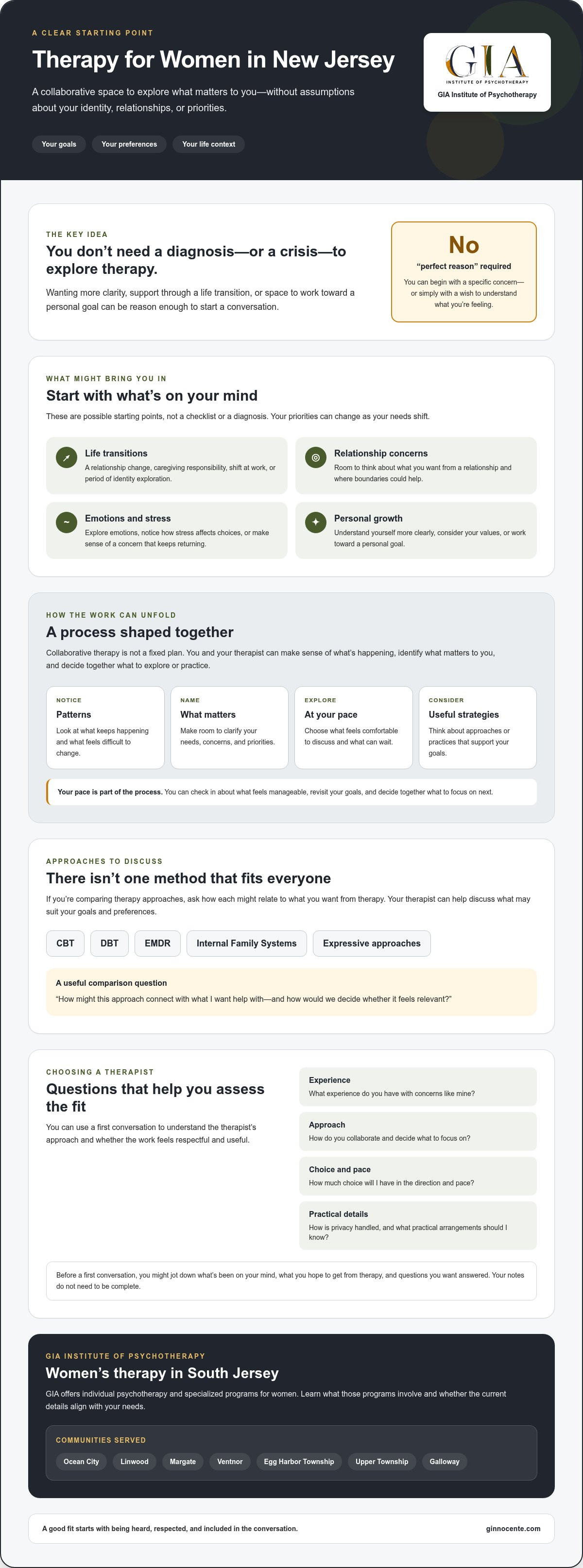
If therapy for women NJ is on your mind, you may be looking for support that understands your experiences without making assumptions about your identity, relationships, or priorities. You don’t need to be in crisis or have a diagnosis to explore therapy. Wanting more clarity, a place to work through a life transition, or support with a personal goal can be reason enough to start a conversation.
The right fit is personal. A therapist can work collaboratively with you to understand what matters and consider approaches that suit your needs, rather than treating one method as right for everyone. GIA Institute of Psychotherapy offers individual psychotherapy and specialized programs for women, serving South Jersey communities including Ocean City, Linwood, Margate, Ventnor, Egg Harbor Township, Upper Township, and Galloway.
In this article, you’ll learn what women-centered therapy can offer, how approaches such as CBT, DBT, EMDR, and Internal Family Systems may differ, and what to ask when you’re considering a therapist. The goal isn’t to make a decision before you’re ready. It’s to help you take a comfortable next step with greater clarity.
Key Takeaways
- Women-centered therapy is shaped around your goals, preferences, and life context. You don’t need a diagnosis to consider support.
- Therapy can help you notice patterns, explore emotions, and consider strategies at a pace that feels workable for you.
- Compare CBT, DBT, EMDR, Internal Family Systems, and expressive approaches by asking how each might relate to what you want from therapy.
- Ask about a therapist’s experience, approach, and practical arrangements to assess whether the fit feels right.
- When exploring therapy for women NJ, learn what GIA Institute’s specialized programs for women involve and whether the current details align with your needs.
What can therapy for women NJ help with?
Women-centered therapy isn’t a single method or a set of assumptions about what women experience. It’s a collaborative way of working in which you and your therapist shape conversations around your goals, preferences, and circumstances. You might want to talk through a major life transition, relationship concerns, anxiety, or a wish to understand yourself more clearly. Your priorities can also change, so you can revisit what you want from therapy as your needs shift.
There’s no single experience of being a woman. Identity, culture, family relationships, work, health, and community can all influence what feels important, but they matter differently to each person. Therapy includes different approaches and goals; the overview of Psychotherapy offers context on its history and range. You don’t need to arrive with a diagnosis or a perfectly defined goal to explore whether it might help.
When might a woman consider talking with a therapist?
You might consider talking with someone when distress keeps returning, a familiar pattern is difficult to change, or you feel stuck and want room to think. That doesn’t mean ordinary challenges are disorders. A therapist can offer a setting to discuss transitions, identity questions, relationship concerns, or emotional well-being without treating your decision to seek support as a sign of failure.
Sometimes the reason is specific. At other times, you simply want to understand what you’re feeling. Either can be a meaningful place to start. Before a first conversation, you could write down what has been on your mind, what you hope to get from therapy, and any questions you want answered. It’s fine if those notes are incomplete.
What does women-centered care mean in practice?
It begins with curiosity rather than assumptions. A therapist can invite you to describe what matters in your own words, listen to how your experiences shape your goals, and check whether the work feels relevant. You can ask how privacy is handled, what collaboration looks like, and how much choice you’ll have in setting the direction and pace of conversations.
For therapy for women NJ, a good personal fit means your perspective is taken seriously, not treated as representative of everyone. You can talk openly about what feels comfortable, what you’d rather approach gradually, and whether your goals need to change. These are reasonable topics to clarify as you decide whether care feels respectful and useful.
How therapy for women in NJ can support personal growth and healing
Collaborative therapy is a process where you and your therapist make sense of what’s happening, identify what matters to you, and decide together what to explore or practice. The work might include noticing patterns, making room for difficult emotions, or trying strategies that support your goals. It isn’t a fixed plan you have to follow regardless of how your needs change.
Some people come to therapy with a clear focus, while others need time to find the words for what feels difficult. You might explore how stress affects your choices, what you want from a relationship, or which habits no longer serve you. The National Institute of Mental Health offers information about mental health conditions common in women, but reading about a condition isn’t the same as receiving a diagnosis. Therapy can focus on your concerns and goals without reducing your experience to a label.
How can therapy help with life transitions and changing roles?
A relationship change, caregiving responsibility, shift at work, or period of identity exploration can reshape daily life. Not everyone will relate to these examples, and the meaning of a change is personal. In therapy, you might consider what you need now, where boundaries could help, which values you want to prioritize, and what next step feels manageable.
For people across GIA’s South Jersey communities, including Ocean City, Linwood, Margate, Ventnor, Egg Harbor Township, Upper Township, and Galloway, these conversations can connect personal reflection with the relationships and responsibilities that make up everyday life. You decide which parts of your situation to discuss and what feels most important to address.
What might emotional healing and self-discovery involve?
Exploration may begin with a current concern and, if you choose, include past experiences that help you understand it. You and your therapist can discuss what feels comfortable to approach and how to check in if a topic feels like too much. There’s no required pace or single definition of progress. Some sessions may focus on reflection; others may involve considering and practicing practical skills.
Those skills could include ways to communicate a need, respond to a strong emotion, or pause before repeating a familiar pattern. They’re options to discuss and try, not guaranteed solutions. Therapy also isn’t the same as medication management: GIA Institute of Psychotherapy does not offer psychiatric medication management. If you’re considering therapy for women NJ, you can learn about GIA’s individual psychotherapy and ask whether its collaborative approach fits what you’re seeking.
Comparing therapy approaches for women: which fit should you discuss?
Therapy approaches can offer different ways to explore concerns or practice new skills, but none is automatically the right choice because you’re a woman. Your goals, preferences, circumstances, and a clinician’s expertise all matter. Use the descriptions below as starting points for a conversation, not as a way to diagnose yourself or decide what treatment you need.
| Approach | What you might discuss | A question to ask |
|---|---|---|
| CBT | Connections among thoughts, feelings, and behaviors, and ways of responding to patterns that are troubling you. | How would we connect this approach to the goals I bring to therapy? |
| DBT | A structured approach that may include practicing skills for navigating emotions and relationships. | What skills might we work on, and how would we decide they’re relevant for me? |
| EMDR | A structured approach a clinician may discuss for processing distressing experiences. | What does the process involve, and how would you assess whether it fits my needs? |
| Internal Family Systems (IFS) | Exploring different inner perspectives or “parts” as a way to understand your responses and concerns. | How do you use this approach, and what choices would I have during sessions? |
| Expressive approaches | Using creative forms of expression to explore or communicate experiences, depending on your preferences and the clinician’s practice. | Is creative expression part of your work, and are there other options? |
How do CBT and DBT differ in a therapy conversation?
CBT may help you examine how thoughts, emotions, and actions influence one another in a particular situation. DBT is more structured and may emphasize learning and practicing skills related to emotions and relationships. These broad descriptions don’t determine what will work for you. Neither approach is exclusively for women, and a therapist can explain whether either one makes sense for your goals.
When might someone ask about EMDR, IFS, or expressive approaches?
You might ask about EMDR if you want to understand how a therapist works with distressing experiences, or about IFS if exploring different inner responses feels relevant. Expressive arts may offer another way to engage when words alone don’t feel like the best starting point. GIA Institute of Psychotherapy lists EMDR, IFS, and Expressive Arts among its approaches; that doesn’t mean each is appropriate for every client.
For therapy for women NJ, consider asking what training and experience a clinician has with an approach, how they assess fit, and what alternatives you could discuss. You don’t need to arrive with a preferred method. The conversation itself can help you understand your options and decide what feels comfortable to explore.
Choosing a therapist for women in South Jersey: questions to ask
Finding a therapist is more than matching a concern to a treatment name. You’re also looking for someone whose experience, communication style, and practical arrangements feel appropriate for you. A short list of questions can help you compare options without needing to have everything figured out in advance.
What should you ask a potential therapist?
Consider keeping a short list nearby when you contact a practice. You might ask:
- Goals: How would we identify what I want help with, and revisit those goals if they change?
- Experience: What experience do you have with the concerns or life experiences I’d like to discuss?
- Approach: How do you decide which approach to recommend, and what alternatives could we talk about?
- Preferences: Can I share what feels comfortable or uncomfortable, and how do you incorporate that feedback?
- Practical details: What should I know about scheduling, fees, insurance, and privacy? Ask the practice directly, since these details can vary.
- Credentials and availability: How can I verify your credentials, and are you currently accepting clients?
These questions are useful whether you’re considering individual psychotherapy or a specialized program. For therapy for women NJ, the label matters less than whether the clinician can explain their approach clearly and make space for your perspective. A common mistake is choosing a method based only on its name. Ask how the clinician would connect it to your goals and what other options you could consider.
How can you assess whether the therapeutic relationship feels right?
Notice how the conversation feels. Do you feel listened to and treated with respect? Can you ask questions, express uncertainty, or say that an approach doesn’t feel right? One conversation can offer clues, but it can’t guarantee what a longer-term relationship will feel like. Fit can be discussed openly and reassessed as you get to know the therapist.
GIA Institute of Psychotherapy serves clients in Ocean City, Linwood, Margate, Ventnor, Egg Harbor Township, Upper Township, and Galloway. To learn more about the practice, Explore GIA Institute of Psychotherapy. You can ask directly about current availability, clinician credentials, and any details you need to make an informed choice.
Taking time to compare options is part of finding care that feels comfortable. If GIA’s services may align with what you’re looking for, review its psychotherapy services as one step in your search.
Considering women’s therapy at GIA Institute in New Jersey
GIA Institute of Psychotherapy offers individual psychotherapy and specialized programs for women. The practice’s approaches include CBT, DBT, EMDR, Internal Family Systems, and Expressive Arts. These are options available at the practice, not automatic recommendations. Which approach may suit you depends on your goals, preferences, and conversation with a clinician.
For therapy for women NJ, individualized care means you can bring your own experiences and priorities rather than fit a preset idea of what women need. You can describe what you hope to explore, ask how a clinician works collaboratively, and discuss whether individual psychotherapy or a women’s program might be worth considering. Program details can depend on your circumstances, so confirm them directly.
What can you ask GIA about its programs for women?
Before deciding whether to begin, ask about the program’s eligibility, format, clinician involvement, and current availability. You might share the concerns or goals you’d like support with, along with any preferences that could help guide the conversation. This gives the practice a clearer sense of what you’re looking for while giving you a chance to learn whether the program’s current details fit.
You can also ask how the practice considers different approaches and whether alternatives are available to discuss. There’s no need to arrive knowing which method you want. The first exchange can simply be about gathering information and understanding possible next steps.
How can you take a first step that feels manageable?
Start small. Write down a few concerns, goals, or questions before reaching out. You might include practical details you want clarified, such as availability, fees, insurance, or how the program works. Asking about logistics doesn’t commit you to starting therapy; it helps you make a more informed choice at your own pace.
A helpful conversation should leave room for questions and uncertainty. You can explain what matters to you and ask whether GIA’s services may fit, without expecting a particular outcome or arrangement. If you’d like to learn more, Contact GIA Institute of Psychotherapy to ask about fit, current availability, and program details.
Take a thoughtful next step toward support that fits
Choosing therapy is a personal decision, and you don’t need to have every answer before you begin. The right approach depends on your goals, preferences, and conversation with a therapist. Asking about experience, how care is shaped collaboratively, and practical details can help you decide whether the fit feels comfortable.
If you’re exploring therapy for women NJ, GIA Institute of Psychotherapy offers specialized programs for women and approaches including CBT, DBT, EMDR, and Internal Family Systems. These are options to discuss, not prescriptions for every person. GIA serves communities across South Jersey, including Ocean City, Linwood, Margate, Ventnor, Egg Harbor Township, Upper Township, and Galloway. Contact the practice to confirm current availability and ask about program details, eligibility, and fit.
You can start with a simple question or a few notes about what you’d like support with. Contact GIA Institute of Psychotherapy to ask about support that fits your needs.
Frequently Asked Questions
Is therapy for women in NJ only for people with a mental health diagnosis?
No. You can consider therapy without having a diagnosis or being in crisis. Some people want support with a life change, a relationship concern, anxiety, or a desire to understand themselves better. You and the therapist can talk about what you hope to explore and decide whether therapy feels appropriate. Your reasons for seeking support don’t need to match anyone else’s, and goals can change over time.
How do I choose a therapist for women in New Jersey?
Look for a therapist whose experience and approach seem relevant to your concerns, then ask how they collaborate on goals and decide what to explore. For therapy for women NJ, consider whether you feel listened to and respected, and whether you can comfortably ask questions. Discuss practical details directly with the practice, including fees, insurance, scheduling, privacy, credentials, and current availability. One initial conversation can offer clues, but doesn’t guarantee long-term fit.
What happens in therapy for women?
Therapy usually begins with a conversation about what brings you in and what you’d like support with. You might explore emotions, recurring patterns, relationships, or personal goals, then work with the therapist to decide what feels useful to focus on. Depending on the clinician’s approach and your preferences, sessions may involve reflection or considering practical strategies. You can ask questions, share what feels comfortable, and revisit goals as your needs shift.
Can therapy help with life transitions or changing relationships?
Therapy can provide space to think through a transition or relationship change, clarify what matters to you, and consider boundaries or next steps. You might bring up a shift at work, caregiving, a changing partnership, or identity questions, if those feel relevant. You don’t need to know exactly what you want before starting a conversation. The therapist can work with you to shape the discussion around your circumstances and priorities.
What is the difference between CBT, DBT, EMDR, and IFS?
CBT explores connections among thoughts, emotions, and behaviors. DBT is a structured approach that may include skills for navigating emotions and relationships. EMDR is a structured approach a clinician may discuss for processing distressing experiences. Internal Family Systems, or IFS, explores different inner perspectives or “parts.” These brief descriptions aren’t recommendations. Ask a therapist how they use each approach, what training they have, and how they assess whether it fits your goals.
Does GIA Institute of Psychotherapy offer therapy for women near Ocean City, NJ?
GIA Institute of Psychotherapy offers individual psychotherapy and specialized programs for women, and serves Ocean City and other South Jersey communities, including Linwood, Margate, Ventnor, Egg Harbor Township, Upper Township, and Galloway. The practice also offers approaches such as CBT, DBT, EMDR, and IFS, though these aren’t automatic recommendations for every client. Ask GIA directly about program eligibility, format, clinician involvement, and current availability to see whether its services may fit your needs.


