

What if your child’s refusal to go to school isn’t defiance, but an alarm signaling that they feel overwhelmed or unsafe? When mornings bring tears, panic, or conflict, it’s understandable to feel helpless, judged, or worried about pressure from the school district. Therapy for school refusal NJ can help families look beyond missed days and understand what may be making attendance feel impossible.
Your child’s distress is real, and struggling to get them through the classroom door doesn’t make you a failure as a parent. School refusal can be connected to anxiety and other emotional challenges, so insisting harder may not address what’s underneath. A thoughtful response can make room for your child’s needs while keeping communication with the school clear and constructive.
This article explains how therapy and school advocacy may help bridge the gap between your child’s anxiety and the classroom. You’ll learn how therapy can support emotional safety, how school advocacy can help families discuss accommodations, and how parents, clinicians, and schools can work together toward steadier attendance and more peace at home.
Key Takeaways
- Track physical symptoms and when school avoidance occurs to help identify patterns and possible stressors.
- Explore how therapy for school refusal NJ may draw on approaches such as DBT or EMDR, depending on your child’s needs and experiences.
- Learn how a 504 plan differs from an IEP and what steps parents can take to request a school evaluation.
- Consider how family therapy can support communication and help home feel steadier while your child works toward re-engagement.
- Child and teen therapy and school advocacy services can help connect emotional support with communication with the school.
Understanding School Refusal in NJ: Why Your Child 'Can't' (Not 'Won't') Go
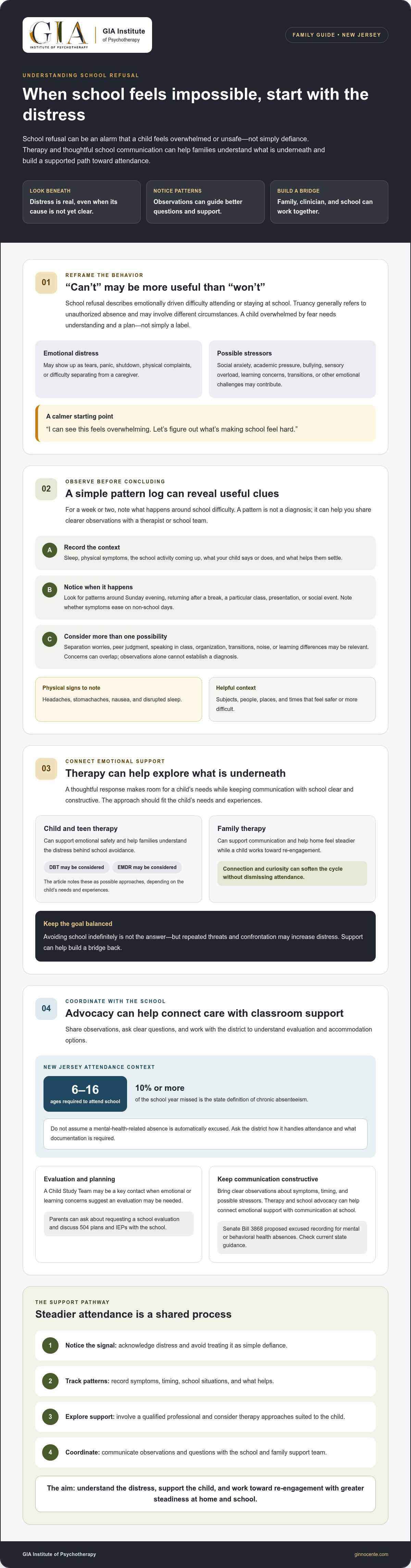
A child who clings to you at the school gate, cries over stomach pain, or shuts down when it’s time to leave may be responding to real distress, not choosing to make mornings difficult. School refusal describes emotionally driven difficulty attending or staying at school. Truancy is generally used for unauthorized absence and may involve different circumstances. The distinction matters: a child overwhelmed by fear needs understanding and a plan, not simply a label. For a neutral overview of the term and how it differs from truancy, see School refusal.
Think of the amygdala, an almond-shaped part of the brain involved in detecting threat, as an alarm. When school feels unsafe, that alarm can trigger a fight, flight, or freeze response before a child can explain what’s wrong. A calm, trusted adult can help the child feel supported while the family works to understand the signal. Social anxiety, academic pressure, bullying, and sensory overload, such as a noisy cafeteria or crowded hallway, may all contribute.
School Refusal vs. Truancy: What NJ Parents Need to Know
In New Jersey, children ages 6 through 16 are required to attend school, and the state defines chronic absenteeism as missing 10% or more of the school year. Don’t assume a mental health related absence is automatically excused. Senate Bill 3868, introduced March 10, 2026, proposed requiring excused recording for mental or behavioral health absences. Check current state guidance and ask your district how it handles attendance and required documentation. A Child Study Team may be a key contact when emotional or learning concerns point to a need for evaluation. Younger children may show distress through tears, physical complaints, or separation fears. Teens may withdraw, become irritable, or describe anxiety about peers, performance, or specific classes.
The Emotional Toll on the South Jersey Family
Repeatedly trying to get a distressed child to school can leave parents feeling ashamed, exhausted, and afraid of being judged. That strain can affect sibling relationships as routines change and attention centers on the morning crisis. Restorative language can soften the cycle without dismissing attendance: “I can see this feels overwhelming. Let’s figure out what’s making school feel hard.” It communicates connection and curiosity rather than blame.
Threats and repeated confrontation may raise distress and make school feel even more threatening. That doesn’t mean avoiding school indefinitely is the answer. It means building a bridge back with support. Therapy for school refusal NJ can help families explore the distress beneath the behavior, while school advocacy can help parents communicate concerns and work toward a thoughtful plan with the district.
A Step-by-Step Guide to Identifying the Root Causes of School Avoidance
Before deciding how to respond, look for what your child’s avoidance may be communicating. A pattern is not a diagnosis, but it can help you ask more useful questions and share clearer observations with a therapist or school team.
Track Patterns in Your Child’s Behavior
For a week or two, keep a simple log. Record sleep, physical symptoms, the school activity coming up, what your child says or does, and what helps them settle. Note subjects, people, places, and times that seem safer or more difficult. A child who resists the morning routine but attends after arriving may be experiencing something different from a child who withdraws from school and other activities altogether.
- Notice physical signs. Headaches, stomachaches, nausea, and disrupted sleep can accompany distress. Record when they begin and whether they ease on non-school days.
- Look for timing. Does distress build on Sunday evening, after a school break, or before a particular class, presentation, or social event? Specific timing may offer clues.
- Consider the fear. Separation anxiety may center on being apart from a caregiver or worries about their safety. Social anxiety may involve fear of peer judgment, speaking in class, or eating in front of others. These concerns can overlap, so avoid settling on an explanation too quickly.
- Stay curious about learning and sensory needs. Difficulty with organization, transitions, or noise, as well as unrecognized learning differences, ADHD, or autism, may make school harder. Share concerns with a qualified professional. Observations alone can’t establish a diagnosis.
Understand the Nervous System’s Role
When a child’s brain reads school as a threat, the fight, flight, or freeze response can take priority over the systems needed for attention, flexible thinking, and learning. Emotional dysregulation in school refusal is difficulty managing intense feelings enough to approach or remain in the school setting. In the middle of panic, explanations such as “There’s nothing to worry about” may not land because the child may not be ready to process reassurance as a logical argument. First offer calm presence and help them feel grounded. Problem solving can come later.
Bring your log to a child therapist for a clinical conversation about what might be driving the pattern and what support could help. A therapist can explore emotional concerns with your family and, where appropriate, discuss whether further assessment or coordination with other professionals may be useful. Child and teen therapy in South Jersey can be one place to begin exploring support.
Effective Therapeutic Modalities: Matching the Right Approach to Your Child
There isn’t one therapy approach that fits every child who avoids school. The starting point is understanding what feels threatening, what helps your child feel safe, and how ready they are to approach school related situations. In therapy for school refusal NJ, the goal isn’t to force a quick return. It’s to help a child build emotional capacity while adults coordinate a realistic path toward learning.
DBT may help children and teens practice distress tolerance skills for difficult moments, such as entering a crowded hallway or staying in class when anxiety rises. EMDR and trauma informed care may be considered when painful experiences, such as bullying or a distressing school event, remain connected to the child’s fear. Internal Family Systems (IFS) offers a way to explore the “part” that feels scared or protective with curiosity rather than criticism. A clinician can help determine which approach, or combination of approaches, fits the child’s needs.
Why Expressive Modalities Can Help When Words Are Hard
Younger children may not have the words to explain why school feels frightening. Play and expressive arts can give them another way to communicate. A child might draw a “school monster,” build a scene with toys, or use colors to show where the day feels difficult. This can make an overwhelming experience easier to notice and discuss, without asking the child to explain everything at once. GIA Institute of Psychotherapy offers Play Therapy and Expressive Arts as part of its child and teen therapy services for families in South Jersey communities.
Nonverbal expression doesn’t replace conversation. It can open a gentler route toward it, helping the therapist and child explore feelings at a pace the child can manage.
CBT and Exposure Therapy: Small Steps Toward the Door
CBT can help a child notice the connection between anxious thoughts, feelings, and avoidance. When appropriate, a therapist may work with the family on gradual, supported steps toward school, sometimes called a “bravery ladder.” The steps should be tailored to the child and coordinated with the school when needed.
- Talk together about what feels hardest, without debating whether the fear is “reasonable.”
- With professional guidance, consider a manageable first step, such as driving past the school or meeting a trusted teacher.
- Build toward more challenging steps as the child develops coping skills and feels ready.
Validation and re-engagement can go together: acknowledge the fear while keeping connection to learning as a shared goal. A child and teen therapist can help families consider a supportive next step without turning each attempt into a test of willpower.
Navigating the NJ School System: Advocacy, IEPs, and 504 Plans
When emotional distress affects school attendance, families can ask the district to consider whether the student needs support to access education. An IEP may provide specialized instruction and related supports for a student found eligible under special education criteria. A 504 plan provides accommodations to support equal access for a student with a qualifying disability, but doesn’t provide specialized instruction in the same way. Anxiety or school refusal alone doesn’t automatically determine eligibility. The child’s individual needs and evaluation matter.
Requesting an Evaluation and Understanding Your Rights
Parents can make a written request to the school district for an evaluation. Describe how the concern affects attendance, learning, and participation, and include relevant records such as attendance information, school communications, and available clinical documentation. Keep copies of what you send. In New Jersey, after a parent gives written consent for an IEP evaluation, the district has 90 calendar days to complete the evaluation, determine eligibility, and implement the IEP. For a 504 plan, districts follow their own evaluation policies and procedures.
The IDEA “stay put” provision generally concerns maintaining a student’s current educational placement during certain disputes over an existing IEP. It isn’t a general guarantee of home instruction for a student who is refusing school. Home instruction and attendance questions can depend on the circumstances and applicable district procedures, so ask the district for its written requirements and consider getting advice specific to your child. Families in Atlantic and Cape May Counties can begin with their district’s Child Study Team and New Jersey Department of Education information.
Planning a Supportive Re-Entry Meeting
A re-entry meeting can bring parents and school staff together to discuss practical supports. With appropriate permission, the child’s therapist may also take part. Consider asking who will be your child’s point person, where they can go if overwhelmed, and how staff will respond if distress rises. Possible accommodations to discuss include a modified schedule, access to a trusted adult, or a quiet space. These are options to explore, not automatic entitlements.
Ask for next steps to be recorded, including who is responsible for each action and when the team will review the plan. Share concrete observations and focus on what helps your child feel safe enough to participate. The specific legal meaning of “stay put” and available services can depend on the details of a case, so seek qualified guidance when needed.
Therapy for school refusal NJ can be part of a broader plan that connects emotional support with school communication. GIA Institute of Psychotherapy offers School Advocacy Services to help families work with New Jersey districts. Explore school advocacy support if you’d like help preparing for those conversations.
Healing the Family System: GIA’s Integrative Approach to Re-Engagement
School refusal can become the center of family life: mornings revolve around getting out the door, everyone watches for the next crisis, and parents may carry anxiety long before the school day begins. Support can include the child and the relationships around them. Family therapy offers space to understand how the struggle affects each person, strengthen communication, and find responses that support the child without making attendance a daily battle.
GIA Institute of Psychotherapy brings awareness of the nervous system together with practical, relatable support. A child may need help naming what feels unsafe, while parents may need room to notice their own stress and choose a steadier response. The goal is not to blame anyone or demand instant change. It’s to create a safe harbor at home while holding caring, consistent boundaries around routines and re-engagement.
Parental Support and Steadier Mornings
Your worry is understandable. Before a difficult morning, take a brief pause to notice your own tension and decide what you want your child to hear from you: calm, connection, and a clear next step. Keep the routine predictable and your words simple. For example, “I can see this is hard. I’m here, and we’ll follow the plan we agreed on.” This acknowledges distress without turning the morning into a debate or dropping expectations altogether.
There’s no need to be perfectly calm every time. Repair matters, too: if the morning gets heated, reconnect when everyone has settled. Remembering the parts of yourself that are patient, resourceful, and loving can help you act from your values during a painful stretch.
Beginning with GIA Institute of Psychotherapy
An initial child or family intake is an opportunity to share what school avoidance looks like, what you’ve noticed, and what your family hopes will change. The clinician can learn about the child’s experience and discuss whether individual therapy for children and teens, family therapy, or another available service may be appropriate. Families can ask how communication with the school might fit into care. GIA also offers School Advocacy Services to support families working with New Jersey school districts.
Therapy for school refusal NJ can be a thoughtful first step toward helping your child feel supported and making home life more peaceful. GIA serves South Jersey communities, including Ocean City, Linwood, Margate, Ventnor, Egg Harbor Township, Upper Township, and Galloway. Learn about therapy and advocacy services.
Take the Next Step Toward a Safer Return to School
Your child’s difficulty attending school is not a measure of your parenting, and it doesn’t have to be solved through pressure alone. Understanding the distress behind avoidance can help you respond with compassion while keeping a path back to learning in view. Support may bring together individual therapy, family involvement, and thoughtful communication with the school.
For families seeking therapy for school refusal NJ, GIA Institute of Psychotherapy offers counseling for children and teens, family therapy, and School Advocacy Services. The practice serves families in Ocean City, Linwood, Margate, Ventnor, Egg Harbor Township, Upper Township, Galloway, and nearby South Jersey communities.
You don’t need to have every answer before asking for help. Contact GIA Institute of Psychotherapy to discuss support for your family.
Frequently Asked Questions
Is school refusal a legal reason to miss school in New Jersey?
School refusal by itself doesn’t automatically make an absence excused in New Jersey. Children ages 6 through 16 are required to attend school, and families should ask their district how it records absences and what documentation it requires. Senate Bill 3868, which would address mental or behavioral health absences, was pending as of March 10, 2026. Check the bill’s current status and your district’s guidance before relying on a proposed change.
How do I know if my child needs an IEP or a 504 plan for anxiety?
An evaluation can help determine which supports may fit your child’s needs. An IEP may provide specialized instruction for a student who meets special education eligibility criteria. A 504 plan provides accommodations for equal access when a disability substantially limits a major life activity. Anxiety alone doesn’t automatically qualify a student for either plan. You can request an evaluation in writing. After written consent for an IEP evaluation, the New Jersey district has 90 calendar days to complete it, determine eligibility, and implement the IEP.
Can a therapist come to the school for an IEP meeting in NJ?
A therapist may be able to participate if you coordinate with the school district and complete any required consent or release forms. Ask the school who can attend, how outside providers are included, and what information may be shared. A therapist can offer clinical context about your child’s needs, but the school team makes educational eligibility and planning decisions. GIA Institute of Psychotherapy also offers School Advocacy Services for families communicating with New Jersey districts.
What if my child refuses to attend therapy sessions for school refusal?
Start by asking what feels uncomfortable about therapy without treating the refusal as defiance. Your child may worry about talking, meeting someone new, or being pressured to return to school before they feel ready. Share those concerns with the therapist and ask whether the first steps can focus on building trust and understanding the child’s perspective. Therapy for school refusal NJ can involve individual child and teen therapy or family therapy, depending on the family’s needs.
How long does therapy for school refusal typically take before we see results?
There isn’t a reliable timeline that applies to every child. Progress depends on what is driving the avoidance, how intense the distress is, and whether home and school supports can work together. Early changes may include clearer communication about triggers or a manageable step toward school, rather than immediate full attendance. Ask the therapist how progress will be discussed and what signs to track. Be cautious of anyone promising a specific result or timeframe.
What is the 'Z-code' or medical excuse needed for NJ school attendance?
A Z-code is a type of health record code, not a universal New Jersey school attendance pass. Don’t assume a particular code or therapist’s note will automatically excuse absences. Districts may have their own documentation procedures. Ask the school what it requires, and speak with your child’s clinician about appropriate records or letters. Senate Bill 3868 proposed rules for mental or behavioral health absences and was pending as of March 10, 2026, so verify its current status.
How can I tell the difference between 'faking it' and genuine school refusal?
You usually can’t determine that from a child’s behavior alone, and physical complaints or distress shouldn’t be dismissed as fake. Look for patterns, such as symptoms before school, disrupted sleep, or fear linked to particular classes or social situations, and share observations with a qualified clinician. School refusal often involves emotional difficulty attending, while truancy may involve different circumstances. Either way, curiosity and careful assessment are more helpful than accusations or assumptions.
Does GIA Institute offer virtual therapy for children who can't leave the house?
GIA Institute of Psychotherapy offers individual therapy for children and teens, family therapy, and School Advocacy Services, but virtual appointments are not confirmed here. Contact the practice directly to ask whether remote sessions are currently available and whether they’re appropriate for your child. GIA serves South Jersey communities, including Ocean City, Linwood, Margate, Ventnor, Egg Harbor Township, Upper Township, and Galloway. If leaving home feels impossible, mention that when you inquire so the team understands your concern.


