

More than 40 therapists are listed in Ocean City, New Jersey, and the clearest way to find one accepting new clients is to contact therapists whose approach fits your needs and ask about current openings. For stress management therapy in Ocean City, NJ, share what’s bringing you to therapy and whether you’re looking for in-person or online sessions.
Taking the first step can feel difficult when stress is already affecting daily life. You don’t need to have everything figured out before reaching out; a brief, honest explanation of what you’re experiencing is enough to start. This article explains how to find stress management therapy in Ocean City, NJ, what to include in an initial message, and how therapy can help you develop practical ways to manage stress. You’ll also learn what to expect as you consider a therapist’s approach and whether the fit feels right.
Key Takeaways
- Focus your search on therapists whose areas of support align with what you’re experiencing, including anxiety, depression, trauma, or a life transition.
- When reaching out, briefly describe why you’re seeking therapy and ask about current openings and session options.
- Use an initial conversation to explain what you hope to change and get a feel for whether the therapist’s approach suits you.
- Talk therapy can help you notice stress patterns, explore what’s contributing to them, and develop practical ways to respond.
How can I find a therapist in Ocean City accepting new clients?
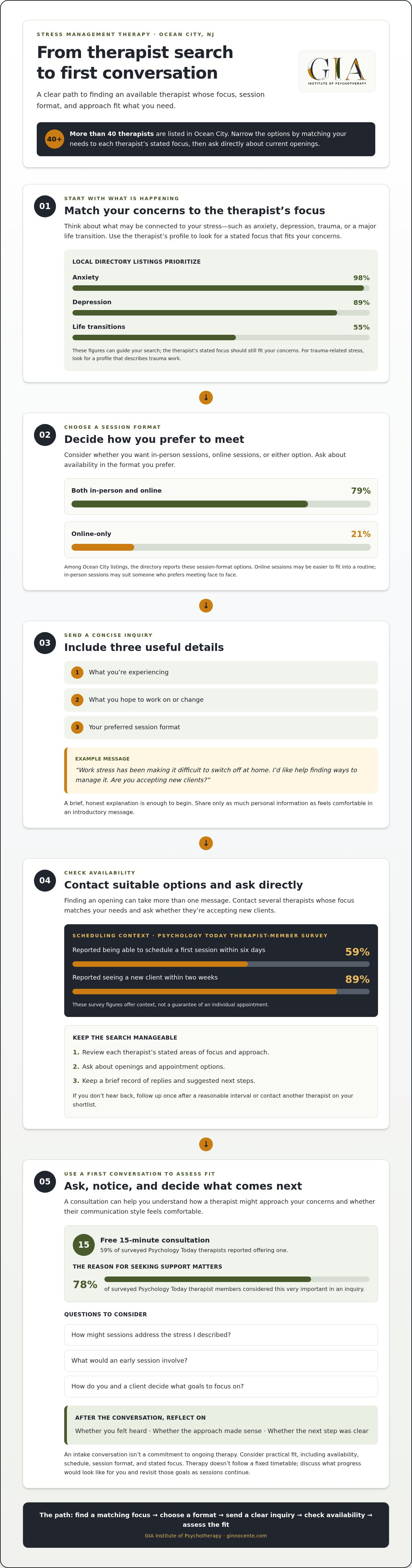
In Ocean City, New Jersey, the directory lists more than 40 therapists. Narrow your search by matching each therapist’s focus to what you’re experiencing, then contact suitable options about openings. For stress management therapy in Ocean City, NJ, identify whether stress connects with anxiety, depression, trauma, or a major life transition. Local directory listings show 98% prioritize anxiety, 89% depression, and 55% life transitions. Those figures can guide your search, but a therapist’s stated focus should still fit your concerns.
For trauma-related stress, look for a therapist whose profile describes working with trauma. In your message, briefly explain what has been difficult and what support you hope to find. For example, you might mention that work pressure is affecting your sleep or that a recent transition has made daily responsibilities harder. This gives the therapist helpful context.
Telehealth is available among Ocean City listings. The directory reports that 79% of listed therapists offer both in-person and online sessions, while 21% offer online-only sessions. When reviewing options, decide whether you prefer meeting in person or connecting remotely, then ask about current openings in the format you want. Online sessions may make it easier to fit appointments into a routine; in-person sessions may suit someone who prefers meeting face to face.
Support for stress and anxiety can include talking through pressure points, recognizing patterns, and developing practical ways to respond. A therapist can help you explore how stress affects your relationships, decisions, and routines. Start by naming one concrete goal, such as responding more calmly to work demands or setting boundaries with family.
Therapy doesn’t follow a fixed timetable. The time it takes to work toward change depends on your goals, the concerns you’re addressing, and how therapy develops. Discuss what progress would look like for you, then revisit those goals as sessions continue.
Finding a therapist accepting new clients
Finding an opening can take more than one message, so make your search manageable. Contact several therapists whose stated focus matches your needs, and ask directly whether they’re accepting new clients. A survey of Psychology Today therapist members found that 59% reported being able to schedule a first session within six days, while 89% reported seeing a new client within two weeks. These figures offer context, not a personal appointment guarantee.
Before reaching out, prepare a short note with three details: what you’re experiencing, what you hope to work on, and your preferred session format. For example, you could explain that ongoing work stress is affecting your sleep and that you want to respond more calmly. Specific details help a therapist understand why you’re getting in touch.
- Review each therapist’s stated areas of focus and approach.
- Send a concise inquiry asking about openings and appointment options.
- Keep a brief record of replies and any suggested next steps.
If you don’t hear back, follow up once after a reasonable interval or contact another therapist on your shortlist. Keep the message simple and respectful. You can ask about appointment options, whether sessions are in person or online, and how to arrange an initial conversation. Share only as much personal information as feels comfortable in an introductory message.
Consider practical fit as well as availability. A therapist may have an opening, but the schedule, session format, or stated focus might not suit your needs. A parent seeking support for a teen, for instance, can look for services specifically for children and teens. Family concerns may call for a different kind of support.
Once you have a possible match, use the first conversation to explain what you’d like help changing and ask how therapy might address it. If you’re exploring therapy support options, keep your main goal in view: finding a setting where you can discuss stress openly and work toward practical change.
Initial contact and consultations
An initial message can be brief, clear, and focused on your reason for seeking support. A survey of Psychology Today therapist members found that 78% considered this reason very important in an inquiry. You don’t need to explain your whole story at once. Share what stress is affecting, what you hope to change, and how you prefer to meet.
For example, write: “Work stress has been making it difficult to switch off at home. I’d like help finding ways to manage it. Are you accepting new clients?” This gives a therapist useful context without requiring a detailed personal history. You can also ask about appointment format and how to arrange a first session.
A consultation can help you understand how a therapist approaches your concerns. A survey of Psychology Today therapists found that 59% offer a free 15-minute consultation. Treat that brief conversation as a chance to share your main goal and hear how the therapist might work with it. It can also help you notice whether their communication style feels comfortable.
Consider preparing a few questions before the call. Keep them specific to your situation:
- How might sessions address the stress I described?
- What would an early session involve?
- How do you and a client decide what goals to focus on?
You can also explain what has or hasn’t helped so far. For instance, if taking breaks hasn’t eased work-related tension, mention that. It helps frame what you want to explore without assuming one strategy works for everyone.
After speaking, note what stood out: whether you felt heard, whether the approach made sense, and whether the next step was clear. An intake conversation isn’t a commitment to ongoing therapy. It helps you decide whether to begin, ask a follow-up question, or take more time to consider your options.
Talk therapy
Talk therapy gives you space to examine how stress shows up in everyday situations. You might discuss a tense meeting, family conflict, or difficulty winding down after work. With a therapist, you can explore the thoughts, emotions, and responses connected to those moments. The aim is to understand your patterns and identify changes that feel workable in your life.
A session may begin with a recent example. Describe what happened, how you felt, and how you responded. If a work email triggered hours of worry, you could explore the thoughts that followed and what helped or intensified the pressure. Reflecting on a specific moment can make repeated reactions easier to recognize and give you a starting point for discussing what you’d like to handle differently.
Therapy can involve more than talking about difficult events. You and your therapist might identify a goal, consider possible responses, and discuss what happened when you tried them. For example, you could practice setting a boundary around after-hours messages, then explore what made that step easier or harder. Progress might mean recognizing a stress pattern sooner, expressing a need more clearly, or choosing a response that better fits your values.
Useful topics to bring into sessions include:
- A situation that repeatedly leaves you tense or overwhelmed.
- What you notice in your thoughts, feelings, or actions afterward.
- A change you’d like to make, such as asking for help or pausing before reacting.
There’s no single script for talk therapy. The focus can shift as your concerns and goals become clearer. You can tell your therapist when an exercise feels useful, confusing, or difficult to apply. That feedback helps shape conversations around your real circumstances, rather than an abstract idea of stress. If you’re ready to explore therapy, take the next step toward support and share what you’d like help working through.
GIA Institute of Psychotherapy: Adult Individual Psychotherapy
GIA Institute of Psychotherapy offers Adult Individual Psychotherapy for people seeking support with stress, anxiety, depression, or life transitions. If daily pressure is affecting your relationships, focus, or sense of balance, individual therapy can give you space to explore what’s contributing and consider practical ways forward.
The practice blends traditional therapy with neuroscience, practical strategies, and expressive approaches. Sessions can help you examine recurring reactions, understand emotional patterns, and work toward changes that fit your circumstances. Bring a specific concern, such as feeling overwhelmed by responsibilities, or begin with a general sense that something needs to change.
Support can also reflect who is affected: GIA offers individual therapy for children and teens, family therapy, and couples counseling. Contact GIA Institute of Psychotherapy to discuss taking a first step toward support.
Take a thoughtful next step toward feeling steadier
Choosing support doesn’t require having every answer before you begin. It means making room to understand what’s weighing on you and deciding what you’d like to change. Stress management therapy in Ocean City, NJ can offer space to explore those concerns with care and at a manageable pace.
Before reaching out, consider the first thing you’d want a therapist to understand. Perhaps stress follows you home from work, affects your relationships, or makes it harder to feel present. Naming that starting point can make an initial conversation feel more grounded. Your goals can become clearer as you talk, reflect, and notice what matters most to you.
If you’re ready to explore whether therapy could be a helpful next step, contact GIA Institute of Psychotherapy. You can begin with a simple description of what you’re experiencing and what kind of support you hope to find. Taking that first step can open space for greater understanding and a steadier way forward.
Frequently Asked Questions
How do I find a therapist who treats my specific concern?
Look for a therapist whose stated focus matches the concern affecting your daily life. For example, someone experiencing panic before work meetings may want support for anxiety, while a person coping with a painful loss may seek help with grief. Note the situations you want to address, then compare them with the therapist’s areas of focus and approach.
How long does it typically take to get an appointment with a therapist?
Appointment timing depends on the therapist’s schedule, your availability, and whether you prefer in-person or online sessions. To find a workable time, contact more than one suitable therapist and share the days or times you can attend. If your schedule is limited, mention that in your initial inquiry so you can discuss openings that fit.
How much does therapy cost?
The cost depends on the provider and the circumstances of your care. Session type, format, and whether using insurance is a priority can affect what you pay. Ask for fee information before scheduling so you understand the amount and payment arrangements. Don’t assume every therapy service has the same cost or insurance coverage.
What should I expect from an initial consultation with a therapist?
Expect a focused conversation about what brings you to therapy and what you hope will change. You can describe a recent example, such as feeling tense during family conversations, and ask how the therapist might approach that concern. The discussion can also clarify next steps and help you decide whether the therapist’s style feels comfortable.
What should I include when I first contact a therapist?
Include a brief description of your main concern, your general availability, and whether you prefer in-person or online sessions. If you’re contacting someone for a child or teen, say the inquiry concerns a young person and include their age. You can save detailed personal history for a conversation rather than putting it in an introductory message.
What stress management therapy services are available in Ocean City, NJ?
Options include individual, child and teen, family, and couples therapy. GIA Institute of Psychotherapy also uses approaches including CBT, DBT, EMDR, Internal Family Systems, and Emotionally Focused Therapy for couples. The practice serves Ocean City, Linwood, Margate, Ventnor, Egg Harbor Township, Upper Township, and Galloway, with an office in Somers Point and online counseling throughout New Jersey. The approach depends on the concern and therapy format.


