

You watch the bedroom door click shut, another evening where your once-vibrant teenager retreats into silence and the blue light of a screen. It is a heavy, isolating feeling to realize that the child you know so well now feels like a stranger. When academic pressure in New Jersey school districts reaches a boiling point and social media creates a constant noise, many parents find themselves searching for a teen therapist NJ adolescents will actually connect with. You want more than a clinical diagnosis; you want your child back.
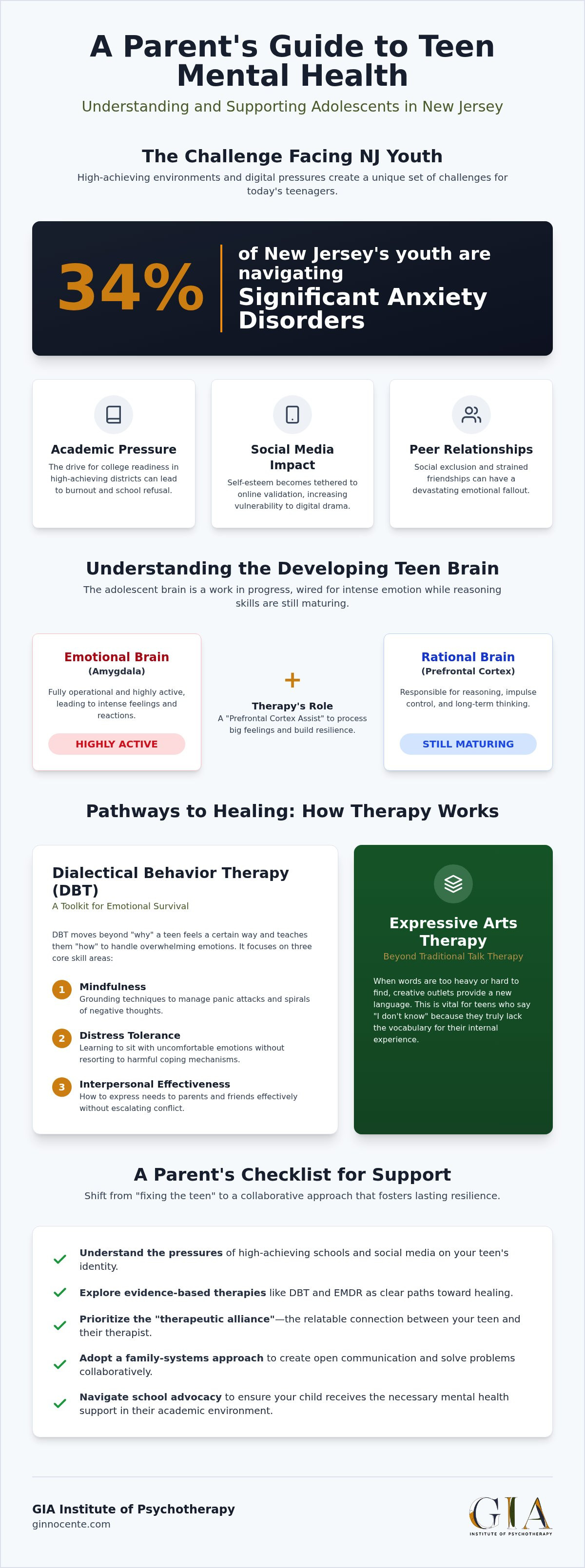
It's understandable to feel overwhelmed by the recent data showing that 34% of our state's youth are navigating significant anxiety disorders. We believe that every struggle is an invitation for growth and every "shut down" is a call for a different kind of conversation. This resource will show you how specialized therapeutic approaches like DBT and Expressive Arts help teenagers navigate school transitions and self-discovery. We will preview practical family strategies and professional school advocacy tools designed to foster resilience, restore communication, and provide a safe harbor for your teen's journey toward healing.
Key Takeaways
- Understand how the unique pressures of high-achieving New Jersey school districts and social media impact your teen's self-esteem and identity.
- Explore how evidence-based approaches like DBT for emotional regulation and EMDR for trauma provide a clear path toward healing and self-discovery.
- Learn why the "therapeutic alliance" is the most critical factor when choosing a teen therapist NJ parents can trust to bridge the gap between clinical expertise and relatable connection.
- Discover how shifting from "fixing the teen" to a collaborative family-systems approach creates lasting resilience and opens new channels of communication at home.
- Gain insights into navigating the NJ school advocacy process to ensure your child receives the necessary mental health support within their academic environment.
Understanding the Modern Adolescent: Challenges Facing NJ Teens
The transition from childhood dependence to adolescent autonomy is rarely a straight line. It's a season of profound internal rewriting, where your child is trying to figure out who they are apart from the family unit. In our local South Jersey communities, this journey is often complicated by a culture of high achievement. While we value the excellence of our schools, the pressure to perform can leave teenagers feeling like they're constantly walking a tightrope. Finding a teen therapist NJ families can rely on means finding someone who understands that this "moodiness" is often a quiet plea for help in a world that feels increasingly loud.
How do we know when it is time to step in? It's the difference between a teen who needs an hour of privacy and one who has completely disconnected from their passions. It's the shift from healthy digital curiosity to a self-esteem that is entirely tethered to the shifting sands of social media. Validation is the first step toward healing. By acknowledging that their world is faster and more demanding than the one we navigated at their age, we create the necessary bridge for connection. We move from being a manager of their behavior to a consultant for their growth.
The Impact of Academic and Social Pressure in South Jersey
In districts like Ocean City and Linwood, the drive for college readiness and extracurricular mastery can become a heavy burden for a developing mind. We often see students struggling with school refusal, which is a complex symptom of underlying anxiety where the school environment feels emotionally unsafe or insurmountable. Beyond the classroom, peer relationships serve as the primary mirror for a teen's self-worth. When these relationships are strained by digital drama or social exclusion, the emotional fallout can be devastating. Professional support helps them process these social dynamics with clarity and confidence.
Neuroscience and the Developing Teen Brain
The adolescent brain is a work in progress, wired for intense emotion and high-stakes risk-taking. During these years, the amygdala is fully operational, while the prefrontal cortex, the center for reasoning and impulse control, is still maturing. Within the framework of child and adolescent psychiatry, we recognize that therapy provides a crucial "prefrontal cortex assist" during these turbulent years. By offering a non-judgmental space, a teen therapist NJ specialist can help your child process big feelings without the fear of being "wrong," allowing their neural pathways to grow toward resilience, stability, and long-term well-being.
Evidence-Based Modalities: How Teen Therapy Actually Works
Many parents fear that therapy involves their child sitting on a couch in silence, staring at the floor while a clock ticks. This vision of clinical care is outdated. Modern adolescent therapy is dynamic, interactive, and deeply rooted in science. According to the latest CDC data, the effectiveness of treatment increases when we match the modality to the teenager's specific developmental stage. Whether they're struggling with a sudden life transition or a long-standing pattern of anxiety, the right approach provides the tools they need to move forward with confidence.
DBT Skills for the Modern Teenager
Dialectical Behavior Therapy (DBT) is essentially a toolkit for emotional survival. It doesn't just ask "why" a teen feels a certain way; it teaches them "how" to handle the feeling. We focus on three core areas to build resilience:
- Mindfulness: Practical techniques to ground the body during a panic attack or a spiral of negative thoughts.
- Distress Tolerance: Helping teens sit with uncomfortable emotions without turning to harmful coping mechanisms.
- Interpersonal Effectiveness: Teaching them how to express their needs to parents and friends without escalating into conflict.
The "Wise Mind" concept in DBT helps teens bridge the gap between their intense emotional impulses and their logical reasoning, allowing them to make balanced decisions even when they feel overwhelmed. This skill is vital for a generation facing constant digital and academic pressure.
Expressive Arts: Beyond Traditional Talk Therapy
Sometimes, words are simply too heavy or too hard to find. When a teenager says "I don't know" in response to a question, it's often because they truly lack the vocabulary for their internal experience. Expressive arts and play therapy allow them to bypass this verbal wall. By focusing on a creative project, the pressure of direct eye contact is removed, making the session feel like a collaborative exploration rather than an interrogation. This creative release is backed by neuroscience, as it engages the sensory parts of the brain where stress is often stored. If you're looking for a teen therapist NJ who uses these creative entry points, you're choosing a path that respects your child's unique way of communicating.
We also utilize Internal Family Systems (IFS) to help teens understand the different "parts" of themselves, such as the part that feels perfectionistic or the part that feels lonely. Along with EMDR for healing past wounds, these modalities ensure that we aren't just treating symptoms, but honoring the whole person. By integrating these diverse methods, we ensure that every teenager finds a language that resonates with their unique journey toward health.
Choosing the Right Teen Therapist in NJ: A Parent’s Checklist
Selecting a guide for your child's mental health is one of the most significant decisions you will make. While clinical credentials provide a necessary foundation, the "therapeutic alliance" remains the strongest predictor of positive outcomes. For a teenager, this connection is everything. They need to feel that their therapist is a safe harbor, someone who truly "gets" them rather than another adult trying to manage their behavior. When searching for a teen therapist NJ families can trust, look for a balance of clinical authority and a relatable, human-centric approach.
Pay close attention to the environment during your first contact. Does the office feel like a sterile medical clinic, or is it a warm, inviting space? A safe environment lowers a teen’s natural defenses and invites vulnerability. During the initial intake, observe how the professional balances your concerns as a parent with your child's need for autonomy. A skilled specialist understands the unique neurobiology of the adolescent brain and the specific stressors found in high-achieving NJ school districts. They should be able to articulate how they will support your child’s individual growth within these complex social systems.
Questions to Ask a Prospective Teen Therapist
Before committing to a long-term journey, it's helpful to have a transparent conversation during the consultation. Don't be afraid to ask direct questions to ensure the fit is right. Consider these inquiries:
- "How do you handle teen resistance if they don't want to engage in the first few sessions?"
- "What is your approach to involving parents while still protecting my child's sense of confidentiality?"
- "Do you have experience with the specific NJ school district my child attends and its unique academic or social pressures?"
Red Flags and Green Flags in Adolescent Care
The right fit often comes down to the subtle ways a therapist interacts with your family. A major green flag is when the therapist speaks directly to your teen during the session, honoring their voice rather than just talking about them to you. This builds immediate trust. Conversely, a red flag is a "one-size-fits-all" approach that ignores your child’s unique interests, hobbies, or identity. In our South Jersey communities, a relatable reputation is vital. You want a guide who feels like a steady, calming presence, someone who can navigate the local landscape with wisdom and skill without leaning on a detached, clinical ego.
Supporting the Journey: The Role of the Family in Teen Therapy
When your child begins their work with a professional, it is natural to hope for a swift resolution to the challenges at hand. However, we view this process as a collaborative evolution of the entire household. It is less about "fixing" a broken part and more about restorative healing for the whole family system. A skilled teen therapist NJ families trust often helps parents realize that the most profound changes happen in the small, quiet moments at home. By moving away from a "fix-it" mindset, you create a space where your child feels supported rather than managed.
Healing is rarely a straight line. It is a journey marked by progress, plateaus, and occasional setbacks. Managing expectations is a vital part of this work. It involves understanding that growth takes time and that a difficult day does not mean the therapy is failing. Parents can support this journey by modeling emotional regulation and healthy vulnerability in their own daily lives. When you share how you navigate a stressful situation with grace, you provide a living blueprint for your teen to follow. This approach helps bridge the communication gap between the therapist's office and your kitchen table.
Overcoming Resistance: When Your Teen Doesn’t Want to Go
"It’s okay to not want to be here." This simple validation can be the most powerful tool in a parent's arsenal. Many adolescents feel that therapy is a sign that they are "wrong" or that their privacy is being invaded. We often suggest a "trial period" where the teen commits to just three sessions before making a final decision. This gives them a sense of agency and control over the process. Our team's warm, relatable approach significantly lowers the clinical barrier, helping even the most hesitant teens feel seen rather than studied. It is about building resilience, restoring communication, and fostering a sense of shared purpose.
Parenting Stress and Self-Care
Parenting a struggling adolescent is deeply taxing. Your own mental health is not a luxury; it is a prerequisite for your child's recovery. You cannot pour from an empty cup. By connecting with Family Therapy South Jersey services, you ensure that the entire household has the support needed to navigate this transition. Setting healthy boundaries while maintaining a restorative connection allows you to be the steady, calming presence your teen needs. If you are ready to explore how a collaborative approach can transform your home, contact GIA Institute today to speak with a compassionate guide.
GIA Institute: A Safe Harbor for Teens in South Jersey
At GIA Institute, we believe that every adolescent carries an innate strength, even when it feels buried under layers of anxiety or academic stress. We serve as a steady, calming presence for families throughout South Jersey, including the coastal communities of Ocean City, Margate, and Linwood, as well as Egg Harbor Township. Our practice is built on the idea that the right teen therapist NJ specialist should be both a highly skilled clinician and a deeply relatable human. We blend traditional clinical expertise with modern, expressive approaches to create a therapeutic environment that feels less like a doctor's office and more like a safe harbor for self-discovery. Our goal is to help your child peel back the layers of their struggle to rediscover the vibrant, capable person they truly are.
The journey toward healing isn't just about managing symptoms; it's about rewriting an internal narrative that may have become stuck in patterns of self-doubt or fear. We provide a space where teenagers can explore their identity and navigate life's transitions with a wise guide by their side. By focusing on relational health and emotional resonance, we help families move from a place of crisis to a state of restorative growth. This community-minded approach ensures that the individual health of your teen is supported by the systems they navigate every day, including their home and their school.
School Advocacy and Mental Health Support
High-achieving NJ school districts offer incredible opportunities, but they can also be the source of significant emotional distress for students who learn or process emotions differently. We recognize that clinical health and academic success are deeply intertwined. Our unique school advocacy services bridge this gap by placing a clinical expert by your side during the complex IEP Advocacy in New Jersey and 504 planning processes. We collaborate directly with NJ school counselors and administrators to ensure that your child’s learning environment is as supportive as their therapy sessions. This holistic approach ensures that the progress made in our office is reinforced in the classroom, giving your teen the stability they need to thrive academically and emotionally.
Start the Healing Process Today
Taking the first step toward professional support can feel daunting, but the path to restoration begins with a simple, compassionate conversation. When you reach out to GIA Institute, you aren't just making an appointment; you're starting a journey toward a more resilient family dynamic. Our intake process is designed to be methodical and patient, allowing you to share your concerns without feeling rushed or judged. From the initial inquiry to the first "safe harbor" session, we prioritize transparency and relational health. If you're ready to see your child reconnect with their passions and find their voice, you can schedule a consultation with a teen therapist in NJ today. We are here to guide your family toward a healthier, more communicative future.
A Path Toward Restoring Connection and Resilience
The transition into adulthood doesn't have to be a journey your family walks alone. We have explored how evidence-based tools like DBT and EMDR provide a reliable framework for emotional regulation, while creative outlets like Expressive Arts bridge the gap when words feel out of reach. In communities like Ocean City and Linwood, the intersection of academic success and mental health is vital. Our specialized school advocacy ensures that your child’s needs are met within the NJ IEP and 504 frameworks, creating a supportive environment both at home and in the classroom.
Finding a compassionate teen therapist NJ families can trust is the first step in rewriting your child's internal narrative from one of struggle to one of strength. You don't have to wait for a crisis to seek a safe harbor for your teenager's growth. It is time to move toward a more communicative, resilient future where your child feels seen and understood. Begin your teen’s journey toward healing with GIA Institute. Transformation is possible, and a brighter, more connected season for your family is within reach.
Frequently Asked Questions
How do I know if my teen actually needs therapy or if it is just a phase?
Deciding between a "phase" and a clinical need involves looking at the intensity and duration of the behavior. If your child's anxiety or withdrawal persists for several weeks and impacts their life in Ocean City or Linwood schools, it's time to seek support. Professional guidance provides a safe space for them to navigate these transitions. Early intervention often prevents temporary struggles from becoming long-term patterns, allowing your teen to reclaim their sense of joy.
Will the therapist tell me what my teenager says in their sessions?
Confidentiality is the foundation of a successful relationship between your child and their guide. While safety concerns are always shared with parents, the specific details of sessions remain private to encourage honest expression. We focus on helping the family unit communicate more effectively without breaking the trust established in the safe harbor of the session. This balance ensures your teen feels respected while you stay informed about their overall progress and well-being.
How long does teen therapy usually last before we see results?
Every healing journey follows its own unique rhythm. Some families notice small, positive shifts in communication within the first few weeks, while addressing deeper trauma through EMDR or DBT may require several months of consistent work. We focus on sustainable growth rather than quick fixes. Progress is often non-linear, but a dedicated teen therapist NJ specialist will help you track milestones and adjust strategies to ensure your child remains on a restorative path.
What if my teen refuses to speak during the session?
Silence is a natural part of the process and isn't a barrier to healing. When a teenager is hesitant to speak, we utilize expressive arts and play therapy to create a non-pressured environment. These creative entry points allow them to process emotions without the weight of direct eye contact or verbal interrogation. By meeting them where they are, we build a relatable connection that eventually makes verbal communication feel safe and accessible for them.
Can you help with my teen’s IEP or 504 plan in NJ schools?
Navigating the educational system can be overwhelming for any parent. We provide specialized school advocacy services to bridge the gap between clinical health and academic success in NJ districts. Our team can participate in IEP and 504 meetings to ensure your child's mental health needs are integrated into their learning plan. This collaborative approach ensures that the support they receive in therapy is mirrored in their daily environment at school.
Is teen therapy covered by insurance, or do you offer private pay options?
We provide both private pay options and support for families using insurance. It's helpful to know that New Jersey recently enacted laws that mandate coverage for preventive behavioral health services for those under 18. This means your family may have expanded access to care even without a formal mental health diagnosis. We can discuss your specific situation during your initial inquiry to ensure you understand the financial path toward your child's recovery.
Do you offer virtual therapy for teens in New Jersey?
We understand that families in communities like Galloway and Ventnor have busy lives. To make support as accessible as possible, we offer both in-person sessions and virtual therapy options for adolescents across New Jersey. Online sessions provide a convenient way to maintain consistent care without the stress of a commute. This flexibility ensures that your teen can receive professional support in the environment where they feel most comfortable and secure.
What is the difference between a teen therapist and a school counselor?
School counselors are essential for academic guidance and immediate social support within the building. However, a teen therapist NJ families choose for clinical care offers a deeper level of treatment for complex emotional challenges. We utilize specialized modalities like Internal Family Systems and trauma-informed care to address the root causes of anxiety or depression. Our role is to provide a long-term, restorative space that goes beyond the scope of traditional school-based services.


