

Support should fit the man, not a stereotype. A search for a therapist for men in Linwood, NJ can start with the local therapist directory, which lists 546 matching therapists with availability. The right fit depends on the concerns you want to address, the clinician’s approach, and practical details such as insurance and session format.
It can be hard to know where to begin, especially when anxiety, depression, stress, trauma, or relationship concerns have been building for a while. Wanting support doesn’t mean you need to have everything figured out before you start. Therapy can offer a place to make sense of what’s happening and consider useful next steps.
This guide explains how to compare male therapists and their specialties, consider insurance and payment, and weigh online against in-person sessions. You’ll also learn what individual therapy can involve and how to assess a good fit, so you can approach the search with greater clarity and less pressure.
Key Takeaways
- Compare therapists by their experience and approach, as well as by whether their focus aligns with what you want to work through.
- Review how insurance coverage, out-of-pocket costs, and payment arrangements may affect your options before choosing a session format.
- Look for support that fits your concerns, whether you’re facing anxiety, depression, stress, trauma, relationship difficulties, or a life transition.
- Choose between online and in-person therapy by considering which setting feels comfortable and workable for your routine.
- Use an initial conversation to describe what you hope to change and consider whether the therapist’s style feels like a good fit.
Male therapists and psychologists in Linwood, New Jersey
A therapist for men in Linwood, NJ can be a male clinician or another therapist whose approach feels comfortable. The local search lists 546 therapists with availability. Use profile details to narrow choices by specialty, appointment format, and location, then consider which clinicians address the concerns you want to explore.
Male Therapist and Psychologist Listings
Listings can help compare a clinician’s gender, professional title, focus, and session format. The 546 matches aren’t a count of male therapists, so read individual profiles before deciding. If you’re looking for a therapist for men in Linwood, NJ, consider whether the profile describes experience with your concerns, such as anxiety or relationship stress, alongside the clinician’s approach.
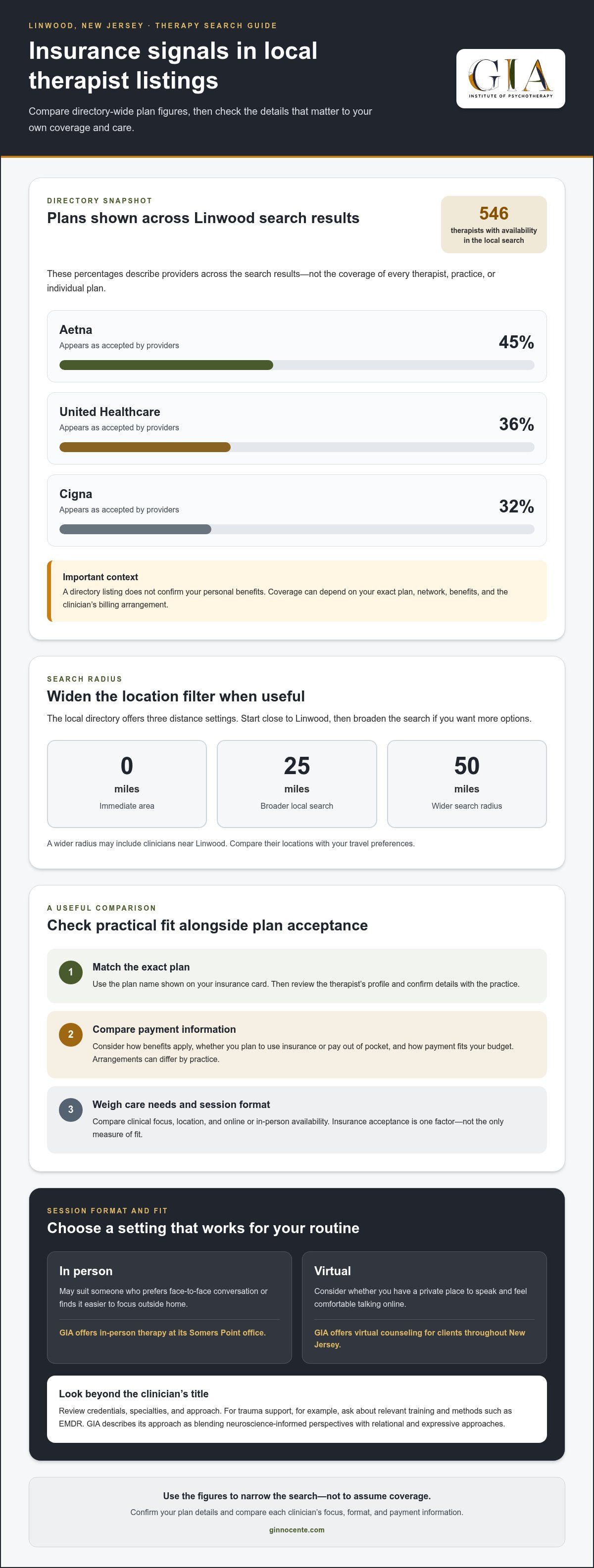
The local directory offers distance filters of 0, 25, and 50 miles. Start with 0 miles for the immediate area, then widen the radius if you want more options. A broader search may include clinicians near Linwood who offer counseling or psychotherapy, so compare their locations with your travel preferences.
When searching for a therapist for men in Linwood, NJ, consider both location and session format. GIA Institute of Psychotherapy offers in-person therapy at its Somers Point office and virtual counseling for clients throughout New Jersey. Compare these options with your work and family routines, privacy needs, and preference for face-to-face or online conversations.
Counselor Qualifications and Licensure
Professional qualifications can clarify a therapist’s training and clinical focus. Review the credentials listed and look for a clinician whose approach connects with your needs. For example, someone seeking trauma support may want to ask about relevant training and methods such as EMDR, rather than relying on a job title alone.
At a first appointment, expect to discuss what brings you to counseling, what you hope might change, and questions about the process. To begin, select a profile that fits your priorities and use its stated process to request an appointment. You can prepare by noting one concern and asking how the therapist typically structures sessions.
For virtual therapy in New Jersey, consider whether you have a private place to speak and feel comfortable talking online. In-person therapy may suit someone who prefers face-to-face conversation or finds it easier to focus outside home. GIA Institute of Psychotherapy offers both formats, so weigh these preferences when considering a therapist for men in Linwood, NJ.
A therapist’s specialties can help distinguish clinicians with similar credentials. If stress is affecting work, for instance, look for an approach that includes practical strategies and fits your goals. GIA Institute of Psychotherapy blends neuroscience-informed perspectives with relational and expressive approaches. During the intake call, you can describe your situation and discuss what kind of support may be relevant.
Accepted insurance and payment methods
Insurance filters can narrow a Linwood search, but directory-wide acceptance figures describe providers across the results, not an individual clinician’s coverage. Compare your specific plan and benefits with the practice’s payment information.
Insurance Plans and Options
In the Linwood search results, Aetna appears as accepted by 45% of providers, United Healthcare by 36%, and Cigna by 32%. These figures help you see which plans appear more often in local listings, but they don’t establish coverage for every practice or plan variation. Start with your exact insurance plan name, then review whether a therapist’s profile lists it.
Coverage for mental health care can depend on your plan’s network, benefits, and the clinician’s billing arrangement. A therapist’s directory listing alone doesn’t explain your personal benefits. In-network and out-of-network care may have different terms, and benefits can vary by service. Use insurance filters as a first sorting step, then review the details of each potential match.
Insurance Filters and Payment Methods
Filters make a broad search more manageable. Select the plan name that matches your insurance card, then compare the resulting profiles for clinical focus, session format, and payment information. If you’re looking for support with mental health disorders, don’t let the insurance label replace a close fit between the therapist’s practice and your needs.
Payment arrangements can differ by practice, so review the information each practice provides rather than assuming every office handles payment the same way. Consider how your benefits apply, whether you plan to use insurance or pay out of pocket, and how payment fits your budget. Understanding these details can help you plan for ongoing therapy.
If a therapist’s profile lists your plan, consider how that option fits your priorities beyond payment. For example, someone seeking trauma support may weigh a relevant specialty, virtual access, and insurance details together. A therapist’s use of EMDR or another method describes an approach, not a promise about insurance coverage. Keep those questions distinct as you compare options.
Make a short comparison list with your plan name, the payment information provided, and the concerns you want to address. This can help you see where practical fit and therapeutic focus align. If several possibilities remain, narrow them by location or session format rather than treating insurance acceptance as the only measure of a useful fit.
Clinical specialties, including men's issues
Specialty can help you find a clinician whose experience relates to your concerns. In Linwood search results, anxiety is listed by 94% of providers, depression by 82%, and relationship issues by 67%. These directory figures describe listed specialties, not the quality or fit of any individual therapist.
How do you choose between a male therapist, a female therapist, and someone who works with men’s concerns? Consider where you expect to feel most comfortable speaking openly, then compare clinical experience and approach. Gender may matter to your comfort, while a relevant specialty can help focus the work. Both are valid factors when considering a therapist for men in Linwood, NJ.
Therapists in the area address concerns including anxiety, depression, trauma, stress, relationship issues, grief, and life transitions. Trauma is listed as a specialty by 62% of providers, while stress management appears for 59%. Self-esteem and grief also appear in local profiles, giving individuals several ways to narrow searches beyond a broad men’s issues label.
Men may seek support for relationship strain, pressure around emotional expression, work stress, or difficulty asking for help. A Substance Abuse and Mental Health Services Administration survey found that men seek treatment for mental health concerns at a significantly lower rate than women with the same concerns. Local directory information also notes that men are more likely than women to misuse alcohol and drugs.
These patterns don’t define any individual or determine what care he needs. They may, however, help someone name a concern that feels hard to raise. For example, if alcohol use is affecting sleep or a relationship, look for a clinician whose stated focus connects with the impact you want to address.
Specialties can overlap. A separation might bring relationship concerns, grief, and stress together; a major career change could involve anxiety and self-esteem. When comparing a therapist for men near Linwood, NJ, note which concerns the therapist addresses and whether the approach makes sense to you.
Session type is another consideration. Individual therapy gives one person space to explore personal patterns, while couples or family sessions focus on shared communication and relationships. Think about who needs to participate and what you hope will change. That can help you decide which type of therapy best matches the situation.
To compare therapists, write down your main concern, preferred therapist gender if relevant, and the specialty you want to discuss. Then review their experience and approach. Descriptions can use broad terms, so consider how each therapist’s stated focus connects to your specific goals before making a shortlist.
Individual therapy for anxiety, depression, stress, and trauma
Individual therapy gives you a private setting to explore how anxiety, depression, stress, or trauma affects daily life. In Linwood, 94% of providers list anxiety as a specialty, and 82% list depression. These directory figures can help you identify areas of focus, but your own goals should guide the conversation.
Anxiety may show up as persistent worry, avoidance, or difficulty concentrating at work. Depression can affect energy, interest, and connection with others. In therapy, you can describe specific examples, such as losing sleep before meetings or withdrawing from friends, and work with a therapist to understand patterns and consider next steps.
Stress can build around a demanding job, family responsibilities, or a major transition. A useful first step is to notice when it rises, what tends to trigger it, and how you respond. A therapist may help you explore these patterns and practice strategies, such as setting boundaries or using mindfulness during a tense moment.
Trauma support starts with your pace and the concerns you choose to discuss. A Linwood-area therapist listed in the search has 10 years of mental health experience, with a focus on grief and trauma. That example illustrates why profile details matter: look for an expressed focus that relates to your concern, then consider whether the clinician’s approach feels understandable.
Cognitive behavioral therapy (CBT) can help you notice links between situations, thoughts, feelings, and actions. For example, if anxiety leads you to avoid a social gathering, therapy can explore what you fear and identify a manageable response. Mindfulness may also help you notice present-moment sensations rather than react automatically. A therapist can discuss how these approaches relate to your goals.
Grief can overlap with anxiety, depression, or stress after a death, separation, or other significant loss. Rather than expecting a single path, use sessions to talk about what has changed and what feels hardest now. A practical starting point is to write down one recent difficult moment, such as an anniversary or an empty evening, and bring it to your session.
At the start of individual therapy, describe what prompted you to seek support and what you hope will feel different. Ask how sessions may address your concern, how you’ll discuss progress, and what approaches might be considered. Clear questions can help you understand the process and decide whether the therapist’s focus fits your needs.
Individual therapy can also help when concerns overlap. For instance, a relationship change may bring grief, stress, and anxious thoughts together. Share how these experiences connect rather than feeling you must choose one label. A therapist can help organize the issues, identify a starting point, and work with you on practical steps that support daily life.
Online and in-person therapy options
For Linwood residents, session format can shape how easily therapy fits daily life. In-person meetings offer face-to-face conversation, while online sessions can remove the trip to an office. Compare both with your schedule, privacy needs, and comfort speaking in each setting.
Which therapists near Linwood, NJ offer online therapy for men? Look for Linwood-area profiles that identify online or virtual sessions, then compare each therapist’s focus and approach. The local search-distance options are 0, 25, and 50 miles, which can help widen your search when nearby choices don’t fit.
An in-person visit may feel easier if you focus best in a dedicated setting. For example, someone who finds home distracting might prefer an office appointment and a predictable travel routine. Consider the location, travel time, and whether the setting helps you speak openly about emotional concerns or life transitions.
Virtual therapy may suit someone with a full workday, caregiving duties, or limited transportation. Before a session, choose a private room, test your device, and reduce background noise. These simple steps can help you focus on the conversation instead of worrying about interruptions.
Format can also affect how you participate. A person exploring thought patterns may prefer an in-person conversation, while another may find it easier to begin from home. Neither preference defines commitment. Focus on whether you can listen, reflect, and speak honestly during the session.
For couples, the decision includes both participants’ schedules and comfort. If partners live or work in different places, a virtual visit may make shared attendance more practical. If face-to-face conversation feels important, an in-person appointment can provide a shared space for working through communication patterns.
Try a practical comparison before choosing: note your preferred setting, the time you can protect for therapy, and what helps you feel present. Then compare those needs with the formats offered. A therapist’s stated specialties and session format can help you assess fit together, rather than choosing based on convenience alone.
Some people use different formats as their circumstances change. A demanding work transition may make virtual visits easier for a time; a later schedule may allow office appointments. Think about the conditions that support regular participation, including privacy, travel, and reliable access to a device.
Explore therapy options and session formats as you consider which setting supports your goals.
Look for Linwood-area therapist profiles that list online or virtual sessions, then compare their focus and approach to find a suitable fit for men.
GIA Institute of Psychotherapy: Adult Individual Psychotherapy
GIA Institute of Psychotherapy offers adult individual therapy for people seeking support with anxiety, depression, or life transitions. Sessions provide space to explore what feels difficult, consider practical strategies, and better understand personal patterns. The practice blends neuroscience-informed perspectives with relational and expressive approaches, tailoring therapy to each person’s concerns.
If you’re considering therapy for yourself, individual sessions may be a useful place to begin. When challenges also affect a partner or family, couples or family therapy may better address shared dynamics. The right starting point depends on who needs support and what you hope to work through.
If you’d like to explore whether this approach fits your needs, visit ginnocente.com and contact GIA Institute of Psychotherapy.
Take the Next Step Toward Support
Choosing a therapist for men in Linwood, NJ is a personal decision, and you don’t need a perfect explanation of what’s wrong. Begin with one honest starting point: what has been weighing on you, what you’d like to feel differently, or what you hope to understand. That can give your first conversation a clear, manageable focus.
GIA Institute of Psychotherapy offers adult individual therapy for people seeking a supportive space to work through concerns and life changes. The practice also provides therapy for children and teens, as well as family therapy when a loved one’s needs or shared family concerns are part of the picture. The aim is to find an approach that feels relevant to the person and situation.
When you feel ready to explore that next step, contact GIA Institute of Psychotherapy. You can share what brings you to therapy and begin a thoughtful conversation about support. Taking that first step can make room for greater understanding, steadier coping, and meaningful change.
Frequently Asked Questions
Which therapists in or near Linwood, NJ specialize in working with men?
A therapist for men in Linwood, NJ may describe men’s issues or related specialties in a profile. GIA Institute of Psychotherapy offers specialized programs for men and women, alongside individual therapy for adults. As you compare options, look for details connecting the therapist’s approach with your concern, such as relationship stress, emotional expression, or a major life change. This can help you decide what to discuss during an intake call.
Which Linwood-area therapists offer in-person sessions, and where are their offices?
GIA Institute of Psychotherapy offers in-person therapy at its downtown Somers Point office, serving people in Linwood and nearby South Jersey communities. Its local coverage includes Ocean City, Margate, Ventnor, Egg Harbor Township, Upper Township, and Galloway. If traveling to Somers Point, consider how the trip fits your workday or caregiving routine. Virtual counseling is also available for New Jersey residents when travel is difficult.
Do therapists in Linwood, NJ accept insurance, and which plans?
Therapist listings may include providers who accept Aetna, United Healthcare, and Cigna, though acceptance differs by provider. The exact plan name and network status matter, so compare your insurance card details with the provider’s information. Review your benefits for outpatient mental health care, including any deductible or copayment that applies. This preparation can help you understand how coverage may fit your care before scheduling.
What are the typical therapy session costs near Linwood, NJ, including sliding-scale options?
Therapy costs vary by practice, clinician, session type, and insurance arrangement, so there isn’t one standard amount for every Linwood-area appointment. Sliding-scale arrangements are also practice-specific. To consider affordability, review your benefits, whether you plan to use insurance, and whether you’re seeking individual, couples, or family therapy. Ask about sliding-scale availability when evaluating a practice, and consider how ongoing sessions fit your budget.
How can I find a therapist in Linwood, NJ who is accepting new clients?
Start with profiles that show current availability, then narrow results by specialty, location, and session format. GIA Institute of Psychotherapy begins its intake process with a client contact form and a 15-minute intake call, which helps match prospective clients with an appropriate therapist. Prepare a brief description of your main concern and preferred appointment format. That makes the first conversation more focused and helps clarify the next step.


